

Lift sling rigging company produce Polypropylene Rope Cargo Net Sling,PP Cargo Net Sling,Polypropylene Cargo Net,Polypropylen-Ladungsnetz,High Quality Polypropylene Rope Thick Sturdy Safety Net,Cargo Lifting Mesh.
Polypropylen-Seil-Ladungsnetz
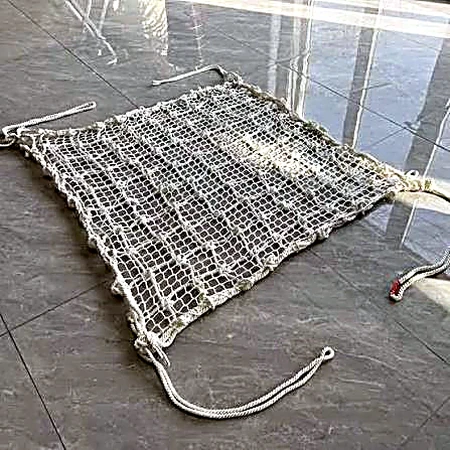
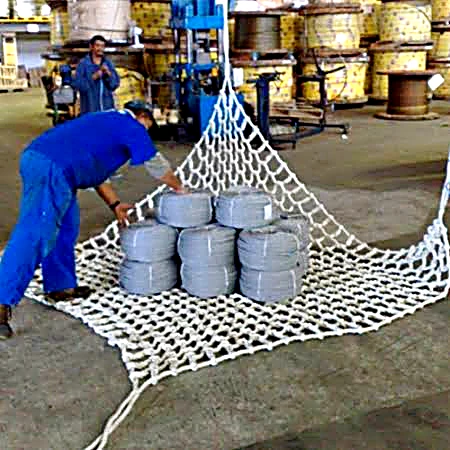
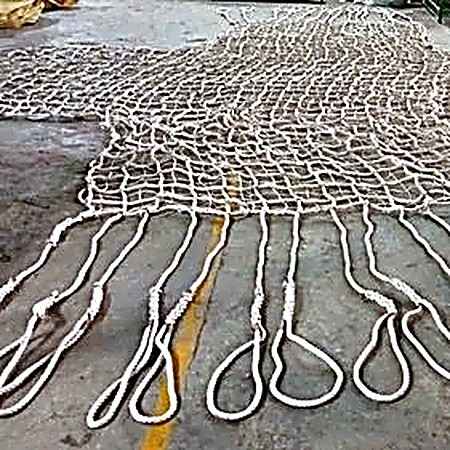
A polypropylene rope cargo net sling is a four-loop synthetic rope net built for general lifting. The cargo sits inside the rope lattice, the four corner loops gather onto the hook, and the net closes on the load as the crane takes up the slack. Every sling is braided from 100 % polypropylene rope in capacities from 0.5 t zu 20 T, rope diameters from 6 mm bis 24 mm and mesh openings from 100 mm bis 400 mm, and each one is load tested before it leaves the plant.
Polypropylene is the utility fibre of the rope range: the most economical of the common rope materials, the lightest, and the only one that floats and absorbs essentially no water. That combination is why this is the net that goes on wet work, on quays, in fish farms and in wash-down bays, and why fleet operators standardise on it for mixed general lifts where a nylon net would be over-specified and a wire rope net would damage the cargo.
| Artikel | Standardsortiment |
|---|---|
| Nennkapazität | 0.5 T – 20 T, four corner loops, rated on a three-leg basis |
| Seil | 100 % Polypropylen, 6 – 24 mm, 3-Strang gelegt oder 8-strängig geflochten |
| Netz | 100 – 400 mm, Quadrat oder Raute, geknotet oder knotenlos |
| Lifting loops | Four spliced corner loops; thimble-lined or steel ring on request |
| Sicherheitsfaktor | 5:1 / 6:1 / 7:1 |
| Behandlung | Ultraviolet-stabilised (standard for this net) |
| Zertifizierung | CE / GS / ER; ISO 9001; CNAS-Labor; DNV |
1. What a polypropylene rope cargo net sling is – und was es nicht ist
Four features define the product. Each one changes what the net will and will not do, so each one is worth settling before you order.
- Seil, not webbing. A round-rope lattice is heavier and bulkier than a flat webbing net of the same capacity, but the strand rolls over the load instead of cutting into it, and a damaged rope net can be re-spliced on site – a torn webbing net cannot.
- Polypropylen, not nylon. PP costs less, weighs less, schwimmt, and does not absorb water or rot. In exchange it is more temperature-sensitive, less abrasion-resistant and stiffer in the hand than nylon. Abschnitt 2 puts the three rope fibres side by side.
- Four lifting loops, one at each corner. This is the standard configuration for a general lifting net: the four loops gather onto the hook, the net closes over the load as the slack comes out, and nothing has to be threaded underneath the cargo.
- A doubled border rope. The border carries the whole load from the mesh into the loops, so it is a heavier rope than the mesh and it is spliced – nicht verknotet – at every corner.
Was es nicht ist: an open rope lattice is not a closed container. Small items fall through, so the mesh must be sized from the smallest item in the load, nicht vom Gesamtgewicht. For genuinely loose or bulk material the correct product is a closed-bottom net – Die Hebenetz aus Polyester – rather than an open cargo net. Nor is it a hot-duty item: polypropylene softens well below nylon, so hot slag, hot castings and welding areas are out of scope at any capacity.
2. Why polypropylene rope – the material decision
Three synthetic fibres dominate lifting rope, und sie sind nicht austauschbar. Choosing between them is the single biggest decision on this page, because it sets the price, the working life and the failure mode of the net.
| Eigentum | Polypropylen | Nylon | Polyester |
|---|---|---|---|
| Dichte | 0.90 – 0.92 g/cm3 – schwimmt | 1.14 g/cm3 – sinkt | 1.38 g/cm3 – sinkt |
| Wasseraufnahme | Essentially nil, unten 0.1 % | Absorbs water and loses strength when soaked | Sehr niedrig |
| Strength loss when wet | Keiner | Small but real | Keiner |
| Rot and odour | Immun | Can rot and hold odour if stored wet | Immun |
| Bruchdehnung | Mäßig, um 15 – 20 % | Hoch – absorbs shock best | Niedrig – least stretch |
| Abriebfestigkeit | Gerecht – the weakest of the three | Gut | Sehr gut – the best of the three |
| Ultraviolet | Degrades quickly unless stabilised | Mäßig | Gut |
| Chemische Beständigkeit | Good against acids, alkalis and aqueous chemicals | Angegriffen durch starke Säuren | Good against acids, von starken Laugen angegriffen |
| Arbeitstemperatur | Um -20 C bis +80 C | Höher | Höchster der drei |
| Relative Kosten | Am niedrigsten | Middle | Höchste |
| Wählen Sie es wann | Nass, chemical or general utility lifting on a budget | Shock loads and irregular impact | Maximum strength per diameter and best abrasion life |
Rope for these nets is braided in three polypropylene constructions, and the choice shows up in how the net handles and how long it lasts. Multifilament – many fine filaments twisted into each strand – is the softest and most flexible, the easiest to splice, and the construction most general lifting nets are made in. Monofilament – a single extruded filament per strand – is stiffer and smoother, resists surface dirt better, but is harsher on the hands and less forgiving over a load. Split-film, made from split polypropylene tape, is the most economical and perfectly serviceable for light duty, with lower abrasion resistance than the other two.
The rope comes off the same braiding floor as our Nylonseile, and the mesh rope is matched to the diameters used in our Sicherheitsseilnetze – so a mixed order of lifting nets and safety nets can be built from one rope specification.
3. How four corner loops actually share the load
Four loops on four corners is the configuration this product is built around, and it is also where most buyers make their only serious mistake. Four loops do not give four times the capacity of one loop.
Load share in a four-leg arrangement is rated on a three-leg basis. That is standard practice across lifting equipment, and it exists because a real load almost never sits perfectly symmetrically: one corner takes up first, one corner sits slack, the cargo shifts as it leaves the ground. Rating on three legs builds that asymmetry into the number on the label instead of leaving it to the rigger.
The second factor is the leg angle, gemessen von der Vertikalen – not from the deck. As the four loops spread wider from the hook, the tension in each leg rises for the same load and the arrangement carries less. Loop length is what controls it: a longer loop lets the net drop further below the hook and opens the legs wider, so if you lengthen the loops for a deep load, re-check the rating rather than assuming it is unchanged.
| Entscheidung | Warum es wichtig ist |
|---|---|
| Loops spliced or knotted | A spliced eye keeps the full rope strength; a knot reduces it. Specify spliced for every lifting net |
| Thimble in the eye or not | A thimble protects the eye against the hook and against its own wear – recommended for heavy or daily use |
| Schleifenlänge | Sets how far the net drops below the hook and how steeply the legs sit, and therefore the leg angle |
| Corner reinforcement | The corner wears first on a rope net; a doubled border and a reinforced corner are what make the four loops last |
| Master-Link, hooks or beam | One master link gathers all four loops onto a single point; four separate hooks on a beam give a more predictable share than four loops on one hook |
4. Technische Parameter
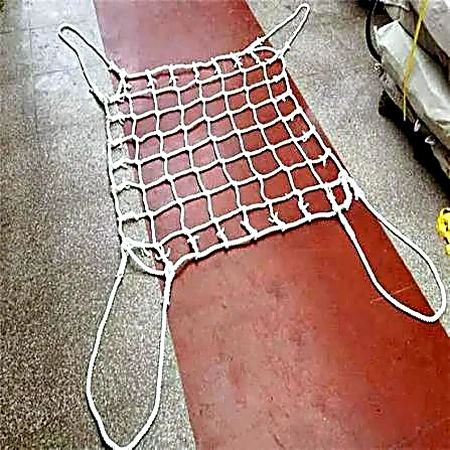
The figures below describe the standard range. Seildurchmesser, Netz, Nettogröße, Grenze, loop length and capacity are all made to order, so treat this table as the starting point for a quotation rather than a fixed catalogue page.
| Parameter | Spezifikation |
|---|---|
| Produkttyp | Polypropylene rope cargo net sling with four corner lifting loops |
| Rope material | 100 % Polypropylen – Multifilament, monofilament or split-film |
| Seilkonstruktion | 3-Strang gelegt (Standard) oder 8-fach geflochten |
| Seildurchmesser | 6 / 8 / 10 / 12 / 14 / 16 / 20 / 24 mm; 12 mm-Standard |
| Mesh-Öffnung | 100 – 400 mm, Quadrat oder Raute; 200 mm-Standard |
| Knoten | Verknotet (repairable on site) oder knotenlos geflochten |
| Grenze | Doppeltes Randseil, heavier than the mesh rope, an jeder Ecke gespleißt |
| Lifting loops | Standardmäßig vier Eckschlaufen – spliced eye, with or without thimble |
| Schleifenlänge | 300 – 600 mm, oder auf Bestellung |
| Nettogröße | 1 X 1 m zu 8 X 8 M, or made to drawing |
| Nennkapazität | 0.5 T – 20 T, set by rope diameter, mesh and lifting arrangement |
| Rating basis | Three-leg basis – the standard assumption for a four-leg arrangement |
| Sicherheitsfaktor | 5:1 / 6:1 / 7:1 |
| Behandlung | Ultraviolet-stabilised – a requirement, not an option, for polypropylene outdoors |
| Farbe | Naturweiß, Schwarz, orange, Grün, blue or a custom colour |
| Arbeitstemperatur | -20 C bis +80 C |
| Zertifizierung | CE / GS / ER; ISO 9001; CNAS-Labor; DNV |
| Anpassung | OEM / ODM-Größe, Netz, Farbe, Etikett, logo and packing |
5. Standard sizes and rated capacities
Capacity follows rope diameter, mesh and lifting arrangement together. The table below gives the working range for each net size at four corner loops, ein Haken. Heavier duty is quoted from a thicker rope rather than from the same net at a higher number.
| Nettogröße | Rope dia. | Netz | Nennkapazität | Typische Verwendung |
|---|---|---|---|---|
| 1.0 X 1.0 M | 8 mm | 100 mm | 0.5 – 1 T | Small parts, Schlagzeug, machine components |
| 1.5 X 1.5 M | 10 mm | 150 mm | 1 – 2 T | Paletten, verpackte Ware, bagged material |
| 2.0 X 2.0 M | 12 mm | 200 mm | 2 – 4 T | Allgemeines Heben, bagged and loose cargo |
| 2.5 X 2.5 M | 14 mm | 200 mm | 3 – 6 T | Holz, drums and mixed loads |
| 3.0 X 3.0 M | 16 mm | 200 mm | 5 – 8 T | Bulk material and scrap |
| 4.0 X 4.0 M | 20 mm | 250 mm | 8 – 12 T | Logs and large loose loads |
| 6.0 X 6.0 M | 24 mm | 300 mm | 12 – 20 T | Quay, hold and yard work |
| Nach Zeichnung gefertigt | 6 – 24 mm | 100 – 400 mm | 0.5 – 20 T | Any size, mesh and loop arrangement |
Where the four loops gather onto a beam instead of a single hook, the arrangement is rated by the beam – sehen Hebetraverse. Where the load is palletised and needs a flat, closed underside, Die Kranpaletten-Frachtnetz is the closer match than an open lattice.
6. Seil, Netz, border and loop options
Everything about the construction of the net itself is set on the drawing, and every line below is a choice rather than a default. The two that matter most are the mesh opening and the loop termination.
| Artikel | Optionen | Wählen Sie es wann |
|---|---|---|
| Seildurchmesser | 6 – 24 mm; 12 mm-Standard | Follows the load and the duty – a thicker rope lasts longer on rough work even at the same capacity |
| Mesh-Öffnung | 100 – 400 mm; 200 mm-Standard | Sized from the smallest item in the load, niemals vom Gesamtgewicht |
| Mesh orientation | Square or diamond | Diamond follows an irregular load as it settles; square is easier to measure and inspect |
| Knot or knotless | Knotted or knotless braided | Knotted can be re-spliced on site; knotless has no knot to wear and hangs flatter |
| Grenzseil | Doubled, heavier than the mesh rope | Always – the border is the load path from the mesh into the loops |
| Corner | Reinforced corner with spliced eye | Always for lifting duty, and essential above 3 T |
| Loop termination | Gespleißtes Auge, thimble-lined eye, or loop over a steel ring | Thimble protects the eye on a hook; a steel ring suits four loops gathering on one master point |
| Schutz | Sleeve or wear pad at contact points | Scharfe Kanten, and structure the net rubs against |
7. Where a polypropylene net is the right answer – and where it is not
This net is sold for general lifting, and general means general: mixed loads, mixed sites, mixed weather. That is exactly what polypropylene rope is good at. It is equally important to know where it stops being the right choice, because buying the wrong fibre is the most common cause of a short service life.
| Pflicht | Is this the right net? | What to use instead |
|---|---|---|
| Nass, Marine, quayside and wash-down work | Ja – the best of the rope nets here | Nothing needs changing: PP floats and does not absorb water |
| Chemical and fertiliser exposure | Ja, for aqueous chemicals | Check first for strong solvents and hot hydrocarbons |
| General utility lifting of mixed cargo | Ja – the most economical rope net | Polypropylene rope, wie angegeben |
| Hot cargo, hot slag, welding areas | NEIN – PP softens well below nylon and polyester | Anschlagseile rated for the temperature, or a chain sling |
| Scharf, highly abrasive loads such as scrap plate | Marginal – PP abrades faster than nylon | Der Hochleistungs-Ladungsnetz aus Nylon with protection sleeves |
| Shock loading and irregular impact | Marginal – PP stretches less than nylon | Der Nylon-Lastenhebenetz, which absorbs shock better |
| Maximum capacity from a thin rope | NEIN – nylon and polyester are stronger per diameter | Nylon or polyester rope, or a flat webbing net |
| Long-term outdoor storage in strong sun | Only if ultraviolet-stabilised | Specify the stabilised rope and inspect for surface chalking |
If your duty falls in the right-hand column, the alternatives are on the same site: Die Netz aus Polyestergewebe zum Heben, Die Gurtband-Ladungshebenetz Und, for tensioned restraint rather than lifting, Die Ladungssicherungsnetz. Tell us the cargo and we will say which one fits rather than quoting the one you asked for.
8. Farbe, Markierung und Identifizierung
A general lifting net moves between yards, trucks and sites, so it has to be identifiable wherever it ends up – and identifiable at the moment of inspection, when the label may already be dirty.
- Die Arbeitslastgrenze, net size and mesh are carried on a sewn capacity label; the rope itself can also be marked.
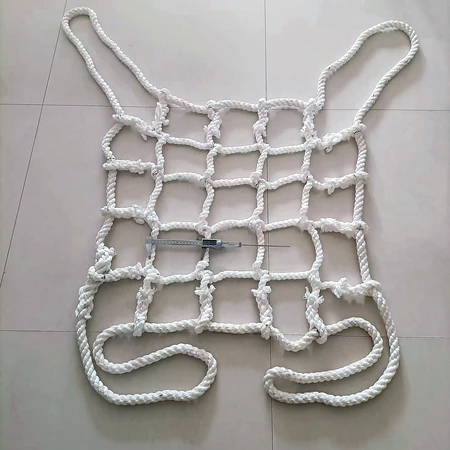
- Because the rope is dyed rather than printed, colour is the most durable identification on a rope net: natural white, Schwarz, orange, green and blue are standard, and a custom colour is possible on larger orders.
- The standard colour code can be applied to the label – violett 1 T, Grün 2 T, Gelb 3 T, grau 4 T, Rot 5 T, braun 6 T, Blau 7 T, orange 8 T – So kann das Netz über einen Meter hinweg gelesen werden.
- A contrasting border rope makes the edge and the four corners obvious at the moment of rigging.
- OEM-Bestellungen können Ihre eigene Marke tragen, Adresse, warning text or certificate number on the label and in the packing.
- Nets ship folded or coiled in a bag or a crate; a rope net is bulky against a webbing net of the same capacity, so allow for it in storage.
9. Qualitätskontrolle und Zertifizierung
We braid the rope and make the net in the same plant, so diameter, Netz, border and loop length are under our control rather than bought in from a third party and assembled.
- 40 Jahrelange Erfahrung in der Herstellung von Hebezeugen – gegründet in 1985 in Taizhou, Jiangsu, mit mehr als 200 Mitarbeiter, einer der größten Produktionsstandorte für Hebegurte und Netze in China.
- CE- und GS-zertifizierte Hebeprodukte, mit JIS-Zertifizierung für Exportaufträge.
- Own testing laboratory with CNAS laboratory accreditation, Europäische CE-Zertifizierung und DNV-Zertifizierung, Und 15 Autorisierte Patente auf unsere Hebeprodukte.
- 1000 t horizontale Testmaschine – the breaking load of every sling is tested and documented rather than sampled, und ein Materialtestbericht wird mit der Bestellung verschickt.
- Every net weighed, measured and marked with its working load limit, net size and mesh before packing.
The certificate set is published on our Zertifizierung Seite, including the CE attestation of conformity to EN 1492-1 for our webbing slings and our ISO 9001 quality management certificate.
10. How to specify a polypropylene rope cargo net sling
Eight pieces of information are enough for us to quote correctly the first time. The two most often left out are the lifting arrangement and the working environment, and both of them change the recommendation.
| Information | Warum es wichtig ist |
|---|---|
| Cargo and how it is presented | Loose, bagged, palettiert, bundled or irregular – this decides the mesh and the net form |
| Bruttogewicht pro Hub | Sets the rope diameter and the rated capacity |
| Load dimensions and shape | Sets the net size, and whether a flat net or a bag form is right |
| Mesh-Öffnung | Sized from the smallest item in the load, niemals vom Gesamtgewicht |
| Hebeanordnung | Four loops on one hook, on a master link, or on a beam – this sets the rating |
| Loop length and type | Sets the leg angle, and whether the eye needs a thimble |
| Umfeld | Wasser, Chemikalien, ultraviolet exposure, temperature and abrasion – this decides whether polypropylene is right at all |
| Documentation and packing | Sicherheitsfaktor, CE / GS-Kennzeichnung, Testbericht, own-brand labelling and export packing |
11. Häufig gestellte Fragen
What capacity can a four-loop polypropylene cargo net sling lift?
The capacity on the label, for the arrangement you actually use – and it is rated on a three-leg basis even though there are four loops, because a real load rarely sits perfectly symmetrically. Standard nets run from 0.5 t zu 20 T; anything above that needs a different product, not a longer label.
Does the leg angle really change the capacity?
Ja, and it is measured from the vertical, not from the deck. The wider the four legs spread from the hook, the greater the tension in each leg for the same load. Loop length controls the angle, so if you lengthen the loops for a deep load, re-check the rating instead of assuming it is unchanged.
Why choose polypropylene instead of nylon?
Price, water and chemicals. Polypropylene is the most economical rope fibre, it floats, it absorbs almost no water and it resists acids and alkalis. Nylon is stronger for a given diameter, stretches further and absorbs shock better, but it takes up water and costs more – so nylon is the right answer for impact duty, not for wet general lifting.
Is polypropylene suitable for outdoor use?
Ja, provided the rope is ultraviolet-stabilised, which we supply as standard for this net. Unstabilised polypropylene degrades in sunlight quickly: it goes dull and chalky and the filaments begin to crumble. Even stabilised, inspect for chalking and retire the net when the surface has gone friable.
Can the net be used in the sea or in a fish farm?
It is one of the best rope nets for it. The net floats, so it can be recovered if it goes over the side; es nimmt kein Wasser auf, so it does not get heavier or rot; and salt water does not affect it. Rinse it in fresh water and dry it in the shade before storage.
Can I lift bags or loose material in an open net?
Small items will pass through an open lattice. For bags, choose a mesh the smallest bag cannot squeeze through. For genuinely loose or bulk material, an open rope net is the wrong product – use a closed-bottom hoisting net instead.
Can a polypropylene rope net be repaired?
Ja, and this is the advantage of rope over webbing. A damaged section can be re-spliced or re-knotted with matching rope by a competent person, and the repair must be recorded. Withdraw the net if a splice has failed, a corner is damaged, or the rope has gone stiff and hard.
Wie wird die Kapazität nachgewiesen??
Nets are supplied at 5:1, 6:1 oder 7:1 wie angegeben. Die Bruchlast jeder Schlinge wird von uns selbst geprüft 1000 Die Maschine und ein Materialprüfbericht werden mit der Bestellung geliefert; the products are CE and GS certified, our laboratory holds CNAS accreditation, and export orders can be supplied with JIS certification.
12. Why buy polypropylene rope cargo net slings from Lift
Wir stellen Hebegeräte in Taizhou her, Jiangsu seitdem 1985. Rope braiding, net making, testing and packing happen on one site, which is why a custom net is a production order rather than a special project.
- Own rope production. Durchmesser, Netz, Grenze, colour and loop length are under our control, so the net is built to your job rather than assembled from a catalogue.
- Tested per net, not per batch. Breaking load is measured on a 1000 t horizontal machine and documented, mit CE, GS, ER, CNAS- und DNV-Zertifizierung hinter dem Sortiment.
- Built around the four-loop configuration. Spliced eyes, optional thimbles, loop length set to your leg angle, and a doubled border rope at every corner.
- Ein Lieferant für das gesamte Hebe-Sortiment. Rope net slings, Gurtbandschlingen, Rundschlingen, Drahtseilschlingen and lifting spreader beams.
- OEM und ODM. Own-brand labelling, custom rope colours, custom sizes and export packing for distributors and fleet operators.
The rest of the net range is on the Frachthebenetze Nabe, with the flat webbing version on the Frachthebenetz page and the Flaches Netz aus Nylongewebe for loads that need a closed, non-abrasive surface.
13. Fordern Sie ein Angebot an
Send the cargo, the gross weight per lift, the load dimensions, die Netzöffnung, the lifting arrangement and the environment the net will work in – or a sketch of the net you have in mind – and our engineers will confirm the rope diameter, the capacity and the loop arrangement in writing. Kontaktieren Sie unsere Ingenieure with your specification.
Hebegurt-Rigging-Unternehmen – Industriepark Lifete, Stadt Taizhou, Provinz Jiangsu, China
Tel: +86 523 8693 5818 | WhatsApp: +86 180 6600 2268 | E-Mail: 702461526@qq.com
HS-Code 630790 – lifting nets of textile materials.