


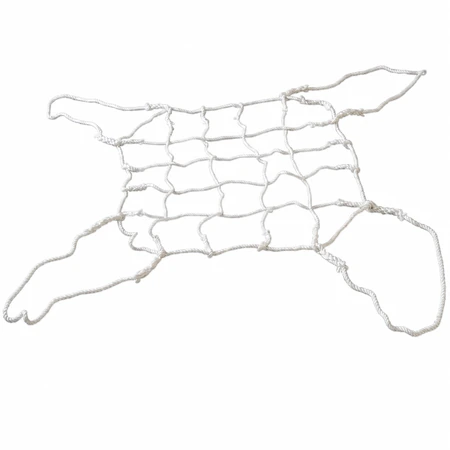
Das Hebegurt-Rigging-Unternehmen stellt Polyester-Hebenetze her,Polyester-Ladungsnetz,Sicherheits-Hebenetzgurt,Bungee-Frachtnetz,Lasthebenetz aus Polyester,Hebebandnetz,Seilhebenetz,Paletten-Frachtnetz,Gartenkletternetz.
Hebenetz aus Polyester
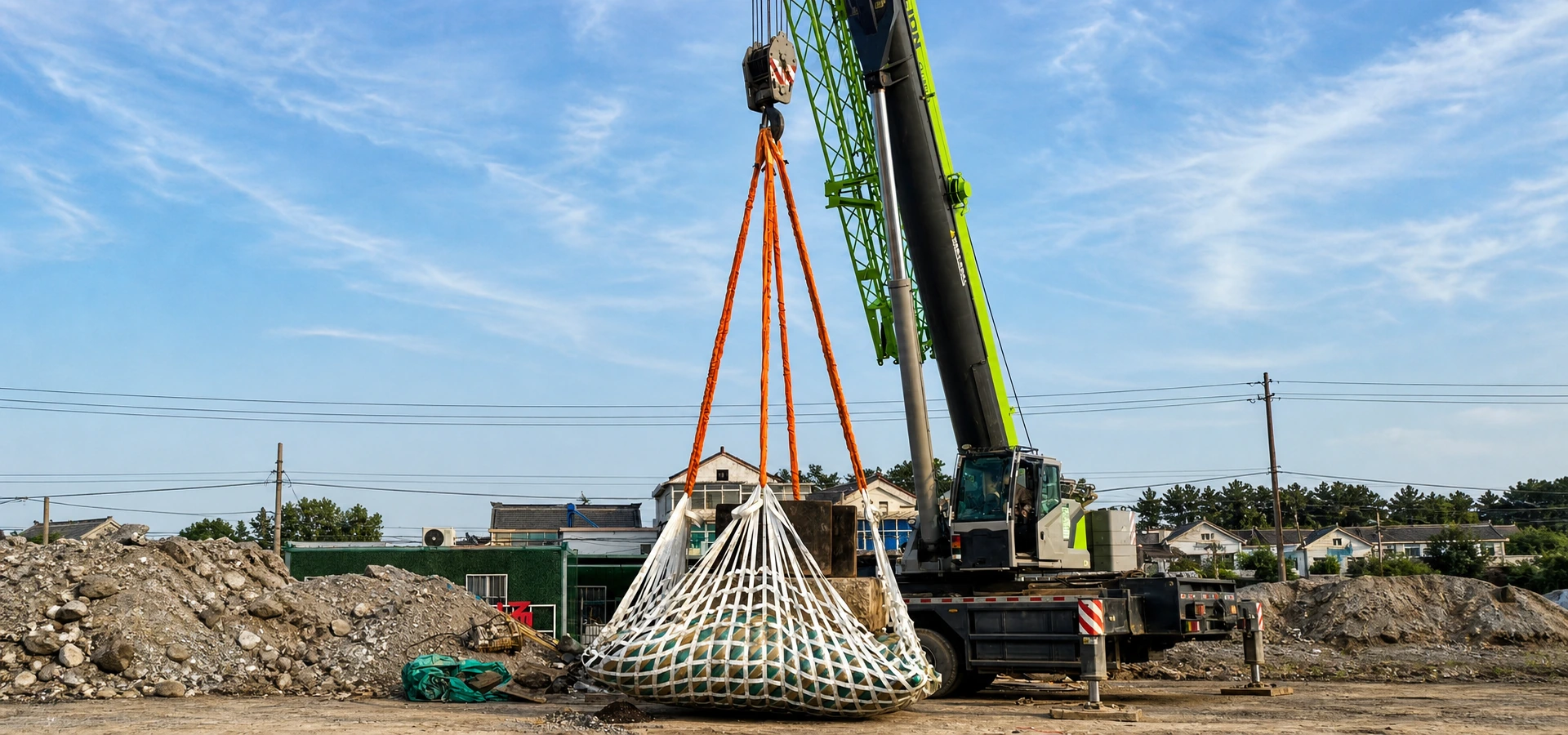
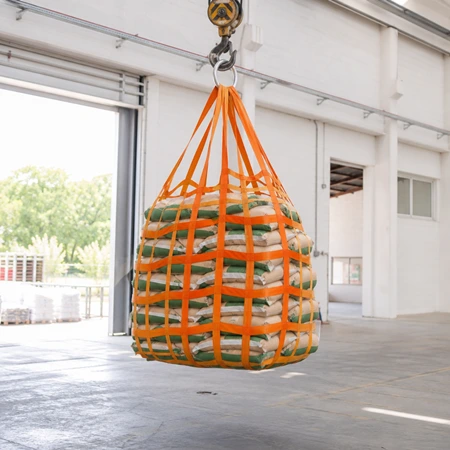
A polyester lifting hoisting net is a soft bag woven from high-tenacity polyester webbing, built to move bagged goods and bulk material in a single crane lift. The load is tipped into the bag, or the bag is laid flat and drawn up around a stack, and four corner loops carry the whole consignment to the hook. There is no pallet to return, no strapping to cut, and nothing to re-handle at the far end.
Because we weave the webbing in our own mill in Taizhou, Jiangsu, die Netzöffnung, bag footprint, Tiefe, bottom construction and working load limit are all set to the cargo rather than to a fixed catalogue. Standard nets cover 0.5 t zu 20 t und 0.6 m³ zu über 10 m³, every net is proof-load tested before packing, and each shipment travels with a material test report. Nets are CE and GS certified, with webbing rated to the EN 1492-1 Basis.
- Fully custom build – Netz, Taschengröße, Tiefe, colour and safety factor (5:1, 6:1 oder 7:1) set to your specification.
- High-tenacity polyester webbing – 25 mm bis 100 mm-Bänder, einzel, duplex or triplex, UV stabilised and rot-proof.
- Wear and heat resistant – working range -40 °C bis +100 °C, with a reinforced bottom for abrasive loads.
- Weich, flexible and light – the flat band contacts the load over a wide area, so bags, cartons and finished surfaces are neither crushed nor marked.
- CE- und GS-zertifiziert – tested on our own 1000 t Maschine, with an ISO 9001 quality system and a CNAS-accredited laboratory behind it.
Why a webbing net bag, and not a rope net or a big bag
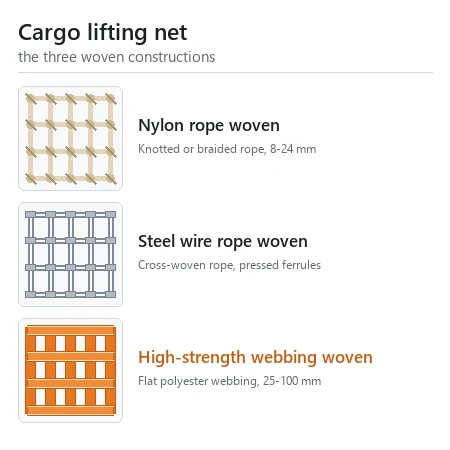
Three products are sold for the same job and they behave very differently once the load is in the air. A rope net concentrates the load on a few contact points. A big bag carries one free-flowing product and is itself the package. A webbing net bag spreads the pressure across flat bands, holds a stacked or mixed load together, and goes back to the store empty.
Tisch 1 – How the four common ways of lifting loose cargo compare.
| Option | Konstruktion | Kontakt mit der Ladung | Best cargo | Limitation |
|---|---|---|---|---|
| Polyester webbing net bag | Flat woven bands, 25-100 mm, 25-300 mm Maschenweite | Wide flat bands, low pressure per cm² | Eingepackt, gestapelt, mixed and bulk cargo | Needs a crane or hook; not a sealed package for powder |
| Nylonseilnetz | Knotted or braided rope, 8-24 mm | Line contact at every rope | Irregular and heavy single items | Ropes mark soft cargo; a tight mesh adds weight |
| FIBC / big bag | Woven PP fabric with a liner | Full surface, sealed | One free-flowing product per bag | Single product only; the bag is the packaging |
| Pallet and strapping | Timber or plastic pallet plus bands | Rigid base | Unitised cartons | Pallet returned or lost; bands cut and discarded; no drainage |
Five decisions that set the specification
A polyester lifting hoisting net is quoted from five numbers. Get them right and the net arrives right; get the mesh wrong and no amount of extra tonnage will fix it later.
Tisch 2 – What we need to know, and why each answer changes the net.
| Entscheidung | Was es behebt | What to tell us |
|---|---|---|
| 1. Cargo form | Whether the net is a bag or a flat sheet, and how the bottom is built | How the cargo arrives: sacks, große Taschen, Ballen, or loose material |
| 2. Weight per lift | Band width and layer count, and therefore the rated capacity | Das Bruttogewicht, das Sie heben möchten, not the weight of the net |
| 3. Gefülltes Volumen | Footprint and depth of the bag | Schüttdichte (t/m³) for loose material, or the height of the stack for bagged goods |
| 4. Mesh-Öffnung | The largest gap the cargo can pass through | The smallest unit in the load: A 25 kg bag, Getreide, aggregate or scrap |
| 5. Entlademethode | Geschlossen, geschnürt, Rutsche oder gefütterter Boden | Whether the bag is tipped, untied over a hopper, or emptied by hand |
Weight and volume are two separate limits, and for light bulk the volume arrives first. Körnung bei ca 0.7 t/m³ und Hackschnitzel bei ca 0.3 t/m³ füllen beide a 3.6 m³ bag, but one lift weighs about 2.5 t and the other about 1 T. Send the bulk density with the tonnage and we will size the bag so that a full bag is also a legal bag.
Technische Parameter
Die folgenden Zahlen decken das Standardsortiment in Beuteln und Großpackungen ab. Netz, footprint, Tiefe, bottom, loops and capacity are made to order, so treat this as the starting point for a quotation rather than a fixed catalogue.
Tisch 3 – Polyester lifting hoisting net: technische Parameter.
| Parameter | Spezifikation |
|---|---|
| Produktname | Polyester lifting hoisting net (Netztasche aus Polyestergewebe) |
| Konfigurationen | Closed bag, release-bottom bag, or flat lifting net |
| Gurtmaterial | 100 % hochfestes Polyester (HAUSTIER); hochfestes Nylon auf Anfrage |
| Bandbreite | 25 / 38 / 50 / 75 / 100 mm (50 mm-Standard) |
| Band construction | Einschichtig, duplex or triplex; woven selvedge, not a cut edge |
| Banddicke | 1.8 mm – 4.5 mm je nach Breite und Lagenanzahl |
| Mesh-Öffnung | 100 × 100 mm-Standard; 25 – 300 mm auf Bestellung gefertigt |
| Nettogröße | Auf die Ladefläche abgestimmt, truck bed or receiving hopper; see Table 4 |
| Taschentiefe | 0.8 M – 2.5 M, oder zum Zeichnen |
| Gefülltes Volumen | Um 0.6 m³ zu über 10 m³, set by footprint and depth |
| Grenze | Folded and double-stitched, reinforced at every lifting point |
| Hebepunkte | Standardmäßig vier Eckschlaufen; acht für eine Spreiztraverse; Schlaufen oben und unten auf Anfrage |
| Nennkapazität (WLL) | 0.5 T – 20 T, von der Band eingestellt, Lagenzahl und Hebeanordnung |
| Sicherheitsfaktor | 5:1 / 6:1 / 7:1 |
| Dehnung bei WLL | 7 % oder weniger |
| Farbe | Farbcode nach Arbeitslastgrenze, oder eine individuelle Hausfarbe |
| Arbeitstemperatur | -40 °C bis +100 °C |
| Weather and chemical | UV-stabilisiert, rot-proof, unaffected by rain, sea water and wash-down |
| Markierung | WLL, mesh and batch printed on the belt, plus a sewn capacity label |
| Standardbasis | Gurtband nach EN zertifiziert 1492-1 |
| Zertifizierung | CE, GS, ISO 9001, JIS on request; CNAS-Labor; DNV |
| Anpassung | OEM / ODM-Größe, Farbe, gedrucktes Logo, Etikett und Verpackung |
| HS-Code | 6307.90 – nets and netting of textile materials |
Standardgrößen, volumes and working load limits
These six lines cover the great majority of bagged and bulk work. Filled volume is calculated from the footprint and the depth with an allowance for the rounded shape a loaded bag takes, so a material that settles well will carry slightly more and one that bridges will carry less.
Tisch 4 – Standard net sizes at four corner loops gathered on one hook.
| Nettogröße (L × B) | Depth | Gefülltes Volumen | Netz | Band | WLL | Typische Fracht |
|---|---|---|---|---|---|---|
| 1.0 × 1.0 M | 1.0 M | 0.6 m³ | 50-100 mm | 50 mm einzeln | 0.5-1.5 T | 25 kg Säcke, kleine Säcke, Ballen |
| 1.5 × 1.5 M | 1.2 M | 1.6 m³ | 50-100 mm | 50 mm-Duplex | 1-2.5 T | Abgepacktes Getreide, Dünger, produzieren |
| 2.0 × 2.0 M | 1.5 M | 3.6 m³ | 50-100 mm | 50 mm-Duplex | 2-4 T | Massengetreide, Sand, Schotter |
| 2.5 × 2.5 M | 1.8 M | 6.8 m³ | 50-150 mm | 75 mm-Duplex | 3-6 T | Massendünger, Kohle, Schrott, Fisch |
| 3.0 × 3.0 M | 2.0 M | 10.8 m³ | 100-150 mm | 75 mm-Duplex | 4-8 T | Große Massenladungen, Kai- und Laderaumarbeiten |
| To drawing | 0.8-2.5 M | Auf Bestellung | 25-300 mm | 25-100 mm | 0.5-20 T | Jeder Fußabdruck, Tiefe und Ladung |
The working load limits above assume a four-loop lift. A two-loop basket de-rates the net – ask for the derated figure rather than reading across from this table.
Mesh-Öffnung, chosen from the cargo
Mesh is the one dimension that cannot be adjusted after the net is sewn, so it is sized from the smallest unit in the load rather than from the total weight.
Tisch 5 – Mesh opening by cargo.
| Ladung | Empfohlenes Netz | Grund |
|---|---|---|
| 50 kg Säcke, große Taschen, Ballen | 100 mm | The sacks are far larger than the opening; the mesh only has to keep the stack together |
| 25 kg Säcke, kleine Säcke | 50-75 mm | Small bags can squeeze through 100 mm once the load settles in the air |
| Getreide, Samen, getrocknete Produkte | 25-50 mm, oder ein geschlossener Liner | Fine material must not sift out on the hook or in transit |
| Dünger, Prillen, Pulver | 25-50 mm, oder ein geschlossener Liner | Fine and moisture-sensitive: a liner keeps the product in and the weather out |
| Sand, Kies, Schotter | 50-100 mm | Fein genug, um die Masse aufzunehmen, open enough for rainwater to drain |
| Kohle, Koks | 100-150 mm | Large lumps; Ein breiteres Netz sorgt dafür, dass das Netz leicht ist und gut abläuft |
| Altmetall, Reststücke | 100-150 mm | Open mesh with a reinforced bottom and wear pads at the contact points |
| Fisch, Schalentiere, Nassprodukte | 25-50 mm | Holds the catch, drains freely, keeps the weight honest |
| Protokolle, Brennholz, große Reste | 150-300 mm | Indivisible pieces: a wide mesh saves weight without losing the load |
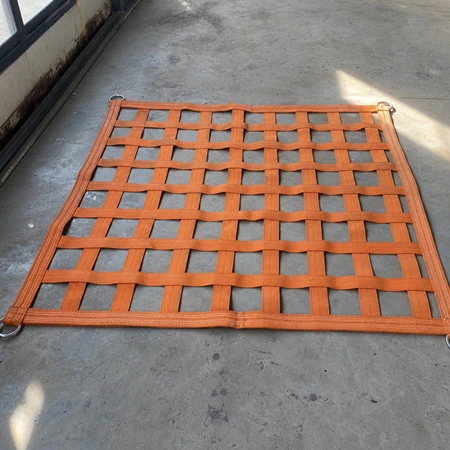
Bottom construction and discharge
How the load comes out is a design decision in its own right. For bagged cargo the answer is usually a person with a knife; for bulk it is usually gravity.
Tisch 6 – Bottom options and how each one is emptied.
| Unten | Wie es funktioniert | Chosen when |
|---|---|---|
| Geschlossen, komplett genäht | The bag holds the cargo permanently and is emptied by tipping or by hand | Verpackte Ladung, and bulk tipped over a hopper or onto a pile |
| Release bottom, geschnürt | Eine geschnürte Naht am Boden wird an der Entladestelle gelöst und die Ladung fällt heraus | Free-flowing bulk – Sand, Getreide, Aggregat – discharged without tipping the bag |
| Rutschenboden | The bag narrows to a chute opened over the receiving hopper | Controlled discharge into a hopper, ein Lastkahn oder ein Förderband |
| Closed with a liner | Im Inneren des Netzes befindet sich eine Stoffeinlage | Dusty or moisture-sensitive bulk: Getreide, Dünger, Pulver |
| Verstärkte Bodenplatte | An extra layer of webbing is stitched across the base | Abrasive and heavy bulk: Aggregat, Erz, Schrott |
| Loops top and bottom | Loops at both ends, so the bag can be lifted either way up | Loading at height, und Entleeren durch Umdrehen des Beutels am Haken |
Lifting arrangements and fittings
Die Aufhängung der Tasche entscheidet darüber, wie viel Last sie tatsächlich trägt, und das Volumen ist unerbittlich, da sich die Ladung im Inneren des Beutels weiterbewegt, während sie in der Luft ist.
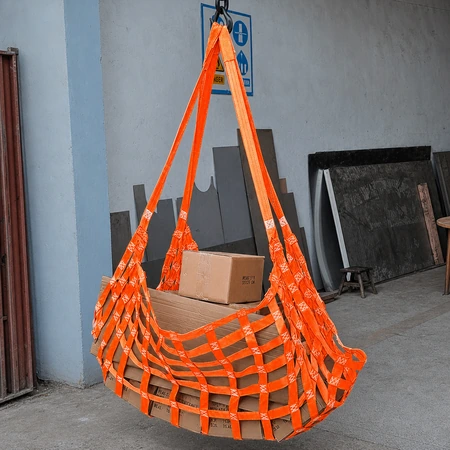
- Four loops on the hook – the standard for bagged and bulk work; the loops gather on the hook or a master ring and the bag closes around the cargo as the crane takes up the slack.
- Eight loops on a spreader beam – the bag stays square, die Ladung bleibt eben, und jede Schleife trägt einen vorhersehbaren Anteil; the right arrangement for large bags and high tonnage, siehe unsere Hebetraverse Reichweite.
- Two-loop basket – faster to rig, aber es mindert das Netz; ask for the derated capacity instead of reading across from the four-loop figure.
- Loops top and bottom – lets the bag be lifted either way up, So wird ein geschlossener Beutel entleert, indem man ihn über einen Trichter stülpt.
Fittings supplied or fitted on request: sewn webbing loops, master ring or master link, Grad 80 Fesseln, laced release bottoms, chutes and discharge sleeves, inner liners, wear pads and protection sleeves for scrap and aggregate, and repair kits for fleets that maintain their own equipment.
Material, stitching and finish
The belt is the product. We weave it on needle looms from high-tenacity polyester yarn, with a woven selvedge rather than a cut edge, so the band does not fray from the outside in.
- 100 % hochfestes Polyester, geringe Dehnung (7 % oder weniger bei WLL), UV-stabilisiert, rot-proof and unaffected by moisture.
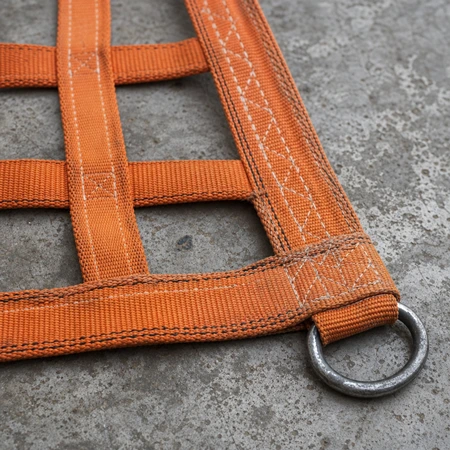
- Locked stitching in high-tenacity polyester thread, run in multiple rows along the border and box-X at every loop – on a cheap net it is the stitch line, nicht der Gürtel, that fails first.
- Gefalteter und doppelt genähter Rand, so the edge of the mesh cannot unravel under load.
- Galvanised or stainless steel rings and master links on request.
- Polyester holds its strength from -40 °C bis +100 °C; above that, or in chemical exposure, tell us and we will quote nylon or another construction.
Testen, certification and traceability
- Forty years of lifting equipment manufacturing – gegründet in 1985 in Taizhou, Jiangsu, mit mehr als 200 employees and one of China’s largest lifting sling and net production bases.
- Every net is proof-load tested on our own 1000 t horizontale Testmaschine – getestet, not sampled.
- A material test report travels with each shipment, quoting the belt batch and the test load.
- CE declaration of conformity and GS certification, mit JIS-Zertifizierung für Exportaufträge.
- ISO 9001 quality management system, a CNAS-accredited laboratory and DNV certification behind the plant.
- Every net is marked with its working load limit, Netz, rated volume and batch number before packing, Daher stimmen die Tasche und die dazugehörigen Papiere immer überein.
Certificates and test reports are available as PDFs for your tender or customs file – see the full Zertifizierung Satz.
Where these nets work
A polyester lifting hoisting net is used wherever loose cargo has to travel between a stack and a hook – quay, Mühle, quarry, yard or hold. The sectors below are the ones where the bagged and bulk version earns its place.
Tisch 7 – Anwendungen nach Sektor.
| Sektor | Was das Netz beherrscht | Warum ein Polyesternetz dazu passt |
|---|---|---|
| Häfen, Kais und Terminals | Verpackte Ladung, Getreide, fertilizer and bulk between quay, barge and hold | Eine Tasche pro Lift, keine Palette, und die Last entleert sich während der Fahrt |
| Landwirtschaft und Futtermittelfabriken | Samen, Getreide, füttern, Dünger und verpacktes Produkt | Ein dichtes Netz oder eine Einlage hält das Produkt drinnen und das Wetter draußen |
| Baustoffe | Sand, Kies, Schotter und abgepackter Zement | Fein genug, um die Masse aufzunehmen, open enough for rainwater to drain |
| Bergbau und Steinbrüche | Aggregat, Erz- und Mineralmassen | Ein verstärkter Boden nimmt den Abrieb auf, der ein Netz abnutzt |
| Fischerei und Lebensmittelverarbeitung | Nasser Fisch, Schalentiere und Produkte | Das offene Netz lässt den Abfluss ungehindert zu, which keeps the weight honest |
| Recycling und Abfall | Lose Kunststoffe, Glas, Metall und Mischmaterial | Contains loose material that would otherwise blow or fall |
| Biomass and power | Hackschnitzel, bellen, Pellets und Massenbrennstoffe | Eine große Tasche für eine bescheidene Tonnage, an die Lautstärkebegrenzung angepasst |
| Construction sites and relief work | Bagged materials raised to upper floors, field cargo | No pallet, keine Streifenbildung, und es kann direkt auf den Boden entleert werden |
Customisation and branding
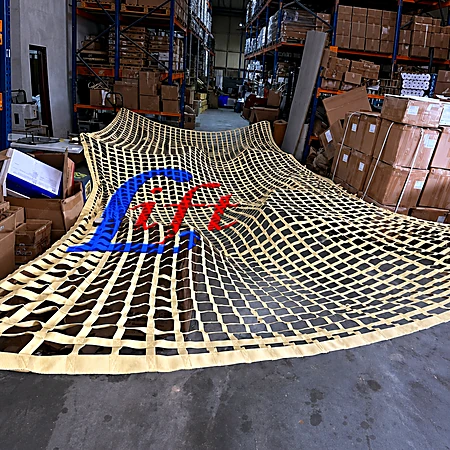
A net that moves between quays, holds and yards has to be identifiable from a distance and has to keep its marking. Farbe, gedrucktes Logo, working load limit and cargo type are all applied in our own plant, so the marking cannot be washed off or pulled away with a label.
- Farbcode nach Arbeitslastgrenze, or a custom house colour to separate your fleet from a competitor’s.
- Logo, brand name, warning text or certificate number printed on the belt, or woven in on larger orders.
- Cargo type printed on the bag, which stops a fine-mesh grain net being sent out for scrap.
- Sewn capacity label in addition to the print, so the net and its paperwork agree at every inspection.
- Packing folded into a bag or a crate – a set of ten net bags takes the space of one pallet.
Pflege, Inspektion und Ruhestand
- Inspect the loops and their stitching first, dann die Grenze, then the bottom closure – on a bulk net the bottom and the corners wear before the mesh does.
- Leeren Sie den Beutel vor der Lagerung vollständig; material left inside holds moisture, Erhöht das Gewicht und verbirgt Schäden.
- Suchen Sie nach Schnitten, Abrieb, gebrochene Nähte, chemische Färbung, Hitzeverglasung und die Farb- oder Glanzveränderung, die auf UV-Abbau hinweist.
- Weigh a wet bag before lifting it. Regen, sea water and wet bulk can add far more than the cargo was rated at, und ein Netz kennt den Unterschied nicht.
- Überschreiten Sie niemals die Nennkapazität, Heben Sie niemals weniger als den gesamten Schlaufensatz an, Und ziehen Sie niemals eine beladene Tasche mit dem Kran seitwärts.
- Sauber und trocken lagern, über dem Boden und vor direkter Sonneneinstrahlung schützen; never repair webbing by knotting, Schweißen oder Erhitzen.
Häufig gestellte Fragen
What is the difference between a polyester lifting hoisting net and a cargo net?
A lifting net is rated, marked and tested to carry a load on a crane hook. A cargo net is a restraint: it holds a load down in transit and is not designed to be lifted. If the net is going onto a hook, it must be the rated version – siehe unsere Ladungssicherungsnetz for the tie-down case.
How do I choose the mesh opening?
From the smallest unit in the load, not from the tonnage. A 25 kg bag needs 50-75 mm; grain or fertilizer needs 25-50 mm or a closed liner; scrap and coal can take 100-150 mm. Once the net is sewn the mesh cannot be changed, so this is the one number worth checking twice.
Why does the volume matter as much as the weight?
Denn leichtes Volumen füllt den Beutel, bevor er das Nenngewicht erreicht. A bag that is full at half its rating doubles the number of lifts and the crane time. Give us the bulk density with the tonnage and we will size the bag so a full bag is also a legal bag.
Lässt sich der Beutel entleeren, ohne ihn zu kippen??
Ja. A laced release bottom or a chute bottom lets a free-flowing load be discharged straight into a hopper, ein Lastkahn oder ein Förderband. Bagged cargo is normally emptied by hand or with a forklift at the far end.
Hält das Netz nasse Ladung??
The net itself is unaffected – polyester does not absorb water and does not rot, so rain, sea water and wash-down do no harm. Zwei Warnungen: wet cargo is heavier, and fine wet material can clog the mesh, Das erhöht das Gewicht und verhindert, dass es ausläuft.
How is the working load limit proved?
Das Gurtband ist nach EN zertifiziert 1492-1 Basis und Netze werden mitgeliefert 5:1, 6:1 oder 7:1 wie angegeben. Every net is proof-load tested on our own 1000 t Maschine, a material test report travels with the order, und die Produkte tragen die CE- und GS-Zertifizierung.
Do you make a flat version for palletised cargo?
Ja – the flat lifting net is the Kranpaletten-Frachtnetz, and the material-led range is covered by the Netz aus Polyestergewebe zum Heben. The rope constructions sit alongside as the Nylon-Lastenhebenetz und die Hochleistungs-Ladungsnetz aus Nylon.
What else do you make from the same webbing?
The same belt goes into our Gurtbandschlingen Und endlose Rundschlingen, and the wider cargo range is listed under Frachthebenetze – including the Gurtband-Ladungshebenetz for flat work.
Fordern Sie ein Angebot an
Send the cargo and whether it is bagged or bulk, die Schüttdichte, wenn Sie sie kennen, das gewünschte Gewicht pro Hub, die Netzöffnung, the discharge method and the environment the net will work in – or a sketch of the bag you have in mind. Unsere Ingenieure bestätigen die Nettogröße, Tiefe, Bodenkonstruktion, band and packing and quote it in one reply. Um es erst einmal durchzusprechen, Kontaktieren Sie unsere Ingenieure.
Hebegurt-Rigging-Unternehmen – Industriepark Lifete, Stadt Taizhou, Provinz Jiangsu, China
Tel: +86 523 8693 5818 | WhatsApp: +86 180 6600 2268 | E-Mail: lift98@jslift.com