

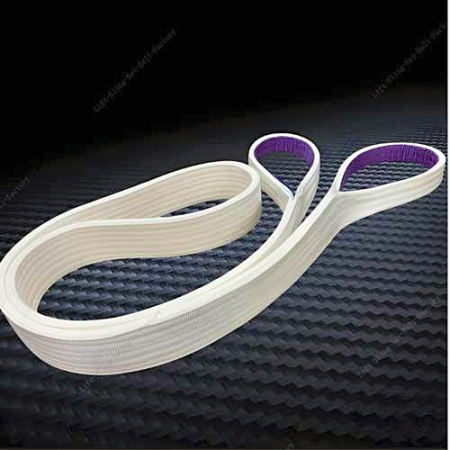
Lift sling rigging company produce Nylon Synthetic Web Sling,Synthetic Lifting Sling,Synthetic Slings,
Nylon Synthetic Web Sling.
Last updated 28 October 2026 · reviewed against EN 1492-1
Nylon is not the strongest fibre on the shelf — it is the one that gives. 一 nylon synthetic web sling stretches 8–10 % at its working load, and that stretch is the product: it turns a snatch into a slow pull, shares load across legs of unequal length, and refuses to shock a crane. It also costs you height, strength when wet, and UV life.
In one line: a nylon synthetic web sling is a flat woven polyamide (PA) band rated 1 t 到 30 t at a 7:1 safety factor to EN 1492-1, elongating 8–10 % at working load so it absorbs shock — against 3 % for polyester, which is the only comparison that matters when choosing between them.
Why nylon, and what it is not for
Nylon yarn is woven into a flat band, stacked into plies to reach the break, and closed with stitched eyes or an endless loop. It is close to polyester in strength per millimetre of width — the two are rated alike on the same build. What separates them is behaviour under a moving load.
So nylon is the right fibre where the load arrives rather than sits: a tow, a snatch recovery, a swell against a moored vessel, a load that settles as it is lifted. It is the wrong fibre for a height-critical pick, for anything that has to stay put for days, and for a hot surface. Those cases belong to polyester webbing slings, and the table below is the whole argument.
| Property | Nylon (PA) | Polyester (PES) |
|---|---|---|
| Elongation at WLL | 8–10 % | ≤ 3 % |
| Under a snatch load | Absorbs it — the band is the spring | Passes it on to the crane and the load |
| Strength when wet | About 10 % lower, recovered on drying | Practically unchanged |
| UV / sunlight | Degrades faster; store out of sun | Better; the outdoor default |
| Acids | Attacked by strong acids | Good resistance |
| Alkalis | Good resistance | Attacked by strong alkalis |
| Abrasion | Excellent — the best of the common fibres | Good |
| Service temperature | About 90 °C | About 100 °C |
Indicative fibre properties, not sling ratings. The label on the sling governs the lift.
What 8–10 % actually costs you
Elongation is quoted as a percentage, which hides the number that matters on site: millimetres of drop. Multiply it by the leg length and the choice stops being abstract.
| Leg length | Nylon at 8–10 % | Polyester at 3 % |
|---|---|---|
| 2 米 | 160 – 200 毫米 | 60 毫米 |
| 4 米 | 320 – 400 毫米 | 120 毫米 |
| 6 米 | 480 – 600 毫米 | 180 毫米 |
| 10 米 | 800 – 1,000 毫米 | 300 毫米 |
Arithmetic on the rated elongation, at working load and at ambient temperature. It is the reason a nylon leg has to be ordered shorter if the hook height is fixed.
Two consequences: a long leg changes the geometry as it takes up, because the load rises into the stretch and the hook angle opens; and on a fixed hook height the sling must be ordered short by roughly its own stretch, or the pick will not clear.
Working load limit by width
Capacity follows the same rule as any flat sling: width × plies sets the load-bearing cross-section. Nylon and polyester are rated alike on the same build, so the table is shared — the difference is what happens while the load is on.
| Web width | WLL | 最少. break | Typical use |
|---|---|---|---|
| 25 毫米 | 1.0 t | 7 t | Tooling, small components |
| 35 毫米 | 1.5 t | 10.5 t | Workshop general purpose |
| 50 毫米 | 2.0 t | 14 t | The most ordered size |
| 75 毫米 | 3.0 t | 21 t | Fabrications, machine parts |
| 100 毫米 | 4.0 t | 28 t | Painted steel, panels |
| 125 毫米 | 5.0 t | 35 t | Pipe, bundled sections |
| 150 毫米 | 6.0 t | 42 t | Precast units |
| 200 毫米 | 8.0 t | 56 t | Heavy fabrications |
| 240 毫米 | 10.0 t | 70 t | Modules, skids |
| 300 毫米 | 12.0 t | 84 t | Top of the single-ply range |
| 上面 12 t | Multi-ply builds of 300 mm web, or the polyester range where the lift is static | ||
Nominal values for the standard build at 7:1. The label on the article is the governing figure.
Capacity by hitch, and the one place nylon helps
The tag gives the vertical figure. Every other arrangement derates it — and on nylon there is a compensating effect worth knowing: because the band stretches, legs in a multi-leg set share load more evenly than slightly unequal polyester legs would. The stretch absorbs the mismatch. The cost is that the assembly springs back when the load comes off.
| Hitch | 因素 | 一 10 t sling gives |
|---|---|---|
| Vertical, single leg | 1.0 | 10.0 t |
| 窒咗 | 0.8 | 8.0 t |
| 籃子, 0–45 ° | 2.0 | 20.0 t |
| 籃子, 45–60 ° | 1.4 | 14.0 t |
| 兩隻腳, 0–45 ° | 1.4 | 14.0 t per assembly |
| 兩隻腳, 45–60 ° | 1.0 | 10.0 t per assembly |
| Four legs, 0–45 ° | 2.1 | 21.0 t per assembly |
Mode factors per EN 1492-1. A choked nylon sling also tightens under load and can be awkward to release — plan the choke point.
Recoil. A nylon sling stores the energy it absorbed. If it fails under tension it gives that energy back along its own line, which is why nobody stands in the bight or in line with a stretched nylon leg — and why a nylon sling is not the article to specify purely because it is soft.
The three conditions that retire a nylon sling early
- Water. Wet nylon loses in the region of 10 % of its strength and recovers when it dries, so a band left out in the rain is not the band on the certificate. Dry it before it goes back in the store; do not leave it coiled wet.
- Sunlight. Nylon is the weaker of the two common fibres under UV. Store it out of the sun, and treat a chalky, stiffened surface as the start of the end rather than as dirt.
- Acid. Alkalis are fine; strong acids are not. A band that has been near battery acid or a pickling bath is retired, not washed.
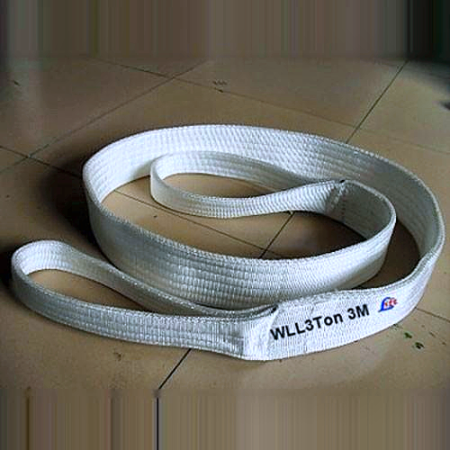
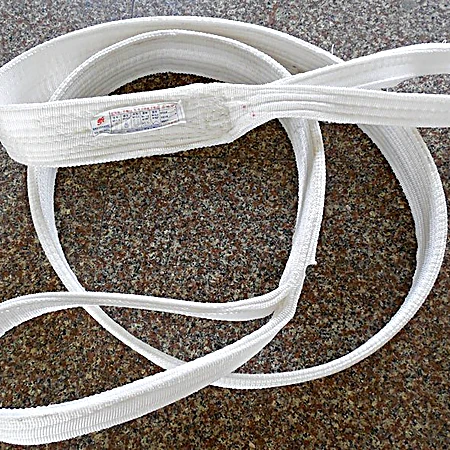
Natural white is an inspection advantage: a stain, a burn, a crushed edge and a pulled stitch all read clearly on an undyed band. Retire the nylon web sling on a cut or snag through the weave, broken stitching, a distorted eye, 玻璃, chemical staining, or an unreadable label.
Builds
- Eye and eye — the standard build; the eye is sized to the shackle or hook, not to the band. See eye and eye flat web slings.
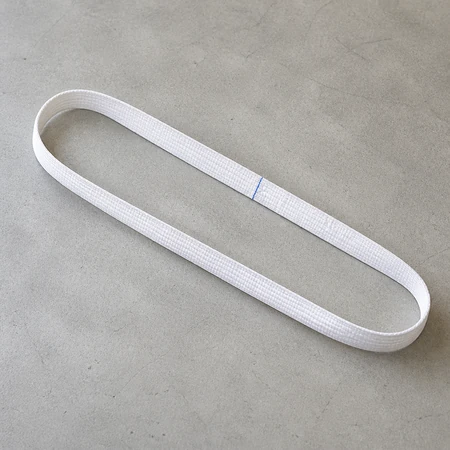
- Endless — a closed loop with no stitch in the load path, for passing around a load. See endless lifting web slings.
- Reverse eye — the eye turned through 90° so the band lies flat on a square corner.
- Sleeved eye — a wear cover at the shackle, replaced before the weave is touched.
Specifying one in four answers
- Load per leg, and whether the figure is already derated for the hitch.
- Hitch and angle: 垂直, choked, 籃子, or multi-leg, and at what included angle.
- Height available: with 8–10 % 拉長, the leg length is set by the hook height, not the other way round.
- Environment: wet, sunlight, acid or alkali, and whether the band will be stored coiled or hung.
Questions about nylon synthetic web slings
What is a nylon synthetic web sling?
A flat woven band of nylon (PA) yarn with eyes or an endless loop, rated for lifting. It is chosen over polyester when the lift has to absorb a snatch rather than hold a dead weight.
What safety factor does it have?
7:1 to EN 1492-1 同 5:1 to ASME B30.9. 一 2 t sling therefore has a minimum breaking force of 14 t under EN 1492-1, and the label states which basis it was built to.
How much does it stretch?
8–10 % at the working load limit, against 3 % or less for polyester. On a 4 m leg that is roughly 320–400 mm — the reason it is not used for height-critical picks.
Does it lose strength when wet?
係. Nylon absorbs moisture and gives up in the region of 10 % of its strength wet, recovering on drying. Polyester loses almost nothing, which is one reason it is the default for marine and outdoor work.
Is nylon resistant to UV and chemicals?
Less UV resistant than polyester, so keep it out of the sun. It resists alkalis well but is attacked by strong acids; polyester is the reverse.
Why is it usually white?
Nylon is supplied natural rather than dyed to a capacity colour, so the band reads white. On nylon the colour is not a capacity code — the label carries the WLL, the length and the standard.
Why is recoil a hazard?
Because the band stores the energy it absorbed. If it fails under load it returns that energy along its own line, so nobody stands in the bight or in line with a tensioned nylon sling.
Related: polyester webbing slings · all webbing slings · eye & eye flat web sling · endless web slings · endless lifting slings · WLL 60 ton webbing slings · 100 tonne webbing sling · nylon rope · 圓形吊帶 · wire rope slings · cargo lashing · ratchet tie down straps
Tell us the load and the hitch
Send the load per leg, the hitch and the height you have available, and we will come back with fibre, 闊度, ply count, leg length and the labelled WLL — on a drawing, before anything is woven.
升降吊索索具公司, Ltd · Lifting & rigging division of China Lifute Sling Group
電話 / WeChat +86 180 6600 2268 · 702461526@qq.com
升降工業園, 泰州市, 江蘇省, China · HS code 630790
Figures are for the standard build to EN 1492-1 喺 7:1; ASME B30.9 builds at 5:1 are available. The labelled working load limit always governs the lift, and the mode factors above do not replace a lift plan.