

Lift sling rigging company produce HMPE/UHMWPE Round Slings,High-Strength UHMWPE Round Sling,HMPE/UHMWPE Endless Round Sling,HMPE Slings,UHMWPE Sling,UHMWPE Rope Round Sling,HMPE/UHMWPE Round Lifting Slings
HMPE/UHMWPE Round Slings
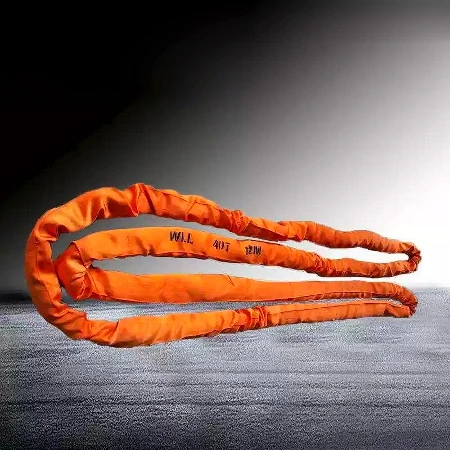
An HMPE round sling is chosen for weight first and strength second. The core is ultra-high-molecular-weight polyethylene — the polymer family sold as Dyneema and Spectra — and it carries the same load as polyester at roughly a quarter to a third of the mass.
On a 40 t sling that is the difference between a two-person lift and a one-person carry. On a scaffold, inside a tank or under a low roof, it is often the difference between a lift that happens and one that does not. Strength is not the interesting part; the combination of strength, low stretch and low weight is.
HMPE, UHMWPE, Dyneema: One Polymer, Three Names
HMPE means high-modulus polyethylene. UHMWPE means ultra-high-molecular-weight polyethylene. Both describe the same class of fibre, and Dyneema and Spectra are brand names for it. Suppliers use the terms interchangeably; buyers sometimes use one to mean “the branded one”.
What actually decides performance is not the label on the spool but three things: the fibre grade, the way the core is laid, and the sleeve. A branded fibre in a thin sleeve will fail sooner than an unbranded fibre in a double sleeve, because the sleeve is what meets the load.
If your specification names a brand, put it on the purchase order — the finished round sling carries the working load limit, length and serial number, not the fibre brand.
Strength per Kilo, Not Strength Alone
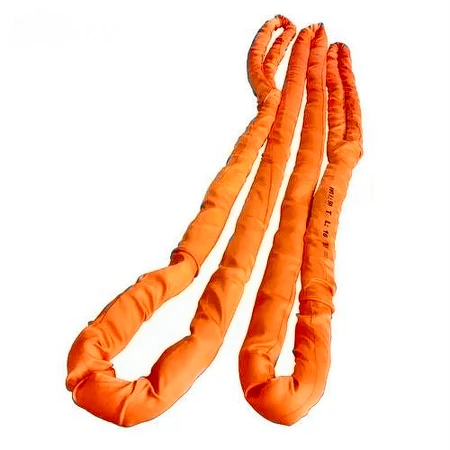
Per kilogram, HMPE carries roughly three to four times the load of high-tenacity polyester. Two properties produce that: higher fibre tenacity, and a specific gravity of 0.97 — about 30% lighter than polyester for the same volume, and lighter than water.
In a round sling the gain shows up in three practical ways. The core is smaller for the same working load limit. A long sling stays light enough for one person to coil and carry, where polyester needs two. And freight on long lengths drops, which matters once you are shipping 30 m and 50 m bodies.
Low stretch is the second half of the story. HMPE elongates less than polyester under the same load, so the hook height you calculate is closer to the hook height you get. That is an advantage in a tight lift and a disadvantage when you want the sling to absorb shock — for repeated snatch loads, polyester is the more forgiving choice.
Cut Resistance: the Fibre Helps, the Sleeve Decides
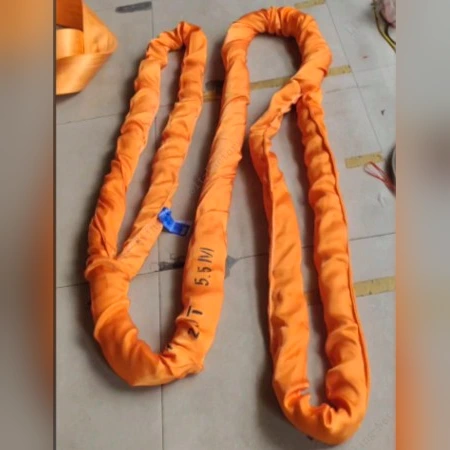
At fibre level, HMPE resists cutting far better than polyester — it is the reason the fibre is used in cut-resistant gloves and rope. In a round sling that advantage is real but bounded: the sleeve is the part in contact with the load, and two layers of woven sleeve will still be opened by a sheared plate edge, a burr, a rebar end or a rough casting.
Treat cut resistance as a margin, not a permission. Where the edge cannot be dressed or rotated, add an edge protector, use a 升降梁 to get the legs off the load, or change the hitch so the contact point moves.
Three Limits to Know Before You Buy
HMPE is the right answer to a narrow question. It is the wrong answer to three others, and those three cause most of the failures we see.
Heat
- HMPE melts at roughly 144–152 °C and should not run continuously above about 70 °C. A sling that survives one hot lift may still lose strength quietly.
- For hot work — castings, hot rolls, preheated fabrications — use a para-aramid round sling instead.
Creep
- Under sustained load, HMPE creeps. For a lift measured in minutes this is irrelevant; for a sling left loaded overnight or used as a permanent static tie, it is not.
- If the load stays on for days, specify polyester or aramid, and re-check the length after the first long hold.
UV and abrasion
- The fibre degrades in sunlight; the sleeve is the shield. Store coiled, out of direct sun, and retire on sleeve condition rather than on age alone.
- HMPE has low resistance to abrasion at fibre level — one more reason the sleeve, not the core, is the wear part.
Technical Parameters
| 產品 | HMPE/UHMWPE endless round sling (soft, no metal fittings) |
|---|---|
| Core | High-modulus polyethylene (UHMWPE) multifilament, parallel lay, waxed |
| Sleeve | Woven polyester as standard; HMPE sleeve or double sleeve on request |
| Working load limit | 1–200 t in standard steps |
| 安全因素 | 7:1 |
| Specific gravity | 0.97 — the sling floats |
| Elongation at WLL | approx. 1% (fibre elongation at break 3–4%) |
| Melting point | approx. 144–152 °C |
| Service temperature | −40 to +70 °C continuous |
| Creep | Low, but present under sustained static load |
| Water and moisture | No significant absorption; suitable for wet and marine use |
| UV | Sleeve-dependent; store out of direct sunlight |
| Length | 0.5–50 m standard; longer to order |
| 顏色 | Blue, white or grey as standard; other colours to order |
| Marking | Sewn label: WLL, length, serial number, standard |
| Packing / OEM | Coil, poly bag, carton; OEM sleeve, 顏色, label and length |
Where HMPE Wins
- Manual handling. Long or high-capacity slings that one person has to carry up a scaffold, into a tank or through a hatch.
- Long bodies. 30 m and 50 m slings where polyester weight becomes the constraint before capacity does.
- Over water. Specific gravity 0.97 means a dropped sling floats and can be recovered.
- Tight hook height. Low stretch keeps the calculated headroom; less elongation to allow for.
- Wet and marine work. No meaningful water uptake, no swelling, no stiffening overnight.
- Export and air freight. Lower mass on long lengths cuts freight and handling cost.
Choose HMPE or Polyester?
Choose HMPE when
- The sling has to be carried by hand
- Length is long and weight is the problem
- The lift is over water
- Stretch must stay small
- Capacity is high but the crane hook is small
Choose polyester when
- Cost per tonne of capacity is the driver
- The load is hot, or the environment is
- The sling stays loaded for long periods
- Shock loads and rough handling are normal
- Abrasion against concrete is continuous
Inspection Notes for HMPE Slings
The failure modes differ from polyester, so the inspection order differs too. Check the sleeve for cuts and glazing first, then the core for show-through, then the label.
- Sleeve cuts. Any cut that exposes the core retires the sling — HMPE core has poor abrasion resistance once unprotected.
- Glazing or stiffening. A shiny, stiff patch usually means heat, not abrasion. Treat it as a strength loss and retire the sling.
- Colour change in the core. A dull or chalky core seen through a split sleeve indicates UV or chemical exposure.
- Length drift. On slings used for long holds, measure against the original length; permanent elongation is creep, and the sling should come out of service.
- Label. If the WLL or serial number is unreadable, the sling cannot be verified — withdraw it.
Frequently Asked Questions
Is HMPE the same as Dyneema?
Same polymer family. HMPE and UHMWPE are the generic material names; Dyneema and Spectra are brands of it. The sling’s performance depends on fibre grade, core construction and sleeve, not on which of those words appears in the title.
How much lighter is an HMPE sling than a polyester one?
Roughly a quarter to a third of the mass for the same working load limit, because the fibre is stronger per kilo and about 30% lighter for the same volume. On a 40 t × 12 m sling this is the difference between one person carrying it and two.
Can an HMPE sling be used for hot loads?
No. Service temperature is about −40 to +70 °C and the fibre melts around 144–152 °C. For hot work use a para-aramid sling, which is rated to roughly 300 °C continuous.
Does it float?
Yes. Specific gravity is 0.97, below water, so a dropped sling stays at the surface — one of the reasons HMPE is used for over-water and marine lifts.
What is the problem with creep?
Under sustained load HMPE slowly lengthens. For lifts of minutes this is negligible; for a sling left loaded overnight, or used as a permanent static tie, it is not. Specify polyester or aramid for those applications and re-measure the length after the first long hold.
Tell us the load, the length and the environment
We build HMPE/UHMWPE round slings from 1 t to 200 t, with sleeve, 顏色, label and length to your specification. Send the lift details and we will come back with capacity, mass and lead time.