

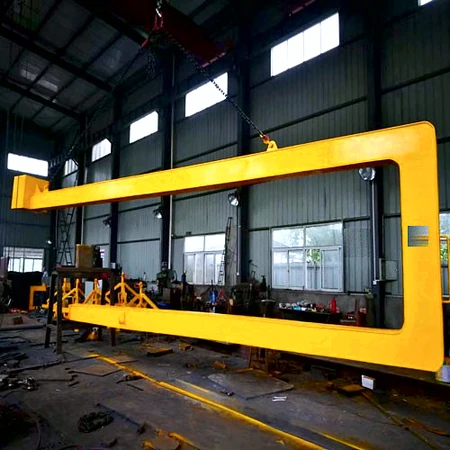
Lift sling rigging company produce Container Loading C Type Hook,C Hooks for Container Loading and Unloading,Container Loading C-Hook,Container Loading twin forks,pipe bundle cradle arm,C-hooks for heavy coil lifting,Heavy-Duty Coil Lifting C Hook For Steel Coil Handling.
Container Loading C Type Hook
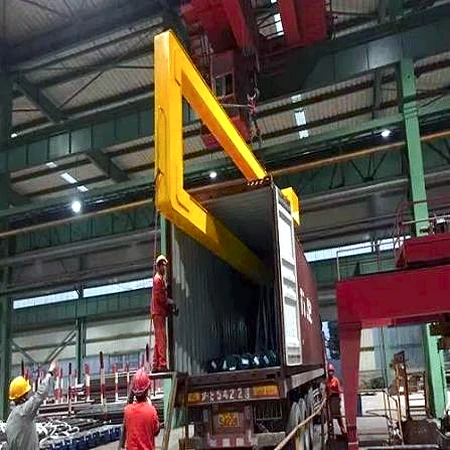
The container loading C type hook is the tool that makes coil loading inside an ISO container practical. A crane hook and a set of slings can lift a coil, but they cannot lower it through a 2.4 m door opening and place it 10 m inside a 40 ft box without the load swinging into the walls. The C hook solves that geometry problem: a rigid C-shaped body hangs vertically from two sling legs, the coil sits on the lower leg with its eye horizontal, and the whole assembly stays inside the narrow envelope of the container. This page gives the working limits, the dimensions and the selection rules our engineers use when a customer asks for a hook matched to a specific coil size and container type.
Why container loading needs its own hook geometry
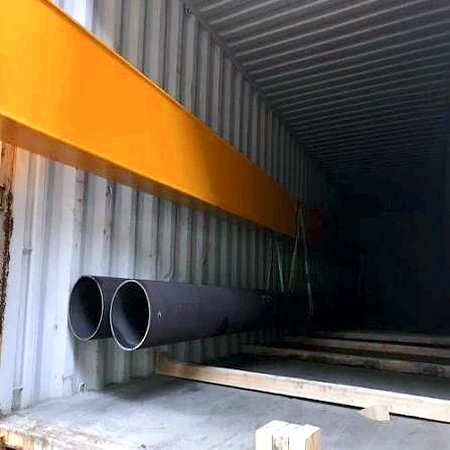
A container gives you 2,350 mm of internal height, 2,330 mm of width, and a door opening that is smaller than the box itself. Once the coil passes the door, the crane operator is working blind or through a camera, with the hook block only centimetres below the roof. Any tackle that needs vertical headroom above the load – slings choked around the coil, a horizontal beam with hanging legs, a scissor tong that opens above the coil – wastes exactly the space that is not available.
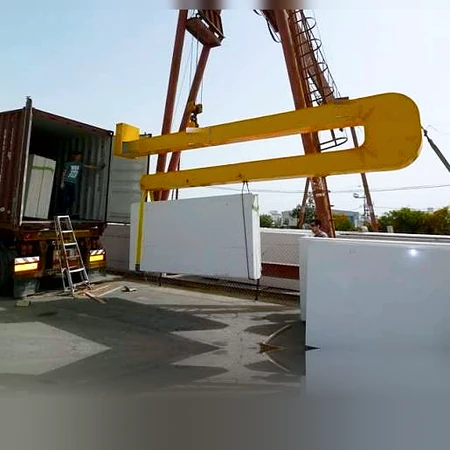
The C type hook removes the headroom problem because its lifting point is above the coil but offset to one side. The load hangs on the bottom leg, the slings run up the back of the hook, and the top of the assembly is no higher than the crane block itself. That is why coil warehouses and steel service centres standardise on this shape for container stuffing, and why a general purpose hook or a bare sling set is a poor substitute.
How the C type hook carries a coil
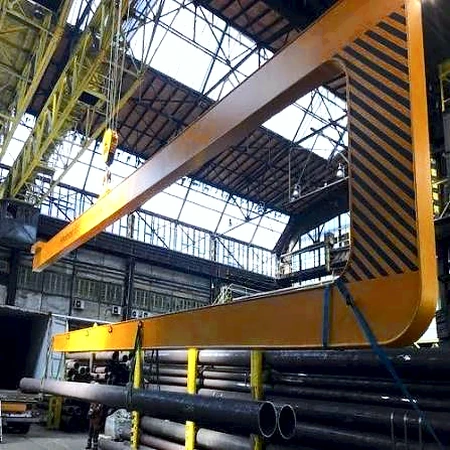
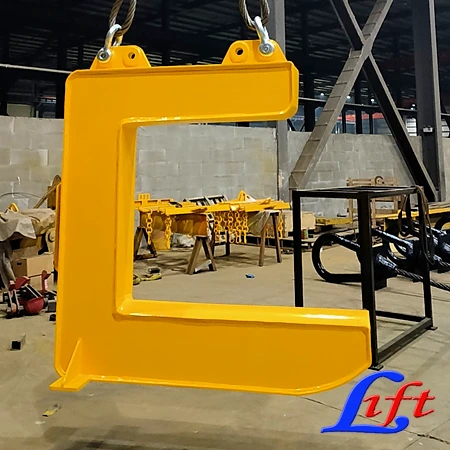
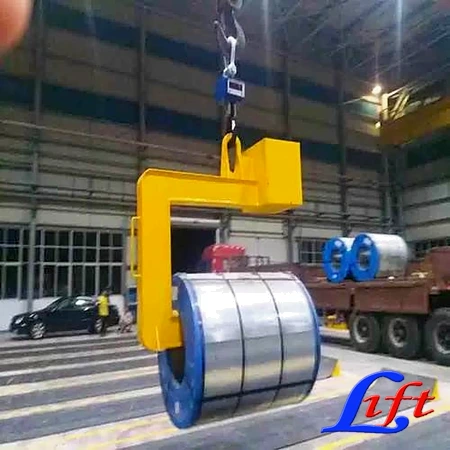
The body is a single welded C: a vertical back, an upper leg that carries the two lifting eyes, and a lower leg that forms the load-bearing fork. The coil is picked up with its axis horizontal, so the lower leg enters the bore of the coil. Because the coil is supported on its inner surface across the full width of the leg, there is no sling contact on the outer wrap – the surface finish, the edge and any protective paper or foil stay untouched.
The centre of gravity of the loaded hook sits close to the vertical back, so the assembly hangs with a slight forward tilt rather than a swing. Two sling legs from the crane hook to the two eyes set the working angle, usually between 45 同 60 degrees included. The eyes are positioned so that the resultant passes through the back plate, which keeps the weld root in compression instead of bending.
Models and working load limits
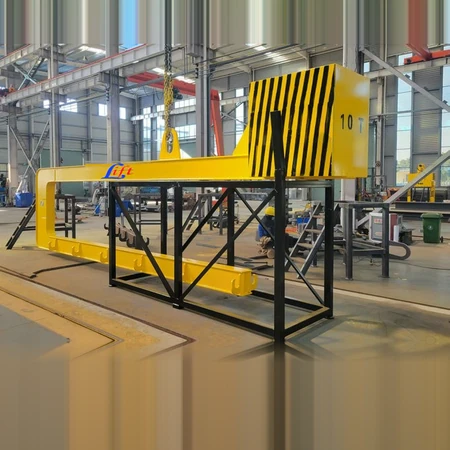
The range below covers coils from 500 毫米到 2,200 mm outside diameter, which is the span that fits through a standard container door. Working load limits are stated for a symmetric two-leg suspension at 45-60 degrees; a single-leg suspension reduces the rating and must be quoted separately.
Container Loading C Type Hook Technical Data
| Model | WLL (t) | Coil OD (毫米) | Coil width (毫米) | Throat depth A (毫米) | Jaw opening B (毫米) | Own weight (公斤) |
|---|---|---|---|---|---|---|
| CCH-3 | 3 | 500 – 1,100 | 300 – 1,000 | 600 | 420 | 180 |
| CCH-5 | 5 | 600 – 1,300 | 300 – 1,200 | 750 | 520 | 300 |
| CCH-8 | 8 | 700 – 1,500 | 350 – 1,250 | 900 | 620 | 470 |
| CCH-10 | 10 | 800 – 1,600 | 350 – 1,300 | 1,000 | 700 | 620 |
| CCH-15 | 15 | 900 – 1,800 | 400 – 1,400 | 1,150 | 800 | 880 |
| CCH-20 | 20 | 1,000 – 2,000 | 400 – 1,500 | 1,300 | 900 | 1,250 |
| CCH-25 | 25 | 1,100 – 2,100 | 450 – 1,550 | 1,450 | 1,000 | 1,600 |
| CCH-30 | 30 | 1,200 – 2,200 | 450 – 1,600 | 1,600 | 1,100 | 2,050 |
Throat depth A is the clear height between the upper and lower legs and decides the largest coil diameter the hook can straddle. Jaw opening B is the clear depth of the lower leg and decides how much of the coil width is supported. As a rule of thumb, keep the coil diameter at least 100 mm below A, and let B cover at least 60 percent of the coil width so the load cannot tilt on the fork.
Technical specification
| 項目 | 規格 |
|---|---|
| 工作負荷限制 | 3 t 到 30 t, single hook; twin-hook sets on request |
| 安全因素 | 4:1 against minimum breaking load |
| Proof test | 1.25 x WLL on every unit before dispatch |
| Body material | Q355B (S355JR) killed steel plate, 20 – 60 毫米 |
| Welding | Full penetration MAG root plus submerged arc fill; MT or UT on the main seams |
| Suspension | Two-leg wire rope sling, 45 – 60 degrees included; shackle eyes 40 – 90 mm pin |
| Surface | Shot blast Sa 2.5, epoxy zinc primer, RAL 1023 polyurethane topcoat |
| 工作溫度 | -20 C to +60 C; low temperature steel on request |
| 標記緊 | WLL, model, 序號, year of manufacture, CE plate |
| 參考標準 | 喺 13155, ASME B30.20, GB/T 3811 design rules |
| HS 代碼 | 8428.90 |
| Options | Fork pockets, adjustable jaw, stainless or galvanised finish, twin-arm version |
Choosing the right size
Four numbers decide the model. The first is the coil weight, which sets the working load limit with a margin for the hook itself. The second is the outside diameter, which must clear the throat depth. The third is the coil width, which must be covered by the jaw. The fourth is the handling height inside the container: the hook plus sling legs plus crane block must still fit under the roof when the coil is set down, so a deep throat on a small capacity hook is often the correct choice rather than the next size up.
Where several coils travel together, or where a coil is longer than a single lower leg can support safely, two hooks are mounted on a 升降散布梁 so the pair stays parallel and the load is shared. For high-volume yards where the crane is the bottleneck, a powered motorized coil lifting tong removes the manual slinging step, 同埋一個 coil handling beam covers the horizontal transport outside the container. The C hook remains the only one of the three that can work at the far end of a 40 ft box.
If your coils sit outside the ranges above, or if you handle both coils and plate in the same bay, the wider family of crane C hooks for coil lifting includes fixed and adjustable jaw versions; the container version differs mainly in a shorter back and a deeper throat.
Loading sequence inside the container
- Park the container on level ground, chock the trailer, and confirm the floor is clean and dry.
- Measure the coil and check it against the hook rating plate; confirm the throat clears the coil diameter with 100 mm to spare.
- Land the hook on the floor just inside the door, lower leg pointing towards the coil stack, and let the slings go slack before the operator enters the box.
- Slide the lower leg into the coil bore, lift 100 毫米, and check that the coil sits square on the fork with no tilt.
- Travel in slowly at floor level, keeping the coil within 200 mm of the floor until the final position is reached.
- Set the coil down, release tension, withdraw the hook, then secure the coil with timber chocks and lashing as required by the packing plan.
Never drag a coil with the hook, never use the hook to push a coil sideways, and never let anyone stand between the coil and the container wall while the hook is in motion.
Manufacture, testing and documentation
Every hook is cut from killed steel plate, welded with a full penetration root, stress relieved where the section demands it, and proof tested at 1.25 times its working load before painting. Main seams are magnetic particle or ultrasonic inspected, and the test certificate travels with the unit. The suspension 鐵絲繩吊帶 are supplied matched to the eye size with thimbles and pressed ferrules, so the assembly arrives ready to hang rather than needing local rigging.
Documentation per shipment includes the test certificate, the CE declaration of conformity, the general arrangement drawing with the actual throat and jaw dimensions, and a laminated inspection card for the operator. Spare wear pads for the lower leg and replacement sling sets are available for the life of the hook.
Floor loading and weight distribution
一 20 ft general purpose container is plated for about 28 t of payload and a 40 ft for about 30 t, but the floor is the real limit: point loading is normally rated at 4.5 t per square metre for a fork lift wheel or a coil footprint. A single 20 t coil standing on 1.2 m of coil width concentrates its load into a small patch, so coils are usually spread along the centre line with timber bearers or laid two abreast to keep the floor pressure inside the plate rating.
The hook does not change those limits, but it does decide where the coil can be placed. Because the load hangs forward of the back plate, the operator can set a coil 300 mm from the side wall without the slings touching the roof or the wall, which is what makes two-abreast loading possible in a 2,330 mm wide box.
Inspection and maintenance
Inspect before each shift: look for cracks at the weld toes between the legs and the back, measure wear on the lower leg where the coil sits, check the eyes for elongation and the sling for broken wires. A wear allowance of 10 percent of the plate thickness is the usual rejection limit; beyond that the hook must be taken out of service. Repainting is cosmetic, but any repair welding on a load-bearing seam requires the manufacturer, a new proof test and re-marking.
常見問題
Will the hook fit through a 20 ft container door?
係. The door opening is 2,340 mm high and the hook body is 600 去 1,600 mm deep, so it passes with the crane block above the door line. For 40 ft boxes the limit is reach, not height; specify the throat depth for the deepest coil position you need.
Can one hook lift a coil that is wider than the jaw?
唔得. The lower leg must support at least 60 percent of the coil width, otherwise the coil can tilt and the edge load on the fork rises sharply. Use a wider jaw or a twin-hook set.
Is this hook also used to lift empty containers?
唔得. Lifting a container by its corner castings needs dedicated container lugs or a certified container spreader. The C type hook described here is for coils and similar cylindrical loads handled inside the container.
What sling angle should the legs be set at?
Between 45 同 60 degrees included. A wider angle increases the compression in the top leg, a narrower one increases the tension and the headroom needed.
Can it be mounted on a forklift instead of a crane?
係, with the fork pocket option. The rating then follows the forklift capacity and the load centre, and the pocket version is supplied with its own test certificate.
Ordering and delivery
Tell us the coil weight, 外徑, 闊度, the container type and the crane hook height, and we will confirm the model, the throat depth and the sling length in one reply. Standard models ship in 15 去 20 working days from Taizhou, with the drawing approved before cutting. To start, 聯絡我哋嘅工程師 with your coil list and we will size the hook for the heaviest and the largest diameter in one pass.