

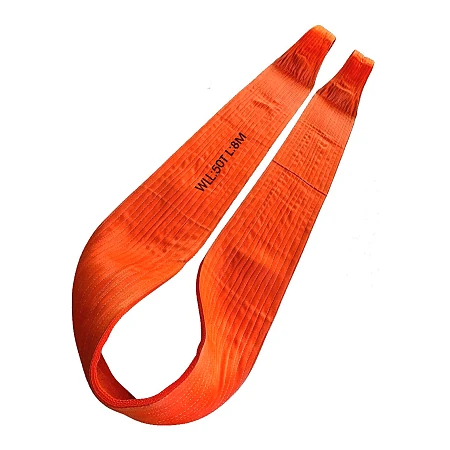
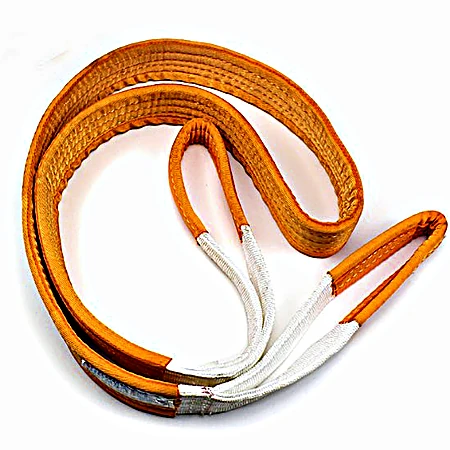
Lift sling rigging company produce 30T Webbing Round Lifting Polyester Strop/ Strap/ Sling,30 Tonne Webbing Sling,WLL 30 Ton Polyester Webbing Slings, 30000kg Heavy Duty Webbing Lifting Sling.30 Tonne Lifting Webbing Sling,30Ton Webbing Sling,30T Flat Web Sling.
30T Webbing Round Lifting Polyester Strop/ Strap/ Sling
A 30 tonne polyester webbing strop is the largest flat band one person can still carry up a ladder and rig alone — about 16 kg at 10 m — and the smallest size at which the fittings around the band start to decide the specification. The band is portable; the hook, the shackle and the headroom are not. This page covers the 30,000 kg flat webbing sling in its three usual names, the two builds that reach that figure, and the one word in the title that needs clearing up before you buy.
Strop, strap, sling — and the word “round”
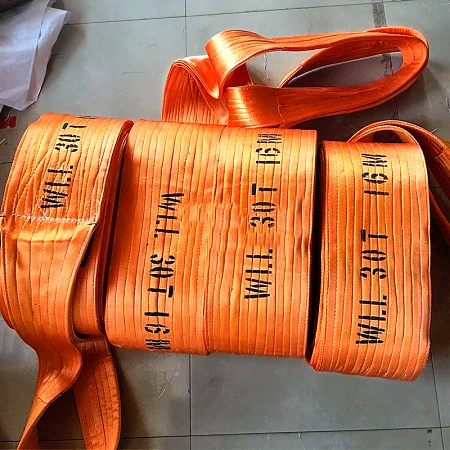
“Strop” is the Australian and UK trade word, “strap” is what the same article is called on a purchase order in South Africa and the Gulf, and “sling” is the standard’s word — one article, three names. The word wóolil is the one that changes what arrives on the pallet, because it describes a different construction rather than a different accent:
| The words on the order | What it actually is | Where it belongs |
|---|---|---|
| Webbing sling / strop / strap, flat eye & eye | Flat woven band, sewn eye at each end, load path visible along its length | This page — the 30 t flat build below |
| Webbing sling, endless or “round” form | The same flat band closed into a loop, no stitching in the load path | Our endless flat webbing sling |
| Round sling (polyester round sling) | A parallel yarn core inside a woven tubular sleeve — a different product entirely | Polyester round slings |
If your requirement came from a tender line reading “30T webbing round sling”, check which of the three it means before the order goes out. The two forms carry the same figure, retire for different reasons, and price differently — the flat band is inspected along its whole length, the round sleeve hides its core.
Two builds reach 30 tonnes
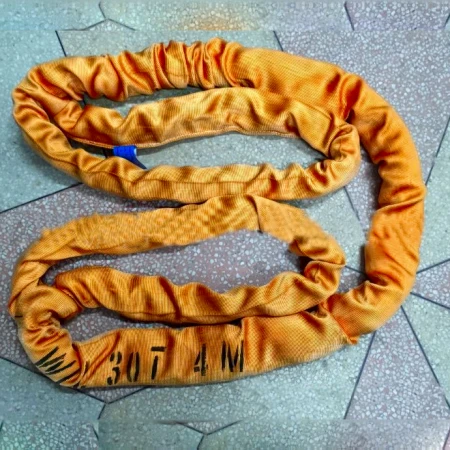
Two band constructions land on 30 t, and the choice between them is decided by the hook and the load, not by the tonnage. Le 240 mm three-ply is the standard build: wider face, thinner band, lower bearing pressure. Le 200 mm four-ply reaches 32 t in a narrower, thicker band that fits a smaller hook bowl and coils tighter.
| Build | Band | Vertical WLL | Choose it when |
|---|---|---|---|
| Standard | 240 mm, three-ply, approx. 6 mm thick | 30,000 kg | The hook or shackle bowl is generous and the load surface is soft, coated or finished |
| Compact | 200 mm, four-ply, approx. 8 mm thick | 32,000 kg | The eye has to seat in a smaller bowl, or the band must coil into a tight space |
At 30 t on a 240 mm band the bearing load is roughly 1,250 kg per centimetre of contact — the number to check against the load before the width is signed off. If that figure is too high for what is being lifted, the answer is a wider band rather than a stronger one: see the wide body webbing sling, where width is chosen from the pressure the load will accept.
Technical parameters
| Produktóo | 30T webbing round lifting polyester strop / strap / sling — flat eye & eye |
|---|---|
| Webbing | 100% high-tenacity polyester (PET), 240 mm three-ply (200 mm four-ply on request) |
| Límite u kuuch meyaj | 30,000 kg (30 t) per leg, vertical mode |
| Factor ti' seguridad | 7:1 — 210,000 kg minimum breaking load |
| Elongation | 7% or less at the working load limit |
| Chowakil | 1–20 m eye to eye as standard; longer to order |
| Ends | Reinforced flat eye, flat or twisted; eye length matched to the hook or shackle bowl |
| Weight | Approx. 1.5 kg per metre of band; ~10 kg at 6 m, ~16 kg at 10 m |
| Working temperature | −40 °C to +100 °C |
| Boon | Orange as standard; WLL colour coding to the buyer’s site procedure on request |
| Marcado | Sewn label plus printed band: WLL, length and mode factors, standard, batch number, date |
| Standard | ICHIL 1492-1; AS 1353 and ASME B30.9 builds on request |
| Test | Proof loaded to 2 × WLL; certificate and test report supplied with each sling |
| OEM | Chowakil, eye form, boon, printed webbing, own label, coil or carton |
What 30 tonnes lifts, by hitch
The label figure is the vertical rating; the hitch multiplies it. Two legs at a wide angle give no more than a single vertical leg, which is the mistake this table exists to prevent.
| Hitch | Mode factor | Capacity of one 30 t strop |
|---|---|---|
| Vertical | 1.0 | 30,000 kg |
| choqueado | 0.8 | 24,000 kg |
| Basket, legs 0–45° | 2.0 | 60,000 kg |
| Basket, legs 45–60° | 1.4 | 42,000 kg |
| Two legs, 0–45° | 1.4 | 42,000 kg |
| Two legs, 45–60° | 1.0 | 30,000 kg |
Where 30 tonnes sits in the range
The size is chosen as much by handling as by capacity, yéetel 30 t is the hinge. Below it, one person carries and rigs the sling without help; above it, the coil needs two people and usually a pallet.
| Buk | Band | Weight at 10 m | The lift it suits |
|---|---|---|---|
| 20 t | 240 mm duplex | ~11 kg | General site work; two legs give 28 t |
| 30 t | 240 mm three-ply | ~16 kg | Single-leg heavy lifts; two legs give 42 t; basket to 60 t |
| 50 t | 600 mm four-ply | ~53 kg | Structural and precast work where the coil is crane- or pallet-handled |
The eye decides whether the sling fits the hook
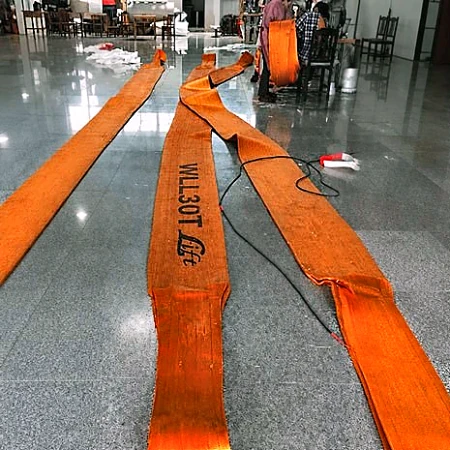
At 240 mm the eye is the part that fails to fit, not the band. A reinforced flat eye carries the full figure on a hook, but it needs a bowl wide enough for two band thicknesses plus the stitching, and an eye long enough that the band does not bear on the hook tip. Twisted (reverse) eyes turn the band 90° at the hook, which suits a shackle pin better than a hook saddle. Send the shackle or hook with the enquiry and the eye is set to it; specifying the eye afterwards is how a 30 t sling ends up derated on site.
Marcado, standard and what the inspector reads
Every strop is marked twice: printed into the band and sewn on a label carrying the working load limit, the length eye to eye, the mode factors, the standard, the batch number and the date. Colour coding by WLL is a second check for the yard — the label is the figure that governs the lift. ICHIL 1492-1 is the standard build; if the destination market calls AS 1353 or ASME B30.9, say so with the enquiry and the label wording and the certificate are issued to that standard rather than retro-fitted afterwards. Related end forms and eye lengths are set out on the eye and eye webbing slings page.
What retires a 30 t strop
- Stitch abrasion at the eye. The eye rubs the hook on every lift; broken or worn stitching at the throat is a retirement, not a repair.
- A cut, not a scuff. A plate edge or burr that has cut yarn is out of service even where the cut looks short — the band is three plies and the damage is rarely confined to the face.
- Grit worked into the band. Concrete dust and sand abrade the yarn from inside as the band flexes; a band that feels stiff and gritty has lost strength invisibly.
- An unreadable label. If the WLL, length or batch cannot be read, the sling cannot be verified and it comes out of service.
Frequently asked questions
Is a “30T webbing round sling” a round sling?
Usually not. The phrase is used for two things: the flat band closed into an endless loop, and the true round sling with a sleeved core. They are different products with different inspection rules and prices. Tell us the form you need and we will quote the right one — this page covers the flat eye & eye strop.
Is 240 mm three-ply or 200 mm four-ply better?
Neither in general. Le 240 mm three-ply spreads the load over a wider, softer face and is the standard build; the 200 mm four-ply gives 32 t in a narrower band that seats in a smaller hook bowl and coils tighter. Decide by the hook and the load surface, then confirm the figure.
How much does a 30 t webbing strop weigh?
About 1.5 kg per metre of band: roughly 10 kg at 6 m and 16 kg at 10 m, eyes included. That is the practical reason this size is still rigged by one person while a 50 t band is not.
Can two 30 t slings lift 60 tonnes?
Only with the legs vertical. Two legs at 0–45° give 42 t and at 45–60° give 30 t. To use the full 60 t, the band has to go under the load in a basket hitch, or the legs have to be held parallel by a spreader beam.
Do you supply a test certificate?
Jaaj. Each strop is proof loaded to 2 × WLL before packing, and ships with a certificate and test report batch-matched to the number printed on the band.
Related slings and fittings
- Polyester webbing slings — the full range from 0.5 t u 50 t
- 20 ton webbing sling — the size below, for two-leg work
- 50 ton webbing sling — where the band becomes a two-person coil
- Wide body webbing sling — when 1,250 kg/cm is too much for the load
- Polyester round slings — the sleeved-core form of the same figure
- Endless flat webbing sling — no stitching in the load path
- Lifting spreader beams — to keep 30 t legs vertical
Send the load, the hitch, the length eye to eye and the hook or shackle it will sit in. We will confirm the band, the eye, the standard and the marking, and quote before the band is woven.