

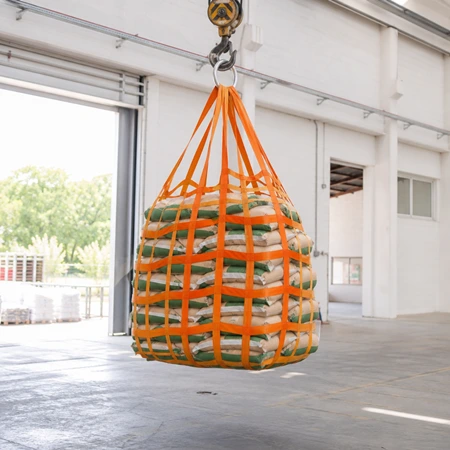

Lift sling rigging company produce Polyester Webbing Net for Lifting,Web Sling Lifting Cargo Net,Polyester Webbing Cargo Net,Flame Retardant Webbing Net,Cargo Nets Of Polyester Webbing,Cargo Lifting Net Web Sling,Polyester Nylon Webbing Lifting Cargo Net,Heavy-duty polyester cargo net with flat sling strap,Large Capacity Cargo Lifting Nets for Heavy-Duty Lifting.
Páawo'ob u correa u poliéster uti'al u líik'esik
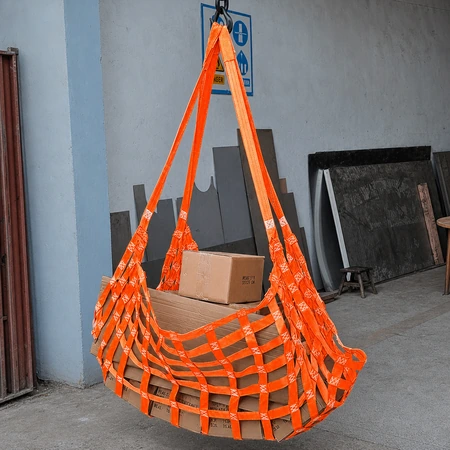
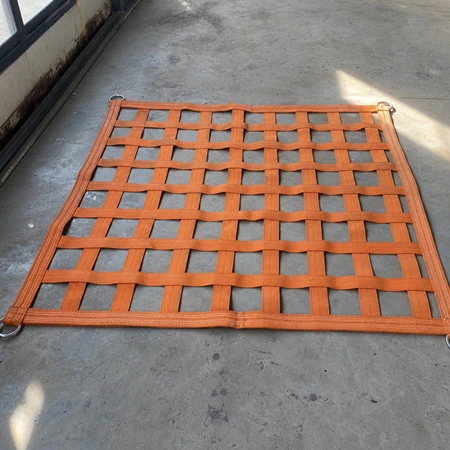
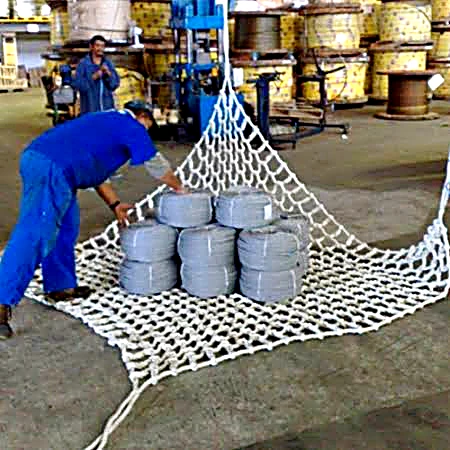
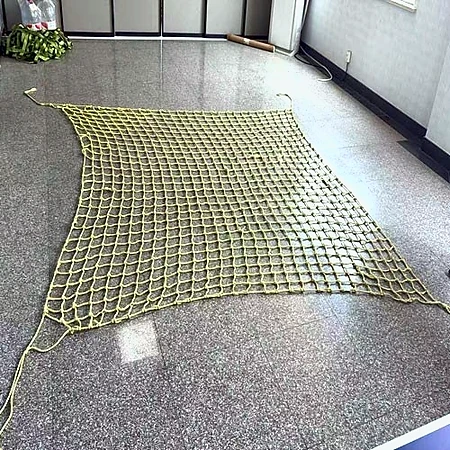
A polyester webbing net for lifting is a lattice of flat high-tenacity polyester (BA'ALCHE) bandas, stitched into a square mesh with a doubled border and reinforced corner loops. The cargo goes in, the four loops are gathered onto the hook or a master ring, and the whole consignment travels as one unit – no pallet, no strapping, nothing to re-handle at the far end.
It is supplied in two forms. The flat net holds loads that keep their own shape – paletas, paquetes, stillages, u páajtal a máquina. The closed-bottom bag contains loads that would otherwise escape the mesh – sacos, ladrillos, offcuts, mixed cargo. Both are cut to the drawing rather than to a catalogue: u kóochil le bandao', u xookil le capas, malla, buk, lifting points and colour are all set before the first metre of webbing is woven, and the finished net is proof-load tested with a material test report.
- Flat PET band, 25-200 mm – juunal, duplex or triplex, with a woven selvedge that does not fray.
- 2 t u 30 t as a net – the rating follows the band, the number of load-bearing bands under the cargo and the way the net is rigged.
- Bajo estiramiento, yo'osal 3-7 % ti' WLL – the net stays tight against the load instead of creeping open over a shift.
- Wet duty without loss of rating – polyester takes up almost no water and does not rot, so rain, wash-down and deck work are normal service.
- CE yéetel GS certificado – tejido, chuuy, marked and proof-load tested in one plant, yéetel ISO 9001, CNAS and DNV behind it.
The load path: jook'ob, buukle, xool, baanda, malla
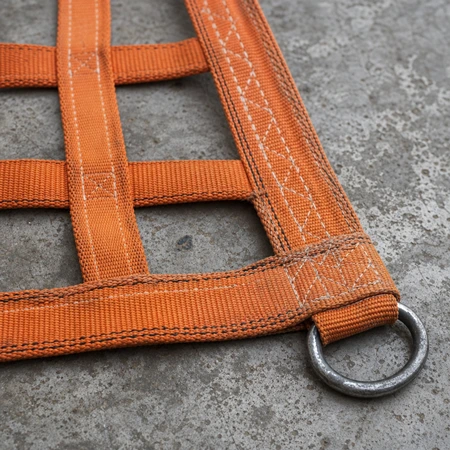
A polyester webbing net for lifting is not one component but five, and the load passes through them in a fixed order. Almost every net failure we are asked to investigate comes down to one link in that chain being built to a lower standard than the band itself – usually the stitching at the corner, which is the cheapest place to save money and the first place to fail.
Mayakche 1 – The five links in the load path, and what each one has to do.
| Link | Ba'ax ku bisik le kuuch | What fails there first | How we build it |
|---|---|---|---|
| Hook or master ring | All four loops gathered to one point | Loops binding on a sharp hook or a worn shackle | Ts'ipit k'ab maestra wa grado 80 shackle offered with the net; loops sized to the fitting |
| Corner loop | The full rated capacity of one corner | Stitching pulling out of the border | Loop stitched through a doubled border with multi-row lock stitch, reinforced above 5 t |
| Xool | The sum of the mesh, redistributed to the corners | Border folding or tearing at the corner radius | Coras dobladas, folded and stitched the full perimeter, wider at the corners |
| Load-bearing band | The cargo’s weight, band by band | Abrasion and cuts from pallet edges and nails | Woven selvedge, duplex or triplex where the net is dragged; sleeves at contact points |
| Malla | Containment – keeping the cargo in | Items squeezing through an over-wide opening | Opening chosen from the smallest item in the load, 50-300 mm |
The practical consequence is that a net is not rated by its band alone. JUNTÚUL 50 mm duplex band can carry 4 t as a single vertical leg, but the net it is woven into may be rated at 2 t because the corner stitching, ma' le bandao', ku jets'ik u xuul. That is why we test the finished net and print the net rating, never the band rating.
Polyester against nylon, polypropylene and wire rope
The fibre choice is usually made on price and then lived with for years. The four materials behave differently in ways that matter on a handling net, and none of them wins on every line.
Mayakche 2 – The four net materials compared on the properties that decide service life.
| Próopiedad | Poliéster (BA'ALCHE) | Nylon (PA) | Polipropileno (PP) | Wire rope |
|---|---|---|---|---|
| Elongación ti' WLL | Yo'osal 3-7 % – the lowest of the soft fibres | Roughly twice polyester | Higher again, and it creeps | Yáanal 1 %, but the net is stiff and heavy |
| Ja | Takes up almost no water; strength unchanged wet | Absorbs several per cent and loses some strength wet | Does not absorb water | Corrodes unless galvanised or stainless |
| Rot and mildew | Inmune | Can mildew if stored wet | Inmune | Not applicable |
| UV outdoors | Ma'alob, and stabilised in the weave | Moderado | Poor unless heavily stabilised | Unaffected |
| Dry abrasion | Ma'alob – best of the soft fibres | Ma'alob, slightly behind polyester | Moderado | Jach ma'alob, but it abrades the cargo |
| Ácidos | Good against most dilute acids | ku atacarta'al tumen ácidos k'a'ankach | Ma'alob | Depends on coating |
| Álcalis | ku atacarta'al tumen k'a'am álcalis | Ma'alob | Ma'alob | Generally good |
| Máax ku yéetel le kuuch | Susulkil, páats', ma' marcado | Susulkil, ma' marcado | Soft but slippery | Marks and crushes; needs sleeves |
| Rigging by hand | Sáasil, folds into a bag | Sáasil, folds into a bag | Asab sáasil | Needs two people and a trolley |
Two conclusions follow. Where the net works in cycles against pallets, concrete and truck beds, polyester is the default because low stretch keeps the mesh tight and dry abrasion is where it is strongest. Where the cargo shock-loads – chatarráaj, demolition, rough castings – nylon’s give is an advantage and the eslinga neta u kuuch nylon aal is the better answer. And where the load is hot, or the net has to be rigid, neither soft fibre belongs on the job.
Band specification
The band is where a quotation is won or lost. Five numbers describe it, all five are printed on the label, and all five are fixed on the drawing before weaving.
Mayakche 3 – The five numbers that describe a polyester lifting band.
| Number | Ba'ax leti' | Range we weave |
|---|---|---|
| Kóoch | Flat width of the webbing | 25 / 50 / 75 / 100 / 150 / 200 mm; 50 mm estándar |
| Layer count | How many webs are stitched into one band | Juunal, duplex (ka'a) wa triplex (óox) |
| Kóochil | Set by width and layer count | 1.8 mm – 6.0 mm |
| Densidad u tejido | Yarn count in warp and weft, which sets tenacity | Set to the EN 1492-1 basis for the rated capacity |
| Xuul | How the selvedge is finished | Woven selvedge as standard; folded and stitched where the band is handled daily |
Mayakche 4 – Working load limit per band, vertical single leg, ICHIL 1492-1 k'oja'ano'obo'.
| Kóoch banda | jump'éel chéen capa | Duplex | Triplex |
|---|---|---|---|
| 25 mm | 1 t | 2 t | 3 t |
| 50 mm | 2 t | 4 t | 6 t |
| 75 mm | 3 t | 6 t | 9 t |
| 100 mm | 4 t | 8 t | 12 t |
| 150 mm | 6 t | 12 t | 18 t |
| 200 mm | 8 t | 16 t | 24 t |
This is a band figure, not a net rating. The net’s capacity follows from how many load-bearing bands sit under the cargo and how the net is rigged – which is why we quote the net, ma' le bandao'.
Malla, border and edge: the three decisions left
Once the band is fixed, three choices remain. They are decided on the drawing, and changing one later means a new net rather than a modification.
Mayakche 5 – Malla, border and edge options.
| Decision | Opciones | Rule we apply |
|---|---|---|
| Apertura de malla | 50 / 75 / 100 / 150 / 200 / 300 mm | Chosen from the smallest item in the load, mix juntéen ti' le peso total |
| Xool | Single fold or doubled and multi-row stitched | Doubled as standard; a single-fold border is only offered on nets under 1 t |
| Edge treatment | Woven selvedge, folded edge, PU coating | Folded where the net is handled daily; PU coating where it is dragged or stored outdoors |
| Corner reinforcement | Standard loop or reinforced corner | Reinforced above 5 t, and on any net used with a spreader beam |
| Kanáanil | K'ab, pad or double band at the contact point | Specified for pallets with nails, machined parts and any sharp edge |
Parámetros técnicos
The figures below cover the standard polyester webbing net for lifting range. Every line is made to order, so treat the table as the starting point for a quotation rather than a fixed catalogue.
Mayakche 6 – Polyester webbing net for lifting: parámetros técnicos.
| Parámetro | Especificación |
|---|---|
| Bin yano'ob producto | Polyester webbing lifting net – flat net or closed-bottom bag |
| Xooko'obo' u banda | 100 % poliéster ka'anal u muuk' (BA'ALCHE) correas |
| Kóoch banda | 25 / 50 / 75 / 100 / 150 / 200 mm (50 mm estándar) |
| Construcción de bandas | jump'éel chéen capa, duplex or triplex; selvedge tejido, ma' jump'éel borde cortado |
| u kóochil le bandao' | 1.8 mm – 6.0 mm dependiendo de ancho yéetel recuento capas |
| Apertura de malla | 100 × 100 mm cuadrado estándar; 50 mm – 300 mm uti'al u k'áatik |
| Buka'aj neto | Length × width for a flat net; opening × depth for a bag; beeta'an u boonol |
| Xool | Coras dobladas, doblado yéetel ya'abkach filas cosido, reinforced at every corner |
| Ti'its u líik'il | Kanp'éel bucles ti'its'o' reforzados estándar; waxak uti'al jump'éel viga esparcidora |
| Buka'aj u ba'al u ts'aik | 2 t – 30 t as a net, set by band, u xookil le capas, load-bearing bands and rigging |
| Factor ti' seguridad | 5:1 / 6:1 / 7:1 |
| Elongación ti' WLL | Yo'osal 3-7 % |
| Boon | Código u boonil tumen límite kuuch meyaj, wa jump'éel boonil najo' personalizado |
| Ja' yéetel putrefacción | Takes up almost no water; does not rot or mildew |
| Temperatura meyaj | -40 °C u +100 °C |
| Tráatamiento | UV estabilizado, anti-envejecimiento, resistente ti' le abrasión yéetel le rasgón |
| K'oja'ano'obo' estándar | Webbing clasificado ti' le EN 1492-1 k'oja'ano'obo' |
| Certificación | CE, GS, JIS ti' j-na'akij; ISO 9001; Laboratorio CNAS; DNV |
| Personalización | OEM / Buka'aj ODM, boon, banda impresa, éetiketa, logotipo yéetel embalaje |
| Código HS | 6307.90 – u líik'esik páawo'ob u materiales textiles |
Standard sizes and rated capacities
Net size is measured along the border for a flat net, and as opening × depth for a bag. The load has to sit well inside the net: a net the same size as the cargo sheds it as soon as the crane takes up the slack.
Mayakche 7 – Standard net sizes; tamaños personalizados, mesh and lifting points are made to drawing.
| Buka'aj neto | Malla | Baanda | Buka'aj u ba'al típica | búukinta'al típico |
|---|---|---|---|---|
| 1.0 × 1.0 m | 100 mm | 50 mm duplex | 2 – 3 t | Tambores, u páajtal a máquina, chéen paletas |
| 1.2 × 1.2 m (4 × 4 ft) | 100 mm | 50 mm duplex | 2 – 4 t | Huella estándar ti' le paleta, kuuch en caja |
| 2.1 × 2.1 m (82 × 82 ichil) | 100 mm | 50 mm duplex | 3 – 5 t | Imperial pallet footprint |
| 2.5 × 2.5 m | 100 – 150 mm | 75 mm duplex | 4 – 8 t | Kuuch envasado, kuuch le nu'ukulo' |
| 2.5 × 6.0 m | 150 mm | 100 mm duplex | 6 – 12 t | Paquetes de tuberías, long cargo, trailer loading |
| 4.0 × 4.0 m | 150 – 200 mm | 150 mm duplex | 10 – 20 t | Kuuch envasado u granel, large pallets |
| 6.0 × 6.0 m | 200 mm | 150 mm triplex | 20 – 30 t | Puerto, barge and heavy bulk handling |
| Meenta'an u boonol | 50 – 300 mm | 25 – 200 mm | 2 – 30 t+ | Taas che'o' camión, nu'ukul, hold and hopper sizes |
Pallet-sized versions are quoted from the pallet footprint and are covered by the grúa paleta kuuch neto; long bulk consignments by the poliéster u líik'il u líik'il u páawo'ob; and the tensioned version for holding loads down in transit is the páawo'ob u asegurar u kuuch.
Rigging arrangements and fittings
How the net is hung decides how much of the load it actually carries. Two arrangements cover most work, and both are rated for the net rather than assumed from the band.
- Kanp'éel bucles ti' le gancho – le estándar. The loops gather on the hook or a master ring and the net closes on the cargo as the crane takes up the slack.
- Ukp'éel bucles ti' jump'éel viga esparcidora – le páawo' ku p'áatal cuadrado, le kuuch ku p'áatal nivel yéetel Amal ti'its'o' ku bisik jump'éel cuota predecible; the right answer for long or wide consignments, using a viga esparcidor u líik'il.
- Bix u póoj, yáanal k'ala'an – contains loose cargo that would otherwise fall through the mesh; the form used for loading and unloading.
- Flat net over a load – for pallets, bundles and stillages that keep their own shape and only need holding together.
Accesorios suministrados wa montados ti' le j-na'akij: bucles u correa cosido, master rings and master links, graado 80 grilletes uti'al u líik'il viga, PU-coated band for high-abrasion and outdoor duty, protection sleeves and pads for sharp edges, yéetel kits reparación yéetel banda coincidente yéetel rosca utia'al u flotas ku mantienen u leti'ob nu'ukulil.
Codificación u boonil, marking and identification
Flat webbing has one advantage a rope net does not: the band itself can carry the identification. We print the working load limit along the web and weave the standard colour into it, so a net can be read from across a yard before anyone picks up the label.
Mayakche 8 – Standard colour code by working load limit.
| Límite u kuuch meyaj | Band colour | Límite u kuuch meyaj | Band colour |
|---|---|---|---|
| 1 t | Violeta | 5 t | Chak |
| 2 t | Ya'ax | 6 t | Chukwa |
| 3 t | K'an | 7 t | Ch'ooj |
| 4 t | Sak éek | 8 t | Pak'aal |
Two rules stand behind the colour. It is a convenience, not the identification – the label is, and it is read before every lift. And where a fleet uses a house colour, we weave that instead and print the capacity on the band, so no net is ever identified by colour alone. Nets ship folded in a bag or a crate; six nets take the space of one pallet.
Ch'uul, hot and chemical: what polyester tolerates
Most net failures blamed on the material are really service conditions the buyer was never asked about. These are the limits we work to, and the questions we ask before quoting a net for a wash-down bay or a chemical plant.
Mayakche 9 – Service conditions and how polyester behaves in them.
| Condition | Rendimiento | What to do about it |
|---|---|---|
| Rain, p'o'ik, deck work | No water uptake, ma' u k'astal, rating unchanged wet | Mixba'aj – store wet if space is short, but dry before inspection |
| Sun and UV | Ma'alob resistencia, stabilised in the weave | Store out of direct sun where possible; retire on colour or gloss change |
| Abrasion on concrete and pallets | Good dry abrasion, best of the soft fibres | Duplex or triplex band, and a sleeve where the net is dragged |
| Heat up to +100 °C | Within range; no loss of rating | Keep clear of hot cargo, weld spatter and exhausts |
| Yóok'ol +100 °C, hot material | Outside the range – polyester softens and loses strength | Use a heat-rated construction or a different product entirely |
| Dilute acids | Ma'alob resistencia | Rinse after exposure and inspect the stitching |
| Strong alkalis | Attacked – strength loss is not visible | Specify nylon instead, and tell us the chemical |
| Oils and grease | Not absorbed, but they hide damage | Clean before inspection so cuts and abrasion can be seen |
| Bordes afilados | A textile cuts – this is the one limit that cannot be engineered out | Protection sleeve or pad at every contact point |
Prueba, certificación yéetel trazabilidad
- cuarenta ja'abo'ob u beeta'al nu'ukulo'ob uti'al u líik'sa'al – beeta'ab tu 1985 tu kaajil Taizhou, Jiangsu, yéetel asab ti' 200 meeyajo'ob.
- Band woven in our own mill, bey u kóochil, u xookil le capas, boonil yéetel impresión ku p'áatal yáanal k kaambalil yo'osal kúuchil u ma'anal.
- Amal neto prueba-kuuch probado ti' k kajnáalo'ob 1000 t máquina horizontales – probado, ma' u muestreado – yéetel jump'éel informe prueba xooko'obo' viajando yéetel le orden.
- CE declaración de conformidad yéetel certificación GS, yéetel u certificación JIS ti' le pedidos jo'osa'al bisbil ba'alche'obo'.
- ISO 9001 t.u.m gestión calidad, jump'éel laboratorio acreditado tumen CNAS yéetel certificación DNV paach le páak'alo'.
- Amal páawo'ob marcado yéetel u límite kuuch meyaj, size and mesh before packing, bey u le páawo'ob yéetel u ju'uno'ob Mantats' ku éejentiko'ob.
Certificados yéetel informes pruebas táan disponibles bey PDFs utia'al u archivo licitación wa jump'éel cheque aduanas – wil tuláakal certificación estableser.
Bik, inspection and retirement
- Xook le marca impresa yéetel le etiqueta Buka'aj u ba'al bey ma' Amal líik'il, and check the load is inside the rating for the way the net is rigged.
- yáax ilawil le lazos ti'its'o' yéetel u chuuy, ts'o'okole' le fronterao', túun le bandas ku bisik kuuch – that is the order in which a webbing net wears.
- Kaxtik cortes, abrasión, jaatik u chuuy, tinción química, heat glazing and the colour or gloss change that signals UV degradation.
- Keep the cargo inside the mesh and off the border, and protect the bands from sharp edges with a sleeve or pad.
- Ma' u máan ti' le Buka'aj u ba'al u ts'a'abal, mixbik'in líik'es ti' menos ti' le múuch' k'iini' u bucles, and never drag a loaded net sideways with the crane.
- Almacenar limpio yéetel tikin, paach le lu'umo' yéetel paach le k'iino'; never repair webbing by knotting, welding or heating it.
- Withdraw the net if a load-bearing band, le fronterao', a loop or its stitching is damaged, and have nets inspected by a competent person at the interval your site requires.
K'áat chi'oba' suuk u beeta'al
What is a polyester webbing net for lifting used for?
Moving bagged, encajonado, palletised and mixed cargo as one unit on a crane hook. The flat form holds loads that keep their own shape; the closed-bottom bag contains loose cargo that would otherwise fall through the mesh. It replaces pallets, strapping and repacking at both ends of the trip.
Why polyester rather than nylon?
Because a handling net works in cycles. Polyester stretches far less at its working load, so the mesh does not creep open as the crane takes up the slack; it takes up almost no water, so the rating holds in wet duty; and it is stronger in dry abrasion against pallets and concrete. Choose nylon where the load shock-loads and a little give is safer.
Is the net rated by the band or as a finished net?
As a finished net. JUNTÚUL 50 mm duplex band carries 4 t as a single vertical leg, but the corner stitching and the number of load-bearing bands may rate the net lower. We proof-load and mark the net, and quote the net capacity – the band table is only the starting point.
What mesh opening should I choose?
From the smallest item in the load, mix juntéen ti' le peso total. 100 × 100 mm is standard and holds bags, bloque yéetel mercancías encajonadas; small or loose items need 50-75 mm, and large indivisible loads can take 150-300 mm.
Can it be used in the rain or on deck?
Jaaj. Polyester takes up almost no water, does not rot, and does not lose strength wet, so rain, wash-down and deck work are normal service. Dry the net before inspection so damage is visible.
Can I lift hot material with it?
Tak +100 °C. Above that polyester softens and loses strength, and hot cargo – fundiciones, escoria, asphalt – needs a different construction. Tell us the temperature and we will say plainly whether a webbing net belongs on the job.
Bix u ye'esa'al le Buka'aj u ba'al?
The webbing is rated to the EN 1492-1 basis and nets are supplied at 5:1, 6:1 wa 7:1 je'el bix u ya'alik. Every net is proof-load tested on our own 1000 t máquina yéetel jump'éel informe prueba xooko'obo' viaja yéetel le orden; the products are CE and GS certified.
What else do you make in the same webbing?
The same band goes into our eslingas u correas yéetel eslingas wóoliso'ob mina'an u xuul, and the net range continues with the correa kuuch u líik'il páawo'ob, le páawo'ob u correa táats' che' u nylon yéetel le nylon kuuch u líik'il páawo'ob. tuláakal le categoría ku chíikpajal yáanal páawo'ob u líik'il kuuch.
K'áatik jump'éel cita
To quote a polyester webbing net for lifting, send the load weight and shape, the net or bag size, u jool le mallao', the band width and layer, the lifting points you need and how many cycles the net will run – wa jump'éel boonol u cama le camión, nu'ukul, saltar wa tolva yaan u caber. k ingenieros ku jaajkúuntik le bandao', u xookil le capa'obo', le Buka'aj u ba'al nominal yéetel le embalaje, yéetel citar ti' jump'éel núukik. Utia'al u tsikbalta'al yáax, t'aan yéetel k ingenieros.
Empresa u aparejo u eslinga u líik'il – Lifute Industrial Park, Taizhou City, u noj lu'umil Jiangsu, China
Tel: +86 523 8693 5818 | WhatsApp: +86 180 6600 2268 | Correo electrónico: lift98@jslift.com