

Lift sling rigging company produce Heavy Duty 70 Ton Tow Straps for Industrial Recovery,70 tonne tow strap,70 Tonne gbígbé Sling,70T Webbing Sling,70 Tonne Flat Lifting Belt.
Heavy Duty 70 Ton Tow Straps for Industrial Recovery.
A 70 tonne tow strap is bought for a number that is not a load: it is the pull that has to be survived, and the pull is the one quantity on a recovery job nobody knows in advance. That is why the figure on this page is a breaking strength, why the working load is a third of it, and why the strap is built to stretch as little as possible.
The short answer. These are Heavy Duty 70 Ton Tow Straps for Industrial Recovery: flat polyester web straps with a minimum breaking strength of 70,000 kg (686 kN), a working load of 23 t on a 3:1 recovery factor, eye-and-eye ends with wear sleeves, 300 mm web at eight plies, and a low-stretch weave so a parting strap does not slingshot. They tow, winch, anchor and pull. They do not lift.
70 tonnes is a breaking strength, not a working load
In lifting, the load is known: it sits on a weighbridge before anyone rigs it. In recovery it is not. A machine that will not move needs a pull that starts at its rolling resistance and then, the moment it breaks free, jumps to something several times larger for a fraction of a second. The strap sees that spike, not the average.
So the number that matters on a recovery strap is the break, and the working load is whatever the safety factor leaves you:
| Factor | Working load | What it is for | What it is not |
|---|---|---|---|
| 2:1 | 35 t | Steady tow on a prepared surface, no shock, tension monitored. | Not a snatch, and not a figure to plan a recovery around. |
| 3:1 | 23.3 t | The working figure we quote: winching, towing, anchoring, pulling skids. | Not a licence to shock load; the spike still has to fit inside it. |
| 4:1 | 17.5 t | Where the pull is repetitive, the ground is bad, or the strap is older. | Not an excuse to keep using a damaged strap. |
| — | 70 t | The break. The point at which the strap is destroyed. | Never a working figure, on any job, for any reason. |
Working load = minimum breaking strength ÷ factor. The label on the strap is the authority; this table explains where the label comes from.
A 70 t strap does not mean 70 t of anything can be pulled with it. It means that at 23 t of steady tension, there is a factor of three in hand for the moment the load lets go.
Polyester or nylon: the fibre decides what the strap does
Two straps of the same breaking strength behave completely differently under the same pull, and the difference is stretch. This matters more on a tow strap than on any lifting sling, because stored stretch is energy, and energy is what comes back at you if something parts.
| Polyester (the standard build) | Nylon (on request) | |
|---|---|---|
| Stretch at working load | In the region of 3 % — about 0.3 m over a 10 m strap. | In the region of 8–10 % — about a metre over the same 10 m. |
| What that is good for | Winching, steady towing, anchoring plant, pulling a skid onto a trailer. | Kinetic recovery, where the stretch is the mechanism and the momentum does the work. |
| What it costs you | Less forgiveness of a shock load: the peak arrives at the anchor almost as soon as it arrives at the strap. | Stored energy: a parted nylon strap recoils, which is why the damper and the exclusion zone are not optional. |
| Water and rot | Indifferent to water; tolerant of most industrial conditions. | Also indifferent to water, but loses strength faster to UV and to acids. |
For industrial recovery the standard build is polyester, and it is the right answer for most of what this page is bought for: a haul truck that has bogged, a straddle carrier that has dropped a corner, a skid that has to be dragged onto a lowbed. Where the job is genuinely kinetic — a running snatch rather than a winch — say so at the enquiry, because the fibre should change rather than the tonnage.
What 70 tonnes costs in construction
The step from a 30 t strap to a 70 t strap is not a step in thickness alone. Three things change together, and they change what the strap is like to use:
- Web and plies. At 300 mm and eight plies the strap is wide enough to spread the pull over the anchor’s contact face and thick enough to survive being dragged over the ground between pulls. A narrower, thicker build would carry the same figure and be worse in service, because the pressure at the anchor goes up as the width comes down.
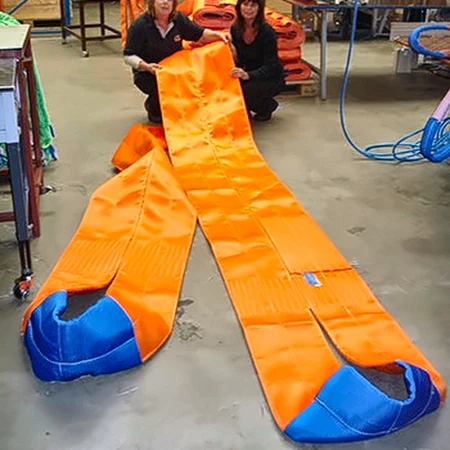
- Eyes. The eye is folded back, stitched through six rows and then sleeved, because at this figure the eye is where the strap meets a shackle that is harder than it is. The sleeve is a wear item: it is meant to be the part that dies first.
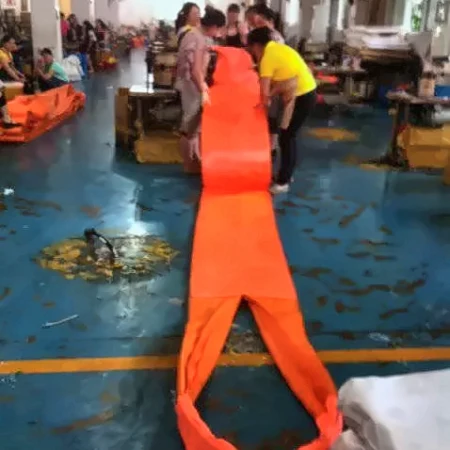
- Mass. A 70 t strap of any useful length is a two-person article. A 10 m strap is not something one rigger flips over a drawbar, and the length is part of the decision for that reason as much as for geometry.
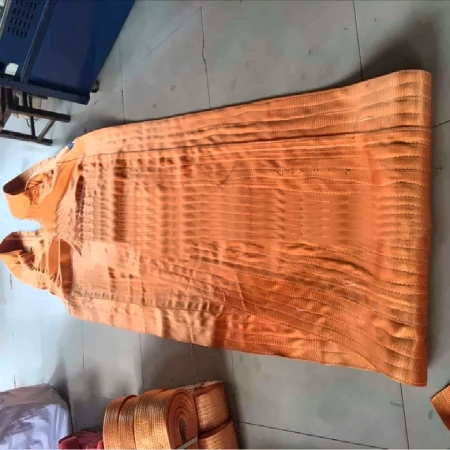
The weave carries a fine longitudinal rib. That rib is the line an inspector follows after a pull, because a strap that has been over a sharp edge shows it there first, and a strap that has been shock loaded shows it as a change in the weave rather than as a cut.
The eye, the shackle and the weakest link
On a 70 t pull the strap is rarely the part that fails first. The chain of load is strap → eye → shackle → anchor point, and it is only as strong as the least of those. Three things decide whether the strap gets to use its 70 t:
- The shackle has to be rated at or above the strap and its pin has to sit in the eye without a step. A bow shackle spreads the load across the eye; a Dee shackle concentrates it in the crown.
- The eye has to be long enough for the fitting. An eye that is short for a large bow loads the inner face and wears through the sleeve in a handful of pulls. Where this is a risk we build the heavy eye version with a longer, reinforced eye on the same web.
- The anchor point has to be a designed point. A strap rated 70 t attached to a fabricated lug of unknown capacity has moved the weakest link to the machine, where nobody can see it.
Where the strap will be dragged across steel edges, pipe ends, broken concrete or a lowbed’s lip, a sleeved steel pipe strap build or a full-length anti-abrasion cover is the answer rather than a thicker web: the wear is at the surface, and a surface layer is cheaper to replace than a strap.
Four jobs that look alike and are not
A tow strap gets bought for all four of the following, and the ratings do not transfer between them. Getting this wrong is the most common reason a strap fails while doing something nobody thought of as a lift.
| Duty | How the strap is loaded | The right article |
|---|---|---|
| Towing | Steady tension, both ends moving, load rolling or sliding. | A tow strap like this one, with the tension watched and the route planned. |
| Winching and pulling | Rising tension applied slowly by a machine, no shock if the winch is operated properly. | The same strap; the winch line and the anchor become the limits. |
| Restraint in transit | Continuous tension, vibration, fatigue, unattended for hours. | A cargo lashing or a ratchet tie-down strap — a lashing capacity, not a recovery rating. |
| Gbigbe | Vertical or angled load, a person underneath, a standing load. | A rated webbing sling with a WLL per hitch. Never a tow strap. |
Not a lifting strap. A tow strap has no working load limit per hitch, no mode factors, and no place in a lift plan. If the job is to raise something, use a sling rated for the hitch — the 60 ton webbing sling or any other in the range — and keep this strap on the ground.
Using a 70 t strap without hurting anyone
A strap that parts at 70 t is not a strap that parts quietly. The energy in the pull has to go somewhere, and the only question is whether it goes into the ground or into a person. Five rules cover it:
- Nobody in the line of pull. Not beside it, not behind the anchor, not leaning on the towed machine. The line is the whole length of the strap and ten metres beyond each end.
- A damper on the strap. A purpose-made damper, or a heavy blanket doubled over the strap near its middle. If the strap parts, the damper takes the energy out of the recoil.
- No knots, no doubled-up straps, no joining two shorts by their eyes and pulling at an angle. Every one of those derates the strap by an amount nobody can calculate on site.
- No shock loading beyond the factor. A 70 t strap on a 3:1 factor is a 23 t working load; a running snatch with a slack line can multiply the tension well beyond the steady figure in a fraction of a second.
- Inspect before every pull, and formally at the interval your site sets: cuts, snags, glazing from heat, abrasion through the weave, broken stitching at the eye, sleeves worn through to the web. Any of those retires it.
Where a 70 t strap is bought
- Mining and quarry plant — haul trucks, loaders and drills that bog or break down on grade
- Ports and terminals — straddle carriers, RTGs and trailers recovered from the apron
- Rail — rolling stock and wagons pulled back onto the rail or along a siding
- Oil, gas and petrochemical — skids and packaged plant dragged onto a lowbed or a jetty
- Heavy construction — excavators and piling rigs recovered from soft ground
- Wind and energy — nacelle and tower sections moved on site
In most of these the strap is not the only article on the job: a wire rope sling does the work where the environment is abrasive, a yika sling does the work where the strap has to go round a corner, and a cargo lifting net does the work where the load is a bundle rather than an object.
Length, and why it is a specification line
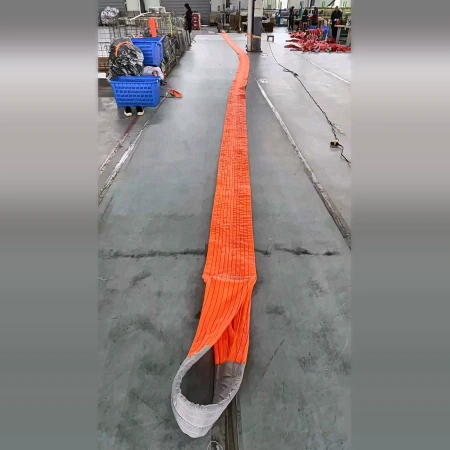
Length is not a convenience on a recovery strap. It sets how far the pulling machine can stand from the casualty, which sets whether the pull is straight, and on a polyester strap it sets how much stretch is in the system — about 3 % of the length at working load, so a 6 m strap gives you roughly 180 mm and a 20 m strap roughly 600 mm.
It also sets what the strap weighs and how it is handled. We build 3–30 m as standard and quote the mass per length on the drawing, because a strap that two people cannot lay out straight is a strap that gets dragged into position and wears out early.
What is printed on the strap, and what is tested
Every strap is proof loaded and inspected before it leaves the works, and the label goes on that individual article: minimum breaking strength, the working load at the factor supplied, length, fibre, manufacturer, serial and date. Where the job needs traceability, the strap travels with a test certificate quoting its serial so the piece on site can be tied back to the proof record.
Two things the label will not do. It will not turn the strap into lifting equipment, and it will not survive being painted over, taped over or worn illegible — and a strap whose label cannot be read is out of service, whatever the web looks like.
Sizing it in five answers
- What is being pulled, and how much does it weigh?
- What is doing the pulling — winch, second machine, or a running snatch — and what tension can it develop?
- What is on each end: shackle size, drawbar, designed lug, or a bare chassis member?
- What is between them: ground, edges, heat, chemicals, salt water?
- How far apart do the two ends have to be, and who is handling it?
Questions we are asked about the 70 t tow strap
Does 70 tonnes mean I can pull 70 tonnes?
No. 70 t is the minimum breaking strength. On the 3:1 recovery factor we quote, the working load is 23.3 t; the extra is there for the moment the load breaks free, not for a bigger machine.
Can it be used as a lifting sling?
No. A tow strap has no working load limit per hitch and no mode factors, so it cannot be rated for a lift. Use a sling rated for the hitch — the range is here.
Polyester or nylon for a snatch recovery?
Nylon, if the job is genuinely kinetic: the stretch is the mechanism. Polyester is the right answer for winching, towing and anchoring, where you want the pull to arrive without stored energy. Say which at the enquiry.
What stretches more, and by how much?
At working load, polyester is in the region of 3 % and nylon 8–10 %. On a 10 m strap that is roughly 0.3 m against a metre — enough to change how a recovery feels, and enough to change what happens if the strap parts.
How long will it last?
The environment decides. Dragged over concrete and grit, a strap is measured in pulls; kept off the ground and stored coiled and dry, it gives years. Inspect for condition rather than age.
Can you supply it with the shackles?
Yes, as a matched set with the fittings rated at or above the strap, supplied with the set’s own marking. Send the anchor detail at each end and we will size the whole chain rather than the strap alone.
Related: flat webbing slings · WLL 60 ton polyester webbing slings · heavy eye webbing sling · heavy duty eye & eye flat web sling · heavy duty endless lifting web slings · cargo lashing · ratchet tie-down straps · wire rope slings · yika slings · cargo lifting nets
Send the pull, not the tonnage
Tell us what is being recovered, what is pulling it, what is on each end and how far apart they have to be, and we will confirm the factor, the width, the eye, the sleeve and the length — on a drawing, before the strap is woven.
Lift Sling Rigging Co., Ltd · Lifting & rigging division of China Lifute Sling Group
Tẹli / WeChat +86 180 6600 2268 · 702461526@qq.com
Lifute Industrial Park, Taizhou City, Jiangsu Province, China · HS code 630790
Breaking strength and working load are quoted for the standard polyester build. Recovery straps are not lifting equipment and are not marked with a WLL per hitch; the label on the article always governs its use.