

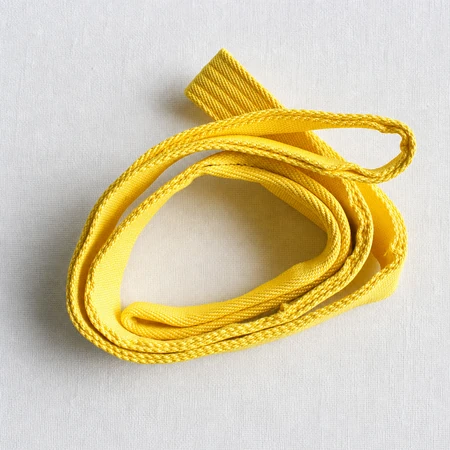
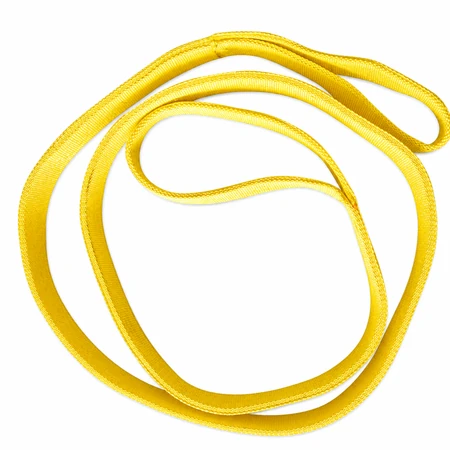
Lift sling rigging company produce Aramid Webbing Sling,Kevlar Webbing Sling,Aramid flat web sling.
Aramid Webbing Sling
Kevlar-Class Flat Woven Webbing — Low Stretch, Cut Resistant, Ko si Ojuami Iyọ
An aramid webbing sling is a flat woven sling whose band is woven from aramid fibre — the Kevlar-class high-modulus polymer also called Aramid 1414 — instead of polyester. What that fibre buys you is not one property but four, and they are usually bought for different reasons. Aramid has ko si yo ojuami at all: it chars and breaks down rather than liquefying, so there is no molten drip and no softening phase. It has the highest cut resistance of any common lifting fibre. O jẹ dimensionally idurosinsin, holding a load without creeping. And it stretches very little, so the load stays where it was set down. The same band that survives a hot workpiece also holds a sustained load, resists a sharp edge and refuses to drip molten polymer when it finally fails.
- Ko si aaye yo — chars instead of melting, so no molten drip hazard
- Best-in-class cut resistance among the common lifting fibres
- Very low stretch and very low creep — it holds what it is given
- Lighter than a polyester band at the same working load limit
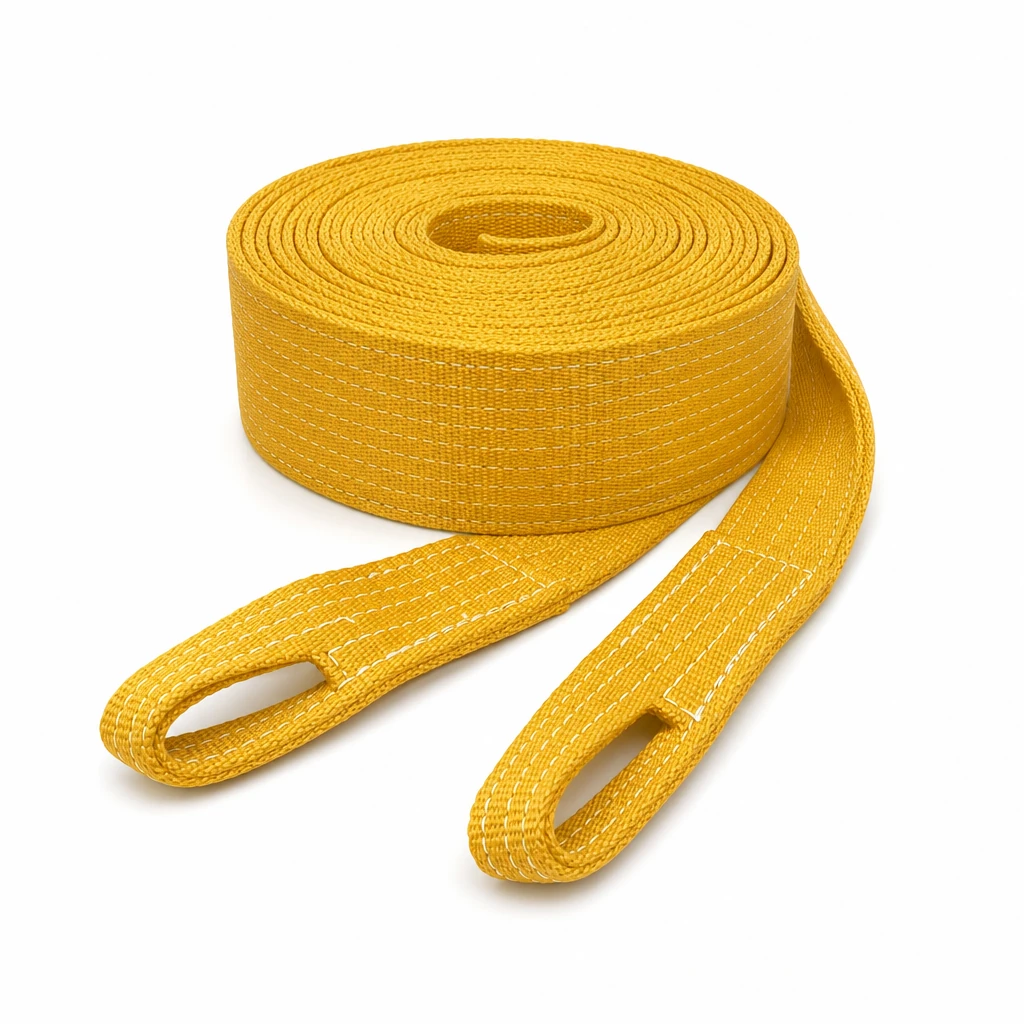
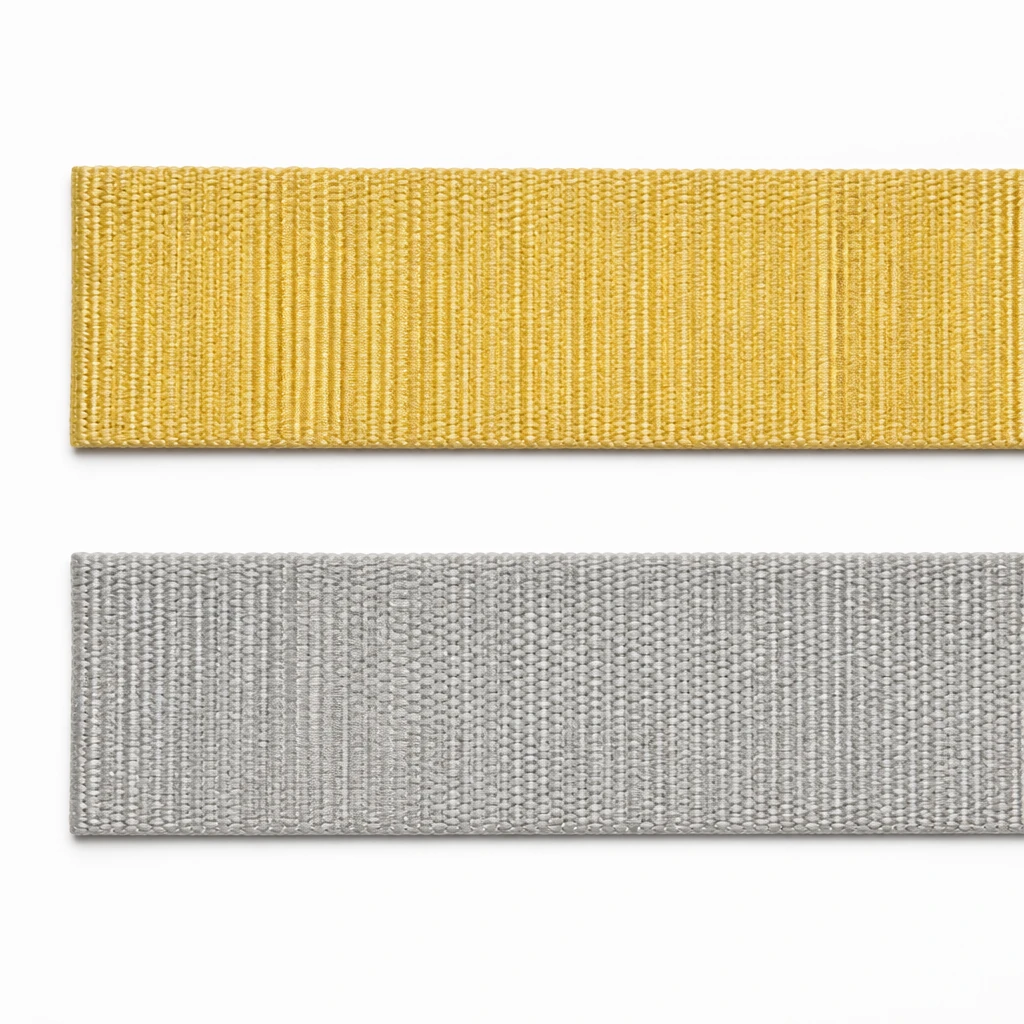
Key Awọn ẹya ara ẹrọ
Ko si Ojuami Iyọ
Aramid kii yo. O tọju eto rẹ titi yoo fi ṣaja ati ki o bajẹ, so there is no softening phase, no molten polymer and no burning drip — a real consideration in confined spaces, tunnels, rail and stage work.
Highest Cut Resistance
Against a sharp edge or a blade, aramid is the strongest of the common lifting fibres. Where an edge is the risk rather than a rubbing surface, it is the safest band to specify.
Dimensionally Stable
Aramid holds a sustained load without creeping. Where a sling has to stay at a set length under a standing load, it is the fibre that behaves — unlike UHMWPE, which creeps under long static load.
Very Low Stretch
The band barely extends under load, so the load stays exactly where it was set down and the sling does not hunt across the bearing surface while you land it.
Light for Its Strength
Aramid is stronger per unit weight than polyester or nylon, so a lighter band does the same job, which tells on a high capacity sling that has to be carried and rigged by hand.
Does Not Absorb Water
Aramid takes up almost no water and does not rot. It will not swell, stiffen or lose strength simply because it got wet.
Aramid Compared with the Other Lifting Fibres
Aramid is not simply “better” than polyester, nylon or UHMWPE. It is better at some things and clearly worse at others, and the honest choice depends on which of those things your lift actually depends on.
| Ohun ini | Polyester | Ọra (polyamide) | Aramid (Kevlar-kilasi) | Dyneema (UHMWPE) |
|---|---|---|---|---|
| Strength for its weight | O dara | O dara | O ga pupọ | Ti o ga julọ |
| Na labẹ fifuye | Déde | High — the stretchy one | O kere pupọ | O kere pupọ |
| Creep under sustained load | Kekere | Kekere | Pupọ kekere - di gigun rẹ | Ti o ga julọ - yoo rarako |
| Ge resistance | O dara | OK | O tayọ | Talaka |
| Abrasion resistance | O dara | O dara | Poor — needs a sleeve or jacket | O dara |
| Flex fatigue (repeated bending) | O dara | O tayọ | Talaka | Talaka |
| Ojuami yo | Isunmọ. 255 °C | Isunmọ. 215–265 °C | None — chars instead | Isunmọ. 145 °C — the lowest |
| UV resistance | O tayọ | O dara | Poor — discolours and degrades | O dara |
| Fofofo | Rara | Rara | Rara | Bẹẹni |
| Gbigba omi | Kekere | Higher — swells | O kere pupọ | O kere pupọ |
| Yan fun | General purpose lifting — the value choice | Shock-absorbing and dynamic applications | Sustained loads, edge risk, ooru, no melt-drip | Lowest weight and wet or marine work |
Cut Resistance Is Not Abrasion Resistance
This is the single most misunderstood thing about aramid, and it decides how you rig with it.
Ge resistance is resistance to a blade or a sharp edge severing the band — a local, high-stress event. Aramid is excellent at it: it is the fibre used in cut-resistant gloves and protective clothing for exactly this reason.
Abrasion resistance is resistance to surface wear from rubbing and sliding — a spread-out, repeated event. Aramid is poor at it. It is why aramid cordage is almost always jacketed or sleeved, and it is the reason aramid performs worst of the common fibres when a sling is dragged across concrete or a rough steel surface.
The practical rule follows directly: an aramid sling on a sharp edge is a good choice; an aramid sling dragged over a rough floor is a bad one. If your lift puts the band against a sharp edge, aramid is exactly right. If it puts the band against a rough abrasive surface, either protect it with a woven sleeve or specify a fibre that tolerates abrasion better.
Where an Aramid Sling Is Chosen
Heat is the best-known reason to buy aramid, but it is not the only one — and for many customers it is not even the main one. These are the applications where aramid is specified on its other merits.
- Sustained or standing loads — aramid holds its length without creeping, so it suits a sling that stays loaded for hours or days rather than for one lift.
- Edge and cut risk — the highest cut resistance of the common fibres, for loads with sharp or sheared edges.
- No molten drip — where a melting fibre would be a hazard in its own right: confined spaces, tunnels, rail work and stage work above people.
- Low-stretch rigging where precision matters — the load stays where it was set, with no stretch to take up and no elastic recovery to absorb.
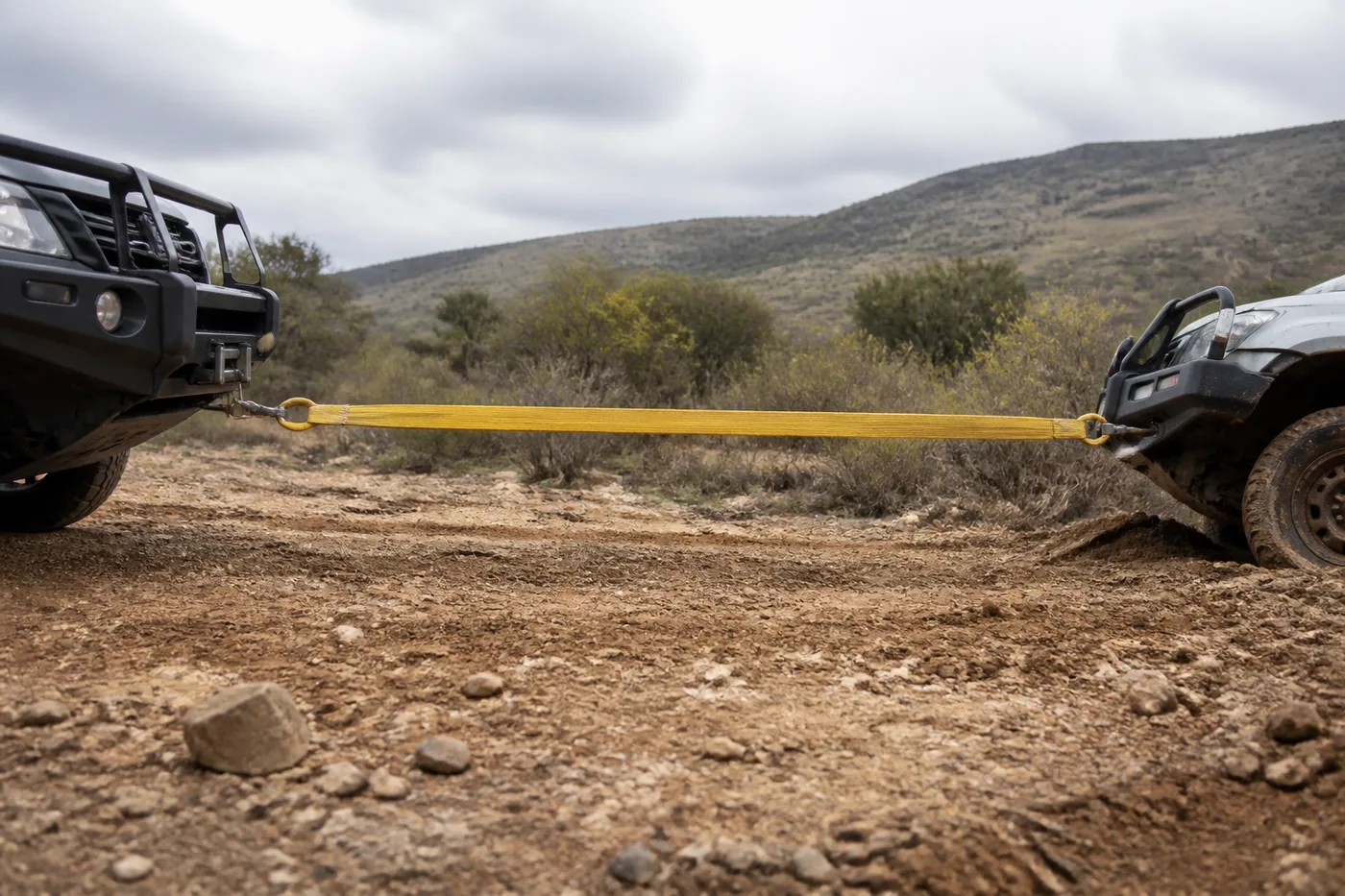
- Low-energy recovery and pulling — a low-stretch strop stores far less energy than a nylon one, which is why aramid is used for vehicle recovery strops rather than kinetic ropes.
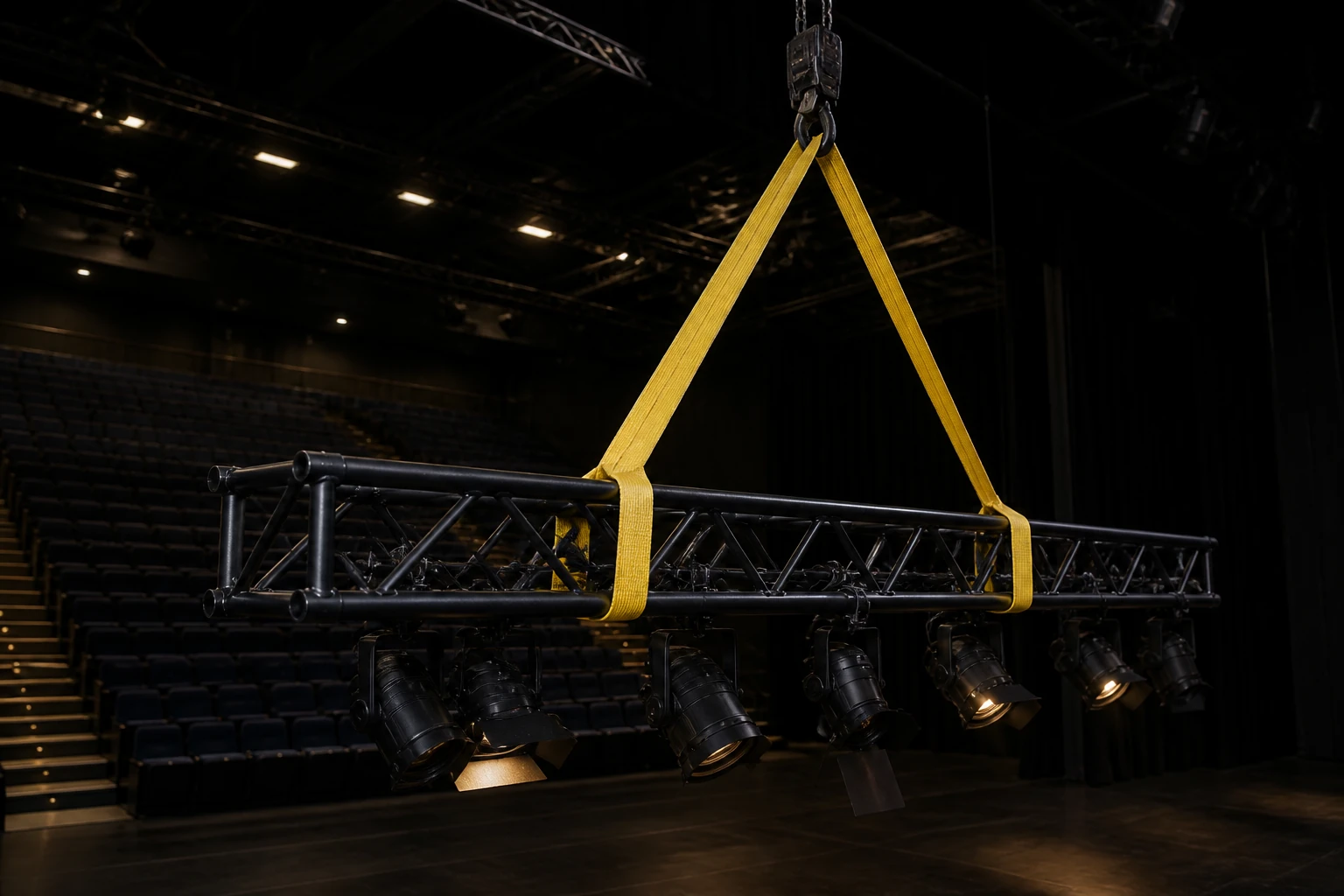
- Ipele, theatre and entertainment rigging — the classic aramid application: imole, kekere na, and it does not drip molten polymer above an audience.
- Iṣẹ gbona — the heat case, covered in detail on our ga otutu webbing sling oju-iwe.
Imọ ni pato
| Orukọ ọja | Aramid webbing sling / Kevlar webbing sling / aramid flat webbing sling / Aramid 1414 webbing sling |
|---|---|
| Load-bearing material | Aramid (Kevlar-kilasi / Aramid 1414) high-modulus fibre, woven into flat webbing |
| Ikole | Flat woven webbing in eye-and-eye or endless form; single-ply or multi-ply |
| Band iwọn | 25 mm si 300 mm as standard, matched to the working load limit and the ply construction |
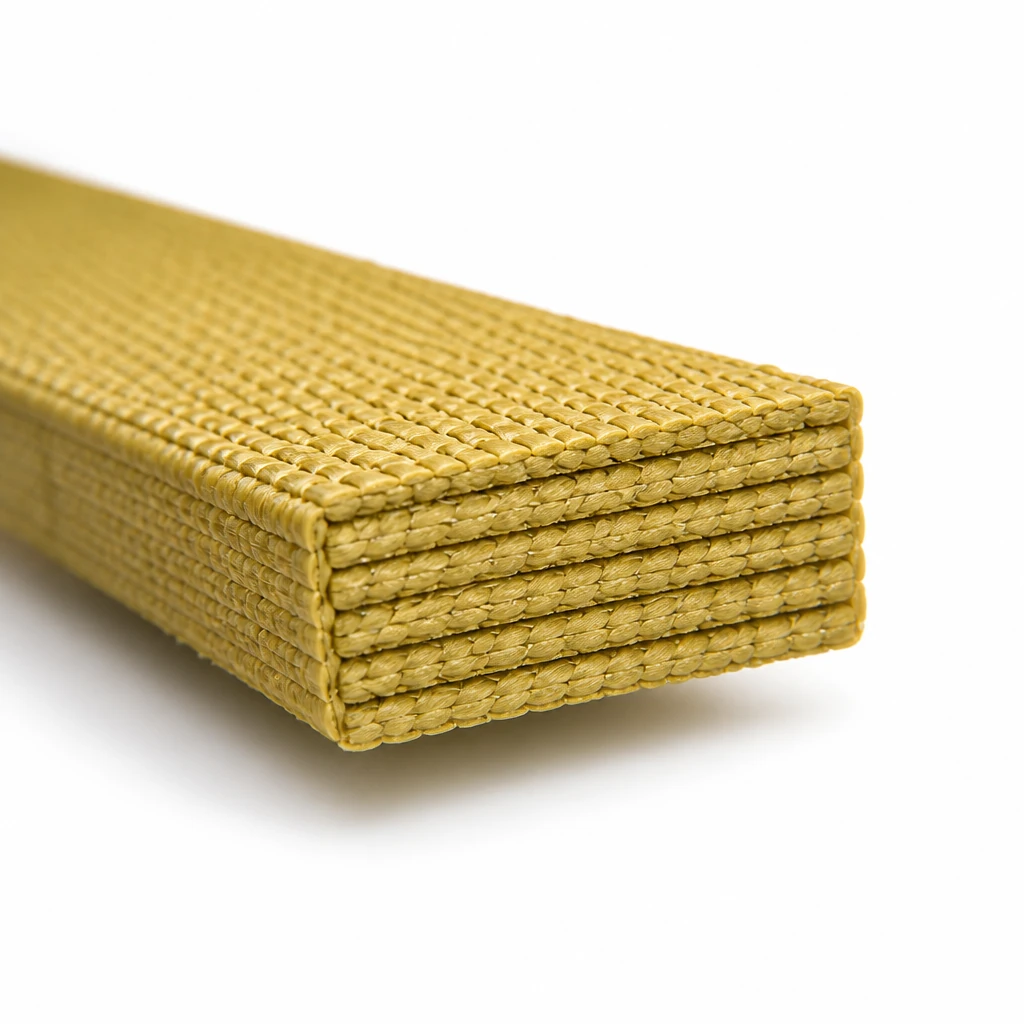
| Band sisanra | Set by the ply construction; several woven layers may be stacked to reach a capacity in a narrow band |
| Iwọn fifuye ṣiṣẹ | 1 t lati 100 t, ni boṣewa awọn igbesẹ ti 1 · 2 · 3 · 4 · 5 · 6 · 8 · 10 · 12 · 15 · 20 · 25 · 30 · 40 · 50 · 100 t |
| Ailewu ifosiwewe | IN 1492-1 iwa ni 7:1 for general-purpose flat woven webbing slings; other factors produced to order |
| Munadoko ṣiṣẹ ipari | 0.5 m si 20 m bi bošewa; gun lati paṣẹ |
| Ilọsiwaju | Gidigidi kekere na - to 3-4 % ni isinmi, far less than polyester or nylon under the same load |
| Nrakò | Very low — aramid holds its length under sustained static load |
| Ojuami yo | Ko si - aramid chars ati decomposes dipo yo, ni ayika 500 °C |
| Protective options | Woven sleeves, edge protectors and jacketing for abrasion and heat; strongly recommended wherever the band rubs a rough surface |
| Àwọ̀ | Natural golden yellow of the aramid fibre, with the capacity stripe or edge colour as required |
| Siṣamisi | Sewn aami pẹlu ṣiṣẹ fifuye iye to, ipari ati ipele; printed band marking optional |
| Iṣakojọpọ | Ikun ninu apo poli tabi apo gbigbe, ike paali, aṣa okeere packing |
| MOQ & OEM | MOQ kekere fun awọn aṣẹ idanwo; OEM ni kikun - agbara, igboro, ply, ipari, awọ, sleeve and marking |
Mimu, Ayewo ati Idiwọn
Aramid is a high-performance fibre, not a tougher version of polyester, and it has three specific weaknesses that a buyer should know before the first lift.
- It hates abrasion. Surface wear from rubbing is the fastest way to lose an aramid band. Use a woven sleeve or an edge protector wherever the sling meets a rough or abrasive surface, and never drag a loaded aramid sling across concrete or rough steel.
- It hates repeated bending. Aramid has poor flex fatigue, so avoid rigging that forces the band to bend sharply and repeatedly over the same small radius — including over a thin shackle pin or a tight hook eye.
- It hates UV. Sunlight degrades aramid and turns it from bright golden yellow to a dull, brittle brown. Store it out of the sun, and treat discolouration from sunlight as damage rather than as fading.
- It is affected by strong chemicals. Keep aramid away from strong acids and alkalis, and confirm chemical compatibility before using it where process chemicals are present.
- Inspect the whole band before every use - gige, gbigbẹ, a dull or brownish colour, rilara lile tabi brittle, glazing, and any damage at the eyes or the stitching.
- Protect the eyes — the eye and its stitching are usually the first thing to go, so reinforced eyes and wear pads are worth ordering where the sling will see hard service.
- Ṣe igbasilẹ rẹ — keep the batch marking and a log of use and exposure. For an aramid sling, the combination of UV hours and abrasion is the best retirement guide you can keep.
Awọn ohun elo
- Ipele, itage ati Idanilaraya rigging - trusses, ina ifi ati daduro iwoye loke awọn eniyan
- Vehicle recovery strops and low-energy pulling, where a stretchy nylon strop would store energy
- Sustained and standing loads, where the sling holds a set length without creeping
- Loads with sharp or sheared edges, where cut resistance is the deciding property
- Confined spaces, tunnels and rail work, where a molten drip from a melting fibre would be a hazard in itself
- Hot work — steel mills, awọn ipilẹ, die casting, glass and welding, with a sleeve where the contact is hot
- Lifts where the band has to be light enough to carry up and rig by hand
- Any lift where a polyester sling has been refused because of heat, edges or a molten-drip risk
Isọdi ati OEM Service
Aramid slings are built to the line rather than picked from a shelf, because the fibre, the ply construction and the protection all have to match the job. So fun wa eru, ayika, what the band will touch and whether the load will be standing or momentary, and we will size the band and the protection to suit.
- Agbara - 1 t lati 100 t, pẹlu awọn igbesẹ agbedemeji laarin awọn iwọn boṣewa
- Band and plies - 25 mm si 300 mm, single-ply or multi-ply, sized around your lifting point as well as your load
- Ipari — eye-and-eye or endless, plain or reinforced eyes, with wear pads where the sling will see hard service
- Idaabobo — woven sleeves and edge protectors for abrasion, and heat resistant sleeves for hot contact
- Gigun ati siṣamisi — effective working length to order; your label layout, language and marking convention
- Made-up items — recovery strops, stage slings and special assemblies built to your drawing
Iṣakoso didara
Every band is checked for width, sisanra, weave density, ply count and colour before the eyes are closed, and every finished sling is checked on its stitching, its working load limit marking, its overall length and its label before packing. A ti ṣelọpọ slings, webbing ati okun awọn ọja fun ise, ailewu ati okeere onibara fun sunmo si meta ewadun, ati pe a jẹ ki ilana naa han: lori ìbéèrè a ipese okun ijẹrisi, awọn isiro idanwo ipele ati sling apẹẹrẹ fun ọ lati mu ati idanwo ṣaaju iṣelọpọ iwọn didun bẹrẹ.
Awọn ibeere Nigbagbogbo
What is an aramid webbing sling?
A flat woven lifting sling whose band is woven from aramid fibre — the Kevlar-class high-modulus polymer also called Aramid 1414 — instead of polyester. The webbing itself carries the load, and the whole working length is visible for inspection.
Why choose aramid rather than polyester?
For one or more of four reasons: heat tolerance, because aramid has no melting point; ge resistance, where aramid is the best of the common fibres; dimensional stability, because aramid holds a sustained load without creeping; and very low stretch, where the load must stay exactly where it was set. If none of those matter for your lift, polyester is cheaper and more abrasion-resistant, and it is the better buy.
Aramid or Dyneema — which should I choose?
Choose aramid for sustained loads (it does not creep), for edge and cut risk, for heat, and where a molten drip would be a hazard. Choose Dyneema where the absolute lightest rigging matters, where the environment is wet or marine, and where the load is momentary rather than standing — remembering that UHMWPE creeps under prolonged static load and has poor cut resistance. Neither is universally better; the loads you actually have decide it.
Is aramid abrasion-resistant?
No — and this is the most common misunderstanding. Aramid has excellent ge resistance but poor abrasion resistance. It resists a blade far better than polyester does, but it wears away faster than polyester when it is rubbed against a rough surface. That is why aramid slings should be sleeved or protected wherever the band rubs, and why you should never drag a loaded aramid sling across concrete.
What are the main limitations?
Mẹta. Abrasion — it needs a sleeve or protector against rough surfaces. Flex fatigue — it does not tolerate repeated bending over a small radius. And UV — sunlight degrades aramid and turns it from bright golden yellow to a dull, brittle brown, so it must be stored out of the sun. Aramid is also affected by strong acids and alkalis.
Can you supply custom capacities, ply constructions, protection and OEM labelling?
Bẹẹni. A kọ lati 1 t lati 100 t pẹlu agbedemeji awọn igbesẹ, in single-ply or multi-ply construction from 25 mm si 300 mm jakejado, in any effective working length from 0.5 m up, with woven sleeves, edge protectors and heat resistant sleeves as required, and with your own label layout, language and marking convention.
Request a Quote for Aramid Webbing Slings
Fi agbara ranṣẹ si wa, whether the load is momentary or standing, what the band will touch, the environment and the length you need — plus any marking or certification your market requires. We will come back with the fibre, ẹgbẹ, ply and protection for your job, plus a sample to test.