

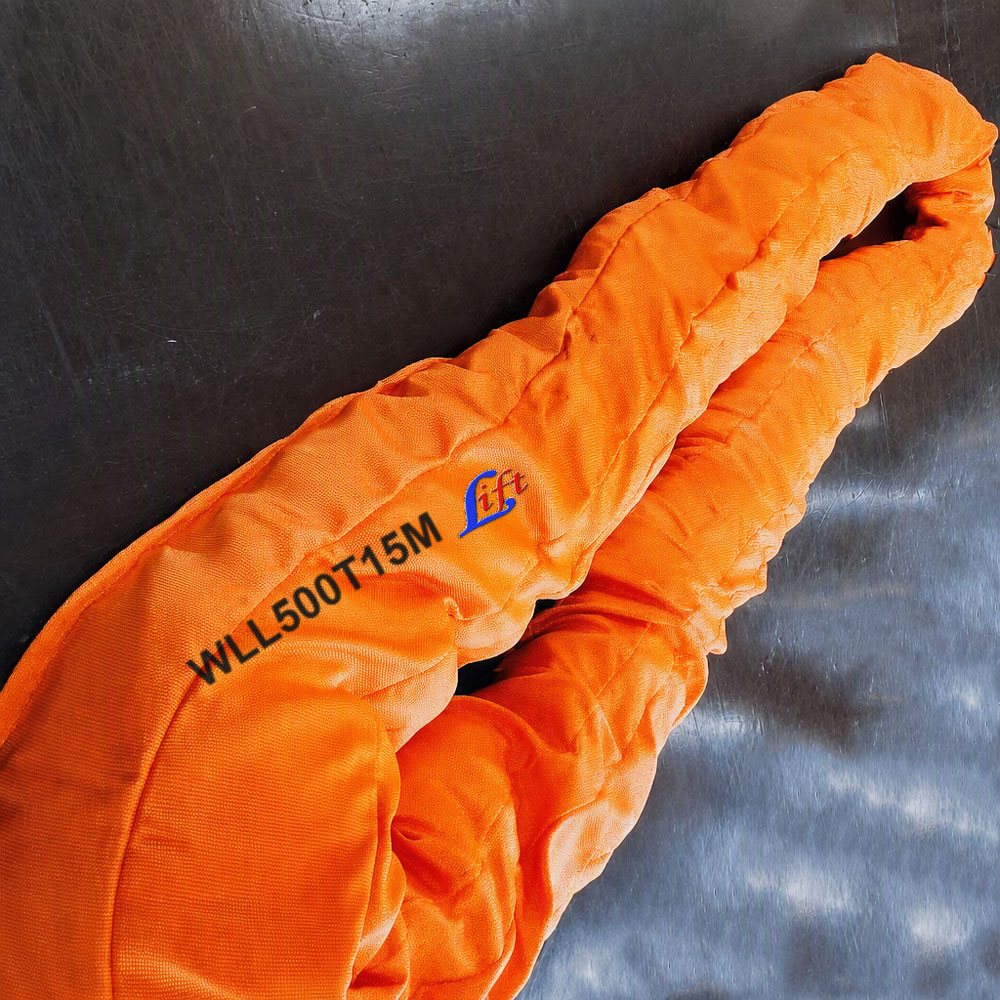
Lift sling rigging company manufacture Double Sleeve Heavy Duty Round Soft Lifting Sling,Double Sleeve Polyester Endless Round Sling for Lifting,Double Sleeve High Load Capacity Polyester Round Sling,Double Sleeve Polyester Endless Round Sling.
Inner sleeve + outer sleeve · 10–1000 tonne
Double Sleeve Heavy Duty Round Soft Lifting Sling
A double sleeve heavy duty round soft lifting sling puts two woven layers between the load and the core. The inner sleeve holds the polyester bundle and keeps grit out of it; the outer sleeve takes everything the lift does to the sling — the concrete edge, the rebar, the drag across the floor.
When the outer layer wears through you are still looking at an intact inner sleeve and an untouched core. That is the whole proposition, and it is worth being precise about, because a second sleeve is often sold as if it raised the capacity. It does not. It buys service life and contact protection.
Two Sleeves, Two Jobs
The core of a round sling is a parallel bundle of polyester filament. It carries load well and tolerates almost nothing else: grit works its way between filaments, UV degrades the outer fibres, and a single cut strand concentrates stress on its neighbours. The inner sleeve exists to keep those things away from it.
The outer sleeve is a separate woven tube over the first. It meets the load, the floor, the stillage and the truck bed. It is also where the label sits, so the identification travels with the sling rather than with a tag that can be cut off.
That division matters in service. Wear is progressive and visible on the outside; the core is protected by two layers instead of one. On a single sleeve sling, a worn patch is a step away from the core. Here it is a step away from the inner sleeve, which is a different decision at inspection.
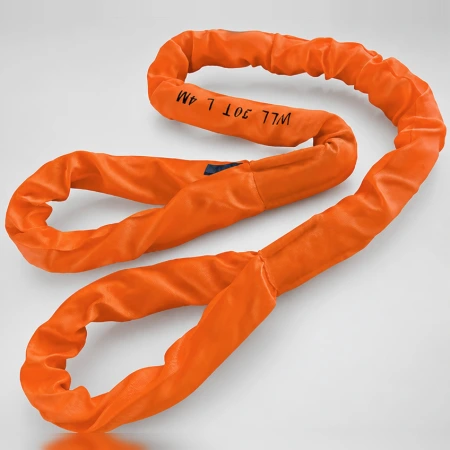
What the Second Sleeve Does Not Do
Three claims worth correcting before you buy
- It does not raise the working load limit. The rating comes from the core and the 7:1 factor. A 100 t double sleeve sling lifts 100 t, exactly like a single sleeve 100 t sling.
- It does not replace edge protection. Two layers of woven polyester will still be cut by a sheared plate or a burred edge. On those loads you need a protector, a softener or a different rigging arrangement.
- It does not add heat resistance. Both sleeves are polyester. The service ceiling stays around 100 °C; above that the lift belongs to a heat-rated construction.
What it does do is extend the interval between the sling entering service and the sling being retired for a worn cover — which, on an abrasive site, is the number that decides cost per lift.
Why It Is Called a Soft Sling
Soft refers to the contact, not to the strength. There is no chain, no wire rope, no hook and no ferrule anywhere in the load path — the sling meets the load as fabric. On painted fabrications, polished shafts, coated pipe and machined castings, that is the difference between a lift and a rework.
The body also conforms. A round sling wraps a curved surface over its full width instead of bearing on two points, so the contact pressure is spread and the load is less likely to be marked or dented. It is quieter, it does not spark, and if it swings into the load it does not damage it.
The same softness is a limitation: fabric will not protect itself from a sharp edge, and it will pick up oil, grit and concrete dust. A double sleeve helps here too — the contaminated layer is the one that gets retired, not the load-bearing one.
Soft contact is also why these slings are specified for rental fleets and for precast yards, where the same sling meets a different surface on every lift.
Specification Range
| Ọja | Double sleeve heavy duty round soft lifting sling, endless |
|---|---|
| Core | High-tenacity polyester (PES) multifilament, parallel lay, waxed |
| Sleeve | Inner woven sleeve plus separate outer wear sleeve, both polyester; label on the outer sleeve |
| Working load limit | 10–500 t: 10 · 20 · 30 · 50 · 80 · 100 · 150 · 200 · 250 · 300 · 400 · 500 t · 550t · 600t · 800t· 1000t |
| Safety factor | 7:1 as standard; other factors to order |
| Standard | EN 1492-2 and ASME B30.9 construction practice |
| Elongation at WLL | Approx. 2–3% |
| Service temperature | −40 °C to +100 °C |
| Length | 1–30 m effective working length; longer bodies quoted individually |
| Colour | Orange as standard; other colours to order |
| Marking | Sewn label on the outer sleeve: WLL, length, serial, standard, date |
| Testing | Proof loaded per batch before dispatch; certificate against the serial number |
| Packing | Coil in poly bag; crate or pallet from 150 t |
| MOQ & OEM | Low MOQ for trial; OEM on capacity, length, sleeve colour, label and packing |
Capacity, and Where the Method Lives
The label figure is the vertical, single-leg rating. Choked and basket arrangements are derived from it, and at 500 t the multipliers are worth hundreds of tonnes.
| WLL | Choked ×0.8 | Basket 0–7° ×2.0 | Basket 45–60° ×1.0 |
|---|---|---|---|
| 50 t | 40 t | 100 t | 50 t |
| 100 t | 80 t | 200 t | 100 t |
| 200 t | 160 t | 400 t | 200 t |
| 300 t | 240 t | 600 t | 300 t |
| 400 t | 320 t | 800 t | 400 t |
| 500 t | 400 t | 1,000 t | 500 t |
The full mode-factor table, including the 7–45° basket and the four-leg caveat, is on the heavy duty round sling page — it applies identically here, because the sleeve does not change the rating.
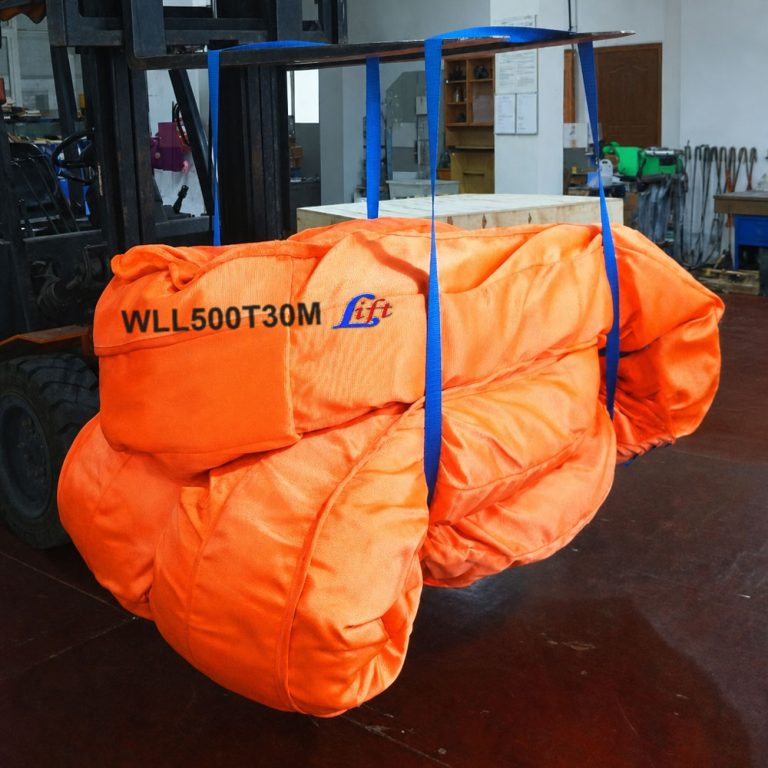
Where the Double Sleeve Pays for Itself
It is the wrong choice on a clean, light, indoor lift where a standard sleeve will outlive the inspection cycle anyway. It earns its cost in five situations:
- Precast and concrete. Abrasive surfaces, release agent and site grit. The outer sleeve absorbs all three.
- Rebar and mesh bundles. Not sharp enough to cut through, abrasive enough to wear a single sleeve thin in months.
- Castings and cast-iron parts. Sand, scale and burred edges on every lift.
- Fabrication and shipyards. Dragging across steel, concrete and the yard itself; the body is rarely lifted cleanly.
- Rental fleets and shared cranes. Unknown surfaces, unknown operators, no control over how the sling is stored. The extra layer is cheaper than the inspection failures.
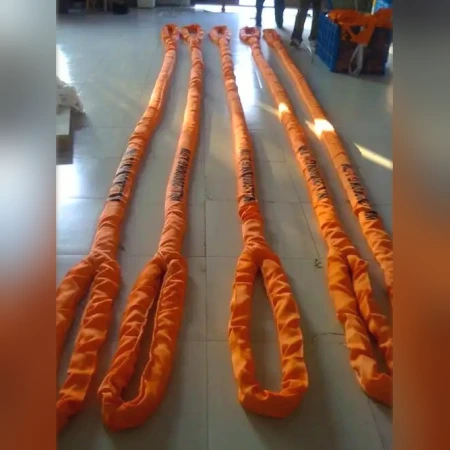
Inspection: Read the Two Layers Separately
- Outer sleeve. Cuts, holes, glazing, compaction and contamination. This is the wear layer, and it is expected to show use — the question is whether it still covers the inner sleeve along the full bearing length.
- Inner sleeve. Any exposure of the inner layer means the outer has failed at that point. Inspect the inner for damage before the sling returns to service.
- Core. Where a view is possible, a dull or brownish cast, or a bundle that has shifted, is damage. Polyester does not fade; it degrades.
- Label and serial. The label sits on the outer sleeve. If it cannot be read, the certificate cannot be matched and the sling cannot be verified.
- Contamination. Oil, concrete dust and grit work into the weave. Clean and dry before storage; store coiled, off the floor, out of sunlight.
Retire on the wear layer, not on the calendar. A double sleeve sling that has been dragged across a precast yard for a year is a different proposition from one that has lifted painted fabrications indoors.
Frequently Asked Questions
Does a double sleeve increase the working load limit?
No. The working load limit is set by the core and the 7:1 factor, not by the sleeve. A 100 t double sleeve sling and a 100 t single sleeve sling carry the same 100 t vertically. The second sleeve buys wear life and contact protection, and it is priced as such.
What is the difference between a double sleeve and a wear pad?
A wear pad is a local reinforcement added where one lift repeatedly bears on an edge. A double sleeve covers the full circumference and the full length, so protection travels with the sling wherever it is rigged. Pads are the cheaper answer to one known edge; a double sleeve is the answer to unknown or changing contact.
Will it mark painted or machined surfaces?
The contact surface is woven polyester, with no metal fittings anywhere in the load path, so it will not scratch or dent a finished surface the way chain or wire rope can. It can still leave a light scuff on soft paint under a heavy load, and it transfers whatever grit is on the floor to the load, so keep the sleeve clean.
What capacity and length can you supply?
From 10 t to 500 t, with 500 t bodies built to order and proof loaded before dispatch. Standard lengths run from 1 m to 30 m effective working length; longer bodies are quoted individually because the body weight and handling change the rigging method.
Can the double sleeve be used on hot loads?
Both sleeves and the core are polyester, with a service ceiling around 100 °C. Above that the lift moves to a heat-rated construction: the para-aramid heavy duty round sling for 300 °C continuous contact, or a high-temperature round sling where the heat is radiant and the load is lighter.
Tell Us the Surface, Not Just the Load
What the sling meets decides whether the second sleeve is worth paying for. Send the load, the surface, the length and the lift frequency — we will confirm the construction and the wear layer before quoting.
Related Products