

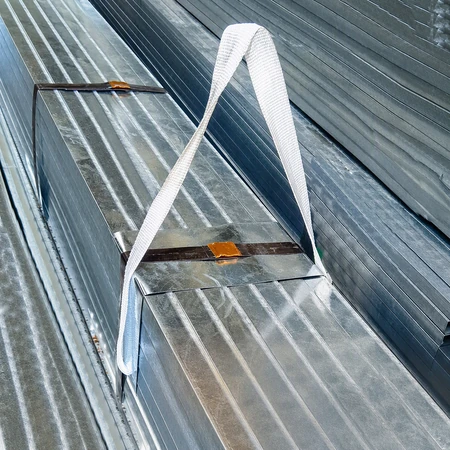
Lift sling rigging company produce One Way Endless Lifting Slings Single Eye For Lifting Steel Pipe And Tubing OEM Avaliable.
One Way Endless Lifting Slings, Oju Nikan, for Lifting Steel Pipe and Tubing — OEM Available
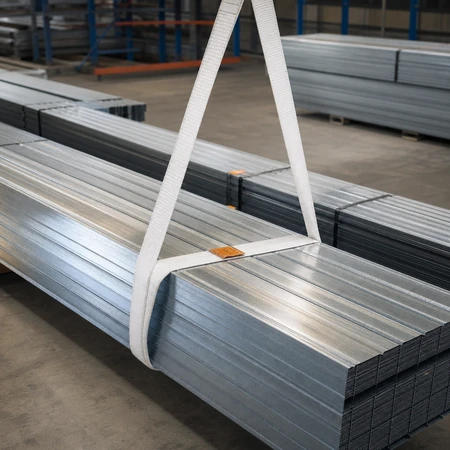
A one way endless lifting sling with a single eye is a flat woven polyester band closed into one stitched eye at one end, with the other end finished plain. The tail passes round the pipe or tube and back through the eye, so the noose closes on the load as the hook takes up. O ti wa ni ra fun ọkan irin ajo: it travels with the consignment, it is not recovered, and it is written off against the job.
Ailopin describes the shape — the band is joined to itself, and the single eye is the only formed end on the article. Ona kan describes the commercial life. Neither word is a grade: okun, wewewe, awọn iwọn, the factor and the working load limit are specified exactly as on a sling that will be used for years, ati awọn isiro tejede lori iye ni o wa isiro ti o waye lati gbe.
Why a single eye is the right end on pipe and tube
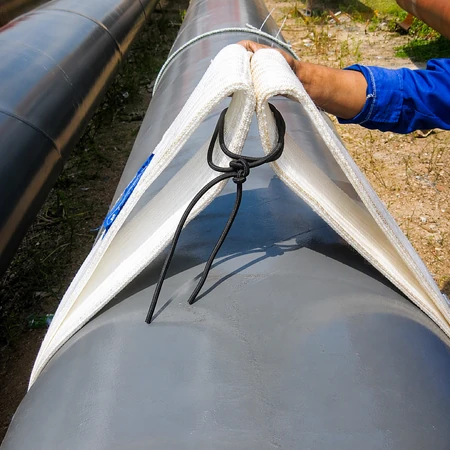
Two eyes make a vertical or a basket sling. One eye makes a choker, and a choker is what a round section usually wants: the noose grips the pipe wherever the band happens to sit, so the pick does not have to be measured against a machined end, a weld or a coating that must not be touched.
- The grip tightens with the load. The tail runs through the eye and the band closes on the tube as the hook takes up, so a bundle that settles on the journey is still held at the next lift.
- Ko si ohun ti irin fọwọkan paipu. There is no hook, ring or buckle anywhere on the article — the eye is the band folded back and stitched — so galvanised, painted and coated surfaces are not bruised by hardware.
- One length covers several diameters. A choker is sized from the girth it wraps rather than from a fixed eye-to-eye distance, which is why one band can serve a pipe size change at the far end of a consignment.
- The tail is the limit. The plain end has to be long enough to pass through the eye and hang clear of the hook; a tail cut to the pick saves weight and a tangle at the hook.
Awọn pato
Every line below is fixed on the order. The band is woven, the eye is stitched and the figures are printed after the width, the factor and the length are agreed, because the working load limit applies to the finished sling and not to the roll.
| Ọja | One way endless lifting sling, oju kan / single-trip pipe sling |
|---|---|
| Webbing | Alapin hun ga-tenacity poliesita, 25-300 mm jakejado, 4 mm tabi 7.5 mm nipọn |
| Iwọn fifuye ṣiṣẹ | 1 t – 24 t, ṣe lati paṣẹ |
| Ailewu ifosiwewe | 5:1 / 6:1 / 7:1, stated on the order — the factor sets the width for a given tonnage |
| Ipari | One formed (didi) eye at one end; plain finished tail at the other |
| Hitch | Choker — tail through the eye, noose closes on the pipe as the lift takes up |
| Gigun | 0.5 m – 100 m, cut to the pick; minimum length rises with band width |
| Siṣamisi | WLL, length and your reference printed on the band |
| Àwọ̀ | To order — one colour per pipe size, customer or tonnage; BS EN 1492-1 capacity colour on request |
| Iṣakojọpọ | Coiled ati aami, banded bale, paali, or packed with the product |
| Igbesi aye iṣẹ | One journey — not recovered, ko tun jade |
| HS koodu | 630790 |
Titobi: width follows the figure and the factor
Iwọn band kii ṣe yiyan ọfẹ. It follows from the working load limit and from the factor, which is why the same tonnage appears at two widths below. A 7:1 band is wider than a 5:1 band ti kanna olusin; ti o jẹ iye owo ti afikun ifosiwewe, ko kan yatọ si ite ti webbing.
| WLL | Iwọn ni 5:1 | Iwọn ni 7:1 | Min. ipari | kg/m ni 5:1 |
|---|---|---|---|---|
| 1 t | 25 mm | 30 mm | 0.5 m | 0.16 |
| 2 t | 50 mm | 60 mm | 1.0 m | 0.35 |
| 3 t | 75 mm | 90 mm | 1.0 m | 0.52 |
| 4 t | 100 mm | 120 mm | 1.5 m | 0.80 |
| 5 t | 125 mm | 150 mm | 1.5 m | 0.85 |
| 6 t | 150 mm | 180 mm | 1.5 m | 0.96 |
| 8 t | 200 mm | 240 mm | 2.0 m | 1.34 |
| 10 t | 250 mm | 300 mm | 2.0 m | 1.64 |
| 12 t | 300 mm | 300 mm | 2.0 m | 1.86 |
| WLL | Iwọn ni 5:1 | Iwọn ni 7:1 | Min. ipari | kg/m ni 5:1 |
|---|---|---|---|---|
| 2 t | 25 mm | 30 mm | 0.5 m | 0.38 |
| 4 t | 50 mm | 60 mm | 1.0 m | 0.68 |
| 6 t | 75 mm | 90 mm | 1.0 m | 1.28 |
| 8 t | 100 mm | 120 mm | 1.5 m | 1.61 |
| 10 t | 125 mm | 150 mm | 1.5 m | 2.04 |
| 12 t | 150 mm | 180 mm | 1.5 m | 2.32 |
| 16 t | 200 mm | 240 mm | 2.0 m | 3.30 |
| 20 t | 250 mm | 300 mm | 2.0 m | 4.62 |
| 24 t | 300 mm | 300 mm | 2.0 m | 5.12 |
Two readings catch buyers out. Awọn kere ipari telẹ awọn iwọn, not the tonnage — a wide band wanted for a soft pipe surface carries a longer minimum with it. And the weight column is a handling figure: ni oke ti awọn akaba ọgọrun mita ti 300 mm band is over a quarter of a tonne, àwọn ẹgbẹ́ náà sì ń rìn bí ẹrù kí wọ́n tó gbé ohunkóhun. 6:1 sits between the two width columns; it is confirmed in writing on the order.
The arrangement decides what the band carries
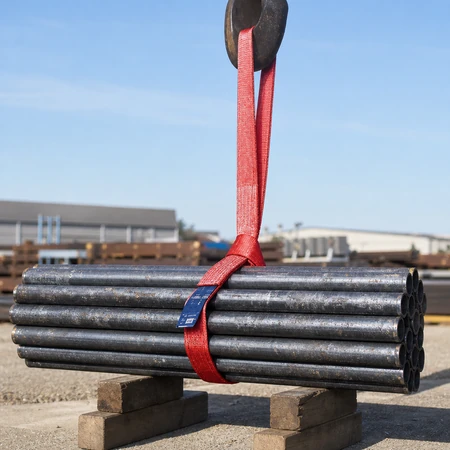
Nọmba ti o wa lori aami ṣe apejuwe eto inaro nikan. The same band used as a choker or a basket carries a different figure, and this is the most common error on a pipe sling, nitori gbogbo awọn mẹta ti wa ni rigged lai eyikeyi ayipada si awọn article.
| Eto | Okunfa | A 5 t sling yoo fun | On pipe and tube |
|---|---|---|---|
| Vertical — band hangs, load on the eye | 1.0 | 5.0 t | Rare: a pipe has nothing to hang from |
| Choked — tail through the eye, noose grips | 0.8 | 4.0 t | The normal arrangement for a round section |
| Agbọn, ẹsẹ 0-45 ° | 2.0 | 10.0 t | Under a bundle, both ends to the hook |
| Agbọn, ẹsẹ 45-60 ° | 1.4 | 7.0 t | Same bundle, legs spread — capacity falls |
A 4.5 t bundle choked on a 5 t band is an overload, kii ṣe ala, and the answer is the next width up rather than a longer sling. Where two picks share a bundle, the figure is read per pick from the pick’s share of the mass, not from the total on the packing list.
OEM: what can be printed, coloured and packed
This is the part of the order that a catalogue cannot answer. On a single-trip band the print and the packing are the whole record of the article, so both are treated as production instructions rather than as paperwork.
- Print to your string. Iwọn fifuye ṣiṣẹ, ipari, and your own part, pack or order number — in the exact string and case you send, on the face that stays out of the choke.
- Awọ bi ikanni keji. One colour per pipe size, per customer or per tonnage sorts a container of identical bands at a glance; BS EN 1492-1 capacity colours where your market reads them.
- Build to your line. Ìbú, sisanra, cut length and eye size are made to order; nothing in the tables above is a stock size.
- Pack with the goods. Coiled ati aami, banded bale, paali, or taped into the bundle — the count on the order, in the carton and on the load is one number.
- Neutral or private label. Bands can be supplied without the maker’s mark; a batch declaration or standard marking is confirmed in writing when the enquiry asks for it.
Kini lati firanṣẹ pẹlu ibeere naa
A pipe sling is specified from the consignment, not from the tonnage alone. Five lines settle it, and a quotation that comes back without them is a quotation to argue about at the dock.
| Ila naa | Why it decides the band |
|---|---|
| Outside diameter and girth at each pick | Sets the length that closes round the pipe with the eye clear of the surface |
| Mass of the bundle, not of one pipe | The pick carries its share of the pack, and the WLL is read off that figure |
| Number and spacing of the pick positions | Two picks per bundle is two bands; the spacing is what stops the bundle bowing |
| Coating and finish | Decides the width, because width is the only thing between the band and the coating |
| Factor and the market it is sold into | 5:1, 6:1 tabi 7:1 is a different width for the same tonnage |
Siṣamisi, packing and the single journey
A single-trip band has no record after the lift, so the print on the band and the packing list carry the whole traceability of the article. On steel pipe consignments that travel by container, that print is the only link between a band on a quay and a line on a packing list.
- Legible lẹhin irin ajo naa, kii ṣe lẹhin iṣelọpọ. Tẹjade ti o jẹ kekere, kekere-itansan, or on a face that enters the choke will not be read on a quay.
- Ayẹwo kan, ni oro. Look at the weave where it meets the load, at the stitch where the eye closes, ati ni aami. A band that fails is destroyed rather than returned to a rack.
- Disposed of, ko ti o ti fipamọ. A band that comes home gets issued again, ati aami rẹ lẹhinna sọ nkan ti kii ṣe otitọ mọ.
Awọn ibeere ti a beere nigbagbogbo
What is a one way endless lifting sling with a single eye?
A flat woven polyester band closed into one stitched eye at one end with the other end finished plain, bought for a single journey with the load it lifts. The tail passes round the pipe and back through the eye, so the sling works as a choker; after the lift it stays with the consignment and is not recovered.
Why one eye instead of two?
Because a choker needs one eye and a tail, not two eyes. The two-eye version of the same band is a vertical or basket sling and is the right choice when both ends hang from hardware; the single-eye version is the simpler article when the band has to close on a round section of pipe.
Kini o ṣe 5:1, 6:1 tabi 7:1 change on the sling?
The width that is cut for the same tonnage. 7:1 jẹ ifosiwewe oniru ti a lo fun gbogboogbo-idi alapin hun webbing slings labẹ European iwa, 5:1 ni aṣa North America olusin fun sintetiki webbing slings, ati 6:1 joko laarin wọn. The factor has to be on the enquiry because it cannot be changed after delivery.
How is the length quoted on a single eye sling?
As the length of the band, cut to the pick — not as the eye-to-eye distance of a finished sling. Give the girth of the pipe at the pick and the reach to the hook, and the cut length follows; that removes the ambiguity before the band is cut.
Will it mark galvanised or coated pipe?
The band is synthetic fibre and no metal part is fitted anywhere on the article, ki o yoo ko họ tabi Burr. Iwọn ni odiwọn aabo: awọn gbooro iye, the lower the pressure on the coating.
Can the band be printed with our reference and packed with the goods?
Bẹẹni, and they are usually ordered together. Iwọn fifuye ṣiṣẹ, the length and your own reference are printed on the band in a colour matched to the order, ati awọn ẹgbẹ le wa ni aba ti inu kan crate, strapped to a stillage or taped into the bundle with the same reference on the outside.
Can a one way sling be used more than once?
It is made, samisi ati owole fun ọkan irin ajo. A single lift does not visibly age a woven band, so a band that looks perfect after use is exactly the case the discipline exists to prevent. Whether a band may be re-used is a decision for the competent person on the receiving site after inspection.
Beere agbasọ ọrọ kan
Send the pipe diameter and girth, the mass of the bundle, awọn ipo ti o yan, the coating, the factor your market reads and the reference to print. We confirm the width, the thickness, the cut length and the marking before the bands are cut.
Tẹlifoonu / WeChat: +86 180 6600 2268 | Imeeli: lift98@jslift.com
Lifute Industrial Park, Ilu Taizhou, Agbegbe Jiangsu, China | HS koodu: 630790
Jẹmọ: ona kan sling ẹka · ailopin gbígbé slings · single use sling with one eye · one way single ply endless flat sling · webbing slings · gbígbé itankale tan ina