

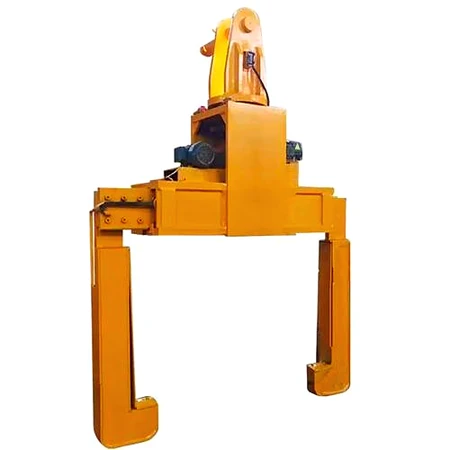
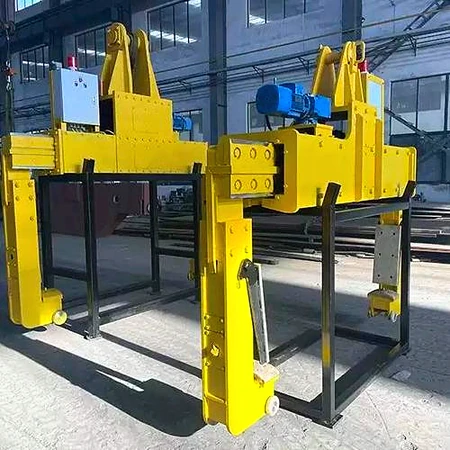
Lift sling rigging company produce Electric Horizontal Coil Lifting Tong,Motorized Coil Lifting Tongs,20T Electric Steel Coil Rotating Lifting Tongs,Coil Tong With Folding Support Arms,Automatic Horizontal Coil Tong,Motorized Coil Tong.
Motorized Coil Lifting Tongs
An electric tong for eye-horizontal steel coils – motor-driven jaws, 90-degree upending, no manual handling and no hydraulic hose on the hook
Motorized coil lifting tongs do the one job a crane hook cannot: take a steel coil lying on its side, hold it by the outside diameter and turn it through 90 degrees so it can be set down standing, or lifted onto a mandrel. Everything that moves is driven by a geared electric motor on the tong itself – the jaws open and close under power, the body rotates under power, and the operator works from a pendant or a radio handset well clear of the load. There is no hydraulic unit to leak over a coil, no slinger on the coil face, and no manual jaw to set. We build the tong in Taizhou in capacities from 5 đến 32 t for coils from 600 mm đến 2200 mm outside diameter, and it sits alongside the rest of our steel-mill range: cái coil handling beam for eye-vertical coils, cái C-hooks for coils for single-eye lifts, và slab billet crane clamp lifting tong for plate and billet.
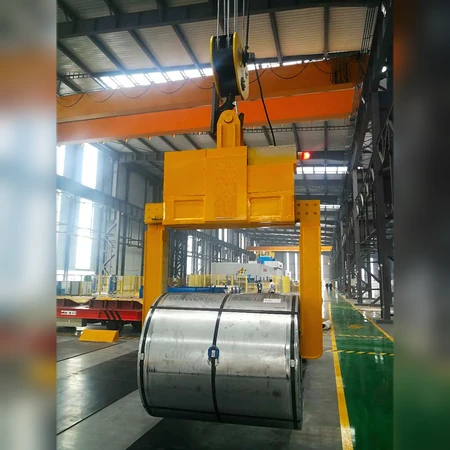
How a Motorized Coil Tong Works
The jaws close on the coil OD, not on the edge
Two jaws travel on a cross-beam and close until the pads meet the outside diameter of the coil. Because the coil is gripped on its curved surface, the contact is spread over a wide pad rather than concentrated on an edge – the reason a coil can be lifted by its OD at all without the wrap opening up. Pads are steel with a polyurethane facing as standard, and copper or brass facings are used where the surface must not be marked.
A geared brake motor does the clamping
The jaw drive is a helical-gear brake motor with a worm reduction: it closes the jaw, holds it with the brake, and cannot be back-driven by the load when the power is off. That is the difference between a motorized tong and a screw clamp – if the pendant is dropped or the power fails, the coil stays clamped. A torque limiter is set at the works so an operator cannot crush a light coil by holding the close button.
Rotation is a separate, slower axis
The body of the tong carries a slewing ring driven by a second geared motor. A 90-degree upend takes 45 ĐẾN 90 seconds depending on the model – slow enough that the coil does not swing, fast enough not to hold up a truck. Mechanical stops are fitted at 0 Và 90 độ, với 180 Và 270 degree stops on the 360-degree version, and a limit switch cuts the drive at each stop instead of relying on the operator’s eye.
Control from outside the hazard
Standard control is a pendant on a 3 m cable with a coiled lead, plus a radio handset as an option. Both give open/close, rotate left/right and an emergency stop. The control box is IP65 and mounted on the tong body, so the only cable crossing the hook is the festoon or the radio link – no hydraulic hose, no air line.
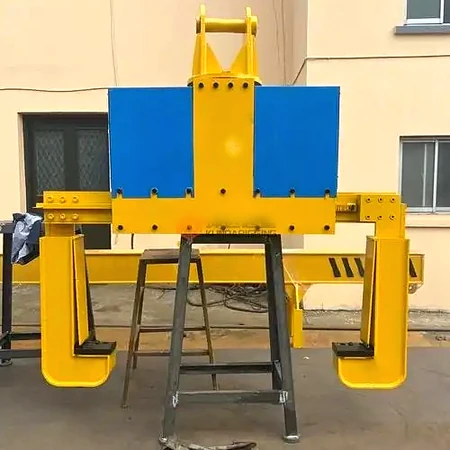
Structure and Materials
The frame is a welded box structure in Q355B, with the jaw carriages in Q460 where the bending moment peaks. Jaws are forged from 42CrMo, hardened and tempered to about 45 HRC, and the gripping pads are replaceable without stripping the jaw. Pins are 40Cr with induction-hardened journals running in greased bushings, and every pin is shouldered and split-pinned. The slewing ring is a sealed, grease-lubricated bearing sized with a static margin well above the rated load, because a coil tong spends its life carrying its load on that one bearing. Finish is shot blast to Sa 2.5, epoxy primer and two polyurethane topcoats in RAL 1023.
Standard Sizes and Parameters
Capacity is the working load limit, and the coil figures are the range the jaws can physically take. Check the widest coil in the programme against the jaw opening, and the heaviest coil against the capacity – the two do not always peak on the same coil.
| Người mẫu | Công suất định mức | Coil OD | Coil width | Jaw opening |
|---|---|---|---|---|
| ECT-5 | 5 t | 600 – 1400 mm | 500 – 1500 mm | 620 – 1460 mm |
| ECT-10 | 10 t | 700 – 1600 mm | 600 – 1700 mm | 720 – 1660 mm |
| ECT-16 | 16 t | 800 – 1800 mm | 700 – 1800 mm | 820 – 1860 mm |
| ECT-20 | 20 t | 900 – 2000 mm | 800 – 2000 mm | 920 – 2060 mm |
| ECT-25 | 25 t | 1000 – 2100 mm | 900 – 2100 mm | 1020 – 2160 mm |
| ECT-32 | 32 t | 1000 – 2200 mm | 900 – 2200 mm | 1020 – 2260 mm |
Standard range. Coil inside diameter does not limit the tong – it grips the outside diameter – but tell us the ID if the coil will be set down on a mandrel. Wider or narrower jaws and intermediate capacities are built to order.
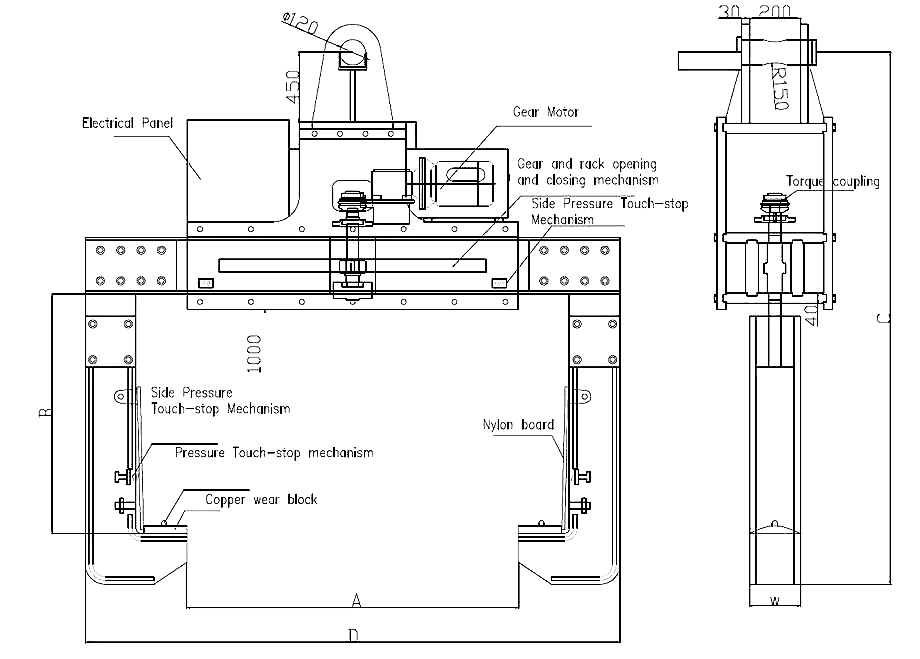
Motorized Coil Lifting Tongs Technical Data
| Dung tích | Coil Parameter | Open Width MỘT (mm) |
Dimensions(mm) | Feeding Speed | Drive Mode | Limit Mode | Remark | ||
| B | C | D | |||||||
| 10Ton | Inner diameter: Φ500mm |
250-1900 | 1000 | 2700 | 2900 | 2-3m/min | Rack and pinion drive | Limit by trip switch | Can be used for high temperature |
| 15Ton | |||||||||
| 30Ton | |||||||||
| 10Ton | Outer diameter: Φ2200mm |
Limit by photoelectric switch | Normal temperature coil | ||||||
| 15Ton | |||||||||
| 30Ton | |||||||||
Specification Summary
| Mục | Đặc điểm kỹ thuật |
|---|---|
| Tên sản phẩm | Motorized coil lifting tongs / electric horizontal coil lifting tong / motorized coil tong / electric coil upender / coil rotating tong |
| Kiểu | Motorized jaw drive with 90° upending (360° slewing optional) |
| Công suất định mức | 5 – 32 t standard; 40 t on request |
| Coil outside diameter | 600 – 2200 mm, model dependent |
| Coil width | 500 – 2200 mm |
| Jaw opening | 620 – 2260 mm between pads |
| Jaw and pads | Forged 42CrMo jaws, about 45 HRC; replaceable steel pads with polyurethane facing; copper or brass facing for non-marking duty |
| Jaw drive | Helical-gear brake motor with worm reduction; self-holding when power is removed; torque limiter |
| Rotation | Separate geared slewing drive; 90° in 45 – 90 s; mechanical stops at 0/90° (180/270° on the 360° version) with limit switches |
| Motor | 1.5 – 4 kW brake motors, 380 V / 50 Hz standard; 415 V / 50 Hz or 460 V / 60 Hz on request |
| Control | Pendant on 3 m cable; radio remote optional; IP65 control box; emergency stop on both |
| Structure | Welded box frame in Q355B; jaw carriages in Q460 |
| Slewing bearing | Sealed, grease-lubricated ring bearing with static margin above rated load |
| Hệ số an toàn | 4:1 on the load-bearing structure |
| Proof load | 1.25 x rated capacity before dispatch, with test certificate |
| Đánh dấu | Dung tích, model, serial number and test date on a stainless nameplate |
| Finish | Shot blast Sa 2.5, epoxy primer plus two polyurethane topcoats, RAL 1023 |
| Temperature | Tiêu chuẩn -20 ĐẾN +60 °C; heat-shielded build for coils above 200 °C on request |
| Options | 360° rotation, non-marking pads, radio remote, spare pad set, coil diameter gauge, explosion-proof motors (quote only) |
| đóng gói | Steel frame, sea freight; control and motors crated separately |
| mã HS | 8428.90 – other lifting and handling machinery (confirm with your customs broker) |
| MOQ | One unit; OEM branding and colour to order |
Specification of the standard motorized tong. Coil dimensions, voltage and rotation angle are confirmed against the coil drawing before the unit is released to production.
How to Specify a Coil Tong
Five numbers from the coil programme decide the model, and one of them is usually the one that changes the answer:
- Heaviest coil – sets the capacity. Do not use the nominal capacity of the crane as the starting point.
- Widest outside diameter – sets the jaw opening. A tong that just clears the largest coil leaves no room for a wrapped or out-of-round coil, so allow 60 mm.
- Coil width against the jaw depth – a narrow coil in a wide tong will sit back in the jaws and can tip.
- Rotation needed – 90 degrees for upending, 360 degrees where the coil must be presented at any angle to a slitting or CTL line.
- Power supply at the crane – voltage, frequency and whether the site allows a trailing cable or wants radio control.
- Duty – a warehouse handling 40 coils a shift needs a different brake and bearing regime from a line that moves four, and a spare tong is cheaper than a stopped line.
Where Motorized Coil Tongs Are Used
- Coil warehouses and steel service centres, stacking and de-stacking eye-horizontal coils
- Slitting and cut-to-length lines, loading the mandrel and removing the remnant
- Hot-dip galvanising and coating lines, where the coil is upended before the entry looper
- Rolling mills and continuous casting, coil transfer from the coiler to the saddle
- Ports and rail transfer points, where the tong travels with the crane rather than the cargo
- Press shops feeding a blanking line from horizontal coil
Operation, Inspection and Maintenance
The tong is a power tool, so the checks are split between the electrical side and the mechanical side:
- Every shift – pads for scoring and wear, jaw travel for obstruction, brake holding with a test lift, pendant cable and plug, emergency stop function.
- Weekly – slewing ring grease, limit switch operation at both stops, torque limiter setting, control box seals.
- Annually – strip and inspect the jaw pins and bushings, NDT the main welds, proof load, re-certify and re-mark.
- Pads and jaw facings are wear parts and are replaced as a set; a jaw with one new pad will grip unevenly and mark the coil.
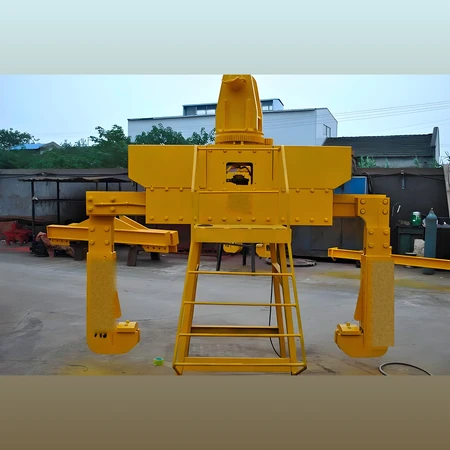
What Ships With Each Tong
- Proof load certificate at 1.25 x rated capacity
- Material certificates for the frame, jaws and slewing ring
- General arrangement drawing with the centre of gravity and hook clearance
- Wiring diagram, control description and operation and maintenance manual
- Spare pad set and spare pin set
- Stainless nameplate with capacity, serial number and test date
Câu hỏi thường gặp
What happens to the grip if the power fails mid-lift?
Nothing. The jaw drive is a brake motor with a worm reduction, so it holds position when the supply is cut – the coil stays clamped until power returns. Rotation also stops and holds under the brake. The emergency stop drops both drives without releasing the jaws.
Can one tong handle both eye-horizontal and eye-vertical coils?
The 360-degree version can present a coil at any angle, so it can pick from a horizontal stack and set down on a mandrel, or turn a coil upright for storage. If the site only ever moves horizontal coils onto a saddle, the 90-degree version is cheaper, lighter and has fewer switches to maintain.
How long does a 90-degree upend take?
Between 45 Và 90 seconds depending on capacity and coil weight, plus the time to close the jaws. The slewing drive is geared for control rather than speed: a fast upend swings the coil on the pads and is the usual cause of a marked or slipping coil.
Does the tong damage the coil surface?
The standard pads are steel with a polyurethane facing, which grips without marking on clean, dry coil. For galvanised, coated or polished coil we fit copper or brass facings so no steel touches the surface. Tell us the surface finish and we will match the pad.
What coil sizes can be handled without a special build?
The standard range covers coils from 600 mm đến 2200 mm outside diameter and 500 mm đến 2200 mm rộng. Coils outside that envelope – narrow slit strip, very large OD, or coils with damaged edges – are quoted against the coil drawing rather than stretched from the standard model.
How is capacity verified?
Every unit is proof-loaded to 1.25 times its rated capacity before dispatch and issued with a certificate quoting the serial number on the nameplate. The structure is designed on a 4:1 nhân tố, and the jaws, pins, stops and slewing bearing are checked dimensionally after the test.
Request a Quote for Motorized Coil Lifting Tongs
Send the coil programme (outside diameter, inside diameter, width and weight), the rotation you need, the crane hook size, the site voltage and how many coils a shift you handle. We will come back with the model, a GA drawing for approval and a delivered price. Công ty TNHH giàn nâng thang máy, Công ty TNHH – telephone and WeChat +86 180 6600 2268, email 702461526@qq.com, Khu công nghiệp Lifute, Thành phố Thái Châu, Tỉnh Giang Tô, Trung Quốc.
The rest of the mill handling range – roll lifting beams, coil beams and C-hooks – sits under lifting devices.
Sản phẩm liên quan