 702461526@qq.com
Lift sling rigging company manufacture Eye and Eye Webbing Sling,Flat Eye Web Sling,Eye Type Webbing Sling,Flat-Eye Web Sling,Polyester Eye-eye Webbing Sling,Flat Eye & Eye Web Sling,2-Ply Eye-Eye Polyester Flat Webbing Sling,Webbing Sling with Eyes.
Eye and Eye Webbing Sling
A two-eye flat webbing sling for lifting, bundling and pulling heavy loads — flat eye or twisted eye, made to order in Taizhou, China
Short description
An eye and eye webbing sling is a flat webbing sling with a sewn eye at each end. It is made for lifting, bundling and pulling heavy loads — the three jobs a two-eye sling does better than anything else. The eyes carry the load onto the hook or the shackle, the flat webbing body carries it across the load, and there is no metal anywhere in the sling to scratch a finished surface or to fatigue.
It is supplied with flat eyes or twisted eyes, sewn from high-tenacity polyester webbing in single, duplex or triplex plies, in widths from 25 mm to 200 mm and working load limits from 1 t to 24 t. The standard is EN 1492-1, the safety factor is 7:1, and every sling carries a sewn label with its working load limit, length, mode, standard and date.
The three uses are not interchangeable, and Section 3 sets out why: a sling made for lifting is rated on a working load limit, a sling used for bundling or tying down is rated on a lashing capacity, and a sling used for pulling is not covered by a lifting rating at all. We mark each sling for the job it was made for. Tell us which of the three you need and the specification follows. For the net range see the cargo lifting nets, and for the rest of the sling range the webbing slings category.
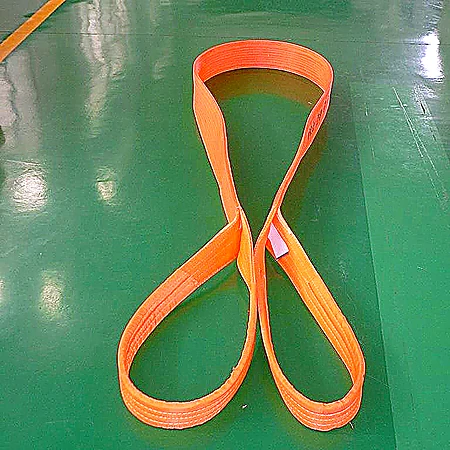
Figure 1 — An eye and eye webbing sling: a sewn eye at each end, no metal, and the working load limit printed and labelled on the sling.
1. What an eye and eye webbing sling is
Five features define the product, and each one decides how it is used.
- An eye at each end. Two sewn eyes, not a continuous loop. That is what separates an eye and eye sling from an endless sling, and it is what allows the sling to be used vertically, in a basket and in a choke hitch.
- Flat webbing, not round rope. A flat band spreads the load across its whole width, so it does not mark or crush what it lifts. A round sling of the same capacity contacts on a much narrower line.
- High-tenacity polyester. Low stretch — about 7 % or less at the working load limit — which keeps the load stable, and good resistance to ultraviolet light and to abrasion for an outdoor sling.
- Sewn, not metal-ended. The eyes are stitched, so there is no hook, no thimble and no ferrule to scratch a load, to corrode or to fail. The label and the stitching are the two things to inspect on every sling.
- Rated on a working load limit, with a mode factor. The figure on the label applies to the mode you use — vertical, basket or choked — and the mode changes the capacity. Section 6 sets out the factors.
It is worth knowing the two other shapes in the range so you can place this one. An endless webbing sling has no eyes at all: it is a continuous loop of webbing, which is convenient but cannot be choked through its own eye. A round sling is a continuous loop of polyester yarn inside a woven sleeve: softer and heavier, and rated differently. The eye and eye sling is the version you buy when you want to choose how it is hitched.
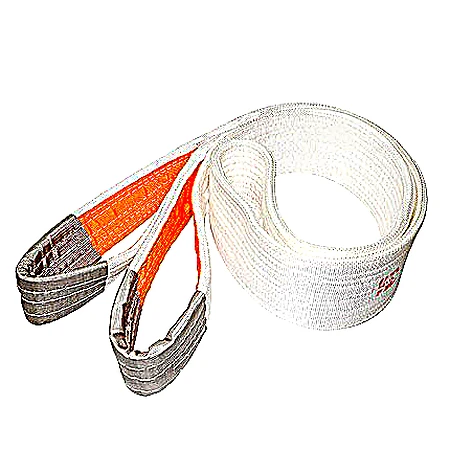
White polyester webbing with a reinforced eye and a protective sleeve — no metal anywhere in the sling |
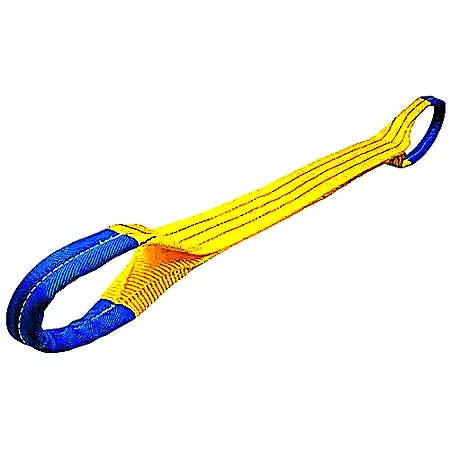
The two eyes are the load path and the flat webbing body carries the load across the cargo |
The other two shapes are on the same site: the endless lifting sling and the dumaloq slinglar.
2. Flat eye or twisted eye
Both ends carry a sewn eye; the difference is the plane the eye sits in, and that single detail decides how the sling sits on a hook and whether it can be choked cleanly.
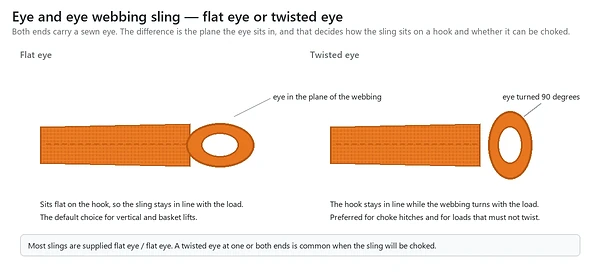
Figure 2 — Left: a flat eye, lying in the plane of the webbing. Right: a twisted eye, turned 90 degrees to the webbing.
| Eye type | How it sits | Best for | What to watch |
|---|---|---|---|
| Flat eye | The eye lies in the same plane as the webbing, so it presents a wide, flat opening to the hook | Vertical lifts, basket lifts and general hook work — the sling stays in line with the load | On a choke hitch the webbing has to twist along its length to let the eye pass through itself |
| Twisted eye | The eye is turned 90 degrees to the webbing, so it presents at right angles to the band | Choke hitches, loads that must not be allowed to rotate, and slings that live on a hook between lifts | The eye root carries more stitching; confirm the eye length and bearing width you need |
| Flat eye one end, twisted eye the other | One eye flat, one turned — the most useful combination for a choke hitch | Choked lifts where the choke eye should present squarely to the load | Order the pair in the order you intend to use them |
Table 1 — Flat eye, twisted eye, and the combination.
Most eye and eye slings are supplied flat eye / flat eye, and that is the right default for general work. A twisted eye at one end is what you specify when the sling will be choked: the twisted eye presents squarely to the load while the webbing turns, and the choke seats properly instead of rolling the band over on itself.
If you are not sure which you need, tell us how the sling will be hitched — vertical, basket, or choked around the load — and we will specify the eye type rather than leaving it to default.
3. Three jobs, three different ratings
An eye and eye sling is bought for lifting, for bundling and for pulling, and the same length of the same webbing can serve all three. What must not be blurred is the rating: the three jobs are governed by different rules, they are marked differently, and a sling made for one job is not automatically safe for another.
| Job | What the sling does | Which rating applies | What governs the specification |
|---|---|---|---|
| Yuk ko'tarish | The eyes sit on a hook, a shackle or a beam, and the sling carries the load off the ground | Working load limit (WLL), rated per EN 1492-1 with the mode factor applied | Webbing width and ply, the mode of lift, the leg angle, and the standard the sling is made to |
| Bundling and tying down | The sling holds a bundle together or holds cargo down on a vehicle or a pallet | Lashing capacity (LC) — a restraint rating, not a lifting rating | The tension the buckle or winch can apply, the friction between the load and the deck, and the restraint forces the arrangement must resist |
| Pulling and towing | The sling pulls a load along, or recovers a stuck vehicle | No lifting rating applies at all | Shock loading, abrasion on the ground, vehicle mass, and fittings that are safe to recover from. This is a recovery-strap product, not a rated lifting sling |
Table 2 — Lifting, bundling and pulling: three jobs, three different ratings.
The reason this matters is that the three look identical in a photograph. A sling rated at 5 t for lifting is not thereby a 5 t lashing, and a lashing is not a lifting sling. We make all three, and we mark each one for the job it was made for, so the label on the sling tells you which rules apply. Where the job is tying cargo down rather than lifting it, the dedicated product is the cargo securing net, which is rated as a restraint and tested on that basis. Where the job is pulling over a long distance or recovering a vehicle, say so at the enquiry stage — the specification changes.
4. Technical parameters
The figures below cover the standard range. Width, ply, length, eye type, eye length, colour and marking are all made to order, so treat this table as the starting point for a quotation rather than a fixed catalogue.
| Parameter | Specification |
|---|---|
| Product type | Eye and eye flat webbing sling with a sewn eye at each end |
| Webbing material | 100 % high-tenacity polyester (PET); nylon webbing on request |
| Webbing width | 25 / 30 / 35 / 50 / 60 / 75 / 100 / 150 / 200 mm |
| Ply | Single (1-ply), duplex (2-ply) or triplex (3-ply) |
| Webbing thickness | 1.8 mm – 6.0 mm depending on width and ply |
| Eye type | Flat eye or twisted eye, at either end or one of each |
| Eye | Sewn with high-tenacity thread; reinforced eye with extra stitching on request |
| Eye length | 100 mm – 1000 mm, or to order |
| Bearing width | Set by the webbing width and the eye fold — stated so the hook or shackle can be checked |
| Length | 0.5 m to 100 m overall, made to order |
| Working load limit | 1 t – 24 t for a single leg in the vertical mode |
| Safety factor | 7:1 standard; 5:1 and 6:1 on request |
| Elongation | 7 % or less at the working load limit |
| Mode factors | Vertical 1.0 · Choked 0.8 · Basket (0–45°) 2.0 · Basket (45–60°) 1.4 |
| Colour | EN 1492-1 colour code by working load limit, or a custom colour |
| Treatment | Ultraviolet-resistant, anti-ageing, abrasion-resistant |
| Working temperature | -40 °C to +100 °C |
| Standard | EN 1492-1; other national standards made on request |
| Sertifikatlash | Idoralar / GS / JIS; ISO 9001; CNAS laboratory; DNV |
| Label | Sewn label carrying the working load limit, length, mode, standard, manufacturer and date |
| Customisation | OEM / ODM width, length, ply, colour, printed webbing, own label and packing |
Table 3 — Eye and eye webbing sling: technical parameters.
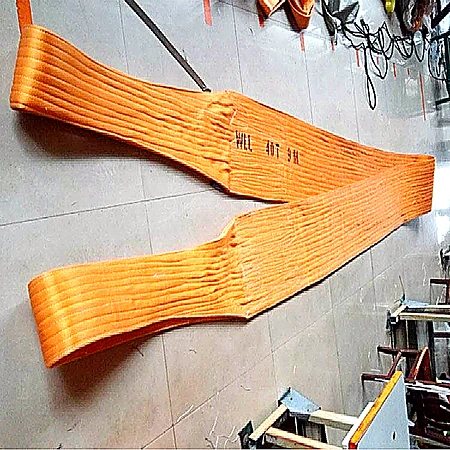
A heavy sling with the working load limit and length printed on the webbing itself — WLL 40 T, 9 m |
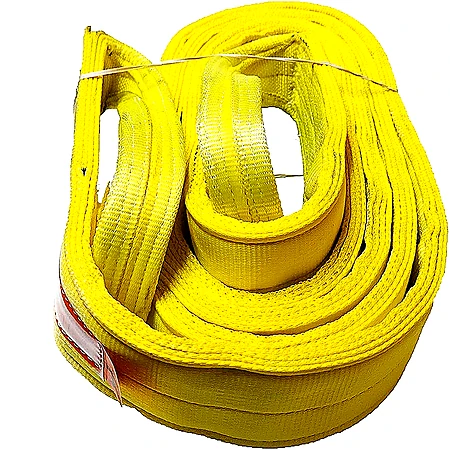
Polyester webbing holds its colour and its weave under load, which is what makes the printed marking legible for the life of the sling |
5. Width, ply and working load limit
Two numbers set the capacity of a flat webbing sling: how wide the band is, and how many plies are sewn into it. A duplex sling is not twice as strong as a single because the plies are stitched together, but it is close, and it wears far better because the outer ply takes the abrasion.
| Webbing width | Single ply (1-ply) | Duplex (2-ply) | Triplex (3-ply) | Typical duty |
|---|---|---|---|---|
| 25 mm | 1 t | 2 t | 3 t | Light loads, tools, small components |
| 50 mm | 2 t | 4 t | 6 t | General lifting, machine parts, drums |
| 75 mm | 3 t | 6 t | 9 t | General lifting, palletised and bundled cargo |
| 100 mm | 4 t | 8 t | 12 t | Heavy lifting, steel and concrete units |
| 150 mm | 6 t | 12 t | 18 t | Heavy and long loads, towing and pulling duty |
| 200 mm | 8 t | 16 t | 24 t | The heaviest standard range, large fabricated loads |
Table 4 — Working load limit by webbing width and ply, for a single leg in the vertical mode.
Capacities in the table are for one leg hanging vertically. In a basket the sling carries more, in a choke it carries less, and in a multi-leg arrangement the leg angle takes its share — the factors are in the next section. Widths of 30 mm, 35 mm and 60 mm, and intermediate capacities, are made to order.
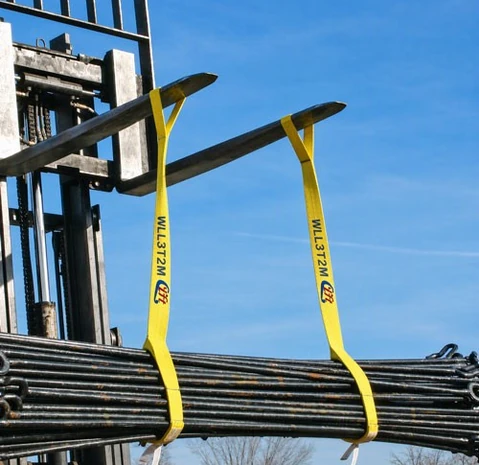
Duplex slings in a bundle duty: the outer ply takes the abrasion and the inner ply carries the load |
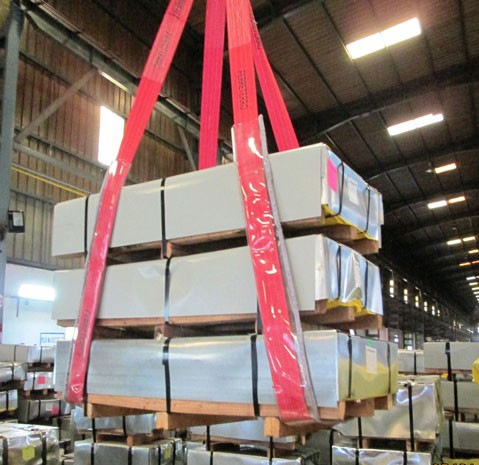
The same webbing on a straight lift — a flat band spreads the load and leaves no mark on a finished surface |
6. Mode factors and the leg angle
The working load limit on the label is not a single number: it is the figure that applies in the vertical mode, and it is multiplied by the factor for the mode you actually use. The factor is measured from the vertical, not from the deck.
| Mode | How the sling is hitched | Factor | Worked example on a 2 t single-ply sling |
|---|---|---|---|
| Vertical | One eye on the hook, the load hanging directly below | 1.0 | 2 t |
| Choked | The sling passes around the load and through its own eye | 0.8 | 1.6 t |
| Basket, 0–45° | The sling passes under the load; both eyes on the hook, legs close together | 2.0 | 4 t |
| Basket, 45–60° | As above, with the legs spread wider | 1.4 | 2.8 t |
Table 5 — Mode factors for a flat webbing sling (EN 1492-1 basis).
Two practical points follow from this table. First, the number printed on the webbing is normally the vertical working load limit, so a sling used in a choke is working below its printed figure and must be understood that way. Second, in a two-leg or four-leg arrangement the legs share the load, but the share is governed by the angle and by how evenly the load sits — the same logic that governs a four-loop net.
Where the legs hang from a beam rather than a single hook, the rating is set by the beam. The lifting spreader beam and the lifting devices in our range are made to take the same fittings.
7. Eye length, effective length and how to measure
More slings are returned or replaced for a length misunderstanding than for any other reason, so it is worth being precise about the three measurements.
| Measurement | What it is | Why it matters |
|---|---|---|
| Eye length | The internal length of the eye, from the bearing point inside the eye out to the tip of the eye | It sets how much of the eye is available over a hook or a shackle, and how far a choke eye can reach through the other eye |
| L — overall length | The sling as supplied, measured from the tip of one eye to the tip of the other | It is the figure printed on the label and the figure buyers normally quote, but it is not the length the lift actually uses |
| EL — effective length | The length in service, normally from the bearing point of one eye to the bearing point of the other | It is the reach of the lift. If you order on L but lift on EL, the load will sit lower than expected |
Table 6 — Eye length, L and EL, and which one you should quote.
Our quotation will state which figure is being quoted, and we recommend putting both on the enquiry: the reach you need and the eye length that suits your hook. Above 100 mm of webbing width, the eye length and the bearing width together decide whether your hook or shackle actually fits — a 200 mm sling may need a longer eye simply to clear the hook body.
A sling sized for a specific hook, beam or load is worth drawing once. If your lift is repetitive, the bir tomonlama sling and the crane pallet cargo net are the two directions that repeat lift tends to take.
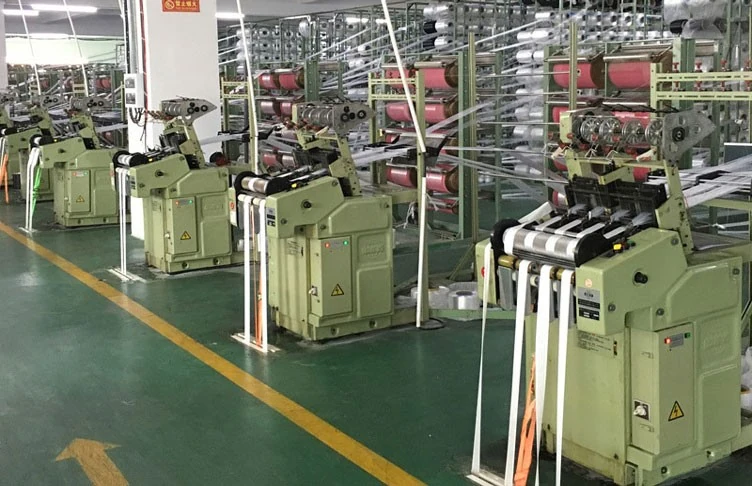
Figure 3 — Our own weaving floor: the polyester webbing that every sling on this page is sewn from.
8. Colour code and identification
A flat webbing sling is identified by colour first and by label second. The colour tells the user the capacity at a glance; the sewn label carries the figures that the colour cannot.
| Working load limit | Standard colour | Working load limit | Standard colour |
|---|---|---|---|
| 1 t | Violet | 5 t | Red |
| 2 t | Green | 6 t | Brown |
| 3 t | Yellow | 7 t | Blue |
| 4 t | Grey | 8 t | Orange |
Table 7 — The standard colour code for flat webbing slings.
- The colour code follows the working load limit, not the width, so a duplex 50 mm sling and a single-ply 100 mm sling are different colours at the same duty.
- Capacities above 8 t, and non-standard slings, carry the manufacturer’s own colour scheme, printed on the sewn label.
- Everything a colour cannot say is on the label: working load limit, length, mode, standard, manufacturer and date of manufacture. A sling with a missing or illegible label comes out of service, whatever colour it is.
- The webbing can also be printed along its length — working load limit, length and your own brand. Printing is the most durable identification on a sling that spends its life being dragged across loads.
- Packing can carry the same information, which matters for fleets that store slings by size and colour rather than individually.
9. Eye protection, wear pads and fittings
An eye and eye sling is deliberately free of metal. What protects it instead is stitching and fabric.
| Option | What it does | Choose it when |
|---|---|---|
| Standard sewn eye | The eye as stitched with high-tenacity thread | General lifting and bundling duty |
| Reinforced eye | Extra stitching at the eye root, where the load concentrates | Repeated lifts, heavy duty, and use in a choke hitch |
| Wear pad in the eye | A fabric pad inside or over the eye | Frequent use on a hook or a shackle, where the eye would otherwise polish and thin |
| Protective sleeve on the body | A sleeve or wear pad over the webbing at the contact point | Sharp-edged loads — steel plate, concrete, machined components |
| Anti-cut edge protection | A heavier sleeve where the band meets a cutting edge | Loads with a genuinely sharp edge, which is the failure mode we see most in returns |
| Round sling instead | A sleeved continuous loop, no exposed stitching | Where the load is very abrasive or where a flat band may slip |
Table 8 — Protection and eye options.
The trade-off is honest: a metal end fitting can be inspected more easily and can be replaced, but it scratches loads and it can corrode or fatigue. A sewn eye cannot corrode and cannot mark a load, which is why a flat webbing sling is the default choice wherever a finished surface has to arrive undamaged. What it cannot do is survive a sharp edge unassisted — that is what the sleeve in the table is for.
For loads that are genuinely abrasive and cannot be sleeved, the right answer is usually a different product rather than a thicker sling: the heavy duty nylon cargo net sling or a wire rope slings arrangement.
10. Quality control and certification
We weave the webbing and sew the slings in the same plant, so width, ply, colour, printing, eye type and eye length are under our control rather than bought in.
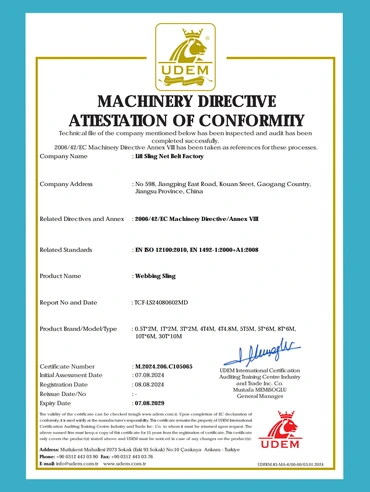 CE attestation of conformity covering our webbing slings to EN 1492-1 CE attestation of conformity covering our webbing slings to EN 1492-1 |
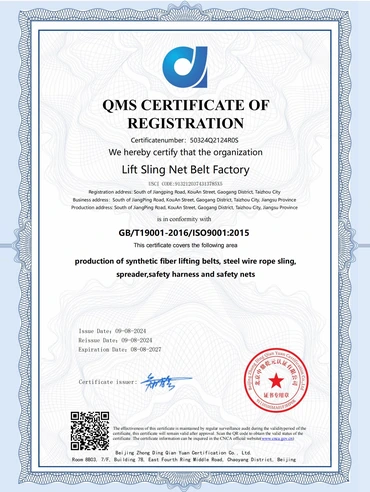 ISO 9001 quality management system certificate ISO 9001 quality management system certificate |
- 40 years of lifting equipment manufacturing — founded in 1985 in Taizhou, Jiangsu, with more than 200 employees, one of China’s largest lifting sling production bases.
- CE and GS certified, with JIS certification on export orders, and a declaration of conformity to EN 1492-1 available for each order.
- Own testing laboratory — our facilities hold CNAS laboratory accreditation, European CE certification and DNV certification, with 15 authorised patents on our lifting products.
- 1000 t horizontal test machine — the breaking load of every sling is tested and documented rather than sampled, and a material test report travels with the order.
- Every sling is measured, weighed and fitted with its sewn label before packing, and the label carries the working load limit, length, mode, standard, manufacturer and date.
The full set of certificates is on our certification page.
11. How to specify an eye and eye webbing sling
Nine pieces of information are enough to quote correctly the first time. The two most often left out are the mode of lift and the eye type, and both of them change the answer.
| Information we need | Why it matters |
|---|---|
| Which job: lifting, bundling or pulling | It decides which rating applies and how the sling is marked. This is the first question we ask |
| Load weight per lift | Sets the webbing width and the ply |
| Mode of lift | Vertical, basket or choked — the mode factor changes the capacity, and a choke needs a twisted eye |
| Eye type and eye length | Flat or twisted, and how long the eye must be to clear your hook or shackle |
| Length you need: L or EL | The reach of the lift, and how much of the sling hangs below the hook |
| Webbing width and ply | Driven by the load and by how abrasive the duty is |
| Colour and marking | The standard colour code is normally required; own-brand printing is optional |
| Protection | Sleeves or wear pads where the band meets a hook or an edge |
| Environment and documentation | Temperature, chemicals, ultraviolet exposure, safety factor, test report and export packing |
Table 9 — What we need to quote an eye and eye webbing sling.
12. Where eye and eye webbing slings are used
| Sector | What the sling does | Why this sling suits it |
|---|---|---|
| General engineering | Lifting machined parts, fabrications and assemblies | The flat band does not mark a finished surface or a painted one |
| Steel and metal stock | Bundling bar, tube and sheet into a safe bundle; lifting it | Duplex and triplex plies take the abrasion of sharp stock |
| Construction and concrete | Lifting precast units, formwork and materials | High capacity for the weight, and no metal to damage formwork faces |
| Logistics and warehousing | Lifting palletised and bundled loads a forklift cannot reach | Two eyes can be hitched in more than one way on the same sling |
| Vehicle recovery and pulling | Pulling a load along a bed or a slipway | Only when ordered as a recovery strap — see Section 3 |
| Towing and plant movement | Moving plant, trailers and equipment short distances | Supplied with the rating that matches the job |
| Marine and offshore support | Handling equipment and stores on a quay or a deck | Polyester is unaffected by water and resists ultraviolet light |
| Utilities and telecoms | Lifting drums, cable reels, poles and hardware | Bundling duty and lifting duty in one sling |
| Rental and hire fleets | Whatever the customer brings to the counter | One design covers vertical, basket and choked use, in a colour-coded set |
| Agricultural and grounds work | Bales, bags, fence posts and machinery | Wide, soft contact with no metal to tear a bag or scratch a machine |
Table 10 — Where eye and eye webbing slings are used.
13. Care, inspection and retirement
- Inspect the eyes and their stitching first, then the body of the webbing, then the label. On a sewn sling the stitching at the eye root is the first thing to fail.
- Look for cut or frayed webbing, broken or pulled stitching, splits across the band, and the stiffening and colour loss that signal ultraviolet or heat damage.
- Reject any sling with a cut edge, with stitching pulled out at the eye, with chemical or heat damage, or with a missing or illegible label. There is no repair for a webbing sling — an eye is either sewn to specification or the sling is scrapped.
- Never knot a webbing sling, and never use a knot to shorten one. A knot reduces the capacity and damages the webbing.
- Keep the band clear of sharp edges, and use the sleeve or wear pad where you cannot. Do not drag a loaded sling across a rough floor.
- Store slings flat or hung, out of direct sunlight, away from heat and away from chemicals, and never with a wet sling left coiled against damp concrete.
- Record the inspection. A fleet that records which sling was inspected and when is the fleet that knows which slings to retire, and the date on the sewn label is what makes that possible.
14. Frequently asked questions
What is the difference between an eye and eye sling and an endless sling?
An eye and eye sling has a sewn eye at each end; an endless sling is a continuous loop with no ends. The endless sling is simpler and has no stitching to inspect at the ends, but it cannot be threaded through its own eye, so a choke hitch is much less practical. Choose eye and eye when you want to choose how the sling is hitched.
Flat eye or twisted eye — which should I order?
Flat eye for vertical and basket lifts and for general hook work: it sits flat and keeps the sling in line with the load. Twisted eye when the sling will be choked, or when the load must not be allowed to rotate. If you tell us how the sling will be hitched, we will specify it.
Why is the capacity lower in a choke hitch?
Because the choke bends the webbing back on itself at the eye and concentrates the load there. The standard factor for a choked flat webbing sling is 0.8, so a 2 t single-ply sling carries 1.6 t choked. The number on the webbing is the vertical figure, which is why the mode matters.
Can I use one sling for lifting and for tying down?
Not on the strength of one rating. Lifting is rated on a working load limit with a 7:1 safety factor; tying down is a restraint duty rated on lashing capacity and governed by how much tension the buckle can apply and how much friction the deck gives you. We make both, and we mark each for its job. Do not assume a 5 t lifting sling is a 5 t lashing.
Can I use a lifting sling to tow or recover a vehicle?
Use a product made for it. A recovery or towing strap is a different specification, designed for shock loading and for being dragged, and it does not carry a lifting rating. Using a rated lifting sling for recovery, or a recovery strap for lifting, is the interchange that causes the accidents. Tell us the job and we will supply the right one.
How long should the eyes be?
Long enough to clear your hook or shackle with the bearing width you need. On wide slings — 150 mm and 200 mm — the eye must be longer simply to clear the hook body. Give us the hook or shackle you intend to use, or the eye length you have on the sling you are replacing.
Should I order on L or EL?
Quote the reach you need and we will state which figure we are quoting. L is the sling as supplied, tip to tip, and it is what is printed on the label; EL is the effective length in service, bearing point to bearing point, and it is the reach of the lift. Ordering on one and lifting on the other is the most common length mistake.
How is the sling proved?
It is made to EN 1492-1 at 7:1, or 5:1 and 6:1 if you specify. The breaking load of every sling is tested on our own 1000 t machine and documented, and a material test report travels with the order. Our products are CE and GS certified and our facilities hold CNAS, CE and DNV certification.
What else do you make?
The sling range continues with webbing slings in other forms, the safety harness and the nylon ropes, alongside our net and rope ranges.
15. Why buy eye and eye webbing slings from Lift

Figure 4 — Our works at Taizhou, Jiangsu: weaving, stitching and testing under one roof.
- 40 years of lifting equipment manufacturing — founded in 1985 in Taizhou, Jiangsu, more than 200 employees, and one of China’s largest lifting sling production bases.
- Weaving and stitching in one plant — width, ply, colour, printing, eye type and eye length are all under our control, so the sling is made to your job rather than selected from a catalogue.
- Both eye types from the same line — flat eye, twisted eye or one of each, with eye lengths set to your hook and bearing widths stated on the quotation.
- Rated honestly for the job — a lifting sling, a lashing and a recovery strap are marked for what they are, and we will say when the job you describe calls for a different product.
- Own testing laboratory and 1000 t test machine — breaking load tested per sling and documented, with CE, GS, JIS, CNAS and DNV certification behind the products.
- One supplier for the whole lifting range — webbing slings, endless slings, dumaloq slinglar, one way slings, wire rope slings, lifting spreader beams, harnesses and the cargo lifting net range.
More from the same works: safety rope nets · polyester webbing net for lifting

Figure 5 — Our lifting products ship worldwide, through distributors and directly to fleets, yards and terminals.
16. Request a quotation
Tell us the job first — lifting, bundling or pulling — then the load weight, the mode of lift, the eye type and eye length you need, the length, the width and ply, and the environment the sling will work in. Our engineers will confirm the specification and quote it in one reply. To talk it through first, contact our engineers.
Lift Sling Rigging Company — Lifute Industrial Park, TayChjou shahri, Jiangsu viloyati, China
Tel: +86 523 8693 5818 | WhatsApp: +86 180 6600 2268 | Elektron pochta: 702461526@qq.com
HS code 630790 — lifting slings of textile materials.
Appendix A — SEO data for this page
The values below are ready to paste into the page’s SEO fields. The keyword set is drawn from eye type and sling configuration language, which is what separates this page from the endless sling and round sling pages in the same category.
| Field | Value |
|---|---|
| Target URL | /webbing-sling/eye-and-eye-webbing-slings-flat-eye-or-twisted-eye/ |
| Primary keyword | Eye and Eye Webbing Sling |
| Secondary keywords | flat eye web sling; twisted eye webbing sling; eye type webbing sling; eye-eye webbing sling; 2-ply eye-eye polyester flat webbing sling; webbing sling with eyes; polyester eye and eye sling; flat eye and eye web sling; two eye webbing sling; eye and eye sling |
| Long-tail / scenario | eye and eye webbing sling 5 ton; flat eye vs twisted eye sling; 2-ply eye-eye polyester sling 3 m; webbing sling with eyes for bundling; eye and eye sling for steel plate; twisted eye sling for choke hitch; eye and eye sling 50 mm width |
| Search intent | Commercial / transactional — the searcher is specifying a two-eye webbing sling |
| SEO title (51 characters) | Eye and Eye Webbing Sling | Flat Eye or Twisted Eye |
| Meta description (147 characters) | Eye and eye webbing sling for lifting, bundling and pulling heavy loads. Flat eye or twisted eye, 25-200 mm widths, EN 1492-1, CE and GS certified. |
| H1 | Eye and Eye Webbing Sling |
| Heading chain | H1 Eye and Eye Webbing Sling → H2 per section → H3 for sub-blocks |
| Canonical | https://www.xulft.com/webbing-sling/eye-and-eye-webbing-slings-flat-eye-or-twisted-eye/ |
| Sitemap priority | 0.8 (product detail page, one level below the webbing sling category) |
| Word count | About 6,050 words in total — roughly 3,500 words of body copy plus 2,550 words of specification tables |
| Images on page | 13 images, every one with descriptive alt text |
| Internal links | 17 unique contextual internal links (see Appendix B) |
| Tables | 18 tables — 14 specification and data tables plus 4 image grids |
| Anchor text style | Descriptive and varied; no two anchors on the page repeat the same phrase |
Table 11 — On-page SEO reference.
Appendix B — Internal link and page-weight plan
Outbound links tell Google which pages are related to this one. Inbound links are what actually push weight and ranking power into the page.
B1 — Outbound contextual links from this page
| Target URL | Anchor text | Where it sits |
|---|---|---|
| /products/cargo-lifting-net/ | cargo lifting nets | Short description — the net category |
| /products/webbing-sling/ | webbing slings | Short description and Section 14 — the category hub |
| /products/endless-lifting-sling/ | endless lifting sling | Section 1 — the shape without eyes |
| /products/round-sling/ | dumaloq slinglar | Section 1 — the sleeved continuous loop |
| /cargo-lifting-net/cargo-securing-net/ | cargo securing net | Section 3 — the restraint-rated alternative for tying down |
| /products/lifting-spreader-beam/ | lifting spreader beam | Section 6 — beam lifts |
| /products/lifting-devices/ | lifting devices | Section 6 — fittings for multi-leg lifts |
| /products/one-way-sling/ | bir tomonlama sling | Section 7 — repetitive single-use lifting |
| /cargo-lifting-net/crane-pallet-cargo-net/ | crane pallet cargo net | Section 7 — repeated pallet lifts |
| /cargo-lifting-net/heavy-duty-nylon-cargo-net-sling/ | heavy duty nylon cargo net sling | Section 9 — the abrasive-load alternative |
| /products/wire-rope-sling/ | wire rope slings | Section 9 — sharp and abrasive duty |
| /certification/ | certification | Section 10 — the certificate page |
| /products/safety-harness/ | safety harness | Section 14 — the rest of the sling range |
| /products/nylon-rope/ | nylon ropes | Section 14 |
| /products/safety-rope-net/ | safety rope nets | Section 15 |
| /cargo-lifting-net/polyester-webbing-net-for-lifting/ | polyester webbing net for lifting | Section 15 |
| /contact-us/ | contact our engineers | Section 16 |
Table 12 — Outbound anchors on this page.
B2 — Inbound links to add, so this page gains weight
These are the links that build this page’s ranking power. Add each one to an existing, already-indexed page, pointing at the eye and eye sling URL with the anchor shown. Vary the anchor as listed rather than repeating one phrase across every source page.
| Source page | Anchor text to use | Why this link builds weight |
|---|---|---|
| /products/webbing-sling/ (category hub) | eye and eye webbing sling | A link from the category hub is the strongest internal signal for a child product page |
| /webbing-sling/ (section page) | flat eye web sling | Passes section-level relevance together with the hub link |
| /products/endless-lifting-sling/ | eye and eye sling | The endless sling page is the natural place to route buyers who actually need eyes |
| /products/round-sling/ | twisted eye webbing sling | Round sling buyers often compare against a flat two-eye sling |
| /products/one-way-sling/ | webbing sling with eyes | One-way and eye-and-eye slings are bought by the same repetitive-lift customer |
| /products/lifting-devices/ | 2-ply eye-eye polyester flat webbing sling | Fittings and slings are specified together |
| Homepage (products list or footer) | webbing slings | One homepage link to the category is enough; do not point the homepage at this page directly |
Table 13 — Inbound internal link plan.
Two rules keep the cluster healthy. First, keep these anchors distinct from each other and from the anchors used on the endless sling and round sling pages — repeating one phrase across many internal links is the fastest way to create keyword cannibalisation inside your own site. In particular, this page should own the eye-type and configuration language (flat eye, twisted eye, two-eye, eye and eye) and should not compete for the general term webbing sling. Second, keep the page one click from the category hub and no deeper: breadcrumb Home > Mahsulotlar > Webbing Sling > Eye and Eye Webbing Slings.
Appendix C — Google indexing and ranking checklist
| Item | What to do for this page |
|---|---|
| Indexability | Return HTTP 200, keep the page out of noindex, and make sure it is not blocked in robots.txt |
| Canonical | Self-referencing canonical to the eye and eye sling URL |
| XML sitemap | Include the URL in the product sitemap, then resubmit the sitemap in Google Search Console |
| Internal links | Apply both tables in Appendix B. The page currently has no inbound internal links, so this is the priority |
| Title and description | Use the two values in Appendix A. The page currently carries the Yoast placeholder pattern rather than a written title and description |
| Heading structure | One H1, then H2 per section, then H3 for sub-blocks — never skip a level |
| Image SEO | Descriptive alt text on all 13 images, file names in lower case with hyphens, WebP format, and lazy loading below the fold |
| Structured data | Add Product JSON-LD with name, image, description, brand and manufacturer, plus BreadcrumbList for the breadcrumb path and Organization at site level |
| Core Web Vitals | Compress images to WebP, set width and height on every image to avoid layout shift, and defer non-critical scripts |
| Page is currently thin | The live page carries a single repeated product-name paragraph and no datasheet, no eye-type explanation and no technical content. Everything in this document is new copy; replace the placeholder text rather than appending to it |
| Existing content to keep | The product-name list already on the page — Eye and Eye Webbing Sling, Flat Eye Web Sling, Eye Type Webbing Sling, Flat-Eye Web Sling, Polyester Eye-eye Webbing Sling, Flat Eye & Eye Web Sling, 2-Ply Eye-Eye Polyester Flat Webbing Sling, Webbing Sling with Eyes. These are useful keyword variants; move them into the body copy or the meta keywords rather than leaving them as a repeated paragraph |
| Image mismatch to review | The page gallery currently includes an orange endless-style sling. If that image is not an eye and eye sling, replace it or move it to the endless sling page, so the gallery matches the product the page sells |
| Search Console | Submit the URL for indexing, then check the Page Indexing and Core Web Vitals reports a week later |
| Rank tracking | Track the primary keyword plus the three main eye-type secondary keywords weekly against the endless sling page and the top three competitors |
Table 14 — Google indexing and ranking checklist.