

Lift sling rigging company manufacture Round Stage Slings with Aircraft Steel Cable Inside,2.0T Wire Core Theatre Stage Sling,Wire Rope Round Sling,Wire Steel Core Black Round sling,Theatre Round Sling,Black Stage Wire Rope Sling.
2.0T Wire Core Theatre Stage Sling
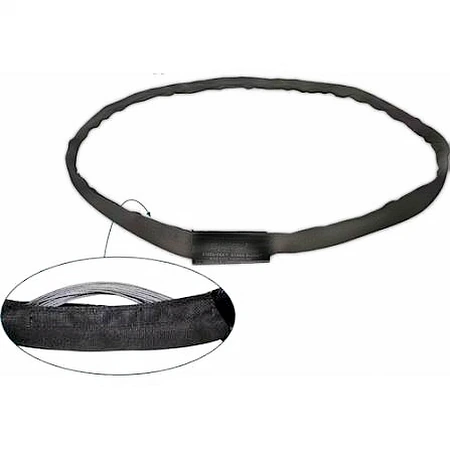
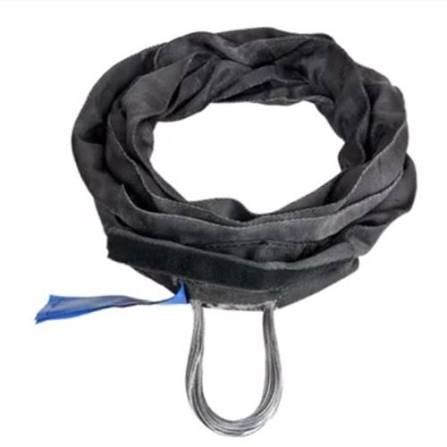
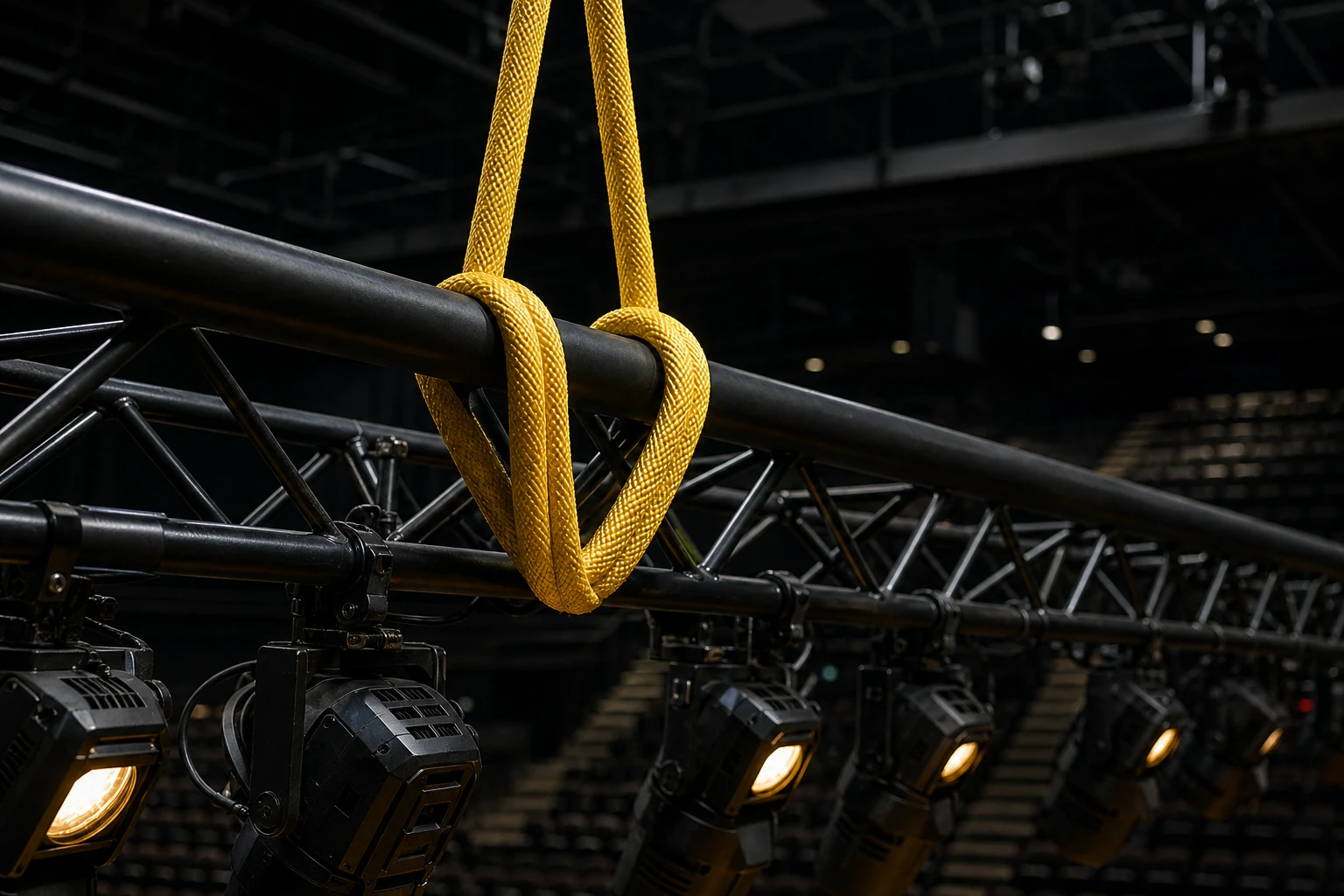
A wire core theatre stage sling is a steel wire rope sling wearing a textile sleeve. Inside the closed black cover sits a galvanised steel aircraft cable, terminated on a swaged ferrule and formed into a loop; outside, nothing metal is presented to the truss or to the paintwork. Riggers specify it for one reason above all others: a steel core does not stretch. Set the trim height once and it stays there, night after night, for the run and beyond.
This page is the 2.0 tonne stage size. Where the job is general rigging rather than a fixed height — a truss being flown for a single show, scenery, a speaker array — the lighter soft-core theatrical stage round lifting sling is usually the better answer, and most stage work is done with one.
Why a steel core, and what it actually changes
- The trim height repeats. A synthetic core extends under load, so a fixture hung on one sits fractionally lower than it was set. A wire rope barely moves, so the height you set is the height you get — on the first performance and on the last.
- No creep under a standing load. Some synthetic cores relax or creep when a load stays on them for hours or days. Steel does not, which is what makes the wire core the choice for anything that hangs rather than lifts.
- It holds up where a textile core should not be asked to. A steel core tolerates sustained heat above the point where a synthetic core would be a poor choice, and the sleeve keeps that heat off the truss and off the load as well as off the rope.
- The geometry does not drift. On a long-term installation, a multi-leg assembly or a fixed rig, the leg lengths stay as drawn instead of settling into a new geometry over the first weeks.
- It is still a soft article. Wrapped in a woven sleeve, it presents a soft face to the load and handles like a round sling rather than like bare wire rope.
What the sling is made of
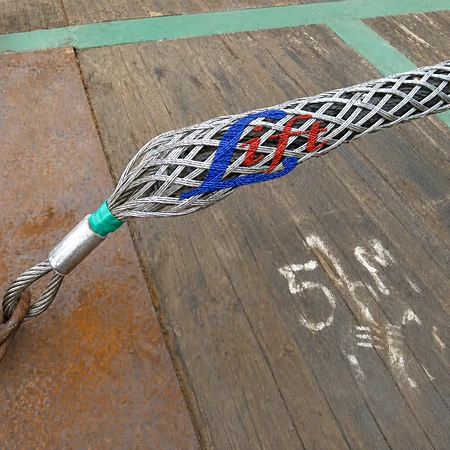
The core is galvanised steel wire rope — aircraft cable — in 6×19, 6×36WS or 6×37 construction, sized to the capacity; our wire rope slings run from 8 mm to 60 mm. The rope is closed with a swaged ferrule joint, the standard termination for a wire rope sling of this type, and the joint sits inside the sleeve where it cannot foul the load.
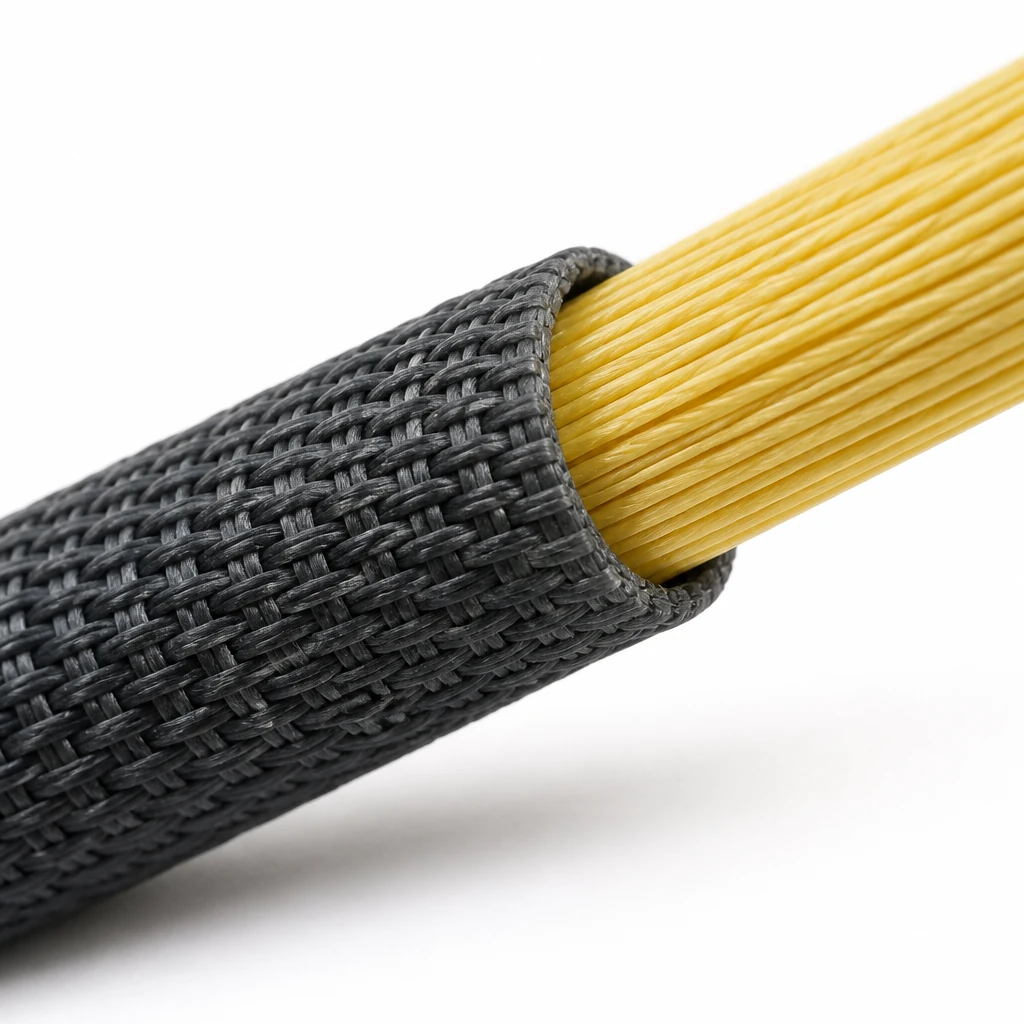
The sleeve is woven polyester, black for stage and studio work, so it does not bounce light and does not read against the masking. It protects the rope from abrasion, from the truss and from the deck, and it is what your riggers actually handle. Because the sleeve hides the core, a cut sleeve is the finding that takes the sling out of service — there is no way to inspect the rope inside.
Wire core or textile core?
The two look alike in the rig and are quoted against each other constantly. The difference is what is inside, and it decides the job.
| Property | Wire core (steel cable inside) | Soft core (polyester / aramid / UHMWPE) |
|---|---|---|
| Elongation under load | Very low — the trim height holds | A few per cent — a fixture sits slightly low |
| Creep on a standing load | None | Possible, depending on the fibre |
| Weight in the hand | Heavier | Light — easily carried to a grid |
| Conforming to a truss tube | Limited by the rope’s bend radius | Settles into the curve of a chord or barrel |
| Minimum bend | A D/d limit that must be observed | Not a governing limit |
| Sustained heat | Tolerates more than a textile core | Limited by the fibre in the core |
| Pre-use inspection | On the sleeve — the rope cannot be seen | On the sleeve, which is also the load path in part |
| Best for | Dead-hung fixtures at exact heights, fixed and long-term rigs | General stage rigging, flown trusses, scenery, arrays |
Steel is not the default. Most theatrical rigging is done with a soft-core sling because it is lighter, conforms to the truss and has no bend-radius constraint. The wire core earns its place where the height must not move.
Technical parameters
Core construction, termination and the length convention are our standard wire rope sling specification. Capacity, circumference and rope diameter are made to order and confirmed on the approved drawing before production.
| Parameter | Specification |
|---|---|
| Model reference | XLF-WCTS-2T (assigned per sling) |
| Form | Endless closed loop — a steel wire rope core inside a woven sleeve: no exposed cable, no metal presented to the load |
| Core | Galvanised steel wire rope (aircraft cable); 6×19, 6×36WS or 6×37 construction; rope diameter sized to the capacity (our wire rope slings run 8 mm – 60 mm) |
| Core termination | Swaged ferrule joint, enclosed inside the sleeve |
| Sleeve | Woven polyester sleeve, black for stage, studio and touring work; a wear layer over the rope, not the strength |
| Working load limit | 2 t — the standard theatre size; other capacities built to order |
| Design factor | 5:1 minimum to ASME B30.9 and EN 13414-1 |
| Elongation | Very low under load, and no creep on a standing load — the reason a dead-hung fixture holds its trim height |
| Circumference | The closed-loop circumference is the ordered length; eye-to-eye length ≈ ½ × circumference |
| Length | Built to the trim height on the drawing — give us either the circumference or the eye-to-eye length you need |
| Arrangement factors | Vertical 1.0 × · basket up to 2.0 × at a narrow angle · choker 0.8 × — confirm the arrangement on the order |
| Bend limit | The rope’s minimum bend diameter (D/d) must be observed; bending tighter than the rating reduces capacity |
| Marking | WLL, core construction, length and identification on the sewn label; black sleeve |
| Working temperature | A steel core tolerates sustained heat above the limit of a textile core; the polyester sleeve still has its own limit, so state the temperature on the enquiry |
| Testing | Proof loaded before dispatch on our own 1,000 t horizontal test machine; certificate with each sling |
| Sertifikatlash | Idoralar / ISO 9001; test report with each order |
| Compliance context | Wire rope sling design to ASME B30.9 / EN 13414-1; stage machinery is inspected under EN 17206, which has replaced DIN 56950-1, and under BGV C1 in Germany |
| Soft-core alternative | Same form with a polyester, aramid or UHMWPE core — see Theatrical Stage Round Lifting Sling |
Length: the circumference is what you order
A closed loop has no ends to measure between, so it is quoted by its circumference — the length of rope if the whole loop were laid out straight — and the length from one side to the other works out at roughly half of it. The same convention applies to the wire core as to a textile endless sling, and it is the convention most often got wrong on an enquiry.
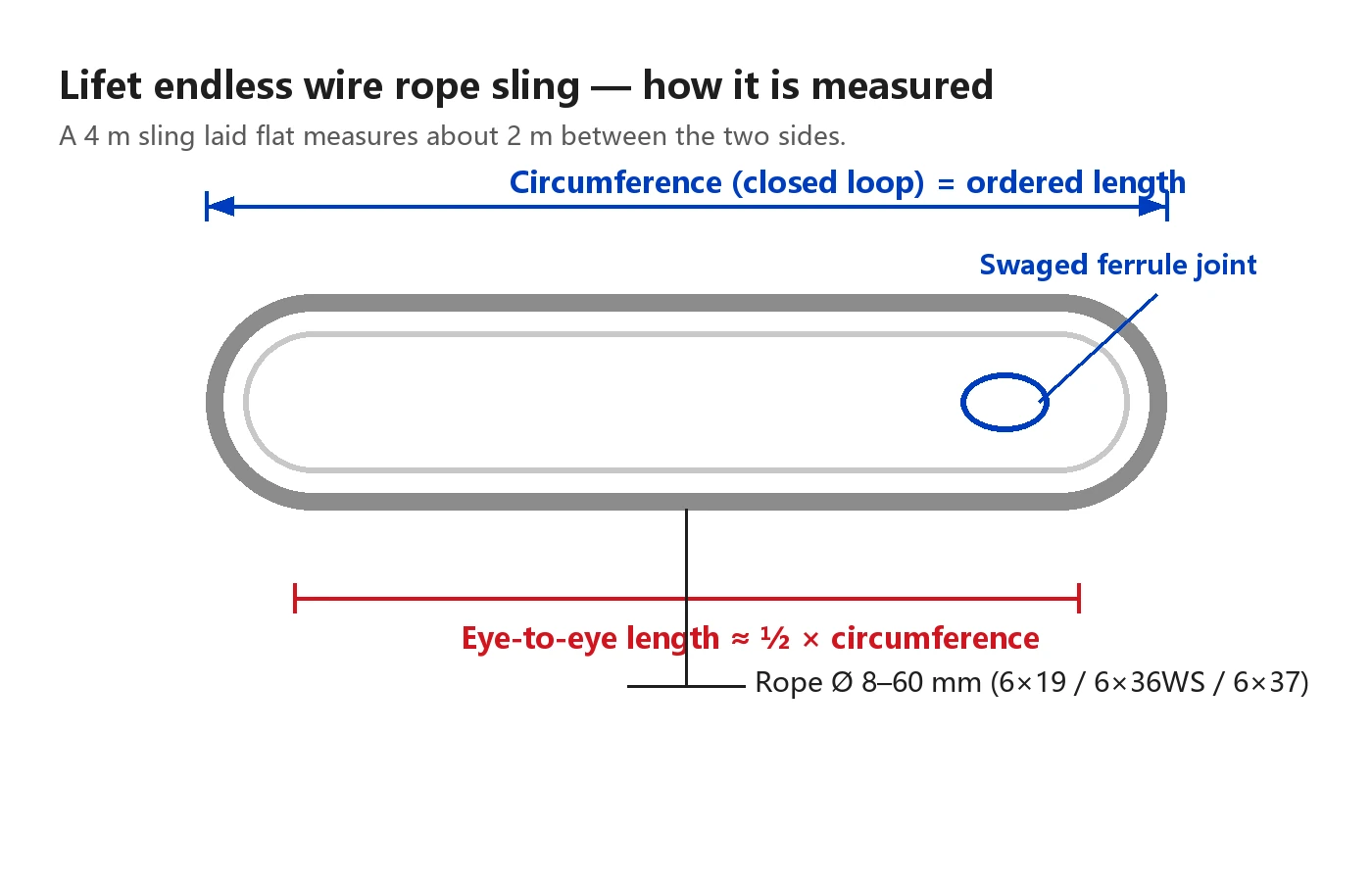
Tell us the working height you need — the distance from the hook to the load, which is what most people actually know — plus the arrangement you will rig, and we will convert it and confirm the circumference and the rope diameter before the sling is made.
Where it is used
- Dead-hung fixtures at a fixed trim height — profiles, moving heads and follow spots that have to land in the same place every night.
- Long-term and installed rigs — venues, studios and worship spaces where the rig is set once and left.
- Multi-leg assemblies — where leg lengths have to stay as drawn instead of settling.
- Positions running hotter than a textile core should be asked to take.
- Any lift where the geometry must not change between the first set and the last performance of a run.
Handling, bend limits and inspection
- Observe the rope’s minimum bend diameter. A wire core bent tighter than its rating loses capacity, so give us the chord or barrel diameter it will wrap.
- Never kink, knot or drag a wire core sling; a kink in the rope is permanent damage inside a sleeve you cannot open.
- Inspect the sleeve before each use for cuts, abrasion, heat glazing and chemical staining. A sleeve cut through to the rope retires the sling.
- Check the loop ends where the core turns and the label for legibility — on a wire core the label is the only thing carrying the capacity, since the colour is black.
- Store it coiled and off the floor, and never let it sit against a hot fixture housing or in chemical contact.
- A sling that has been kinked, overloaded, or exposed to a heat source or a chemical comes out of service pending a decision.
What to send us for a quotation
- The capacity you need per sling — 2 t is the standard theatre size
- The working height, or the circumference if you already quote it that way
- What it goes around — truss chord, barrel or eye — and the diameter, so we can check the bend limit
- The arrangement: vertical, basket or choker
- How hot the position runs, and whether the load stays on for hours or days
- The marking your venue needs to read, and the sleeve colour you want
Send the rig details or a photograph of the truss through our contact page and we will confirm the capacity, the circumference, the rope construction and the sleeve before the sling is made. For the wider family see dumaloq slinglar, and for the same closed form without a steel core see the endless round sling.
Frequently asked questions
Does a 2.0T wire core stage sling stretch under load?
Very little, compared with a textile core, and it does not creep. That is the whole point of specifying it: a dead-hung fixture, a truss or a long-term installation keeps the trim height it was set to, instead of settling as a synthetic core relaxes under a load that stays on it for hours or days.
Is the steel cable exposed?
No. The galvanised wire rope sits inside a closed woven polyester sleeve, so nothing metal touches the truss or the paintwork. The sleeve is a wear layer over the rope rather than the strength — and because the rope cannot be seen, the integrity of the sleeve is what the pre-use inspection turns on.
Can I bend it around a tight radius?
A wire rope has a minimum bend diameter, and bending it tighter than that reduces the capacity. The D/d relationship — the diameter the sling is bent around divided by the rope diameter — governs it, so tell us the chord or barrel diameter the sling will wrap. A textile core conforms to a curve without that limit, and that is the main thing the wire core trades away.
When should I choose a wire core instead of a textile core?
When the height has to repeat exactly, when the load stays on for a long time, or when the position runs hotter than a textile core should be asked to take. For general stage rigging most work is done with a soft-core sling — lighter, conforming, and with no bend-radius limit. See the theatrical stage round lifting sling; where heat is the driver rather than stretch, an aramid round sling or a high temperature round sling may suit better.
Related products
- Theatrical Stage Round Lifting Sling — the soft-core black stage sling, and the right first choice for most rigging.
- Endless Round Sling — the jointless closed form in the full capacity range.
- Aramid Round Sling — Kevlar-class core for hot fixtures and standing loads.
- High Temperature Round Sling — for hot metalwork and foundry positions.
- Eye-Eye Round Sling and round sling with eyes — where a defined eye end suits the rig better than a plain loop.
- Wire Rope Slings — the bare wire rope product this core comes from, 8 mm to 60 mm.
- Ko'taruvchi yoyuvchi nur — to keep the legs vertical on a long bar or truss.
- Polyester Webbing Slings — where a flat band suits the aperture better.
Request a quotation for your 2.0T wire core theatre stage sling — tell us the trim height, the arrangement and the diameter it wraps, and we will size the loop and the rope to it.