

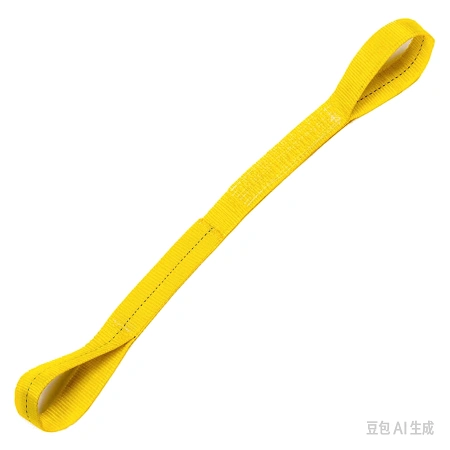
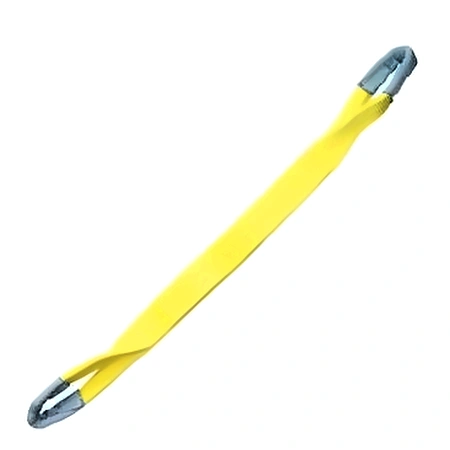
Te hamani nei te hoê taata hamani hoho'a i te Polyester Flat Eye & Mata Web Sling,Te mata papa'i i ni'a i te mata Polyester Web Sling,Eye and Eye Web Slings (Mata papa'i aore râ mata roroa).
Webbing Sling · Eye and Eye
Mata papa'i polyester & Mata Web Sling
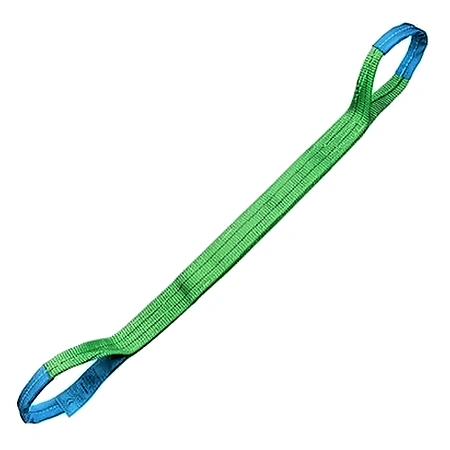
A polyester flat eye & eye web sling is the most direct answer to a simple question: where does the sling attach? Two folded, stitched eyes at each end sit straight on the hook, the shackle or the master link, and the distance between them is fixed at the length you ordered. No wrapping, no threading, no adjustment on site. Made from 100% polyester teitei webbing in a flat band 25–300 mm Lātū, rated 1 t 24 t working load limit and built to I ROTO 1492-1 e te hoê 7:1 design factor. Where the lift is planned and repeated — a mould, te hoê pŭpŭ, a bundle that lands in the same cradle every time — this is the sling the method statement is written around.
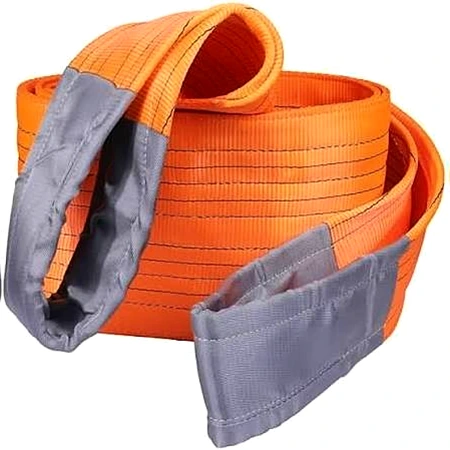
E piti mata, one fixed length
The eye and eye form does one thing the endless sling cannot: it declares where the sling attaches. That matters more than it sounds. On a planned lift the rigger does not choose a hitch, he executes one, and a sling with two defined pick-up points makes the geometry of the lift repeatable — the same angle, the same leg length, the same headroom, every cycle.
It also makes the sling’s condition visible. An eye is a discrete component: you can look at the fold, the stitching rows and the hook contact zone in one glance, and condemn it on evidence rather than on the average condition of a two-metre band.
The trade-off is that everything is decided at order time — the working length, the eye length and the ply. Get the length convention wrong and the sling arrives either short and unusable or long and out of headroom. Both are avoidable, and both start with the two numbers below: the length convention, and the eye length that clears your hook.
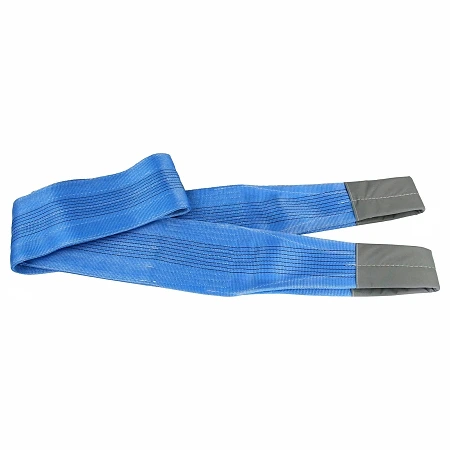
Mata papa'i aore râ mata roroa?
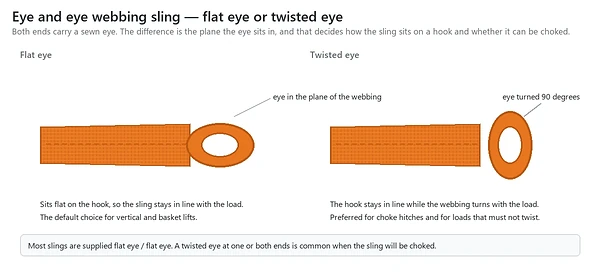
Both ends of an eye and eye sling carry a sewn eye. The difference is the plane the eye sits in, and it decides how the sling sits on a hook. It is the first specification question on almost every enquiry.
| Atiʻi | Mata papa'i | Mata roroa |
|---|---|---|
| Eye plane | In the plane of the webbing | Turned 90° to the webbing |
| On the hook | Lies flat on the hook seat; the band stays in line with the load | Hook stays in line while the band turns with the load |
| Mea maitai roa a'e | Vertical and basket lifts, loads that must not rotate | Choker hitches, and loads that would otherwise twist the band |
| Common supply | Ha'api'ira'a, both ends | One or both ends, i ni'a i te aniraa |
| Parau | Wider seating on the hook, less eye wear | Keep the twist out of the bearing area; check the eye fold more often |
Most slings ship flat eye at both ends. A twisted eye at one or both ends is specified when the sling will be choked, or when the load must stay square to the hook. Mixed configurations — flat one end, twisted the other — are a normal build, not a special.
Technical specification
| Parameter | Te mau faataaraa |
|---|---|
| Hoa | Polyester flat eye & eye web sling / flat eye to eye polyester web sling / te mata e te mata |
| Ha'api'ira'a | I ROTO 1492-1, 7:1 faahoro; I 1353 referenced for Australian supply |
| I hea 'oe | 100% polyester teitei (PES); polyamide e polypropylene i ni'a i te aniraa |
| WLL | 1 t – 12 t single ply standard; 2 t – 24 t ply piti; multi-ply up to 50 t i ni'a i te aniraa |
| Te hoê hoho'a | 7:1 e piti ONE 1492-1; 6:1 e 8:1 engineered to specification |
| Webbing | 7.5 mm ply hoê; 2 × 7.5 mm (15 mm) ply piti; hohoa 25 – 300 mm |
| Te roaraa o te mata | 300 – 900 mm faito, measured with the eye pulled flat; longer eyes to order |
| Working length | Te roaraa o te ohipa maitai (EWL) 0.8 – 3 m faito, custom to 200 m; tolerance ±3% |
| Te mata | Folded eye, multi-row lock stitching across the full band width; reinforced eye with inner sleeve available |
| Te faaroaraa | Max 3% i WLL; max 10% at breaking load |
| Mā'i'i | −40 °C e tae atu i te +100 °C (polyester) |
| Te tapa'oraa | I ROTO 1492-1 tae, one black stripe per tonne, WLL, Raʻa, i hea 'oe, ha'api'ira'a, te taata hamani e te pŭpŭ |
| Te mau papa'iraa | MTC, type-test reports and Declaration of Conformity; CE e tae atu i te 2006/42/CE i nia i te 7:1 faahoro |
| Te tapo'iraa | PE pute, carton, pallet; matched sets packed and labelled as a set |
Te mau rahi tu'ati
Pick by the vertical WLL, then read across for the eye length that fits your hook or shackle. Single ply is 7.5 mm polyester; double ply is two plies sewn into a 15 mm, giving more capacity at the same width and a band that resists cutting better.
| Mā'ohii | Ply | Tae | WLL faati'a | WLL | Te ete WLL | Hohoa | Te roaraa o te mata | Min te roaraa |
|---|---|---|---|---|---|---|---|---|
| EWE-1T | Mānono | Violet | 1,000 kg | 800 kg | 2,000 kg | 30 mm | 300 mm | 0.8 m |
| EWE-2T | Mānono | Matie | 2,000 kg | 1,600 kg | 4,000 kg | 60 mm | 300 mm | 1 m |
| EWE-3T | Mānono | Ō'ō | 3,000 kg | 2,400 kg | 6,000 kg | 90 mm | 350 mm | 1 m |
| EWE-4T | Mānono | Kekeu | 4,000 kg | 3,200 kg | 8,000 kg | 120 mm | 500 mm | 1.5 m |
| EWE-5T | Mānono | Ura | 5,000 kg | 4,000 kg | 10,000 kg | 150 mm | 550 mm | 1.5 m |
| EWE-6T | Mānono | Puraunu | 6,000 kg | 4,800 kg | 12,000 kg | 180 mm | 600 mm | 1.5 m |
| EWE-8T | Mānono | Uriuri | 8,000 kg | 6,400 kg | 16,000 kg | 240 mm | 700 mm | 2 m |
| EWE-10T | Mānono | Kāpā | 10,000 kg | 8,000 kg | 20,000 kg | 300 mm | 800 mm | 2 m |
| EWE-12T | Mānono | — | 12,000 kg | 9,600 kg | 24,000 kg | 300 mm | 900 mm | 2 m |
| EWED-2T | Tāta'ipiti | Matie | 2,000 kg | 1,600 kg | 4,000 kg | 30 mm | 350 mm | 1.5 m |
| EWED-4T | Tāta'ipiti | Kekeu | 4,000 kg | 3,200 kg | 8,000 kg | 60 mm | 400 mm | 1.5 m |
| EWED-6T | Tāta'ipiti | Puraunu | 6,000 kg | 4,800 kg | 12,000 kg | 90 mm | 450 mm | 1.5 m |
| EWED-8T | Tāta'ipiti | Uriuri | 8,000 kg | 6,400 kg | 16,000 kg | 120 mm | 500 mm | 2 m |
| EWED-10T | Tāta'ipiti | Kāpā | 10,000 kg | 8,000 kg | 20,000 kg | 150 mm | 550 mm | 2 m |
| EWED-12T | Tāta'ipiti | — | 12,000 kg | 9,600 kg | 24,000 kg | 180 mm | 600 mm | 3 m |
| EWED-16T | Tāta'ipiti | — | 16,000 kg | 12,800 kg | 32,000 kg | 240 mm | 700 mm | 3 m |
| EWED-20T | Tāta'ipiti | — | 20,000 kg | 16,000 kg | 40,000 kg | 300 mm | 800 mm | 3 m |
| EWED-24T | Tāta'ipiti | — | 24,000 kg | 19,200 kg | 48,000 kg | 300 mm | 900 mm | 3 m |
I ni'a 10 t te EN 1492-1 colour code no longer applies — the sewn label and the black stripes (one per tonne) govern. E hamanihia te mau roaraa roa a'e e te mau faito teitei a'e no te faaue; multi-ply builds up to 50 t are quoted against the lift, not off a shelf.
Two-leg lifts: the arithmetic that decides the size
The label is a single-sling figure in a straight lift. Almost every eye and eye sling is used in a pair, and the pair changes the number. I ROTO 1492-1 gives a mode factor for a two-leg assembly that already accounts for both legs: 1.4 with the legs up to 45° from vertical, e 1.0 i rotopu i te 45° e te 60°.
| Te koki o te avae mai te vertical | Fa'ahoro'ā | What it means in practice |
|---|---|---|
| 0–45° | 1.4 | The normal working range. TE 6 t load needs 2 × 5 t: 6 ÷ 1.4 = 4.3 t per sling. |
| 45–60° | 1.0 | No capacity gain from the second leg at all — the same 6 t load now needs 2 × 6 t. |
| Hoê avae, tūti'a | 1.0 | Hoê sling, hoê avae: the label figure, no reduction. |
| Hoê avae, ua hepohepo | 0.8 | The eye passes round the load and back through itself or through the hook. |
Hi'oraa i ravehia
TE 6 t mould lifted on two eye and eye slings with the legs at 30° from vertical: 6 t ÷ 1.4 = 4.3 t required per sling → EWE-5T (5 t, 150 mm, 550 mm mata). Open the legs to 55° and the same lift needs 6 t per sling → EWE-6T. The load has not changed; the rigging has. Ten degrees of leg angle bought a heavier sling, and that is exactly the conversation to have before the order, eiaha i muri a'e.
Raʻa: the number buyers get wrong
An eye and eye sling carries two length figures and only one of them is the lift. Te te roaraa o te ohipa (EWL) is the distance between the bearing points — inside of one eye to inside of the other, laid flat and unloaded. That is what determines headroom. Te roaraa taatoa includes both eyes, so it is longer than the EWL by roughly two eye lengths. TE 2 m EWL e 550 mm eyes measures about 3.1 m hopea i te hopea.
I ROTO 1492-1 holds the EWL to ±3% of nominal, measured with the sling laid flat on a tape graduated in millimetres. I ni'a i te hoê 6 m sling that is 180 mm of permitted variation — which is why matched sets for multi-leg lifts are ordered as a set and stamped with their own length, rather than assembled from stock.
If you know the hook height above the load’s pick-up points, send that instead of a length. It is the number that actually constrains the lift, and it removes the ambiguity entirely.
Matched pairs and multi-leg assemblies
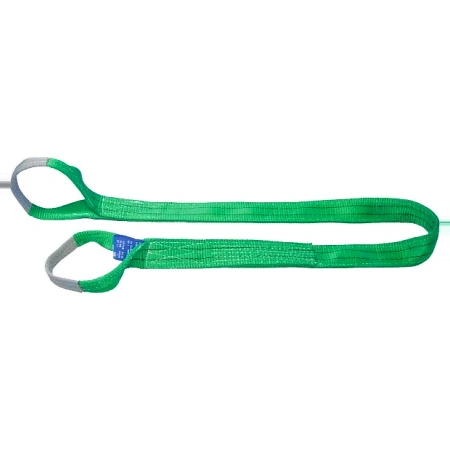
Two slings of nominally the same length can differ by up to 3% each, in opposite directions. On a symmetric two-leg lift that is enough to put most of the load into one leg, and on a four-leg assembly it is enough to make one leg do nothing at all while another is overloaded — the classic reason a four-leg set is rated as a two-leg set off two legs.
- Order as a set — state the number of legs and the length once, and the slings are cut, sewn and measured together.
- Same ply, same eye length — a mixed set changes both the stretch and the geometry.
- Label the set — batch number and set number on every label, so a sling that comes back from repair can be matched to its partners.
- Check on arrival — lay the set flat together and compare bearing point to bearing point before the first lift.
Where these slings earn their keep
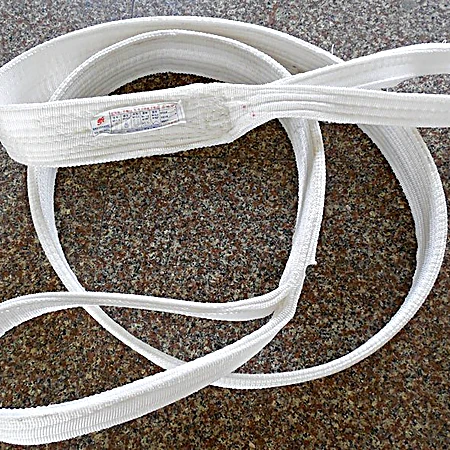
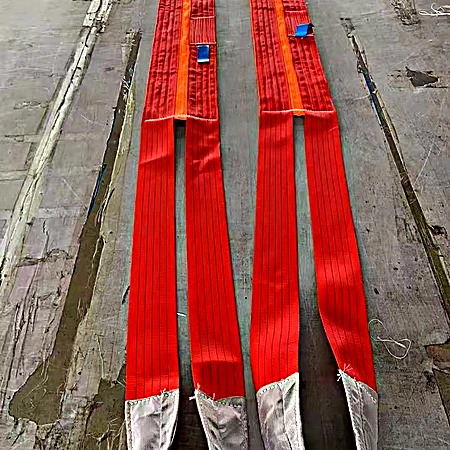
- Te mau rave'a precast e te sima — two eyes onto two lifting anchors or a spreader, wide band on the concrete face, no marking of the finish.
- Moulds, dies and tooling — a repeatable pick-up point that does not change between cycles.
- Machinery and skids — eyes straight onto hooks or shackles, no wrap that could slip on a painted surface.
- Stone and finished plate — flat band in a basket with sleeves, where a wire rope would leave a line.
- Containers and stillages — four-leg assemblies off a master link, ordered as a matched set.
For repetitive basket and choker work on the same load profile, te tahi Sling webbing hope ore is the better article, because the wear rotates around the loop instead of staying at two eyes. On delicate or highly finished surfaces a sling porotiti conforms better still.
Hi'opo'araa: the eye is the part that fails first
Webbing rarely fails in the middle. It fails at the eye-to-body junction, where the load path turns through the fold and the stitching carries the whole rated load in shear. That junction gets the first thirty seconds of every inspection.
- Eye fold: te mau, te hi'o, or a fold that has flattened and hardened. Withdraw it.
- Te tuituiraa: broken or pulled threads, a stitch line that has started to unravel at the edge, or a seam that has elongated.
- Hook contact zone: the inside of the eye wearing thin where the hook sits. This is the highest-pressure point on the whole sling.
- Manahune: te mau, abrasion and chemical or heat damage along the full length, both faces.
- Ā'ā'ati: legible WLL and length, and matching the lift plan. A sling without a readable label is out of service.
Never knot a sling, and never join two slings eye-to-eye through each other: that doubles the load on a single eye and puts the connection outside any rated configuration. Connect through the eye with a shackle sized to it. A tapea i te pǔpǔ ia vai paari e ia vai ore, pad edges, and stay inside −40 to +100 °C.
Te mau uiraa ui-pinepine-hia
What is a flat eye and eye web sling?
A flat woven polyester sling with a sewn eye at each end, the eyes lying in the plane of the webbing. The eyes connect directly to hooks, shackles or master links and the working length between them is fixed at manufacture. Rated 1 t 24 t i roto i te faito au noa, 7:1 e piti ONE 1492-1.
Flat eye or twisted eye — which do I need?
Flat eye for vertical and basket lifts and for loads that must not rotate; it sits flat on the hook and keeps the band in line with the load. Te mata roroa ia hepohepo ana'e te ofa'i, or when the load must stay square to the hook while the band turns. Mixed ends are a normal build.
How is the length measured?
Te roaraa o te ohipa maitai: inside of one eye to inside of the other, laid flat and unloaded, held to ±3% by EN 1492-1. Overall length includes both eyes and is longer by roughly two eye lengths. If you know the hook height above the pick-up points, send that instead.
Can eye and eye slings be used in a choker?
ae. Pass one eye through the other, or pass the sling round the load and hook both eyes. Capacity falls to 0.8 of the label figure, and a twisted eye is usually specified because the eye then sits correctly in the choke.
What is the difference from an endless sling?
Aita e hopearaa to te hoê ofa'i hope ore: hoê loop, aita e mau tao'a, and the wear rotates around it. An eye and eye sling has two defined pick-up points and a fixed length, so the lift geometry repeats exactly. Use eye and eye for planned lifts with hardware, endless for repeated basket and choker work.
Do you supply matched pairs and multi-leg sets?
ae, and they should be ordered as a set rather than assembled from stock. Same ply, same eye length, measured together and labelled with a set number, so the legs share the load as designed.
Can it lift hot or sharp loads?
Polyester is rated −40 to +100 °C; above that use a heat-resistant or wire rope sling. Sharp edges need sleeves or corner pads — flat webbing cuts far more easily than a round sling.
What we need to quote
A polyester flat eye & eye web sling is made to the lift rather than picked off a shelf, so the first sample lands closer the more of these numbers you can give us.
- Load weight, shape and the pick-up points; number of legs and the leg angle
- Working length (EWL) or the hook height above the load — say which
- Eye length needed to clear the hook or shackle, and flat or twisted eye
- Ply hoê aore ra ply piti; colour code if a specific WLL band is required
- Te mau rima, edge protection or reinforced eyes for abrasive duty
- Ha'api'ira'a, tapa'oraa, documentation and destination market
Send your lift details for an eye and eye sling quotation
Te niuniu / WeChat: +86 180 6600 2268 | Imera: 702461526@qq.com
Tuʻaʻana: Te vahi faaapu no Lifute, Te oire no Taizhou, Mataeinaa no Jiangsu, Te fenua Taina