

Lift sling rigging company manufacture Polyester Webbing Sling,Endless Polyester Webbing Sling,Eye and Eye Polyester Webbing Sling,Polyester Webbing Sling with eyes,Polyester Flat Webbing Sling,Polyester Webbing Lifting Sling.
Polyester Webbing Sling.
Last updated 28 October 2026 · reviewed against EN 1492-1
The default sling for anything finished, painted or machined: ha polyester flat webbing sling spreads its load over width instead of concentrating it on a hook, stretches no more than 3 %, and states its capacity in the colour of the weave.
In one line: a polyester webbing sling is a flat woven PES band with an eye at each end (or an endless loop), fakafuofua 1 t ki he . 100 t working load limit at a 6:1 safety factor to EN 1492-1, elongating ≤ 3 % at that load, and colour coded so the capacity is readable from across the yard.
Ko e hā ia ., in engineering terms
Polyester yarn is woven into a flat band, the band is folded or stacked into plies to reach the required break, and the ends are either looped back and stitched into an eye or woven closed into an endless loop. The stitch pattern is the joint: it puts the load into shear across the full width rather than into the last row of thread.
Two properties make it the standard choice. It is soft, so it bears on the load over the full band width instead of marking it. And it is stiff in extension — 3 % at WLL against 8–10 % for nylon — so a pair of slings stays level and a height-critical pick stays predictable.
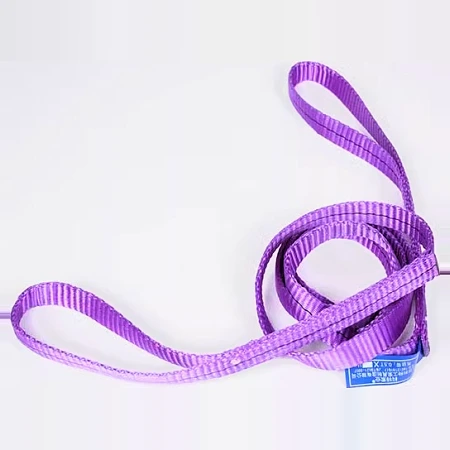
Working load limit by width
The capacity of a polyester webbing sling is set by the cross-section of load-bearing yarn, which is width × plies. The table gives the conventional single-ply range; anything above it is built in multiple plies of the same width.
| Web width | WLL | Min. break | Ngaue'aki angamaheni |
|---|---|---|---|
| 25 mm | 1.0 t | 6 t | Tooling, small components |
| 35 mm | 1.5 t | 9 t | Workshop general purpose |
| 50 mm | 2.0 t | 12 t | The most ordered size |
| 75 mm | 3.0 t | 18 t | Fabrications, ngaahi konga 'o e misini |
| 100 mm | 4.0 t | 24 t | Painted steel, panels |
| 125 mm | 5.0 t | 30 t | Pipe, bundled sections |
| 150 mm | 6.0 t | 36 t | Precast units |
| 200 mm | 8.0 t | 48 t | Heavy fabrications |
| 240 mm | 10.0 t | 60 t | Modules, skids |
| 300 mm | 12.0 t | 72 t | Top of the single-ply range |
| ʻolunga 12 t | Multi-ply builds of 300–400 mm web — see the 60 toni mo e 100 toni slings | ||
Nominal values for the standard build. The label on the article is the governing figure, and every sling is proof loaded against its serial before dispatch.
Capacity by hitch: the number that is not on the tag
The tag gives one figure, for a vertical lift. Every other arrangement derates it, and this is where most site errors start — a 5 t sling choking a 4.5 t load is an overload, not a margin.
| Hitch | Factor | HA 5 t sling gives |
|---|---|---|
| Hangatonu, single leg | 1.0 | 5.0 t |
| Kafo | 0.8 | 4.0 t |
| Kato, 0–45° | 2.0 | 10.0 t |
| Kato, 45–60° | 1.4 | 7.0 t |
| Two legs, 0–45° | 1.4 | 7.0 t per assembly |
| Two legs, 45–60° | 1.0 | 5.0 t per assembly |
| Four legs, 0–45° | 2.1 | 10.5 t per assembly |
The colour is the capacity
ʻI LOTO 1492-1 assigns a colour to each WLL, which is the fastest inspection on site: if the band is yellow it is 3 t, whatever the paperwork says. ʻolunga 10 t no colour is assigned, because the band becomes too wide for colour alone to be reliable — there the label and the set record carry it.
| Lanu | WLL | Lanu | WLL |
|---|---|---|---|
| Vaioleti | 1 t | Kulokula | 5 t |
| Lanu mata | 2 t | Lanu koko | 6 t |
| Lanu engeenga | 3 t | Lanu pulū | 8 t |
| Kulei | 4 t | Moli | 10 t |
ASME B30.9 does not use colour coding; the tag states the WLL and the hitch. Never infer capacity from colour on a sling built to B30.9.
Eye types and builds
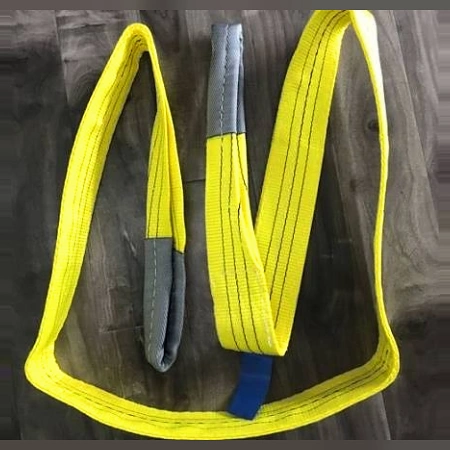
- Eye and eye — an eye at each end, the most common build; the eye is sized to the shackle or hook it will sit in, not to the band. See the eye and eye flat web sling.
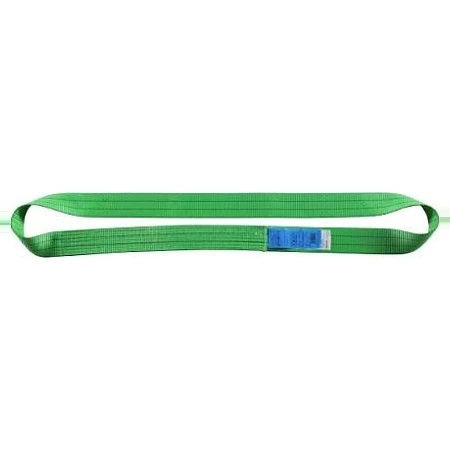
- Endless — a closed loop with no stitching at the load path, used where the sling must be passed around the load. Sio endless lifting web slings.
- Reverse eye — the eye turned through 90° so the band lies flat against a corner; the build for a load with square edges.
- Sleeved eye — a heavier cover over the eye, the wear part that is replaced before the weave is touched. Worth it wherever the sling chokes a shackle.
- Heavy eye — a reinforced, larger eye for a large bow shackle or a crane hook at high tonnage.
Polyester against the other fibres
| Fibre | Fakaloloa 'i he WLL . | Choose it when | Avoid when |
|---|---|---|---|
| Polyester (PES) | ≤ 3 % | The pick must stay level and the load must not be marked. The default. | Uta faka'ohovale, or alkalis at strength. |
| Nailoni (PA) | 8–10 % | The band has to absorb a snatch or a swell. | Height-critical lifts; it stretches and recovers. |
| UHMWPE | Lower still | Mass is the problem — the same rating at a fraction of the weight. | Mafana, or a load left hanging: it creeps. |
| Alamiti | Ma'olalo | Castings, welded fabrications, furnace areas. | Cost-driven orders; abrasion without a sleeve. |
Specifying one in five answers
- Load per leg, not total load — and whether the figure is already derated for the hitch.
- Hitch and angle: hangatonu, kafo, basket, or multi-leg, and at what included angle.
- Lōlōa: the effective working length, eye to eye, not the cut length of web.
- Eye size and fitting: the shackle bow or hook it has to sit in.
- ʻātakai: surface, fua mafana, kemikale, and whether it will be stored wet or in sunlight.
Questions about polyester webbing slings
What is a polyester webbing sling?
A flat woven band of polyester yarn, with an eye at each end or woven into an endless loop, rated for lifting. It is the standard sling wherever the load is finished, painted or must not be marked by wire rope.
What safety factor does it have?
6:1 to EN 1492-1 mo e 5:1 to ASME B30.9. HA 2 t sling therefore has a minimum breaking load of 12 t, and the label states which basis it was built to.
How much does it stretch?
No more than 3 % 'i he fakangatangata 'o e kavenga ngaue, and it recovers when the load comes off. Nailoni, by comparison, runs 8–10 %, which is why polyester is preferred for precision picks and paired lifts.
What do the colours mean?
In EN 1492-1 the band colour states the WLL: vaioleti 1 t, lanu mata 2 t, lanu engeenga 3 t, kulei 4 t, kulokula 5 t, lanu koko 6 t, lanu pulū 8 t, moli 10 t. ʻolunga 10 t there is no assigned colour and the label carries the figure.
Polyester or nylon?
Polyester for a controlled pick: 3 % against 8–10 % fakaloloa, and better resistance to UV and to weak acids. Nylon is the answer where the band must absorb shock, or where alkalis are present.
Can it be used choked?
ʻIo, ʻi 0.8 of the vertical rating — a 5 t sling chokes 4 t. The choke point wears fastest, so a sleeve there is worth fitting rather than replacing the sling.
When is it retired?
On a cut or snag through the weave, broken or drawn stitching, a distorted or worn eye, glazing from heat, chemical damage, or an unreadable label. Any one of those retires the sling; none of them is repairable.
Related: all webbing slings · · eye & eye flat web sling · · endless web slings · · endless lifting slings · · WLL 60 ton webbing slings · · 100 tonne webbing sling · · ngaahi sling takai · · ngaahi slings maea uaea · · one way slings · · ngaahi kupenga hiki uta
Tell us the load and the hitch
Send the load per leg, the hitch and the length eye to eye, and we will come back with width, ply count, eye size and the labelled WLL — on a drawing, before anything is woven.
Hiki Sling Rigging 'a e Kautaha., Ltd · Lifting & rigging division of China Lifute Sling Group
Tel / WeChat +86 180 6600 2268 · 702461526@qq.com
Paaka Ngaue'anga 'o Lifute, Kolo ko Taizhou, Vahefonua Jiangsu, China · HS code 630790
Figures are for the standard build to EN 1492-1 ʻi 6:1; ASME B30.9 builds at 5:1 are available. The labelled working load limit always governs the lift, and the mode factors above do not replace a lift plan.