 702461526
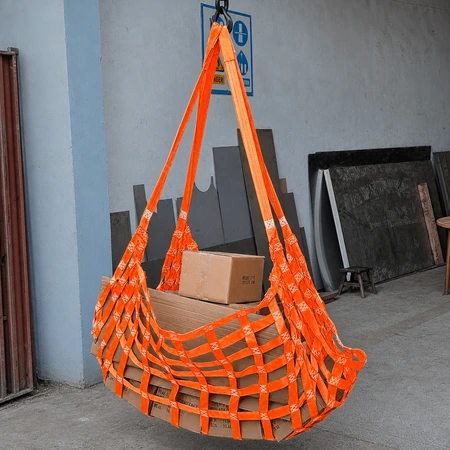
Lift sling rigging company produce Cargo Securing Net,Load Securing Net,Small mesh cargo securing net,Container securing net,Cargo secure webbing net
Cargo Securing Net
A flat-belt restraint net that stops the load moving in transit — woven to order in Taizhou, China
Short description
A cargo securing net is made of flat belts through a special process, and it is used to prevent traffic accidents caused by the movement of goods during transportation. The belts are woven into an open lattice, laid over the load and tensioned down to the vehicle or container, so the load is held in place instead of being left free to slide, rock or topple.
It is important to be clear about what this product is. A securing net restrains a load; it does not lift one. Restraint is a different duty from lifting, it is calculated differently, and it is governed by a different standard. Getting that distinction right is what keeps a load on the truck — and it is the reason this page is written around restraint rather than lifting capacity.
We weave the belts ourselves, so band width, mesh, net size and fittings are set to your load and your vehicle rather than to a catalogue. Nets are supplied with ratchet tensioners and marked with the lashing capacity and pre-tension in daN, and the products carry CE and GS certification. The lifting versions of these nets are on the cargo lifting nets pages — this page covers restraint only.

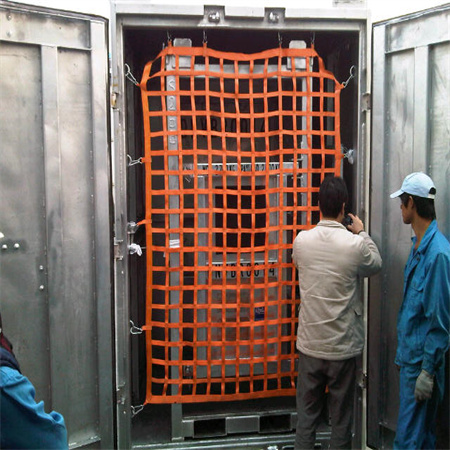
Figure 1 — A flat-belt net fitted across a container doorway, restraining the goods behind it so they cannot shift in transit.
1. What a cargo securing net is
The net itself is simple: flat high-strength webbing belts woven into an open lattice, with a stitched and reinforced border and attachment points at the corners and along the edges. What makes it a securing product rather than a lifting product is everything around that lattice.
- It is tensioned, not lifted. The net is pulled down onto the load with ratchet tensioners until it presses the cargo against the deck. It never takes the load’s weight.
- It works through friction and containment. The downward pressure raises the friction force between load and deck, and the lattice stops the load spreading, rocking or shifting sideways.
- It is rated in restraint terms. The label carries the lashing capacity (LC) and the standard tension force (STF) in daN — the units used for load securing — not a lifting working load limit.
- It has to hold in every direction. Braking pushes the load forward, acceleration pulls it back, cornering throws it sideways, and a poor road can lift it. A net laid over a load addresses several of those at once.
- It is quick to apply and reusable. One net over a load replaces dozens of individual straps, and it folds into a bag at the end of the trip.
Securing nets are supplied in three practical forms: a cover net that lies over a load on a flatbed or in a container, a partition or bulkhead net that holds cargo back from a door or a bulkhead, and a bag form for loose goods that would otherwise spread. The fittings differ between them; the restraint principle does not.
2. Securing is not lifting: why the two are rated differently
This is the single most important thing to understand about a cargo securing net, and the most common mistake buyers make. A net that looks like a lifting net is not a lifting net, and the reverse is also true. The two duties are calculated on different bases, and using one for the other is a safety failure rather than a paperwork problem.
| Point of comparison | Cargo securing net (this page) | Lifting net |
|---|---|---|
| What it does | Restrains a load that stays on the vehicle | Carries the full weight of a load in the air |
| Governed by | EN 12195-1 (calculation of securing forces) and EN 12195-2 (webbing lashings) | Lifting standards, with the webbing rated on the EN 1492-1 basis |
| Rated in | Lashing capacity (LC) and standard tension force (STF), in daN | Working load limit (WLL), in tonnes |
| Safety basis | Sized so the arrangement resists the acceleration and friction case for the journey | Sized with a 5:1, 6:1 or 7:1 factor and proof-tested per sling |
| Tested | The band and the tensioner are type-tested to EN 12195-2 | Every sling breaking-load tested on our own 1000 t machine |
| Failure mode | The load moves — which means a road accident | The sling breaks — which means a dropped load |
Table 1 — Why a securing rating and a lifting rating are not interchangeable.
If your requirement is to lift a load — a pallet onto a roof, a bundle into a hold — you need a lifting net: the crane pallet cargo net, the polyester webbing net for lifting or the heavy duty nylon cargo net sling. If your requirement is to keep a load still from the loading bay to the delivery point, you are in the right place.
3. How a flat-belt net holds a load
A securing net works through three mechanisms at once, and the diagram below shows where each one acts.

Figure 2 — Left: the net over a load, the lashing straps and the ratchet tensioner. Right: the four directions the load tries to move, and the friction that resists all of them.
| Mechanism | How it works | What it needs from you |
|---|---|---|
| Friction (tie-down) | The tensioned net presses the load onto the deck, and friction between load and deck resists sliding. This is the primary effect of a cover net | A clean, dry deck, or anti-slip mats. Without friction the same net restrains far less |
| Containment | The lattice physically stops the load spreading, rocking or throwing individual items out | A mesh fine enough that the smallest item cannot pass through, and the net fitted tight rather than loose |
| Direct restraint | Where the net is anchored to the load’s own securing points and to the deck, the belt itself carries the restraint force | Certified anchor points on the vehicle and on the load — never a random protrusion |
Table 2 — The three mechanisms a securing net uses.
The numbers that govern restraint are worth knowing, because they explain why a net fitted badly holds almost nothing.
- The strap angle decides the downward force. A tie-down belt is most effective between 75° and 90° to the deck. As the belt flattens, the effective downward force falls away — at about 30° you keep only around half of it, because the effective capacity follows LC_eff = LC x sin α. A net pulled down steeply holds; a net pulled flat mostly looks tidy.
- Pre-tension is set by the tensioner, not by the belt. STF (standard tension force) is how hard the ratchet can pre-tension the belt, and it is marked on the label in daN alongside the LC. A ratchet that cannot reach the required pre-tension cannot make the net work.
- Friction is a multiplier you can change. Anti-slip mats raise the friction coefficient between load and deck, which is exactly what a frictional method depends on. The same net with mats restrains substantially more than the same net without them.
- Direct lashing follows different geometry. Where the net is anchored directly to the load, restraint comes from the belt’s own LC rather than from friction, and both the vertical angle and the plan-view angle want to sit in the 30–60° range. Four anchor lines as a minimum, two per side and crossed.
A securing net very often combines the two: the lattice over the top provides friction and containment, and the edge belts run down to the deck as direct lashings. That is why a purpose-made net restrains better than the same length of loose strap — the geometry is built in rather than improvised at the roadside.
4. Technical parameters
The figures below cover the standard securing range. Band, mesh, net size, edge fittings and tensioners are all made to order, so treat this table as the starting point for a quotation rather than a fixed catalogue.
| Parameter | Specification |
|---|---|
| Product type | Cargo securing net (load restraint net) — cover net, partition net or bag form. Not a lifting device |
| Band material | 100 % high-tenacity polyester (PET) webbing; high-tenacity nylon on request |
| Band width | 25 mm / 35 mm / 50 mm / 75 mm / 100 mm |
| Band layer | Single layer or duplex (two layers stitched as one belt) |
| Band thickness | 1.8 mm – 4.0 mm depending on width and layer count |
| Mesh opening | 100 × 100 mm standard; 50 mm – 300 mm to order |
| Net size | Made to the load footprint, the vehicle bed, or the container or doorway aperture |
| Lashing capacity (LC) | Marked on the net label in daN; set from the belt width, layer count and number of anchorage lines |
| Pre-tension (STF) | Set by the ratchet tensioner and marked on the label in daN |
| Standard basis | EN 12195-1 (calculation of securing forces) and EN 12195-2 (webbing lashings) |
| Edge | Folded and double-stitched border; reinforced at every attachment point |
| Fittings | Ratchet tensioners, hooks, D-rings, cambuckles, lashing points; grade 80 steel where used |
| Colour | Orange standard for visibility; blue, green, black or custom |
| Treatment | UV-resistant, anti-ageing, abrasion and tear resistant |
| Working temperature | -40 °C to +100 °C |
| Certification | CE / GS / JIS; ISO 9001; CNAS laboratory; DNV |
| Customisation | OEM / ODM size, printed webbing, label, logo, colour and packing |
Table 3 — Cargo securing net: technical parameters.
 Flat high-strength belts woven into a 100 mm square lattice with a folded and double-stitched border Flat high-strength belts woven into a 100 mm square lattice with a folded and double-stitched border |
 Corner detail: the reinforced attachment point where the net is tensioned down to the deck Corner detail: the reinforced attachment point where the net is tensioned down to the deck |
5. Standard net sizes
A securing net is sized to the load it covers or to the aperture it closes, not to a lifting capacity. The load must be fully covered, with the border landing on the deck or on the anchor points rather than hanging in mid-air.
| Net size | Mesh | Band | Typical use |
|---|---|---|---|
| 1.0 × 1.0 m | 100 mm | 25 – 35 mm | Small pallets and crates in vans and light trucks |
| 1.2 × 1.2 m (4 × 4 ft) | 100 mm | 35 – 50 mm | Standard pallet load on a flatbed or in a curtain-sider |
| 2.5 × 1.2 m (8 × 4 ft) | 100 mm | 50 mm | Two pallets abreast, van and light truck beds |
| 2.5 × 2.5 m | 100 mm | 50 mm | Flatbed loads, machinery and mixed cargo |
| 5.0 × 2.5 m | 100 – 150 mm | 50 – 75 mm | Full-length flatbed and trailer loads |
| 2.4 × 2.6 m (container aperture) | 100 mm | 75 mm | Container doorway net — restrains the load behind the doors |
| Made to drawing | 50 – 300 mm | 25 – 100 mm | Any load footprint, vehicle bed or aperture size |
Table 4 — Standard securing net sizes. Custom sizes, mesh and attachment points are made to drawing.
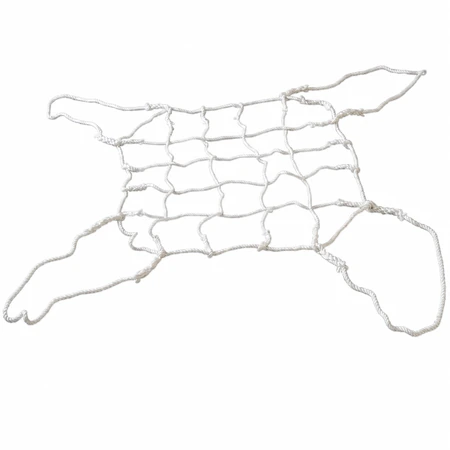
 A flat securing net laid out ready to fit — the border must land on the deck or the anchor points, not hang free A flat securing net laid out ready to fit — the border must land on the deck or the anchor points, not hang free |
 Bag form: for loose goods that would otherwise spread across the deck Bag form: for loose goods that would otherwise spread across the deck |
6. Cover net, partition net or bag
The same lattice is supplied in three arrangements, and the fittings differ between them. Choosing the right one is most of the job.
| Arrangement | How it is fitted | Used when |
|---|---|---|
| Cover net over the load | The net is spread over the load and tensioned down to the deck or to the vehicle’s anchor points. Friction and containment do the work | Flatbed, curtain-sider and container loads that must not move in any direction — the most common arrangement |
| Partition or bulkhead net | The net is fixed upright across the vehicle or across a container doorway and tensions against its own frame | Holding cargo back from the doors so the container can be opened safely, or separating two loads in one vehicle |
| Bag form | The net is closed at the bottom and the cargo sits inside it | Loose or bagged goods that would spread across the deck without containment |
| Tarpaulin-style cover net | A fine-mesh net laid over a load to hold a sheet or light goods down | Light cargo on open vehicles, where weight is not the problem but wind and movement are |
Table 5 — The four ways a securing net is used.

Figure 3 — A flat-belt net holding a stacked load together: the lattice contains the cargo while the tensioned belts press it onto the deck.
One practical point about the partition and container nets: their job is often to protect the person opening the doors rather than to secure the load for the journey. A load can be perfectly restrained for transport and still be dangerous the moment the doors are opened, which is why the two duties are specified separately.
7. Choosing the net and the number of lashings
The number of lashings and anchor points is not a matter of judgement on the day; it follows from the load, the deck and the journey. Four questions settle it.
- What is the gross load, and how is it presented? A dense block that cannot spread is easier to restrain than a tall, light stack that can topple. Tall loads need spring lashing or blocking against a headboard as well as a cover net.
- What is the friction between the load and the deck? Steel on steel, plastic on aluminium and wet decks all reduce friction sharply. Anti-slip mats and a clean, dry deck do more for a securing arrangement than an extra strap usually does.
- Where can the net be anchored? Anchor points must be rated for the restraint force and must be part of the vehicle structure. Never hook a belt over a random protrusion or a load’s own packaging.
- Does the load need blocking as well? Restraint at the front — against a headboard or a front stop — carries the braking force far more efficiently than any strap, and it should be the foundation the net is added to rather than an alternative to it.
Give us those four answers and the vehicle or container dimensions, and we will size the net, the band and the fittings, and tell you how many anchorage lines the arrangement needs. We will also tell you honestly when a net is the wrong answer and blocking or a different method should carry the load.
8. Fittings and tensioners
Fittings are where a securing net is won or lost. A net is only as strong as the tensioner that pre-tensions it and the anchor point it pulls against.
| Fitting | Used with | Note |
|---|---|---|
| Ratchet tensioner | Cover net, bag form | Sets the pre-tension (STF). Marked on the label; a tensioner that cannot reach the required STF makes the net ineffective |
| Cam buckle | Light duty | Lighter and faster than a ratchet, but reaches a much lower pre-tension — only for light loads |
| Hooks and D-rings | Any arrangement | The attachment between the net and the anchor point; grade 80 steel where a steel fitting is used |
| Lashing points | Cover net | Rated anchor points on the vehicle. The restraint force has to go somewhere, and it must be a rated point rather than a convenient edge |
| Protection sleeve | Sharp-edged loads | Slips over the belt at the contact point; the cheapest way to extend net life |
| Anti-slip mat | Frictional restraint | Raises the friction coefficient between load and deck — often the single most effective addition |
| Repair kit | Fleets maintaining their own equipment | Spare belt, stitching thread and a spare tensioner |
Table 6 — Fittings and tensioners for a securing net.
The straps and belts that make up a securing net come off the same looms as our webbing slings and endless round slings, so a fleet can standardise its belt width, colour and markings across lifting and securing equipment.
9. Colour, printing and identification
A securing net is inspected at the roadside and by the driver before every trip, so the identification has to be readable in bad weather and has to survive being dragged over a deck.
- Lashing capacity (LC) and standard tension force (STF) are printed along the belt in daN, which is the unit load securing is calculated in.
- The net size and the date of manufacture are printed as well, so an inspector can match the net to the vehicle and judge its age on the spot.
- A sewn capacity label is fitted in addition to the printed marking, so the net and its paperwork always agree.
- Orange is the standard high-visibility colour; blue, green, black and custom colours are available for fleet identification.
- OEM orders can carry your own brand, address, warning text or certificate number woven into the belt.
- Nets ship folded in a bag or a crate, so a fleet order takes a fraction of the space the same number of loose straps would.
10. Quality control and certification
Our webbing is certified for the lifting standard as well as being type-tested for securing duty, which is unusual in this market and useful if you buy both products from one supplier.

Figure 4 — Our own weaving floor: high-strength belts coming off the needle looms, the same webbing used in every net on this page.
 CE attestation of conformity covering our webbing slings (EN 1492-1) CE attestation of conformity covering our webbing slings (EN 1492-1) |
 ISO 9001 quality management system certificate ISO 9001 quality management system certificate |
- CE and GS certified lifting products, with JIS certification on export orders.
- Own testing laboratory — our facilities hold CNAS laboratory accreditation, European CE certification and DNV certification, with 15 authorised patents on our lifting products.
- 1000 t horizontal test machine — used to proof and break-test every lifting sling we make, and to type-test the webbing our securing nets are cut from.
- Webbing rated to the EN 1492-1 basis for strength, and belts used in securing duty are supplied to the EN 12195-2 material requirements.
- Every net marked with its lashing capacity, pre-tension, net size and mesh before packing.
- 40 years of lifting equipment manufacturing — founded in 1985 in Taizhou, Jiangsu, with more than 200 employees.
11. How to specify a cargo securing net
Eight pieces of information are enough for us to quote correctly the first time. If you are unsure about the restraint calculation, send the load details and we will work it through with you.
| Information we need | Why it matters |
|---|---|
| Transport mode and jurisdiction | Road, rail, sea or air, and which national load-securing rules apply — the calculation basis differs |
| Load details | Weight, dimensions, whether it can spread or topple, and what it is made of |
| Load and deck materials | Sets the friction coefficient, which decides how much restraint the net can actually contribute |
| Net size or aperture size | The net has to cover the load fully, or close the doorway or bulkhead it is fitted to |
| Mesh opening | Fine enough to contain the smallest item; sized from the cargo, not from the load weight |
| Band width and layer | Sets the available lashing capacity and the wear life of the net |
| Anchor points available | How many rated points the vehicle has, and where — this sets the number of lashing lines |
| Documentation and packing | LC and STF marking, certificate, test report, own-brand printing and export packing |
Table 7 — What we need to quote a cargo securing net.
12. Where cargo securing nets are used
| Mode or sector | What the net restrains | Why a flat-belt net suits it |
|---|---|---|
| Road transport, flatbed | Machinery, steel, timber, pallets, drums and mixed cargo | Covers the whole load in one action and combines friction with containment |
| Road transport, curtain-sider | Palletised and boxed goods that can shift against a soft curtain | Contains the load where the curtain itself carries no restraint |
| Container transport | Cargo behind the doors, and cargo that must not shift in transit | A doorway or partition net makes the container safe to open and stops load migration |
| Rail freight | Palletised and loose cargo in wagons and flat wagons | Long nets cover a wagon bed and can be tensioned at regular intervals |
| Sea and inland waterway | Deck cargo, and cargo inside barges and holds | Rust-free, UV-stabilised and unaffected by salt water |
| Air cargo | Palletised freight on air pallets and in pallet nets | Low net weight, and containment without sharp fittings that could damage the aircraft structure |
| Heavy haulage and project cargo | Transformers, plant and out-of-gauge loads | Combined with direct lashings and blocking for indivisible loads |
| Waste, recycling and agriculture | Bales, refuse, compost and bulk loads on open vehicles | Containment stops loose material leaving the vehicle in transit |
| Military and disaster relief | Palletised and loose relief cargo in trucks and aircraft | One net per load, quick to apply and reusable over many trips |
Table 8 — Where cargo securing nets are used, by transport mode and cargo.

Figure 5 — Load restraint at a port terminal: wide soft-contact rigging at work during loading, with a net stowed on the deck.
13. Care, inspection and retirement
- Check the net before every trip, and record the check. Look at the tensioner first, then the stitching at every attachment point, then the belts.
- Reject any belt with cuts, edge damage, broken stitching, chemical staining, heat glazing or the colour and gloss change that signals UV degradation.
- Check the vehicle’s anchor points as well as the net. A perfect net on a corroded anchor point restrains nothing.
- Keep the deck clean and dry, and fit anti-slip mats wherever the load-to-deck friction is low. This is a securing measure, not a refinement.
- Never use a securing net to lift a load, and never use a lifting net as a tensioned securing net unless the label carries both ratings.
- Store nets clean and dry, off the ground and out of direct sun, and never repair a webbing belt by knotting, welding or heating it.
- Withdraw the net from service if a belt, a stitch line or a tensioner is damaged, and have nets inspected by a competent person at the interval your fleet requires.
14. Frequently asked questions
Can I use a cargo securing net to lift a load?
No. A securing net is rated for restraint, not for lifting, and the two are calculated on completely different bases. If you need to lift, use a lifting net with a working load limit and a per-sling proof test — the crane pallet cargo net, the polyester webbing net for lifting or the heavy duty nylon cargo net sling.
What is the difference between LC and STF?
LC (lashing capacity) is the restraint force the belt is rated to carry, and STF (standard tension force) is how hard the ratchet tensioner can pre-tension the belt. Both are marked on the label in daN. LC matters most in direct lashing, where the belt itself holds the load; STF matters most in tie-down lashing, where pre-tension creates the friction that does the holding.
How tight should the net be?
Tight enough to reach the pre-tension marked on the label, with the belts running as steeply to the deck as the load allows — close to 75° to 90° is where a tie-down belt works best. A belt laid almost flat loses most of its downward force, so a net that looks neatly covered can be holding very little.
Do I need anti-slip mats?
If the restraint relies on friction — which is what a cover net does — then yes, in most cases. Anti-slip mats raise the friction coefficient between the load and the deck, and the same net then restrains substantially more. On smooth metal or plastic surfaces, mats often make more difference than an extra strap.
How many lashings or anchor points do I need?
It follows from the load, the deck friction, the vehicle and the journey, not from a rule of thumb. Direct lashing wants a minimum of four anchor lines, two per side and crossed, with the vertical and plan-view angles in the 30–60° range. Send us the load and vehicle details and we will work the arrangement through with you.
Will the net stop cargo moving inside a container?
A doorway or partition net stops the load migrating towards the doors and makes the container safe to open. For the journey itself the load still needs to be restrained as a whole, so a container is usually secured with a partition net plus blocking or dunnage rather than with a net alone.
What mesh opening should I choose?
Fine enough that the smallest item in the load cannot pass through it. 100 mm is our standard and holds pallets, cartons, bags and drums; loose or small items need a tighter mesh, and large indivisible loads can take a wider one.
Can the net be repaired?
A damaged belt cannot be repaired by knotting or heating, and a cut belt must be replaced. We supply repair kits with matching belt and stitching thread for fleets that maintain their own equipment, and we can re-weave tensioned nets to the original drawing.
What else do you make for load handling?
The same webbing goes into our webbing slings, round slings and wire rope slings, and the net range continues with the nylon flat webbing net and the webbing cargo lifting net.
15. Why buy cargo securing nets from Lift

Figure 6 — Our works at Taizhou, Jiangsu: we weave the belts, cut and stitch the nets, and test the webbing in the same plant.
- 40 years of lifting equipment manufacturing — founded in 1985 in Taizhou, Jiangsu, more than 200 employees, and one of China’s largest lifting sling and net production bases.
- Own weaving mill — belt width, layer count, colour, printing and mesh are under our control, so the net is built to your load and your vehicle rather than assembled from a catalogue.
- Own testing laboratory and 1000 t test machine — the webbing behind every securing net is strength-tested in our own plant, with CE, GS, JIS, CNAS and DNV certification behind the products.
- Lifting and securing from one supplier — one belt specification, one colour system and one set of markings across a whole fleet.
- OEM and ODM — own-brand printing on the belt, custom colours, custom sizes and export packing for distributors and fleet operators.
See the full certification set, or our export coverage below.
More from the same works: cargo lifting net · nylon cargo lifting net · polyester lifting hoisting net · nylon ropes · vehicle lifting net · safety rope nets · cable pulling socks

Figure 7 — Our lifting and securing products ship worldwide, through distributors and directly to fleet operators.
16. Request a quotation
Send us the transport mode, the load details, the net or aperture size, the mesh opening, the belt width and the anchor points you have available — or a drawing of the load and the vehicle. Our engineers will confirm the net, the fittings, the number of lashing lines and the packing, and quote it in one reply. To talk it through first, contact our engineers.
Lift Sling Rigging Company — Lifute Industrial Park, Lungsod ng TaiZhou, Lalawigan ng JiangSu, China
Tel: +86 523 8693 5818 | WhatsApp: +86 180 6600 2268 | E-mail: 702461526@qq.com
HS code 630790 — lifting nets and load restraint nets of textile materials.
Appendix A — SEO data for this page
The values below are ready to paste into the page’s SEO fields. Title and description are written to the length Google actually displays, and the keyword set is drawn from terms this page can win without competing against the lifting-net pages in the same category.
| Field | Value |
|---|---|
| Target URL | /cargo-lifting-net/cargo-securing-net/ |
| Primary keyword | Cargo Securing Net |
| Secondary keywords | cargo securement net; load securing net; load restraint net; flat belt securing net; truck cargo net; container securing net; load restraint webbing net; securing net for flatbed; cargo net for load restraint; belt cargo securing net |
| Long-tail / scenario | cargo securing net for flatbed truck; load restraint net for container doors; flat belt securing net 2.5 x 2.5 m; net to stop cargo moving in transit; truck load securing net with ratchet; anti-slip cargo net for steel loads |
| Search intent | Commercial / transactional — the searcher is specifying restraint equipment to buy |
| SEO title (49 characters) | Cargo Securing Net | Flat-Belt Load Restraint Net |
| Meta description (148 characters) | Cargo securing net woven from flat high-strength belts to stop loads moving in transit. Restraint net for trucks, containers and rail, CE certified. |
| H1 | Cargo Securing Net |
| Heading chain | H1 Cargo Securing Net → H2 per section → H3 for sub-blocks |
| Canonical | https://www.xulft.com/cargo-lifting-net/cargo-securing-net/ |
| Sitemap priority | 0.8 (product detail page, one level below the cargo lifting net hub) |
| Word count | About 5,600 words in total — roughly 3,350 words of body copy plus 2,250 words of specification tables |
| Images on page | 13 images, every one with descriptive alt text |
| Internal links | 18 unique contextual internal links (see Appendix B) |
| Tables | 15 tables — 13 specification and data tables plus 2 image grids |
| Anchor text style | Descriptive and varied; no two anchors on the page repeat the same phrase |
Table 9 — On-page SEO reference.
Appendix B — Internal link and page-weight plan
Internal links are how a new page inherits authority. Outbound links tell Google which pages are related to this one; inbound links are what actually push weight and ranking power into this page.
B1 — Outbound contextual links from this page
| Target URL | Anchor text | Where it sits |
|---|---|---|
| /products/cargo-lifting-net/ | cargo lifting nets | Short description — the category hub |
| /cargo-lifting-net/crane-pallet-cargo-net/ | crane pallet cargo net | Section 2 — the lifting alternative for pallets |
| /cargo-lifting-net/polyester-webbing-net-for-lifting/ | polyester webbing net for lifting | Section 2 — the lifting alternative in the same belt |
| /cargo-lifting-net/heavy-duty-nylon-cargo-net-sling/ | heavy duty nylon cargo net sling | Section 2 — the heavy lifting bag form |
| /webbing-sling/ | webbing slings | Section 8 — the same belt in sling form |
| /round-sling/endless-round-sling/ | endless round slings | Section 8 |
| /products/wire-rope-sling/ | wire rope slings | Section 14 |
| /cargo-lifting-net/nylon-flat-webbing-net/ | nylon flat webbing net | Section 14 |
| /cargo-lifting-net/webbing-cargo-lifting-net/ | webbing cargo lifting net | Section 14 |
| /certification/ | certification | Section 15 — the certificate page |
| /cargo-lifting-net/cargo-lifting-net/ | cargo lifting net | Section 15 — the parent detail page |
| /cargo-lifting-net/nylon-cargo-lifting-net/ | nylon cargo lifting net | Section 15 |
| /cargo-lifting-net/polyester-lifting-hoisting-net/ | polyester lifting hoisting net | Section 15 |
| /products/nylon-rope/ | nylon ropes | Section 15 — the raw material page |
| /vehicle-lifting-net/ | vehicle lifting net | Section 15 — RoRo and breakbulk |
| /safety-rope-net/aramid-fall-protection-safety-net/ | safety rope nets | Section 15 — the personnel-protection range |
| /wire-rope-sling/cable-pulling-socks-grip/ | cable pulling socks | Section 15 — the wire rope mesh grip |
| /contact-us/ | contact our engineers | Section 16 |
Table 10 — Outbound anchors on this page (18 unique internal links).
B2 — Inbound links to add, so this page gains weight
These are the links that build this page’s ranking power. Each one should be added to an existing, already-indexed page and should point at the cargo securing net URL with the anchor shown. Vary the anchor as listed rather than repeating one phrase across every source page.
| Source page | Anchor text to use | Why this link builds weight |
|---|---|---|
| /products/cargo-lifting-net/ (hub) | cargo securing net | A link from the category hub is the single strongest internal signal for a child product page |
| /cargo-lifting-net/ (section page) | cargo securement net | Passes section-level relevance together with the parent hub link |
| /cargo-lifting-net/cargo-lifting-net/ | load restraint net | The parent detail page is closely related and already indexed, so the link is worth the most in context |
| /webbing-sling/ | load securing net | Material page to finished-product page: a natural relevance match |
| /cargo-lifting-net/heavy-duty-nylon-cargo-net-sling/ | flat belt securing net | The lifting sibling; the two pages should link both ways because the same buyer needs both duties |
| /cargo-lifting-net/crane-pallet-cargo-net/ | truck cargo net | Pallet and vehicle loads are where restraint is specified most often |
| /products/nylon-rope/ | securing net for flatbed | Raw material page to finished product page |
| Homepage (products list or footer) | cargo lifting net | One homepage link to the section is enough; do not point the homepage at this page directly |
Table 11 — Inbound internal link plan.
Two rules keep the cluster healthy. First, keep these anchors distinct from each other and from the anchors used on the lifting-net pages — repeating one phrase across many internal links is the fastest way to create keyword cannibalisation inside your own site. Second, this page should sit one click from the hub and no deeper: breadcrumb Home > Products > Cargo Lifting Net > Cargo Securing Net, with the breadcrumb links in the HTML rather than only in a script.
Appendix C — Google indexing and ranking checklist
| Item | What to do for this page |
|---|---|
| Indexability | Return HTTP 200, keep the page out of noindex, and make sure it is not blocked in robots.txt |
| Canonical | Self-referencing canonical to https://www.xulft.com/cargo-lifting-net/cargo-securing-net/ |
| XML sitemap | Include the URL in the product sitemap, then resubmit the sitemap in Google Search Console |
| Internal links | Apply both tables in Appendix B. The page needs at least one inbound link from an indexed page before it will be crawled quickly |
| Title and description | Use the two values in Appendix A; keep them unique against the lifting-net pages, which target different keywords |
| Heading structure | One H1, then H2 per section, then H3 for sub-blocks — never skip a level |
| Image SEO | Descriptive alt text on all 13 images, file names in lower case with hyphens, WebP format, and lazy loading below the fold |
| Structured data | Add Product JSON-LD with name, image, description, brand and manufacturer, plus BreadcrumbList for the breadcrumb path and Organization at site level |
| Core Web Vitals | Compress images to WebP, set width and height on every image to avoid layout shift, and defer non-critical scripts |
| Terminology caution | This page deliberately targets restraint language (securing, load restraint, lashing capacity, LC, STF) and must not be optimised for lifting keywords. That separation is what stops this page competing with the lifting nets in the same category |
| Existing content to keep | The page already carries the five product bullets — fully customizable safety ratio / length / colour, premium materials, wear and high-temperature resistance, soft flexible lightweight with no harm to cargo, and CE and GS certification. Keep the ones that still apply, but note that the lifting wording should be replaced with restraint wording on this page |
| Search Console | Submit the URL for indexing, then check the Page Indexing and Core Web Vitals reports a week later |
| Rank tracking | Track the primary keyword plus the three main secondary keywords weekly against the parent page and the top three competitors |
Table 12 — Google indexing and ranking checklist.