

Lift sling rigging company produce High Temperature Lifting Sling,High Temperature Sling,Heat Resistant Sling,Heat Resistant Flat webbing sling,High Temperature Resistant Flat Webbing Sling,high temperature resistant aramid sling,High Heat Resistant Round sling,High Temperature Resistant Soft Round Sling.
สลิงยกอุณหภูมิสูง
ก high temperature lifting sling is not a single product, and the two shapes it is sold in are not interchangeable. The fibre is the same in both — aramid, the Kevlar-class filament with no melting point — but where that fibre sits decides how the sling behaves when the heat arrives. In a flat band the aramid is the load path. In a round sling it is a core inside a sleeve that can be taken off and replaced. Everything that follows is a consequence of that one difference.
Polyester, nylon and polypropylene webbing slings stop at roughly 90 องศาเซลเซียส. That is not a margin you can argue with; it is the point where the yarn starts losing the structure that carries the load, long before anything is visible on the outside. Above that band you need aramid, and once you are specifying aramid the question is only ever: flat or round?
Two Shapes, One Fibre — What Each One Is For
Both forms are made to order from 1 ถึง 100 ที, both use a 7:1 safety factor as standard, and both can carry a woven heat resistant sleeve where the sling meets the hot surface. The choice is decided by the shape of the load and by what you are willing to replace.
High Temperature Flat Webbing Sling
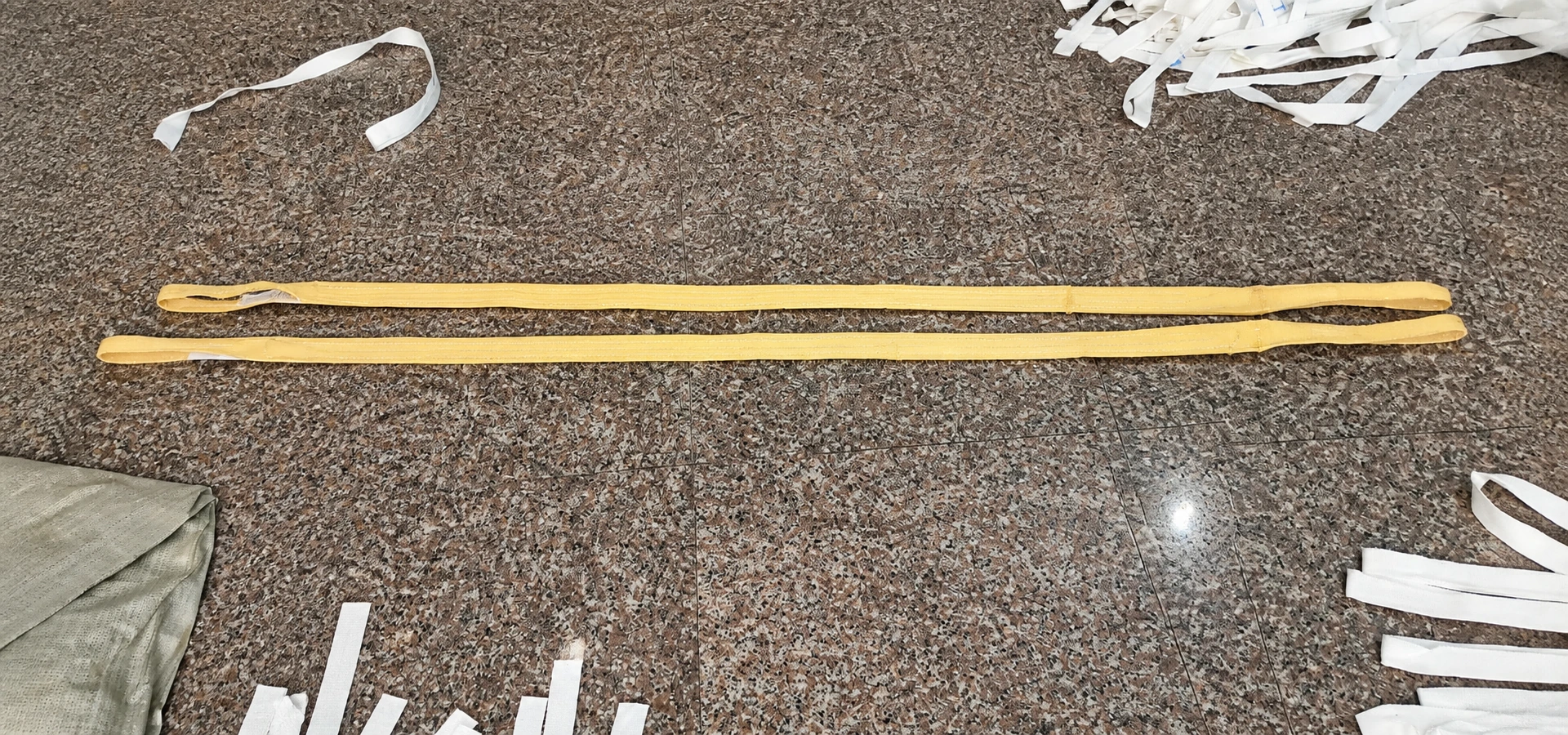
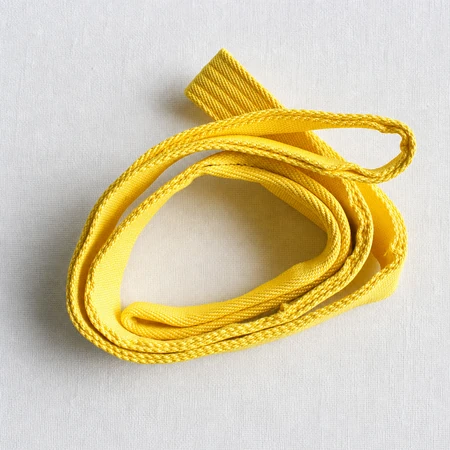
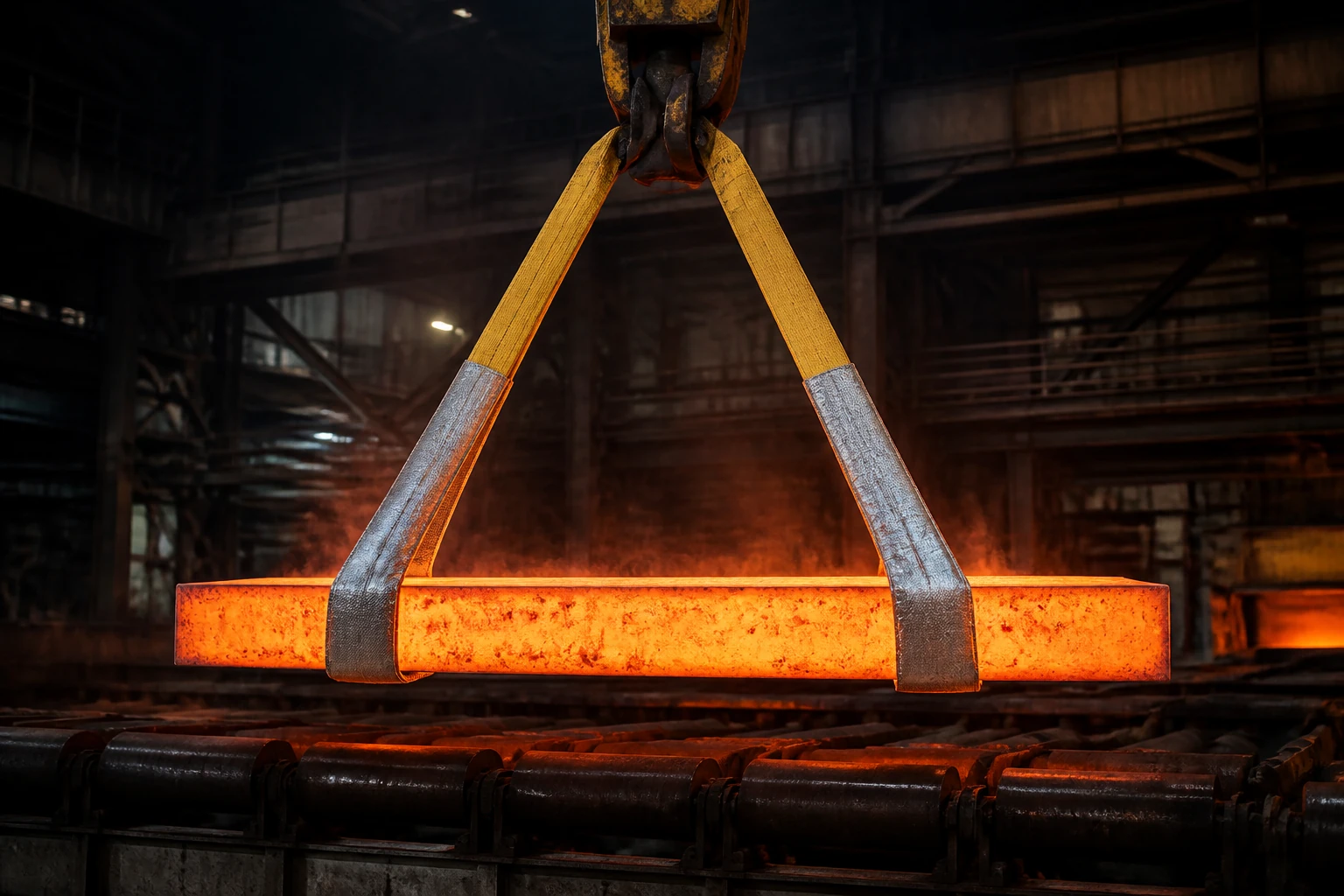
A flat band is the direct descendant of an ordinary webbing sling: warp yarns run the length of the band and every one of them carries load. In the high-temperature version those yarns are aramid, and a sacrificial sleeve is fitted — sliding or fully sewn — over the section that will touch the workpiece.
- Best bearing behaviour on flat work. Slabs, plate, billet ends, fabricated sections and anything with a straight edge gets a wide, even contact patch instead of a line contact.
- Thin in the gap. Where the hook opening or the clearance under the load is tight, a flat band costs less room than a round body of the same capacity.
- The whole load path is visible. You can inspect the aramid along its full length, which matters on a fibre whose heat damage shows as a scorched or brittle patch.
- The weak point is structural, not cosmetic. Because the band is the load path, a burn through the sleeve and into the band retires the sling, not just the cover. On curved loads the band also touches along a single line, so heat and pressure concentrate in the same place.
Full construction detail, sleeve options and the aramid temperature ladder are on the สลิงสายรัดอุณหภูมิสูง page.
High Temperature Round Sling
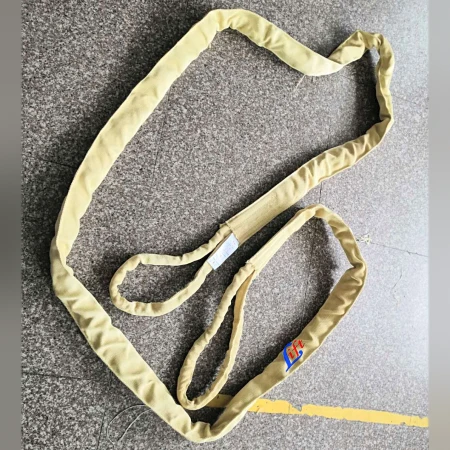
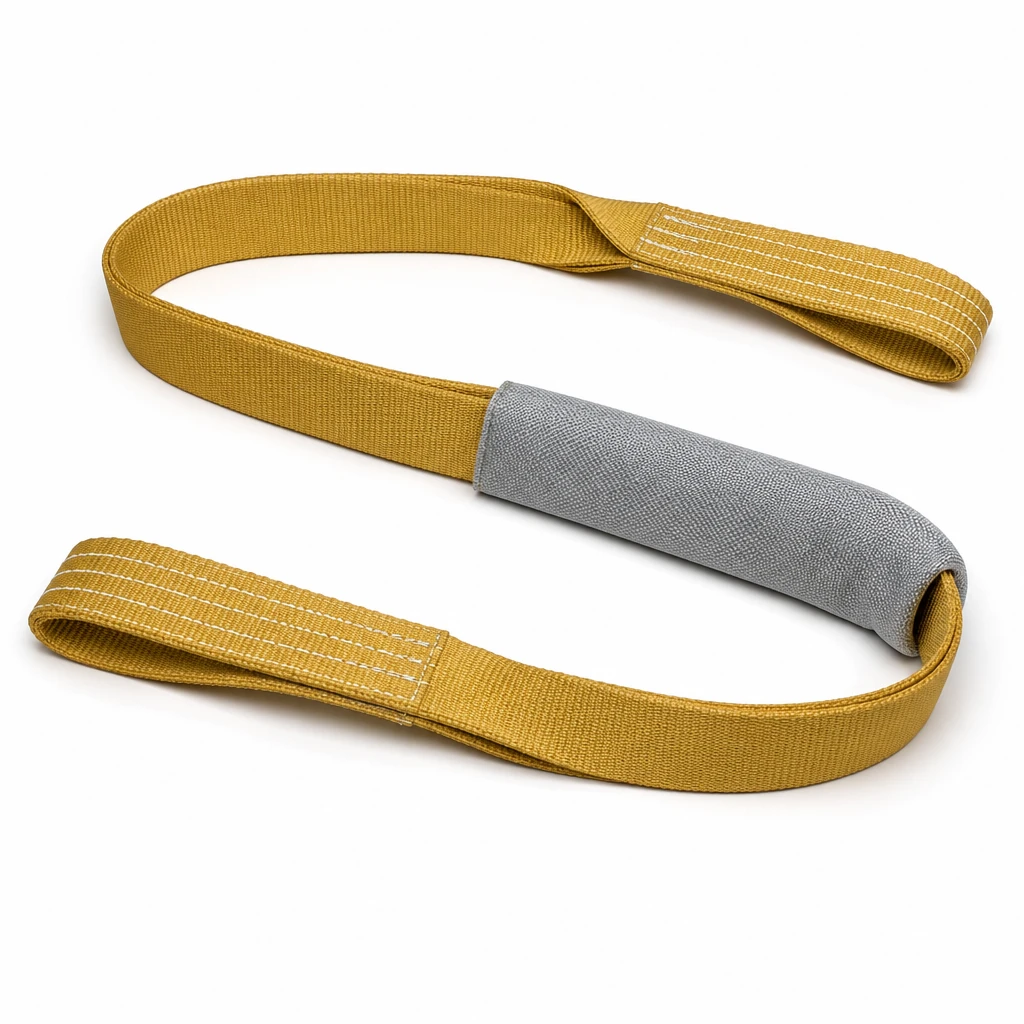
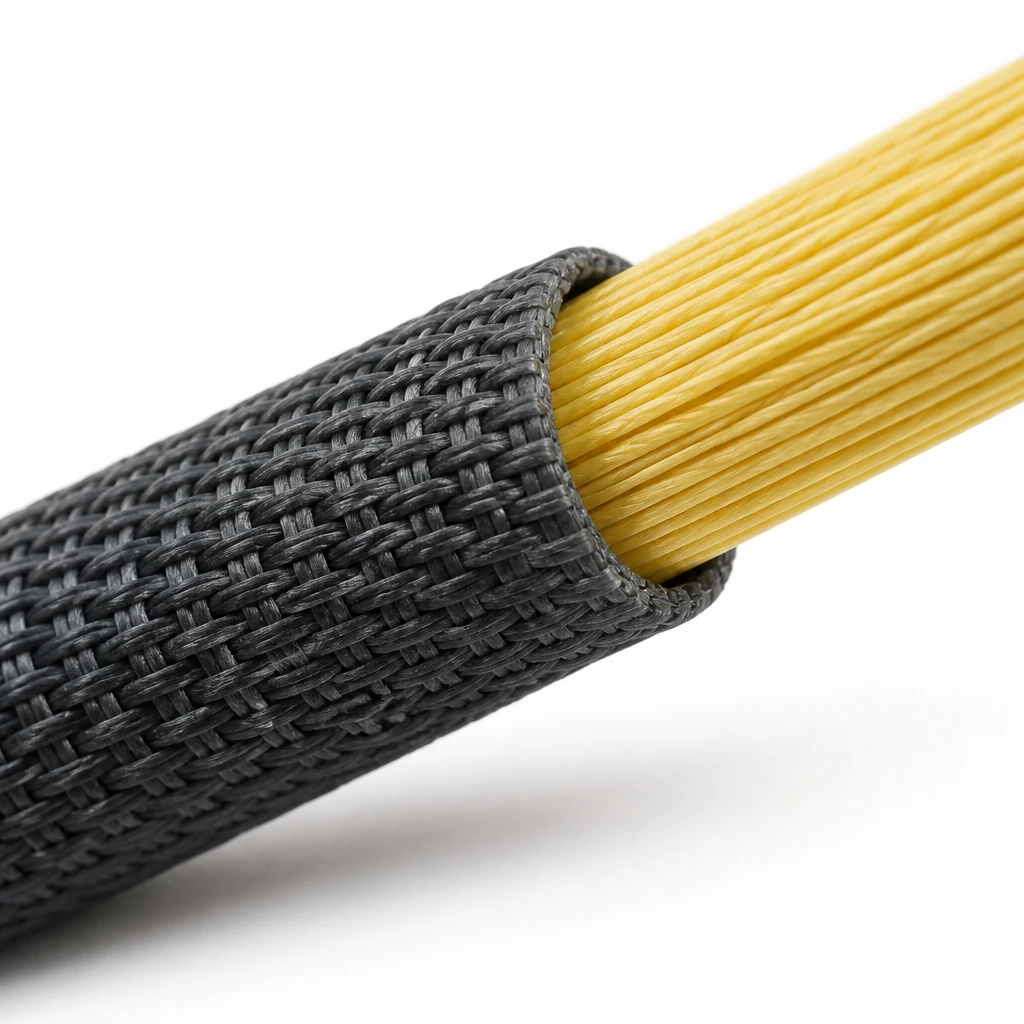
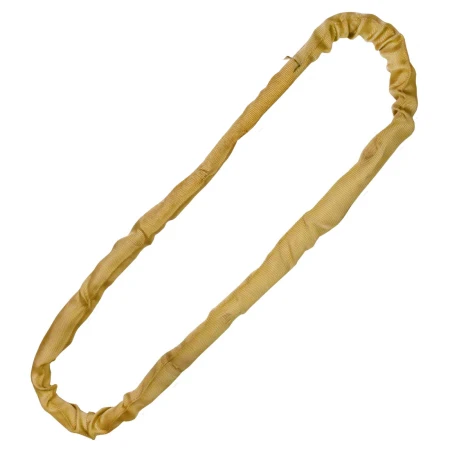
A round sling turns the construction inside out. The load path is a parallel filament core sealed inside a woven tubular sleeve, closed into an endless loop with no ends and no stitching in the load path. The sleeve is a separate part — and on hot work that is the entire commercial argument, because the sleeve is what burns and the sleeve is what you replace.
- The heat protection is replaceable. A scorched or worn-through cover comes off and a new one goes on; the core behind it stays in service.
- Core and sleeve can be different fibres. A polyester core under an aramid sleeve covers the 90–150 °C band that most hot work actually falls into, without paying for aramid in both parts.
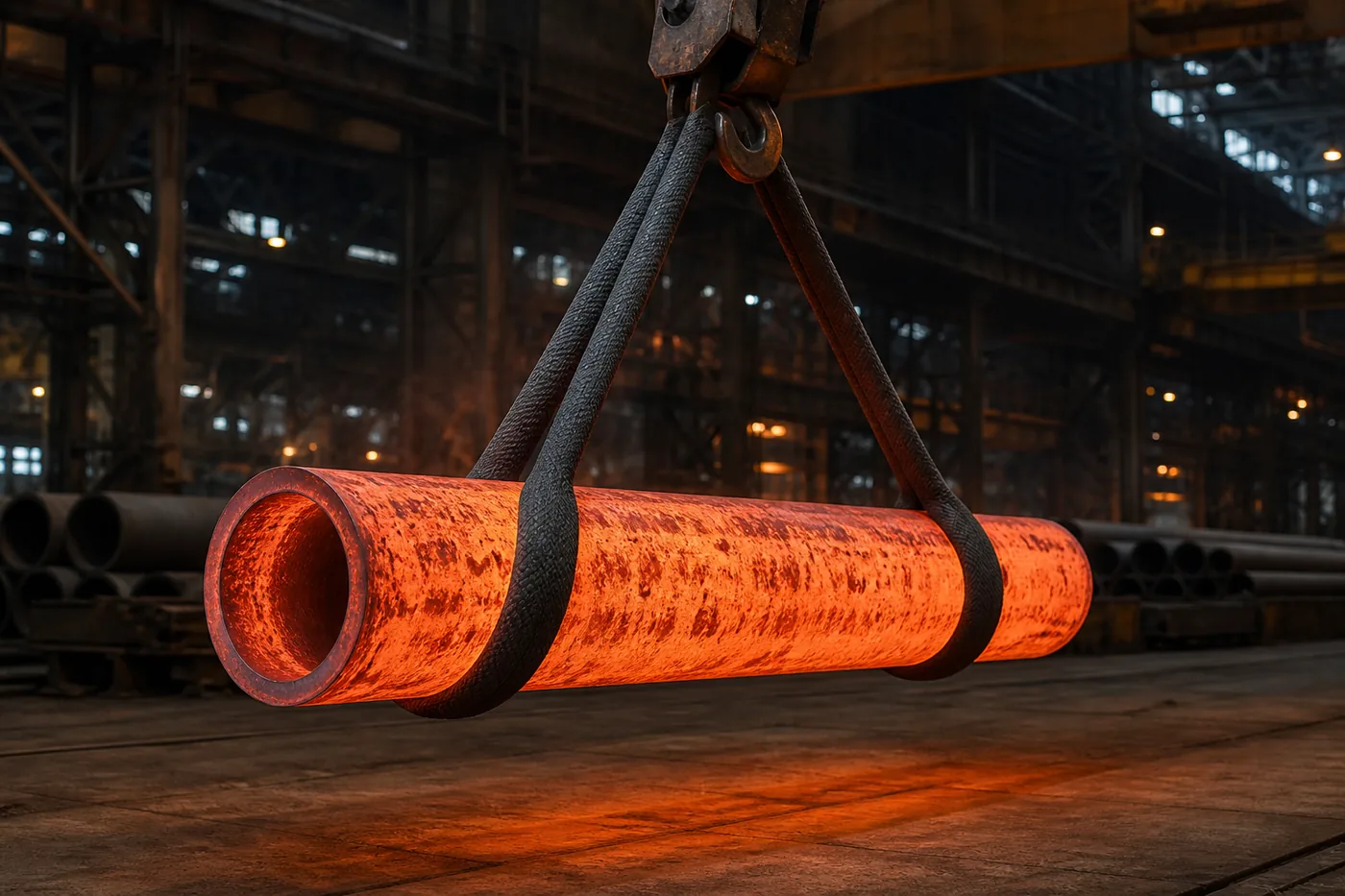
- It conforms. Pipes, rolls, dies, trunnion pins and castings get 180° of contact instead of a line, which spreads both the bearing pressure and the heat.
- Capacity without width. A parallel core carries heavy loads in a compact body, which is why the 30–100 t hot lifts are usually round slings.
- The trade-off is inspection. The core is hidden. You judge the sling by the sleeve, then slide the sleeve back and look at the core before it goes back into hot service.
Sleeve combinations, spare sleeves and the full specification range are on the heat resistant round sling page; the aramid-core version is the aramid round sling, and the heavy end is covered by the heavy-duty para-aramid endless round sling.
Flat Against Round, On A Hot Job
The same job can often be rigged either way. These are the rows that actually decide it.
| Decision | Flat webbing sling | สลิงกลม |
|---|---|---|
| Where the heat protection sits | In the load path — the band itself is aramid | In a separate sleeve over the core |
| What you replace after a burn | The sling | The sleeve, supplied as a spare part |
| Core and sleeve fibre | Single fibre throughout | Can differ — cheaper core, heat-resistant sleeve |
| Contact on a curved load | A single line along the band edge | Conforms around the curve |
| Contact on plate and slab | Wide, even bearing patch | Narrower contact band |
| Body width for the same capacity | Thin in the hook gap | Rounder, bulkier body |
| Inspection of the load path | Visible full length | Hidden inside the sleeve |
| Best fit | Hot plate, slab, billet, fabrication | Hot pipe, roll, die, mould, heavy curved work |
Technical Parameters
The values below are the standard range. Anything on this page is produced to order, so the figure that governs your lift is the one stated on the quotation and the sewn label.
| Parameter | ข้อมูลจำเพาะ |
|---|---|
| ผลิตภัณฑ์ | High temperature lifting sling — flat webbing and round, aramid construction |
| Load-bearing fibre | Aramid (Kevlar-class / Aramid 1414) high-modulus filament; polyester core with aramid sleeve for 90–150 °C duty |
| Heat resistant sleeve | Woven aramid, glass or coated sleeve — sliding or fully sewn, fitted to the contact section |
| ขีดจำกัดภาระการทำงาน | 1–100 t: 1 · 2 · 3 · 4 · 5 · 6 · 8 · 10 · 12 · 15 · 20 · 25 · 30 · 40 · 50 · 100 ที |
| ปัจจัยด้านความปลอดภัย | 7:1 as standard (ใน 1492-1 / ใน 1492-2 practice); other factors to order |
| Band width (flat) | 25–300 mm, single or multi-ply, matched to the capacity |
| Effective working length | 0.5–20 m standard; longer to order |
| การยืดตัวเมื่อขาด | ประมาณ. 3–4 % for aramid — low stretch, low creep under a standing load |
| Continuous working temperature | ประมาณ. 200 °C aramid band; up to approx. 300 °C at the sleeve/load interface on heavy-duty builds |
| Short excursion | Brief exposure up to approx. 500 °C — dwell time is the limiting variable |
| จุดหลอมเหลว | None — aramid chars and decomposes instead of melting |
| Ends / form | Flat: eye-and-eye or endless. Round: endless loop, no stitching in the load path |
| การทำเครื่องหมาย | Sewn label with working load limit, length and batch; sleeve marking optional |
| การบรรจุ & OEM | Coil in poly or carry bag, labelled carton; full OEM on capacity, ความยาว, sleeve and label |
On standards. The general-purpose sling standards list polyester, polyamide and polypropylene, with a scope of roughly −40 °C to +90 องศาเซลเซียส. A high temperature sling sits outside that scope, so its temperature rating is a manufacturer’s specification, not a figure quoted from the standard. We state the rating for the exact fibre, band and sleeve you are buying — never assume it carries across from another construction.
Capacity by Configuration
The label gives the vertical working load limit. Every other arrangement is that figure times a mode factor, and on a 40 t sling the difference between a narrow basket and a wide one is tens of tonnes.
| WLL vertical | Choked ×0.8 | Basket 0–7° ×2.0 | Basket 7–45° ×1.4 | Basket 45–60° ×1.0 |
|---|---|---|---|---|
| 5 ที | 4.0 ที | 10.0 ที | 7.0 ที | 5.0 ที |
| 10 ที | 8.0 ที | 20.0 ที | 14.0 ที | 10.0 ที |
| 20 ที | 16.0 ที | 40.0 ที | 28.0 ที | 20.0 ที |
| 30 ที | 24.0 ที | 60.0 ที | 42.0 ที | 30.0 ที |
| 50 ที | 40.0 ที | 100.0 ที | 70.0 ที | 50.0 ที |
| 100 ที | 80.0 ที | 200.0 ที | 140.0 ที | 100.0 ที |
Which One For Your Heat Job
Temperature band first, shape second. The band tells you the construction; the shape of the load tells you the form.
| What the sling actually sees | Construction to specify |
|---|---|
| Up to 90 องศาเซลเซียส | Standard polyester sling — no reason to pay for heat resistance |
| 90–150 °C | Polyester or standard core with a heat resistant sleeve |
| 150–200 °C | Aramid band or aramid core, with an aramid sleeve at the contact |
| 200–300 °C at the interface | Heavy-duty aramid construction, sleeve at the contact, short dwell |
| ข้างบน 300 องศาเซลเซียส, or long soak | Specialist construction — send us the duty and we will specify it or say it cannot be done |
Then three questions, in this order. What is the load and how is it rigged? Weight, configuration, mode factor, then capacity. How hot, for how long, contact or radiant? This is the answer that selects aramid, and it is the one most enquiries leave out. What shape is the surface? Flat and straight favours a flat band; curved favours a round sling.
If the lift is long as well as hot, the sling angle usually matters more than the sling. Our lifting beams and spreader beams are built for that combination.
Inspection And Retirement
On this class of sling the failure order is predictable: sleeve, then core, then the label. Inspect in that order, after every hot lift rather than at the start of the shift.
- Sleeve — scorching, glazing, a stiff or brittle feel, worn-through patches. It is a consumable; replace it on condition.
- Core — slide the sleeve back where you can and look. A dull, brownish or discoloured core has been overheated and no sleeve change recovers it.
- Band or body — a hard, glazed or crackling section on an aramid band is a permanent loss of strength, even where the colour still looks acceptable.
- Label — if the working load limit and the batch cannot be read, the sling cannot be verified and it comes out of service.
- Handling — never drag a loaded sling, never quench a hot one, and use edge protection on any sheared or machined edge.
Where They Are Specified
Rolling mills and forge shops lifting hot slabs, blooms and billets. Foundries and die casting, where a mould or casting is moved before it has cooled. Pipe and tube mills, where a round sleeve settles into the curve of a hot pipe. Glass works and kilns, where a hot article has to be moved without being marked. Aluminium smelting and heat-treatment bays, where the ambient temperature alone rules out an ordinary sling. Heavy plant maintenance, where a hot component has to come out before it equalises.
คำถามที่พบบ่อย
Why can a high temperature lifting sling go where polyester cannot?
Because the failure is different. Polyester softens and then melts around 255 องศาเซลเซียส, but it has already lost usable strength at roughly 90 องศาเซลเซียส, which is the working limit the standards use. Aramid has no melting point at all — it keeps its structure to around 500 °C and then chars. There is no softening phase, no liquid failure and no hidden loss of strength across the whole band.
Flat or round — which is better in heat?
Neither, in the abstract. On flat work a flat band gives a wider bearing patch and a thinner profile in the hook. On curved work a round sling conforms, spreading both heat and pressure, and its sleeve is replaceable, so a burnt cover does not retire the sling. Decide by the shape of the load, then by what you are prepared to replace.
Do I need the sleeve, or is the aramid enough?
Where the sling touches the hot surface, fit the sleeve. It is the sacrificial layer, it costs a fraction of the sling, and it also takes the abrasion from the hot workpiece. Where the whole environment is hot rather than one contact point — a furnace aisle, a heat-treatment bay — the aramid does the work and a sleeve may not be needed.
How much can it lift choked or in a basket?
The label figure is the vertical rating. Choked it is 0.8 times; in a basket at 0–7° it is 2 times, falling to 1.4 times between 7° and 45°, and to 1 times between 45° and 60°. At a wide basket angle a basket gives no more than a straight lift — the most common rigging error on heavy hot work.
Is a high temperature sling certified to a standard?
The general-purpose sling standards cover polyester, polyamide and polypropylene in a scope of roughly −40 °C to +90 องศาเซลเซียส, so a high-temperature construction sits outside them. Its temperature rating is a manufacturer’s specification. Tell us the standard marking or document your market requires and we will confirm exactly what can be provided for your construction before the order.
Send the load, the surface temperature and the dwell time, and we will come back with the form, the fibre, the sleeve and the rating — plus a sample to test before volume production.