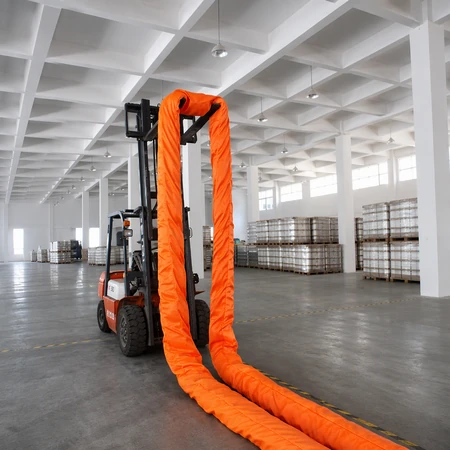
Ширкати лифт rigging Sling Sling Endless Round истеҳсол мекунад.
Endless Round Sling — Closed-Loop Sling, 1– 1000 т
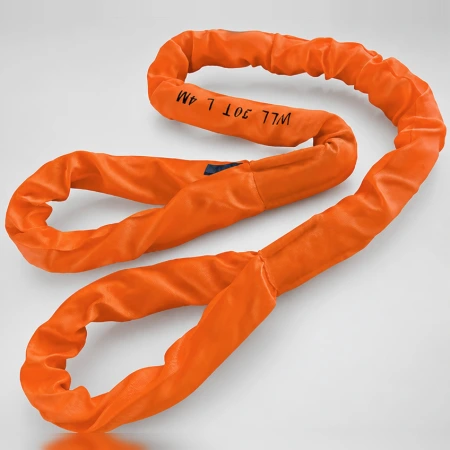
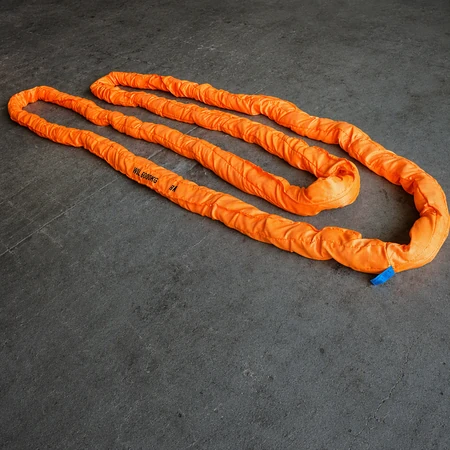
Ан чархи мудаввари беохир is a closed loop: the core runs continuously inside the sleeve and is closed on itself, so there is no eye, тимсол нест, no hook and no stitching anywhere in the load path. It is made in high-tenacity polyester across 27 LFTEERS articles, аз 1,000 кг ба 1,000,000 кг, in bodies from 0.5 м ба 80 м. Because the loop has no ends it can be turned, re-reeved and re-oriented after a lift — which is why it is the usual choice for basket and choke work on plant that must not be marked.
- Маҳдудияти сарбории корӣ1,000 кг ба 1,000,000 кг
- Доираи мақолаLFTEERS-1 to LFTEERS-1000, 27 андоза
- Андозаҳои бадан15 × 50 мм то 610 × 1,060 мм
- Дарозӣ0.5– 80 м, effective or circumference
- Вазни воҳиди0.47 ба 226 кг/м
- Металл нестNothing on the sling touches the load
What “endless” changes for the rigger
Endless describes the construction of the loop, not the length of the article. Nothing is spliced, sewn or fitted into the load path, and four things follow on site.
- The loop has no direction. Both halves are the same article, so the sling can be turned end for end and re-reeved after a lift. In a basket the two legs are identical, which is not true of a sling with an eye at one end and a fitting at the other.
- Wear can be spread. The contact point moves as the sling is rotated along the loop, so the sleeve is not destroyed in one place while the rest of the body is new.
- There is nothing to mismatch. No eye has to be offered to a hook of the right shape, and no fitting has to be rated with the sling. The hook goes through the loop, or the loop goes round the load.
- The sleeve is the whole inspection. The core cannot be opened and looked at, пас остин тиреза аст: what it shows is what the core has been through.
Endless Round Sling specifications
| Маҳсулот | Endless round sling — closed-loop polyester round sling, 1 т ба 1000 т |
|---|---|
| Сохтмон | Асоси филаменти пайвастаи мувозӣ дар остини бофташуда, ба як ҳалқаи беохир баста; no metal and no stitching in the load path |
| Асосӣ | High-tenacity polyester multifilament, параллел гузоштан, муми; UHMWPE or aramid to order |
| остин | Полиэстери тобовар бофта шудааст, стандарти як қабати; остин дукарата барои фармоиш |
| Маҳдудияти сарбории корӣ | 1,000 кг ба 1,000,000 кг, як пои амудӣ - 27 мақолаҳо, LFTEERS-1 to LFTEERS-1000 |
| Сарбории шикаста | 7 × working load limit |
| Омили бехатарӣ | 7:1 ҳамчун стандарт; 5:1 to order for markets working to ASME B30.9 |
| Дарозии WLL | Approximately 2–3 % |
| Ҳарорати хидмат | -40 °C то +100 °C, ядрои полиэстер |
| Дарозӣ | 0.5 м ба 80 м; minimum rises with the article, maximum is 80 m in every size |
| Ранги | Захираи афлесун ё кабуд; ДАР 1492-2 capacity colour applied when the order asks for the standard code |
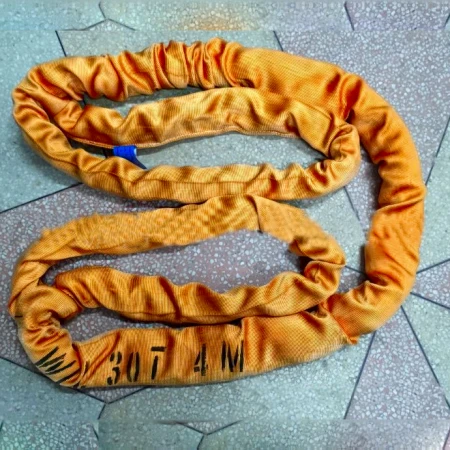
| Нишон додан | Working load limit and length printed on the sleeve; тамғаи бо WLL дӯхташуда, дарозӣ, рақами серия ва стандарт |
| Санҷиш | Исбот пеш аз фиристодан бор карда шудааст; сабти санҷиш ба рақами силсилавӣ мувофиқат мекунад |
| Бастабандӣ | Дар халтаи полиэтиленӣ печонида шудааст, картон нишондодашуда; паллет ё сандуқ мувофиқи дархост |
| Рамзи HS | 630790 — бар-доштани шлангхои материалхои бофандагй |
| MOQ / OEM | MOQ паст барои фармоиши озмоишӣ; OEM оид ба дарозӣ, ранги остин, нахи аслӣ, тарҳбандии тамғакоғазӣ ва бастабандӣ |
Доираи мақола: моделро интихоб кунед
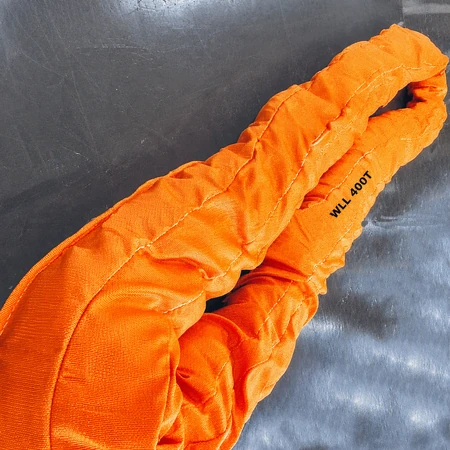
The article number carries the capacity — LFTEERS-10 is the 10,000 кг фалакон, LFTEERS-100 the 100,000 кг як. Ғафсӣ ва паҳнӣ баданро тавсиф мекунанд, the two length columns give the shortest and longest body made in that article, and the unit weight is what you add to the crane load.
| Моддаи №. | WLL (кг) | WLL (т) | Ғафсӣ (мм) | Васеъ (мм) | Мин (м) | Макс (м) | Вазн (кг/м) |
|---|---|---|---|---|---|---|---|
| LFTEERS-1 | 1,000 | 1 | 15 | 50 | 0.5 | 80 | 0.47 |
| LFTEERS-2 | 2,000 | 2 | 16 | 60 | 0.5 | 80 | 0.60 |
| LFTEERS-3 | 3,000 | 3 | 18 | 70 | 0.5 | 80 | 0.82 |
| LFTEERS-4 | 4,000 | 4 | 20 | 75 | 0.5 | 80 | 1.20 |
| LFTEERS-5 | 5,000 | 5 | 25 | 80 | 0.5 | 80 | 1.47 |
| LFTEERS-6 | 6,000 | 6 | 27 | 90 | 1.0 | 80 | 1.70 |
| LFTEERS-8 | 8,000 | 8 | 28 | 100 | 1.0 | 80 | 2.20 |
| LFTEERS-10 | 10,000 | 10 | 29 | 110 | 2.0 | 80 | 3.00 |
| LFTEERS-12 | 12,000 | 12 | 30 | 125 | 2.0 | 80 | 3.40 |
| LFTEERS-15 | 15,000 | 15 | 31 | 150 | 2.0 | 80 | 4.00 |
| LFTEERS-20 | 20,000 | 20 | 32 | 180 | 2.5 | 80 | 5.60 |
| LFTEERS-25 | 25,000 | 25 | 34 | 200 | 2.5 | 80 | 6.80 |
| LFTEERS-30 | 30,000 | 30 | 68 | 220 | 2.5 | 80 | 8.20 |
| LFTEERS-40 | 40,000 | 40 | 75 | 250 | 2.5 | 80 | 10.9 |
| LFTEERS-50 | 50,000 | 50 | 86 | 270 | 2.5 | 80 | 13.8 |
| LFTEERS-60 | 60,000 | 60 | 126 | 280 | 4.0 | 80 | 16.6 |
| LFTEERS-80 | 80,000 | 80 | 138 | 300 | 4.0 | 80 | 22.0 |
| LFTEERS-100 | 100,000 | 100 | 152 | 320 | 4.0 | 80 | 27.0 |
| LFTEERS-200 | 200,000 | 200 | 230 | 460 | 5.0 | 80 | 66.0 |
| LFTEERS-300 | 300,000 | 300 | 310 | 535 | 5.0 | 80 | 82.0 |
| LFTEERS-400 | 400,000 | 400 | 380 | 680 | 5.0 | 80 | 98.0 |
| LFTEERS-500 | 500,000 | 500 | 410 | 760 | 8.0 | 80 | 116.0 |
| LFTEERS-600 | 600,000 | 600 | 460 | 830 | 8.0 | 80 | 139.0 |
| LFTEERS-700 | 700,000 | 700 | 498 | 880 | 8.0 | 80 | 155.0 |
| LFTEERS-800 | 800,000 | 800 | 520 | 940 | 9.0 | 80 | 178.0 |
| LFTEERS-900 | 900,000 | 900 | 580 | 1,000 | 9.0 | 80 | 202.0 |
| LFTEERS-1000 | 1,000,000 | 1,000 | 610 | 1,060 | 9.0 | 80 | 226.0 |
The series code is shown as supplied on the factory sheet. In that sheet the 20,000 kg article carries the code LFTEERS-15 for a second time; it is shown here as LFTEERS-20 so that the code matches the capacity ladder. Thickness and width are the body dimensions specified for the article, and the minimum length is the shortest body that can be closed and sleeved at that capacity. If your price list uses a different prefix, replace it across the table — the rest of the code is the capacity.
Capacity changes with the hitch, not with the tonnage on the sleeve
The figure printed on the sleeve is the working load limit of one leg hanging vertically. It is the number the sling is proof loaded against, and the starting point of a lifting plan — not the tonnage it will pick up in the arrangement you are actually using. Apply the factor for the hitch, and remember that a set of legs is calculated on fewer legs than it has, зеро бори воқеӣ ҳеҷ гоҳ ба таври комил симметрӣ наменишинад.
| Тартиб | Омил | 5 т фалаҳ | 20 т фалаҳ |
|---|---|---|---|
| Як чарх, амудӣ | × 1.0 | 5.0 т | 20.0 т |
| Як чарх, нафас кашидааст | × 0.8 | 4.0 т | 16.0 т |
| Як чарх, basket 0–7° | × 2.0 | 10.0 т | 40.0 т |
| Як чарх, basket 7–45° | × 1.4 | 7.0 т | 28.0 т |
| Як чарх, basket 45–60° | × 1.0 | 5.0 т | 20.0 т |
| Ду по, 0-45° аз амудӣ | × 1.4 | 7.0 т | 28.0 т |
| Ду по, 45-60° аз амудӣ | × 1.0 | 5.0 т | 20.0 т |
| Чор по, 0-45° аз амудӣ | × 2.1 | 10.5 т | 42.0 т |
| Чор по, 45-60° аз амудӣ | × 1.5 | 7.5 т | 30.0 т |
Two lines in that table settle most orders. Аввал, ду 5 t слангхо намесозанд а 10 t муқаррар: at 0–45° from vertical they carry 7 t together, and past 45° they carry 5 т. Дуюм, a four-leg set is worked on three legs, which is why the factor is 2.1 ва не 2.8. Where the capacity is close to the limit, the honest answer is usually a нури бардоштан rather than a bigger sling — keeping the legs vertical recovers the factor that an open leg angle has just spent.
Дарозӣ: effective length or circumference
Фаҳмони беохир интиҳо надорад, Пас, дарозии онро метавон бо ду роҳ иқтибос кард, a factor of two apart. This is the most common ordering error on a round sling and the most expensive to correct, because the sling has to be remade rather than adjusted.
| Иқтибос оварда шудааст | Он чизе ки шумо мегиред | Барои истифода бурда мешавад | Мисол |
|---|---|---|---|
| Давомнокии кори самаранок | Нисфи давра - қалмоқе поён ба сарборӣ ва нусхабардорӣ | Лифтҳои амудӣ ва қаҳваранг, where the hanging height is known | 4 м EWL = 8 ҳалқаи м |
| Давра | Дарозии даври пурра | Лифтҳои сабад, where the girth of the load drives the length | 8 m loop = 4 м EWL |
On the slings we supply the figure printed on the sleeve is the дарозии самаранок, Пас чоп ва иқтибос ҳамеша мувофиқат мекунанд. Барои сабад, дарозии борро чен кунед, сарлавҳаро ба қалмоқ илова кунед, ва ин рақамро иқтибос кунед: бадан дар атрофи бор роди дуру дарозеро тай мекунад, and a sling that only just reaches forces the legs wide — the same as buying a smaller sling.
Where an endless loop earns its place
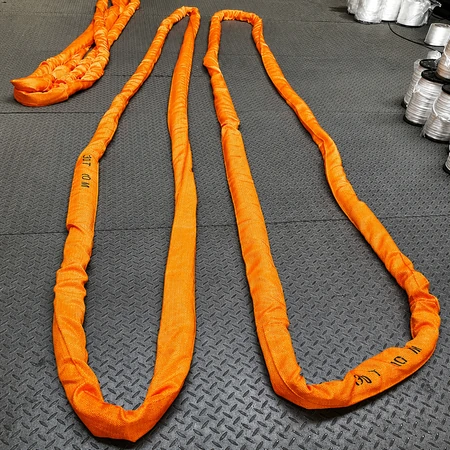
- Болорҳои пешакӣ ва сегментҳои пул picked in a basket at each end, where the sleeve protects the formed face and the chamfer.
- Гӯшаҳои пӯлод sitting in a basket, where the doubled body gives twice the vertical capacity and follows the curve of the coil instead of bearing on one line.
- Трансформаторҳо, генераторхо ва катхои машинахо with small trunnions and painted surfaces — nothing metal touches the load.
- Шаблон ва мемирад whose lifting holes are drilled, на барои як васлкунӣ пешбинӣ шудааст, so a soft loop threaded through the hole is the whole method.
- Скидҳо, чаҳорчӯба ва сабадҳои оффшорӣ choked at each corner with 6–12 m bodies, the sleeve taking the corner abrasion so the core does not.
- Stage and studio work around truss and set pieces where a scratch is a re-spray.
Беохир, eye-eye or flat webbing
| Меъёр | Слинги мудаввари беохир | Слинги мудаввари чашм | Flat endless webbing sling |
|---|---|---|---|
| Тамос бо бор | Round body, conforms to curves and corners | Round body with two loaded eyes | Wide flat face, spreads pressure over an area |
| Дарозӣ | Set by the loop; either convention can be quoted | Fixed between the eyes | Set by the sewn loop |
| Роҳи боркунӣ | Пайваста, no termination | Асоси доимӣ, eyes formed by the sleeve | Sewn join in the loop |
| Ривинг | Can be turned and re-reeved after a lift | One orientation only | Can be turned, but the join takes the wear |
| Беҳтарин барои | Basket and choke work, awkward plant, ҷисмҳои дароз | Repeated lifts on the same two points | Васеъ, flat and easily marked loads |
None of the three replaces another. For a fixed length and two known pick-up points see the фалаҳаи гирди чашм; for a wide face and a visible load path see the фалаҳони бофтаи беохири ҳамвор. Both round sling forms are built from the same core and sleeve, so the choice is a rigging decision rather than a capacity one. For hard service the остини дукарата чархзании мудаввар adds a second wear layer at the same rating, for weight-critical work there is a Слинги мудаввари UHMWPE аслӣ, and for hot loads an фалаҳаи мудаввари арамид.
Санҷиш ва ба нафақа баромадан
Асосро дидан мумкин нест, so the sleeve is the record of what the sling has been through. Пеш аз ҳар истифода тафтиш кунед, ва расман дар фосилае, ки режими шумо талаб мекунад.
- Check the full length of the sleeve for cuts, бандҳо, шишабандӣ, гудохта ва ранг кардани химиявй, and open the sleeve at the join if anything looks wrong.
- Read the print and the label. If the working load limit or the length can no longer be read, слингро тафтиш кардан мумкин нест ва аз кор мебарояд.
- Дар дохили остин хокро ҳис кунед; он ядроро аз даруни он дуру дароз пас аз руфтани хавлй мерезад.
- Retire on any cut or hole that exposes the core, шишабандии гармӣ, ядрое, ки сахт ё лӯнда шудааст, ҳамлаи кимиёвӣ, ё тамғаи гумшуда.
- Нигоҳ доштани печонидашуда ва берун аз фарш, аз равшании рӯз ва дур аз гармӣ, ҳалкунандаҳо ва пошидани кафшер. Never store a sling wet in a closed bag.
- Ҳеҷ гоҳ фалаҳони пурборро ба як тараф кашола накунед, and never lift on a damaged sleeve.
Саволҳои зуд-зуд додашаванда
What is the difference between an endless round sling and a round sling with eyes?
An endless round sling is a closed loop with no termination: the core runs continuously inside the sleeve and nothing is spliced or sewn into the load path. А чархи мудаввар бо чашмон has two defined eyes at a fixed distance, so its length is set by the eyes and it works in one orientation.
Is the length the circumference or the effective length?
Both are used and they differ by a factor of two. Effective length is half the loop — hook down to the load and back up. Circumference is the full loop. А 4 м дарозии самаранок як аст 8 ҳалқаи м, so the convention has to be stated on the order.
How much capacity is lost in a choker?
A choked endless round sling is rated at 0.8 of its vertical working load limit, ҳамин тавр а 5 т слинг медихад 4 т. A basket raises the figure to 2.0 at 0–7°, 1.4 at 7–45° and 1.0 at 45–60°. A four-leg set is calculated on three legs, giving 2.1 at 0–45° from vertical and 1.5 at 45–60°.
What does LFTEERS-10 mean?
The article number is the working load limit in tonnes: LFTEERS-10 is 10,000 кг амудӣ, LFTEERS-100 is 100,000 kg and LFTEERS-1000 is 1,000,000 кг. The range follows the 1-2-3-4-5-6-8-10-12-15-20-25-30-40-50-60-80-100-200-300-400-500-600-700-800-900-1000 нардбон, so there is no 7 т, 9 т ё 11 t article.
How heavy is a long endless sling?
The last column of the article table is the weight per metre: 0.47 kg/m at LFTEERS-1, 3.00 kg/m at LFTEERS-10 and 226 kg/m at LFTEERS-1000. Multiply by the loop length and add the label and packing to get the figure to put against the crane. Where that number is a problem, a UHMWPE core gives the same capacity at a fraction of the weight.
Can the same sling be used in a basket and a choke?
Бале, and that is one of the reasons for the endless form: the same article goes round the load either way. What changes is the working figure, so the rating has to be recalculated for the hitch actually used.
How is the sling tested and documented?
Each sling is proof loaded before dispatch and the test record is matched to the serial number on the sewn label. Breaking load is 7 × the working load limit, and the factor can be varied to order where the market requires it.
Request an endless round sling quotation
Борро ба як по фиристед, the hitch and the leg angle, the distance between pick-up points and the headroom to the hook — plus the length convention and any marking or documentation your site requires. Мо иқтидорро тасдиқ мекунем, дарозӣ ва остин, ва иктибоси завод-ро бо накша нишон дихед, a proof-load record and a sample. нигаред full round sling range for the rest of the series.
Иқтибос ва намунаи ройгон гиред