

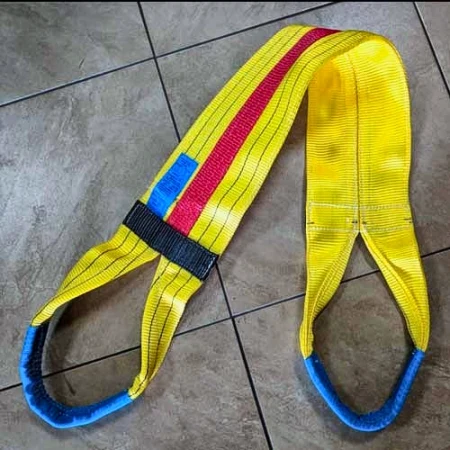
Lift sling rigging company produce WLL 60 Ton Polyester Webbing Slings,60000kg Heavy Duty Lifting Sling,60Ton flat lifting sling,60 Ton Crane Sling,60Tonne Heavy Duty Webbing Sling,60 Ton Lifting Belt Industrial Polyester Crane Lift Webbing Sling,60Tonne Webbing Sling,60 Ton Flat Lifting Belt.
WLL 60 Ton Polyester Webbing Slings.
ஏ 60 tonne webbing sling is not a bigger version of a 3 tonne band. It is a different article: the plies are counted, the eye is built to clear a 60 tonne shackle, the stitching has to be inspected row by row, and the band arrives as a two-person lift with a drawing attached. Everything below is what that involves.
The short answer. Our WLL 60 Ton Polyester Webbing Slings are flat polyester bands rated 60,000 kg in vertical hitch, 48,000 kg choked and 120,000 kg in basket, built on a 6:1 factor to a minimum breaking load of 360,000 kg. They are woven from high-tenacity polyester, assembled in plies to the width the load needs, eye-formed at both ends, proof loaded, and marked per EN 1492-1 with the figure for each hitch.
What changes when the figure is 60 டன்கள்
Four things, and each one is a specification decision rather than a sales detail.
Bearing pressure. 60,000 kg spread across a 300 mm band is 200 kg for every millimetre of width. On a painted steel fabrication that figure decides whether the coating survives the lift; on a machined shaft it decides whether the band crushes the surface it is holding. It is also the reason a 60 t sling is wide rather than merely thick — width is the only part of the geometry that lowers pressure without adding height.
Eye clearance. The eye has to seat on the bow of the shackle or the throat of the hook, not on its pin, and not bent round a fitting two sizes too small. On a 60 t assembly the fittings are large enough that the eye’s internal length becomes the constraint: an eye that is short for the fitting concentrates the load on the inner face and wears out there first, long before the band itself shows anything.
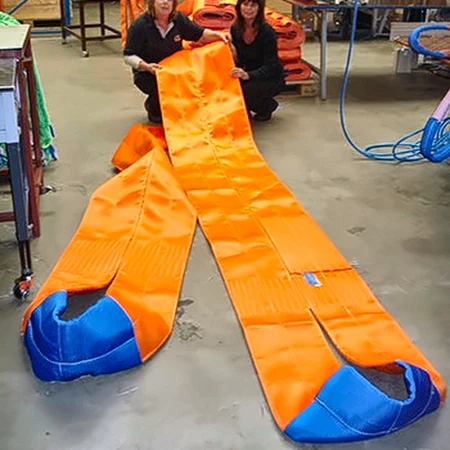
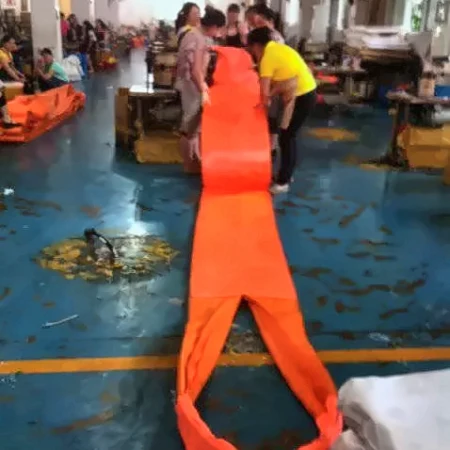
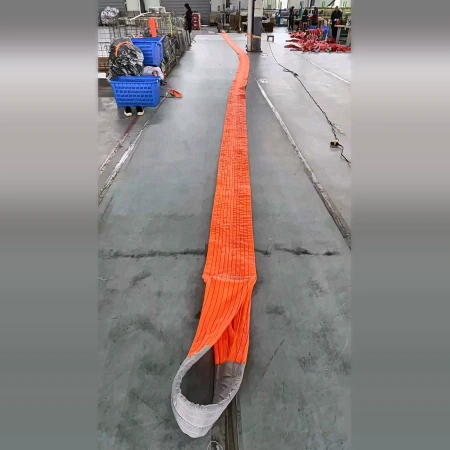
Mass and handling. ஏ 60 t band is heavy enough that rigging it is a planned operation, not a one-handed one. Length matters as much as width here: the same sling at 12 m is a different handling problem from 4 மீ, and both need two people, a clean floor and somewhere to lay it out. We quote the mass against the drawing so the lift plan has the right number.
Transport. ஏ 60 t sling of any useful length is coiled, strapped and crated or palletised, and it takes volume in a container that a 5 t sling does not. It also has to arrive without a fold set pressed into the webbing, which is why it is coiled to a diameter rather than folded flat.
The figure is per hitch, மற்றும் 60 t is not the only number on the label
When a buyer asks for a 60 ton webbing sling, the first useful question back is which hitch it will be used in — because the same band gives five different answers depending on how it is hitched, and every one of them is printed on the label. The numbers below are this sling’s rating, not a generic table:
| ஏற்பாடு | காரணி | Capacity | Where it is used |
|---|---|---|---|
| செங்குத்து | 1.0 | 60 டி | A single leg straight up from the hook. |
| மூச்சு திணறியது | 0.8 | 48 டி | Round the load and back through its own eye; the wrap grips. |
| கூடை, 0–45° | 2.0 | 120 டி | Under the load, both eyes on the hook, செங்குத்து அருகில் கால்கள். |
| கூடை, 45–60° | 1.4 | 84 டி | The same basket with the legs spread. |
| இரண்டு கால்கள், 0–45° | 1.4 | 84 t assembly | Pair to one hook, சுமை பகிரப்பட்டது, செங்குத்து அருகில் கால்கள். |
| இரண்டு கால்கள், 45–60° | 1.0 | 60 t assembly | Pair with the legs spread. |
| மூன்று மற்றும் நான்கு கால்கள், 0–45° | 2.1 | 126 t assembly | Multi-leg; not three or four times the single figure. |
| மூன்று மற்றும் நான்கு கால்கள், 45–60° | 1.5 | 90 t assembly | Multi-leg, spread. |
Mode factors per EN 1492-1; the assembly figure is the single-sling WLL multiplied by the factor. The label on the article always governs.
The choked line is the one that catches people out. ஏ 60 t band choked is a 48 t band, so a load that has to be choked and weighs 55 t needs the next size up — not a longer sling, and not a second wrap of the same one.
How a band that carries 60,000 kg is built
Polyester yarn is woven into a flat band, and the band is then assembled into plies. On a 60 t sling the ply count and the width are solved together: fewer plies in a wider band gives a flatter, more conformable article that spreads pressure on a delicate load; more plies in a narrower band gives a stiffer article that suits a compact hook and a hard load. Neither is better in the abstract — the load picks.
The eyes are the part that takes the work. The band is folded back on itself, the fold is stitched through six rows in a pattern sized to the eye, and the eye is then reinforced with a wear sleeve so the shackle bow bears on a sacrificial layer rather than on the load-bearing weave. That sleeve is the first thing to wear and the cheapest thing to renew; a sling whose eye is worn into the weave is a sling that is finished.
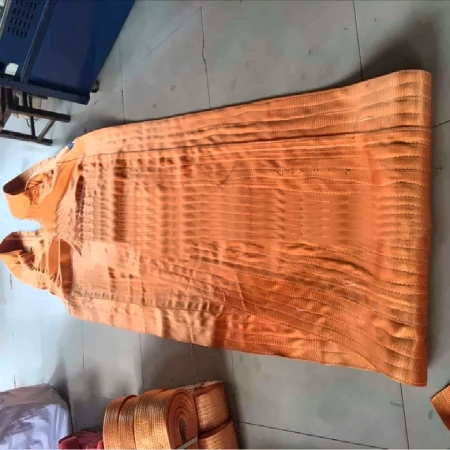
The weave itself carries a fine longitudinal rib, and that rib is not decoration: it is where the yarn runs, and it is the line an inspector follows when looking for a cut, a snag or a pulled thread after a lift.
The eye, the hook and the shackle have to agree
Most of the 60 t slings we replace were not worn out in the band. They were worn out in the eye, because the eye was made to a default length and then used on a fitting that did not match it. Three things settle it before the band is woven:
- The fitting that will hold it — a 60 t shackle and a 60 t hook do not have the same bearing surface, and the eye has to be sized to the larger of the two if both will be used.
- The load’s own geometry — a flat eye sits on a bow; a twisted eye turns the band through 90 degrees so it lies flat against the side of the load rather than edge-on.
- The direction of the last metre — if the band has to leave the hook at an angle, the eye takes that angle on its inner face and needs the clearance to do it without a hard spot.
Where the fitting is unusually large, or where the sling will be used interchangeably on hooks of two sizes, we build the heavy eye webbing sling instead: longer eye, extra reinforcement, and the same band. It costs a little more and it removes the failure mode.
One sling, or an assembly
A single 60 t sling is rarely the whole answer above about 30 டி, because at that level the load is usually a fabricated item that wants four pick points rather than one. Two routes:
- Multi-leg assemblies — two or four 60 t legs to a master link, with the assembly figure taken from the table above rather than by adding the legs together. The load does not share evenly, and a four-leg assembly is not 240 டி.
- A spreader — where the load must not be squeezed, or the pick points are wider than the included angle allows, அ தூக்கும் விரிப்பு கற்றை takes the horizontal component out of the legs and the slings work vertically again.
Below 60 t the range steps down in the same construction, so a mixed lift can be built from one family: தி 5 tonne webbing sling, தி 4 tonne and the 3 tonne bands are the same weave in fewer plies. The full range sits under flat webbing slings.
What is tested, and what is printed on the band
Every 60 t sling is proof loaded and inspected before it leaves the works, and the label is applied to that individual article rather than to the batch. The label carries the working load limit for each hitch, நீளம், the material, the standard, the manufacturer, a serial number and the date. Where the job needs it, the sling goes out with a test certificate to EN 10204 3.1 quoting that serial, so the piece on site can be traced back to the proof load record.
One thing worth saying plainly. The colour of a webbing sling identifies its WLL only up to the top of the coded range — above that, colour is by agreement and means nothing on its own. On a 60 t sling the label is the only authority, and a band whose label cannot be read is out of service regardless of how good the webbing looks.
Handling, storage and the end of a 60 டி ஸ்லிங்
A band of this size is easy to damage and expensive to replace, and almost all of the damage is avoidable:
- Lay it out and hook it; never drag it across concrete or over a weld seam to get it into position.
- Keep it off hot work. Polyester is comfortable to 100 °C and fails by melting, not by stretching politely.
- Store coiled, clean and dry, சூரிய ஒளி வெளியே, off the floor, with its certificate and its inspection record.
- Inspect before every lift and formally at the interval your site sets — cuts, ஸ்னாக்ஸ், பஞ்சர்கள், broken stitching, a distorted or worn eye, chemical or heat damage, an unreadable label. Any one of those retires the band.
Where 60 tonnes is the normal answer
- Wind turbine components — nacelle sections, hubs, blade root fixtures
- Shipbuilding and ship repair — blocks, modules, fabricated panels
- Power transformers and heavy electrical plant, where the case must not be marked
- Precast concrete and segment moulds, where the lifting point is a cast-in loop
- Steel structures — trusses and girders with a finished coating
- Skids, modules and packaged plant for transport and installation
Sizing it in five answers
We do not quote a 60 t sling from a tonnage alone. Five things settle width, நீளம், eye and assembly, and every one of them changes the price:
- The load and its mass, and whether the figure is per leg or total.
- How it will be hitched — vertical, choked, basket, and the leg angle.
- The fitting that holds it: கொக்கி, கட்டை, master link, or a cast-in loop.
- The surface: painted, machined, abrasive, hot, or chemically exposed.
- The length between bearing points, and how it will be stored and inspected.
Questions we are asked about the 60 டி ஸ்லிங்
Is a 60 t webbing sling one band or several?
One article, built from several plies of woven polyester assembled into a single band with a single label. It is not two slings used together, and it must not be treated as one — the rated figure belongs to the finished article.
Why is the choked rating 48 t and not 60 டி?
இசைக்குழு தன்னை எதிராக ஏற்றப்பட்ட மற்றும் மடக்கு பிடியில் ஏனெனில், so the fibres work in a way the vertical rating does not describe. இது சாதாரணமானது, அது லேபிளில் உள்ளது, and it is the reason a 55 t choke needs the next size up.
Can it be used in the rain or at sea?
Polyester is happy wet and does not lose strength from water; it loses strength to abrasion, to heat and to chemicals. Wet use is fine — the inspection regime after salt water exposure is what needs attention.
How long will a 60 t sling last?
சூழல் தீர்மானிக்கிறது, காலண்டர் அல்ல. A band on painted steel indoors gives years; the same band dragged over grit gives shifts. Inspect for condition, never against a fixed service life.
Do you supply the assembly with shackles and master link?
ஆம், as a matched assembly with the fittings rated at or above the sling, supplied with the assembly’s own marking and figure. Send the pick points and we will size the whole arrangement rather than the legs alone.
What is the lead time?
தரநிலை 60 t bands are built to order; the queue depends on length, eye type and whether the certificate is 2.2 அல்லது 3.1. Confirm the drawing first — the figure on the label is only correct if the drawing behind it is.
Related: flat webbing slings · heavy duty eye & eye flat web sling · heavy eye webbing sling · eye and eye webbing slings · சுற்று slings · wire rope slings · endless lifting slings · cargo lifting nets · பரவல் கற்றைகளை தூக்குதல்
சுமை அனுப்பவும், not the tonnage
என்ன தூக்கப்படுகிறது என்று சொல்லுங்கள், the mass, how it will be hitched and what holds the eye, and we will come back with width, ply count, eye type, length and the assembly figure — on a drawing, before anything is woven.
லிஃப்ட் ஸ்லிங் ரிக்கிங் கோ., Ltd · Lifting & rigging division of China Lifute Sling Group
டெல் / WeChat +86 180 6600 2268 · 702461526@qq.com
லிஃப்யூட் தொழில்துறை பூங்கா, தைஜோ நகரம், ஜியாங்சு மாகாணம், China · HS code 630790
Figures quoted are for the standard build to EN 1492-1 at 6:1. ASME B30.9 builds at 5:1 are available on request; the labelled WLL always governs the lift.