

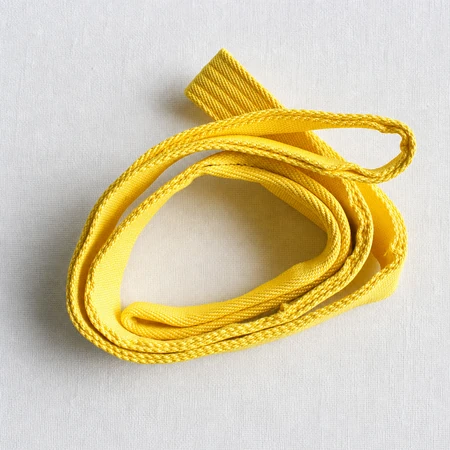
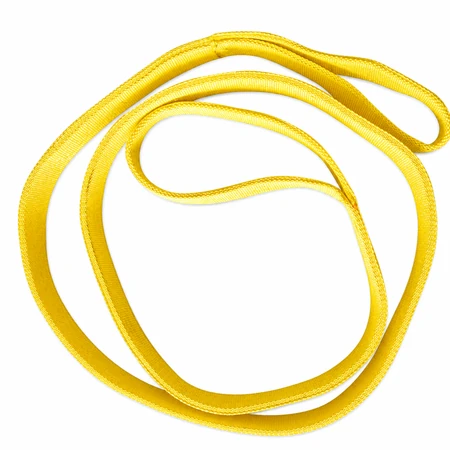
Lift sling rigging company produce Aramid Webbing Sling,Kevlar Webbing Sling,Aramid flat web sling.
Aramid Webbing Sling
Kevlar-Class Flat Woven Webbing — Low Stretch, Cut Resistant, Ingen smältpunkt
En aramidbandslinga is a flat woven sling whose band is woven from aramid fibre — the Kevlar-class high-modulus polymer also called Aramid 1414 — instead of polyester. What that fibre buys you is not one property but four, and they are usually bought for different reasons. Aramid has ingen smältpunkt at all: it chars and breaks down rather than liquefying, so there is no molten drip and no softening phase. It has the highest cut resistance of any common lifting fibre. Det är det formstabil, holding a load without creeping. And it stretches very little, so the load stays where it was set down. The same band that survives a hot workpiece also holds a sustained load, resists a sharp edge and refuses to drip molten polymer when it finally fails.
- Ingen smältpunkt — chars instead of melting, so no molten drip hazard
- Best-in-class cut resistance among the common lifting fibres
- Very low stretch and very low creep — it holds what it is given
- Lighter than a polyester band vid samma arbetsbelastningsgräns
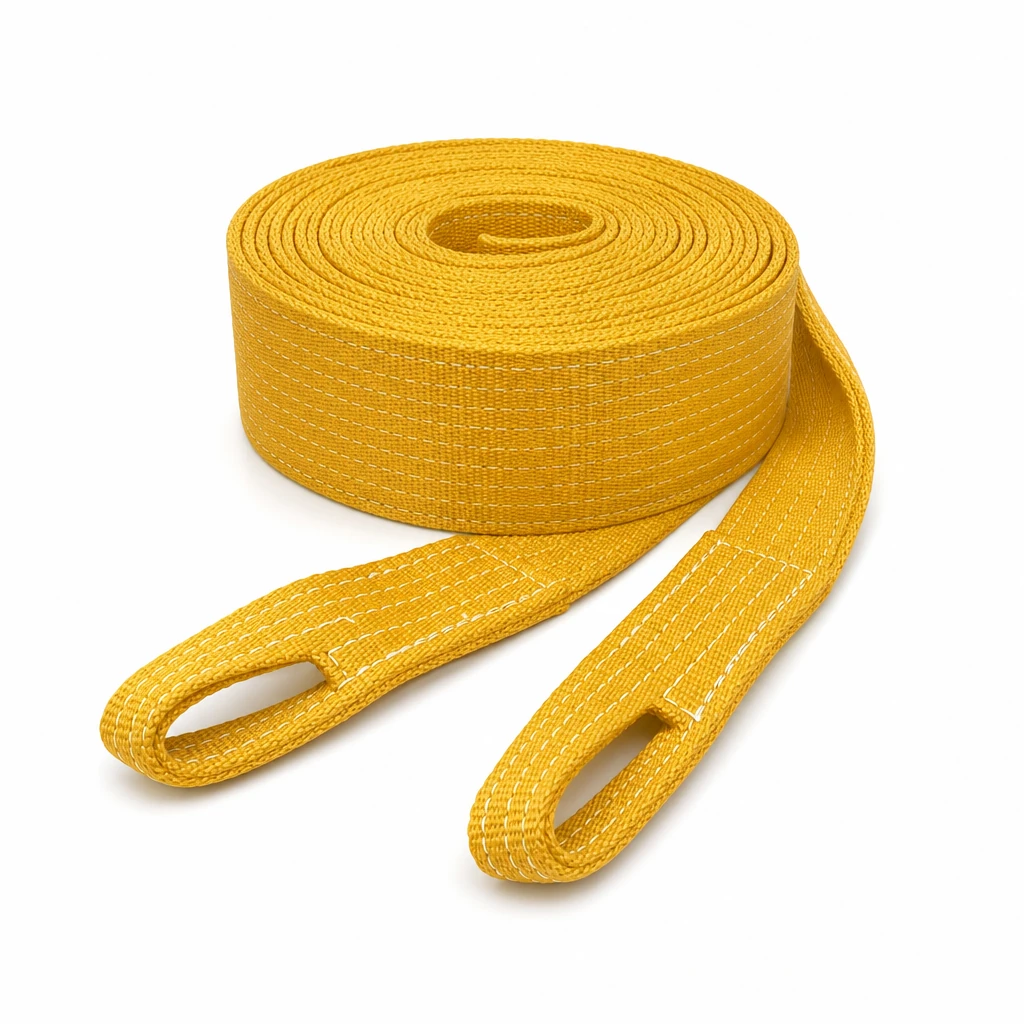
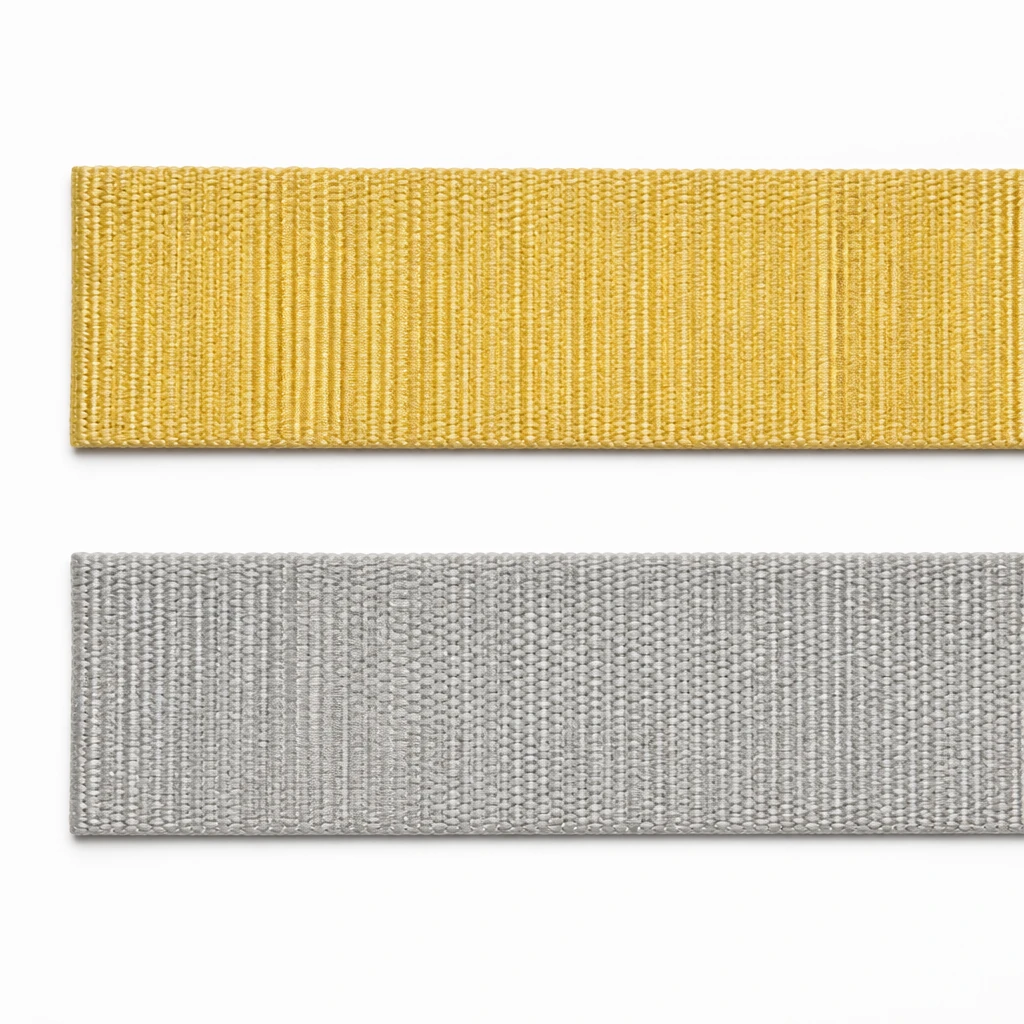
Nyckelfunktioner
Ingen smältpunkt
Aramid smälter inte. Den behåller sin struktur tills den förkolnas och sönderdelas, so there is no softening phase, no molten polymer and no burning drip — a real consideration in confined spaces, tunnels, rail and stage work.
Highest Cut Resistance
Against a sharp edge or a blade, aramid is the strongest of the common lifting fibres. Where an edge is the risk rather than a rubbing surface, it is the safest band to specify.
Dimensionally Stable
Aramid holds a sustained load without creeping. Where a sling has to stay at a set length under a standing load, it is the fibre that behaves — unlike UHMWPE, which creeps under long static load.
Very Low Stretch
The band barely extends under load, so the load stays exactly where it was set down and the sling does not hunt across the bearing surface while you land it.
Light for Its Strength
Aramid is stronger per unit weight than polyester or nylon, so a lighter band does the same job, which tells on a high capacity sling that has to be carried and rigged by hand.
Does Not Absorb Water
Aramid takes up almost no water and does not rot. It will not swell, stiffen or lose strength simply because it got wet.
Aramid Compared with the Other Lifting Fibres
Aramid is not simply “better” than polyester, nylon or UHMWPE. It is better at some things and clearly worse at others, and the honest choice depends on which of those things your lift actually depends on.
| Egendom | Polyester | Nylon (polyamid) | Aramid (Kevlar-klass) | Dyneema (UHMWPE) |
|---|---|---|---|---|
| Strength for its weight | Bra | Bra | Mycket hög | Högsta |
| Stretch under load | Måttlig | High — the stretchy one | Mycket låg | Mycket låg |
| Creep under sustained load | Låg | Låg | Mycket låg — håller sin längd | Högre — kommer att krypa |
| Cut resistance | Bra | OK | Excellent | Dålig |
| Nötningsbeständighet | Bra | Bra | Poor — needs a sleeve or jacket | Bra |
| Flex fatigue (repeated bending) | Bra | Excellent | Dålig | Dålig |
| Smältpunkt | Ca. 255 °C | Ca. 215–265 °C | Inga – tecken istället | Ca. 145 °C — the lowest |
| UV-beständighet | Excellent | Bra | Poor — discolours and degrades | Bra |
| Flyter | Inga | Inga | Inga | Ja |
| Vattenabsorption | Låg | Higher — swells | Mycket låg | Mycket låg |
| Välj det för | General purpose lifting — the value choice | Shock-absorbing and dynamic applications | Sustained loads, edge risk, värme, no melt-drip | Lowest weight and wet or marine work |
Cut Resistance Is Not Abrasion Resistance
This is the single most misunderstood thing about aramid, and it decides how you rig with it.
Cut resistance is resistance to a blade or a sharp edge severing the band — a local, high-stress event. Aramid is excellent at it: it is the fibre used in cut-resistant gloves and protective clothing for exactly this reason.
Nötningsbeständighet is resistance to surface wear from rubbing and sliding — a spread-out, repeated event. Aramid is poor at it. It is why aramid cordage is almost always jacketed or sleeved, and it is the reason aramid performs worst of the common fibres when a sling is dragged across concrete or a rough steel surface.
The practical rule follows directly: an aramid sling on a sharp edge is a good choice; an aramid sling dragged over a rough floor is a bad one. If your lift puts the band against a sharp edge, aramid is exactly right. If it puts the band against a rough abrasive surface, either protect it with a woven sleeve or specify a fibre that tolerates abrasion better.
Where an Aramid Sling Is Chosen
Heat is the best-known reason to buy aramid, but it is not the only one — and for many customers it is not even the main one. These are the applications where aramid is specified on its other merits.
- Sustained or standing loads — aramid holds its length without creeping, so it suits a sling that stays loaded for hours or days rather than for one lift.
- Edge and cut risk — the highest cut resistance of the common fibres, for loads with sharp or sheared edges.
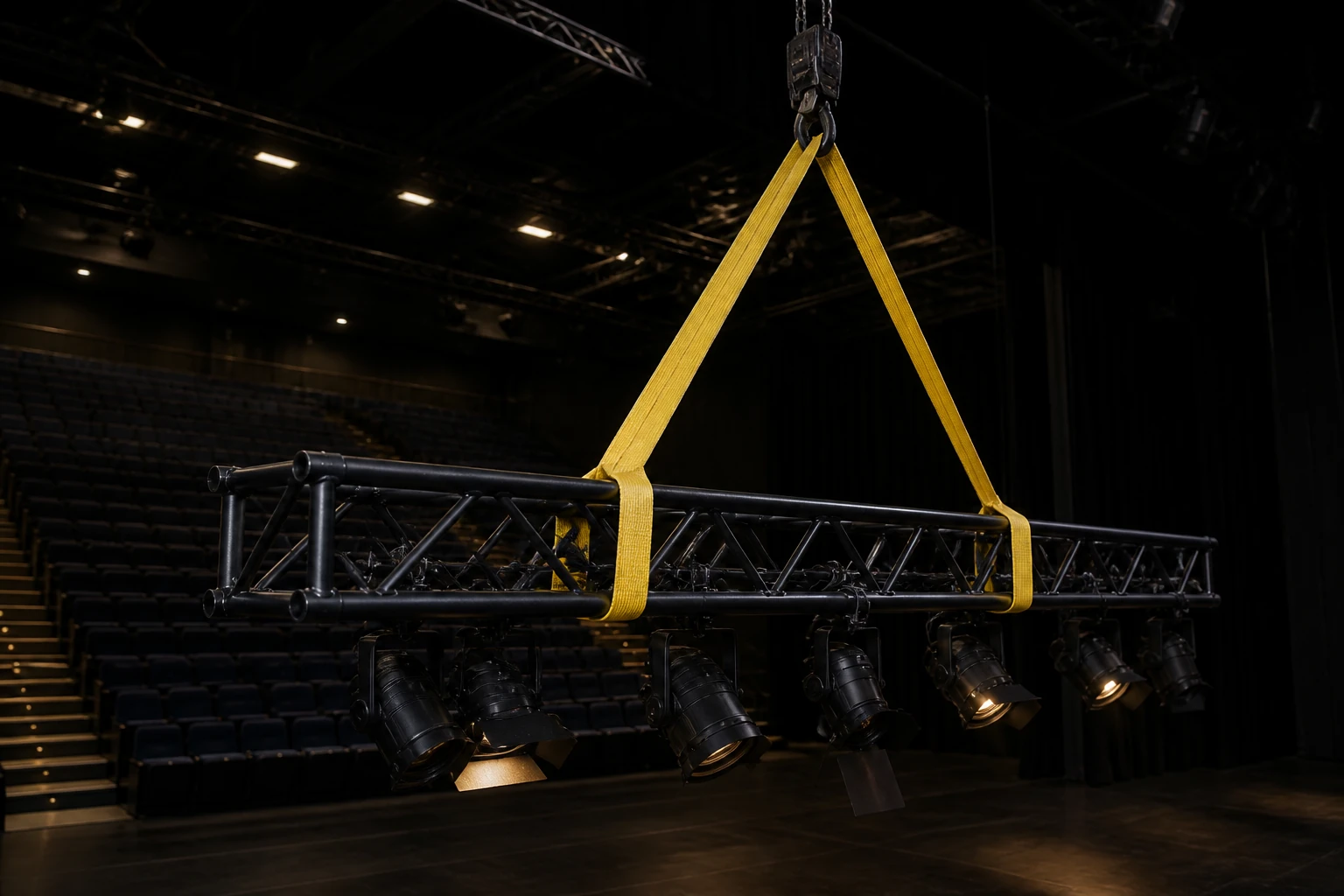
- No molten drip — where a melting fibre would be a hazard in its own right: confined spaces, tunnels, rail work and stage work above people.
- Low-stretch rigging where precision matters — the load stays where it was set, with no stretch to take up and no elastic recovery to absorb.
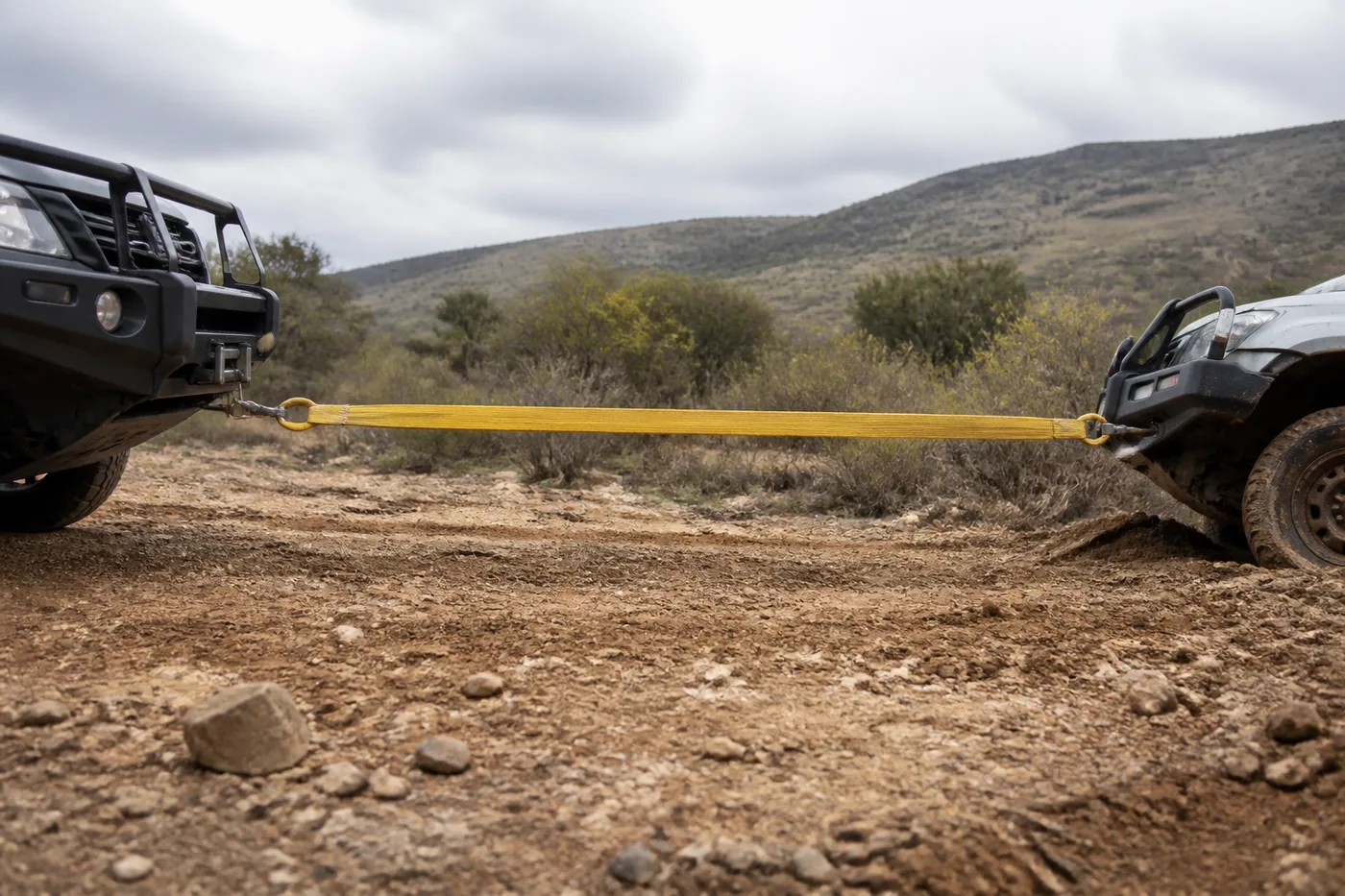
- Low-energy recovery and pulling — a low-stretch strop stores far less energy than a nylon one, which is why aramid is used for vehicle recovery strops rather than kinetic ropes.
- Etapp, theatre and entertainment rigging — the classic aramid application: ljus, låg sträcka, and it does not drip molten polymer above an audience.
- Hett arbete — the heat case, covered in detail on our högtemperaturslinga sida.
Tekniska specifikationer
| Produktnamn | Aramidbandsele / Kevlar vävsele / aramid flat webbing sling / Aramid 1414 vävslinga |
|---|---|
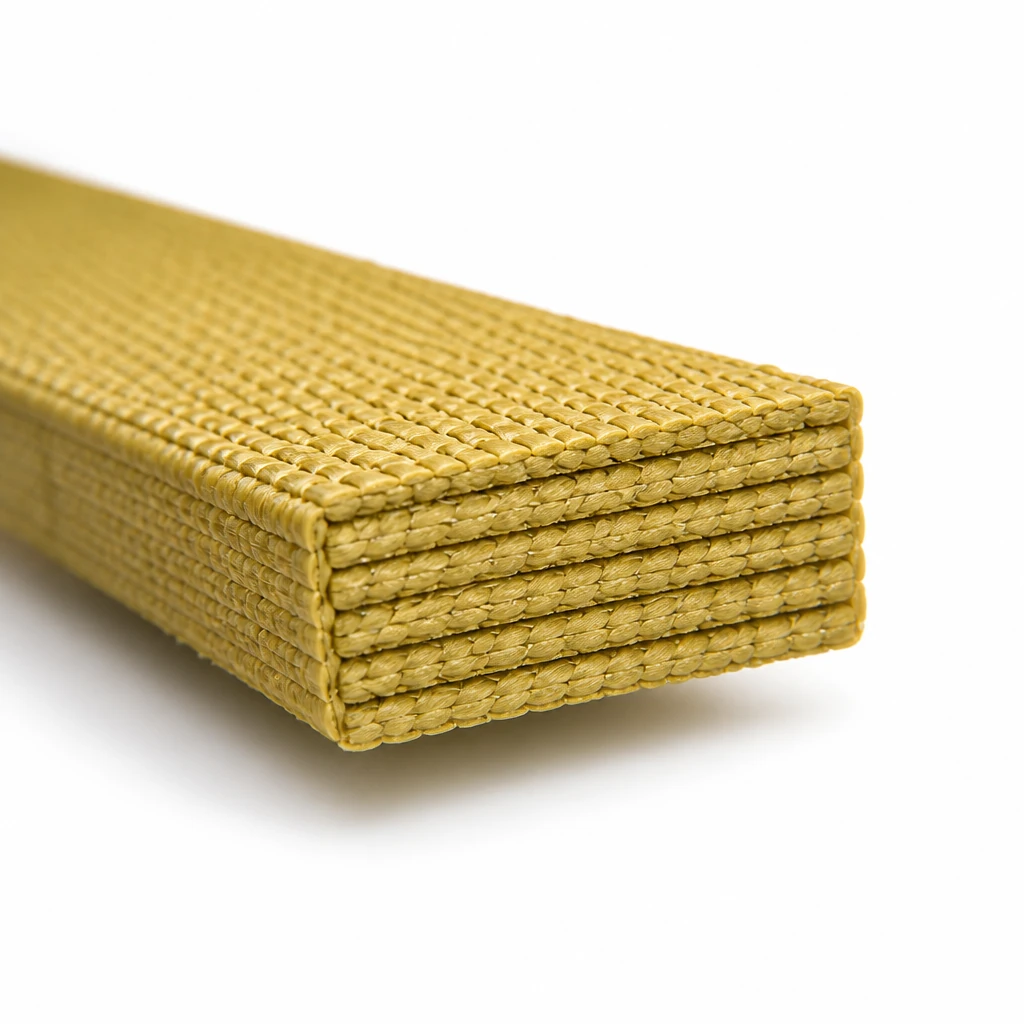
| Bärande material | Aramid (Kevlar-klass / Aramid 1414) fiber med hög modul, vävda till platt väv |
| Konstruktion | Plattvävd väv i öga-och-öga eller ändlös form; enkel- eller flerskikts |
| Bandbredd | 25 mm till 300 mm som standard, anpassas till arbetsbelastningsgränsen och skiktkonstruktionen |
| Bandtjocklek | Set by the ply construction; several woven layers may be stacked to reach a capacity in a narrow band |
| Arbetsbelastningsgräns | 1 t till 100 t, i standardstegen 1 · 2 · 3 · 4 · 5 · 6 · 8 · 10 · 12 · 15 · 20 · 25 · 30 · 40 · 50 · 100 t |
| Säkerhetsfaktor | I 1492-1 praxis är 7:1 för allmänna platta vävda selar; andra faktorer som produceras på beställning |
| Effektiv arbetslängd | 0.5 m till 20 m som standard; längre att beställa |
| Förlängning | Mycket låg sträcka - cirka 3–4 % i rasten, far less than polyester or nylon under the same load |
| Krypa | Very low — aramid holds its length under sustained static load |
| Smältpunkt | Ingen — aramid förkolnar och sönderdelas istället för att smälta, vid omkring 500 °C |
| Protective options | Woven sleeves, edge protectors and jacketing for abrasion and heat; strongly recommended wherever the band rubs a rough surface |
| Färg | Natural golden yellow of the aramid fibre, with the capacity stripe or edge colour as required |
| Märkning | Sydd etikett med arbetsbelastningsgräns, längd och parti; printed band marking optional |
| Förpackning | Rulla i en polyväska eller bärväska, märkt kartong, anpassad exportförpackning |
| MOQ & OEM | Låg MOQ för provbeställningar; full OEM — kapacitet, bredd, lager, längd, färg, sleeve and marking |
Hantering, Inspektion och begränsningar
Aramid is a high-performance fibre, not a tougher version of polyester, and it has three specific weaknesses that a buyer should know before the first lift.
- It hates abrasion. Surface wear from rubbing is the fastest way to lose an aramid band. Use a woven sleeve or an edge protector wherever the sling meets a rough or abrasive surface, and never drag a loaded aramid sling across concrete or rough steel.
- It hates repeated bending. Aramid has poor flex fatigue, so avoid rigging that forces the band to bend sharply and repeatedly over the same small radius — including over a thin shackle pin or a tight hook eye.
- It hates UV. Sunlight degrades aramid and turns it from bright golden yellow to a dull, brittle brown. Förvara den från solen, and treat discolouration from sunlight as damage rather than as fading.
- It is affected by strong chemicals. Keep aramid away from strong acids and alkalis, and confirm chemical compatibility before using it where process chemicals are present.
- Inspect the whole band before every use — nedskärningar, fransning, a dull or brownish colour, a stiff or brittle feel, glasering, and any damage at the eyes or the stitching.
- Protect the eyes — the eye and its stitching are usually the first thing to go, so reinforced eyes and wear pads are worth ordering where the sling will see hard service.
- Spela in det — keep the batch marking and a log of use and exposure. For an aramid sling, the combination of UV hours and abrasion is the best retirement guide you can keep.
Ansökningar
- Etapp, theatre and entertainment rigging — trusses, lighting bars and suspended scenery above people
- Vehicle recovery strops and low-energy pulling, where a stretchy nylon strop would store energy
- Sustained and standing loads, where the sling holds a set length without creeping
- Loads with sharp or sheared edges, where cut resistance is the deciding property
- Confined spaces, tunnels and rail work, where a molten drip from a melting fibre would be a hazard in itself
- Hot work — steel mills, gjuterier, pressgjutning, glass and welding, with a sleeve where the contact is hot
- Lifts where the band has to be light enough to carry up and rig by hand
- Any lift where a polyester sling has been refused because of heat, edges or a molten-drip risk
Anpassning och OEM-service
Aramid slings are built to the line rather than picked from a shelf, because the fibre, the ply construction and the protection all have to match the job. Berätta för oss lasten, the environment, what the band will touch and whether the load will be standing or momentary, and we will size the band and the protection to suit.
- Kapacitet — 1 t till 100 t, inklusive mellansteg mellan standardstorlekarna
- Band and plies — 25 mm till 300 mm, enkel- eller flerskikts, sized around your lifting point as well as your load
- Slutar — öga och öga eller oändlig, vanliga eller förstärkta ögon, with wear pads where the sling will see hard service
- Skydd — woven sleeves and edge protectors for abrasion, and heat resistant sleeves for hot contact
- Längd och markering — effektiv arbetslängd på beställning; din etikettlayout, språk och märkningskonvention
- Made-up items — recovery strops, stage slings and special assemblies built to your drawing
Kvalitetskontroll
Varje band kontrolleras för bredd, tjocklek, weave density, ply count and colour before the eyes are closed, och varje färdig lyftsele kontrolleras på dess sömmar, dess arbetsbelastningsgränsmarkering, dess totala längd och dess etikett före packning. Vi har tillverkat selar, webbing och repprodukter för industri, säkerhets- och exportkunder i nära tre decennier, och vi håller processen synlig: på begäran tillhandahåller vi fibercertifikatet, batchtestfigurerna och en provsele som du kan hantera och testa innan volymproduktionen påbörjas.
Vanliga frågor
What is an aramid webbing sling?
A flat woven lifting sling whose band is woven from aramid fibre — the Kevlar-class high-modulus polymer also called Aramid 1414 — instead of polyester. The webbing itself carries the load, and the whole working length is visible for inspection.
Why choose aramid rather than polyester?
For one or more of four reasons: heat tolerance, because aramid has no melting point; skärmotstånd, where aramid is the best of the common fibres; dimensional stability, because aramid holds a sustained load without creeping; and very low stretch, where the load must stay exactly where it was set. If none of those matter for your lift, polyester is cheaper and more abrasion-resistant, and it is the better buy.
Aramid or Dyneema — which should I choose?
Choose aramid for sustained loads (it does not creep), for edge and cut risk, for heat, and where a molten drip would be a hazard. Choose Dyneema where the absolute lightest rigging matters, where the environment is wet or marine, and where the load is momentary rather than standing — remembering that UHMWPE creeps under prolonged static load and has poor cut resistance. Neither is universally better; the loads you actually have decide it.
Is aramid abrasion-resistant?
No — and this is the most common misunderstanding. Aramid has excellent cut resistance but poor abrasion resistance. It resists a blade far better than polyester does, but it wears away faster than polyester when it is rubbed against a rough surface. That is why aramid slings should be sleeved or protected wherever the band rubs, and why you should never drag a loaded aramid sling across concrete.
What are the main limitations?
Tre. Abrasion — it needs a sleeve or protector against rough surfaces. Flex fatigue — it does not tolerate repeated bending over a small radius. And UV — sunlight degrades aramid and turns it from bright golden yellow to a dull, brittle brown, so it must be stored out of the sun. Aramid is also affected by strong acids and alkalis.
Can you supply custom capacities, ply constructions, protection and OEM labelling?
Ja. Vi bygger från 1 t till 100 t inklusive mellansteg, in single-ply or multi-ply construction from 25 mm till 300 mm bred, in any effective working length from 0.5 m upp, with woven sleeves, edge protectors and heat resistant sleeves as required, and with your own label layout, språk och märkningskonvention.
Request a Quote for Aramid Webbing Slings
Skicka oss kapaciteten, whether the load is momentary or standing, what the band will touch, the environment and the length you need — plus any marking or certification your market requires. Vi återkommer med fibern, band, ply and protection for your job, plus ett prov att testa.