

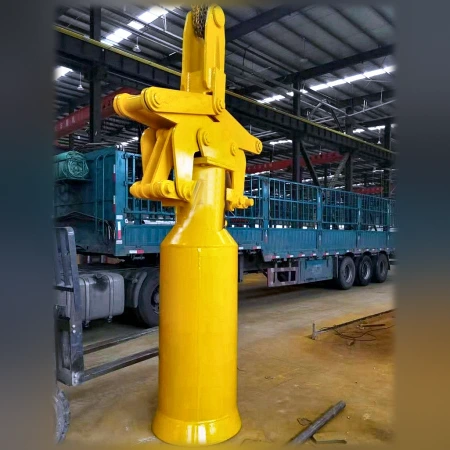
Lift sling rigging company produce Ingot Tongs Lifting Clamp,Round ingot lifting tong,Ingot Lifters and Tongs,Automatic Ingot Tong,Horizontal Ingot Tong,Round Ingot Tongs,slab tongs,Automatic Round Ingot Tong,Rotating Ingot Tong,Vertical ingot tongs,Silicon ingot tongs,Steel ingot rotating tongs,Aluminum ingot tongs.
Ingot Tongs Lifting Clamp
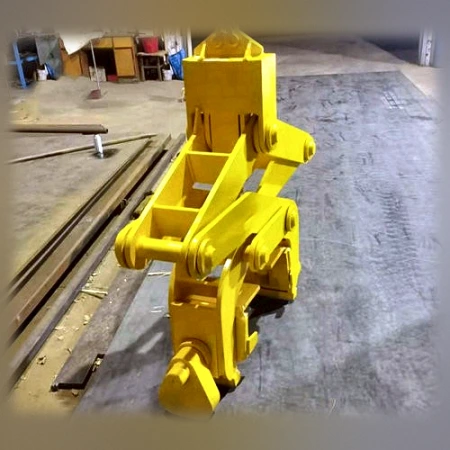
An ingot has no lifting point. No lug, no eye, no hole – just a cast shape that is often still hot. An ingot tong manufactures the missing lifting point out of the ingot’s own weight: two jaws close on the body, and the heavier the ingot, the harder they bite.
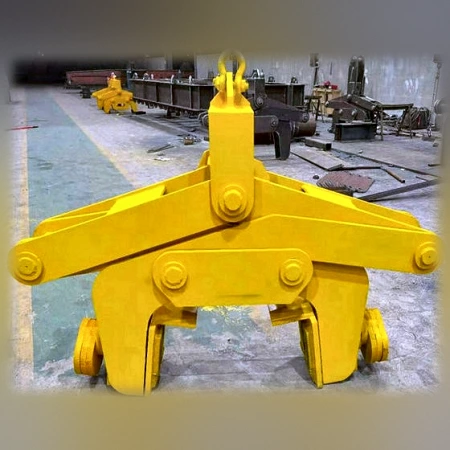
How a Tong Holds Without a Lifting Point
The mechanism is a four-bar linkage. As the crane takes up, the centre pin rises, the arms rotate about their pivots, and the jaws are driven inward. Nothing is powered and nothing is clamped by hand – the lifting force itself is what closes the jaws. Three consequences follow, and they decide everything about how the tong is specified:
- Grip rises with load. A self-tightening tong grips hardest at its rated load and least when the ingot is light, which is why a tong has a working range rather than a single number.
- Grip depends on friction. The jaws do not bite into the ingot; they hold it by friction on the contact faces. Scale, oil, mould release agent and a polished as-cast surface all reduce that friction.
- The shape must match. A jaw that touches an ingot on one line instead of a face has already lost most of its grip – and that is a taper problem, not a tong problem.
Five Tongs Sold Under One Name
The same page name covers several different tools, and the first job is to know which one the application needs. They are not interchangeable, and choosing the wrong one is the most common mistake in an ingot tong inquiry.
| Тип | Ingot it is built for | What decides it |
|---|---|---|
| Round ingot tong | Cylindrical ingot standing on end | Diameter range and taper on the body |
| Horizontal ingot tong | Ingot lying down, picked from above | Body length and where the centre of gravity sits |
| Slab tongs | Rectangular slab or bloom | Slab thickness, and the width of the gripping faces |
| Automatic tong | Any of the above, in a repeating cycle | Whether the jaws latch open and release on set-down |
| Rotating ingot tong | Ingot that must be turned from vertical to horizontal | Rotation drive, and the clearance the ingot sweeps |
Automatic and rotating are not separate shapes – they are features added to a round, horizontal or slab tong. That is why a specification has to name both: “automatic round ingot tong” says far more than “ingot tong”.
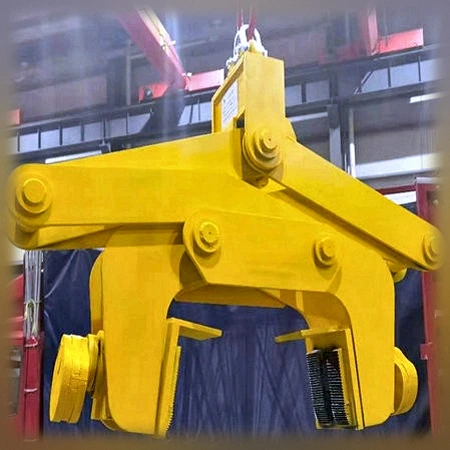
The Taper Is the Interface
Ingots are cast in a mould with draft, so the body is a truncated cone, not a cylinder. The jaws must sit on that taper. If they are cut for a parallel body, contact collapses to a line at one end, and the tong will slip at a load well below its rating.
| What to measure | Зашто је важно | Радни пример |
|---|---|---|
| Diameter at the top face | Sets the jaw opening at pick-up | А 2 degree draft over 100 mm of jaw height moves the surface by about 3.5 мм – enough to turn a face contact into a line contact |
| Diameter at the bottom face | Sets the jaw opening at release | |
| Height between them | Turns the two diameters into an angle |
Тхе 3.5 mm figure is trigonometry on a stated example, not a tolerance from our drawing. Send the two diameters and the height between them, and the jaw is cut to that taper – a tong built for a parallel ingot cannot be corrected on site.
Choosing the Model: the Inputs That Matter
| Инпут | What it decides | How to state it |
|---|---|---|
| Ingot shape | Роунд, square, slab or bloom | Sketch or photo, with dimensions |
| Size range | Jaw opening and arm length | Smallest and largest, both |
| Taper | Jaw face angle | Two diameters plus the height between |
| Тежина | Linkage section, pins, jaw size | Heaviest single ingot |
| Температура | Jaw material and heat protection | Cold, or the temperature at pick-up |
| Orientation | Вертицал, horizontal or rotating | How it stands when the crane reaches it |
| Cycle | Manual latch or automatic release | Ingots per shift, and whether a man is at the tong |
| Crane and headroom | Overall height, hook interface | Rated capacity and clear height |
| Површина | Jaw serration and friction pair | As-cast, descaled, науљени, обложене |
Hot Ingots Are a Different Specification
| Cold ingot | Hot ingot | |
|---|---|---|
| Jaw material | Standard wear-resistant steel | Heat-resistant grade, checked at the working temperature |
| Pins and bushes | Normal clearance | Clearance and lubricant chosen for heat, or dry-running bushes |
| Linkage | No shielding needed | Heat shield between ingot and linkage |
| Paint | Standard finish | Heat-resistant coating, or bare steel accepted |
| Rating | Set on cold strength | Set on strength at temperature, which is lower |
Ingot Tongs Lifting Clamp Technical Data
| Модел | SWL | Ingot Steel Scope(мм) | Макс. Opening size(мм) | Open and close |
| DYG1T(Φ50-100) | 1Тон | Φ50-100 | 105 | Manual |
| DYG1T(Φ100-160 ) | 1Тон | Φ100-160 | 170 | Manual |
| DYG2T(Φ80-130 ) | 2Тон | Φ80-130 | 145 | Manual |
| DYG2T(Φ100-200 ) | 2Тон | Φ100-200 | 210 | Manual |
| DYG3T(Φ120-220) | 3Тон | Φ120220 | 240 | Manual |
| DYG3T(Φ160-250) | 3Тон | Φ160-250 | 270 | Manual |
| DYG5T(Φ200-320) | 5Тон | Φ200-320 | 340 | Manual |
| DYG5T(Φ250-400 ) | 5Тон | Φ250-400 | 440 | Manual |
| DYG6T(Φ300-500 ) | 6Тон | Φ300-500 | 530 | Manual |
| DYG10T(Φ710-730 ) | 10Тон | Φ710-730 | 760 | Automated |
| DYG15T(Φ550-700 ) | 15Тон | Φ550-700 | 750 | Automated |
| DYG25T(Φ1200-1600 ) | 25Тон | Φ1200-1600 | 1680 | Automated |
A tong rated for cold ingots is not a hot-ingot tong with the paint burnt off. If the ingot is taken straight from the mould, say so at the inquiry and give the temperature – the rating, the pins and the shielding all follow from it.
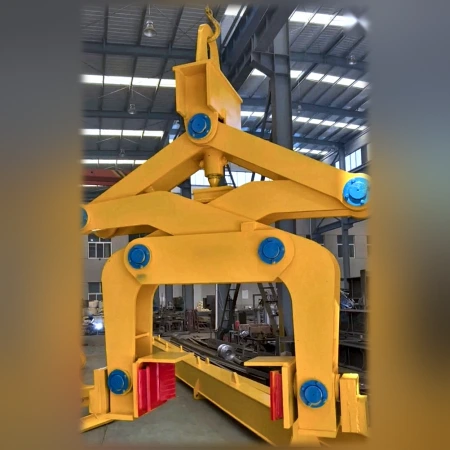
Wear: Where the Grip Disappears
| Wear point | What happens | How to check it |
|---|---|---|
| Jaw face | Serration flattens, friction falls | Compare the tooth profile against a new jaw |
| Jaw opening | Grows as jaws wear; the tong closes less deep | Measure the opening at a known ingot size |
| Pivot pins | Wear turns the four-bar into a loose linkage | Rock the arms by hand with the tong empty |
| Bushings | Clearance lets the jaws skew | Watch for one jaw touching before the other |
| Weld seams | Cracks at the arm-to-jaw joint | Visual and dye-penetrant on a schedule |
A tong does not fail by breaking. It fails by gripping less, quietly, until the day it does not. That is why the jaw opening is the number to record: it is a direct measure of how much grip has been consumed.
Безбедна употреба
| Risk | Узрок | Control |
|---|---|---|
| Slip at pick-up | Jaws on scale or on the wrong taper | Test bite: lift a few centimetres, stop, check |
| Two ingots at once | Jaws spanning a gap | One ingot per lift, every time |
| Release under load | Latch worn or defeated on an automatic tong | Latch function test at each shift start |
| Load swings | Tong not centred over the ingot’s centre of gravity | Present the tong square to the ingot |
| Person at the jaws | Guiding by hand | Tag line, and an exclusion zone under the load |
| Overload | Heavier ingot than the rating, or an unknown ingot | Weigh it; never lift an unweighed ingot on a light tong |
What to Send With the Inquiry
- Ingot shape, with a sketch or photo and its dimensions.
- Diameter or thickness at both ends, and the height between them.
- Weight range, and the heaviest single ingot.
- Cold or hot, with the temperature at pick-up if hot.
- How the ingot stands when the crane reaches it.
- Manual, automatic or rotating – and how many ingots per shift.
- Crane capacity, hook type and the clear height under the hook.
Често постављана питања
What is an ingot tongs lifting clamp?
A below-the-hook tool with two jaws on a four-bar linkage that grips an ingot on its body. The crane’s lift closes the jaws, so the tong makes a lifting point where the ingot has none.
Why does the grip increase with the load?
Because the linkage is self-tightening: the lifting force is fed back through the arms into the jaws, so a heavier ingot produces a harder bite. What limits the tong is friction at the jaw face, not the linkage itself.
Why does my tong slip on an ingot that fits it?
Usually taper. Ingots are cast with draft, so the body is a truncated cone; jaws cut for a parallel body touch on a line instead of a face and lose most of their grip. Scale and oil on the surface do the same thing.
What is the difference between automatic and manual tongs?
An automatic tong latches open and releases when the load is set down, so the crane operator can work without a man at the jaws. A manual tong is latched and released by hand, which is simpler but needs an operator beside the load.
Can one tong handle both round ingots and slabs?
Not properly. Round ingots need curved jaws and slab tongs need wide flat faces on a different opening; a compromise jaw touches both shapes badly. Two tongs are usually cheaper than one that fits neither.
Can it lift a hot ingot straight from the mould?
Only if it is built as a hot-ingot tong. Heat changes the jaw material, the pin clearance and the rating, so the temperature has to be stated at the inquiry rather than discovered at commissioning.
Send the ingot sketch with both diameters and the temperature – the jaws, the linkage and the rating follow from that. Send ingot dimensions