

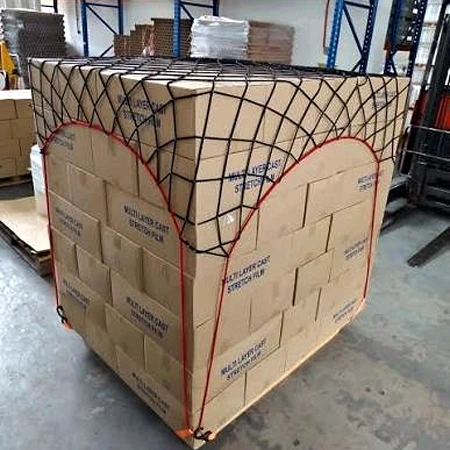
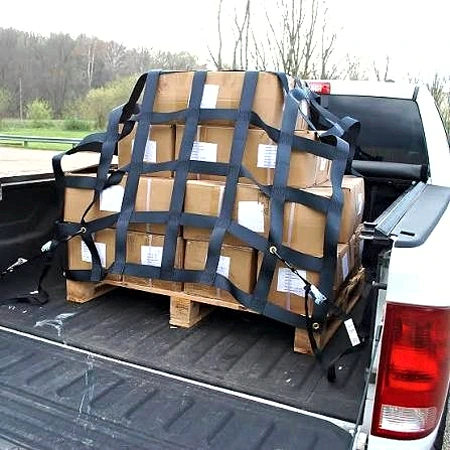
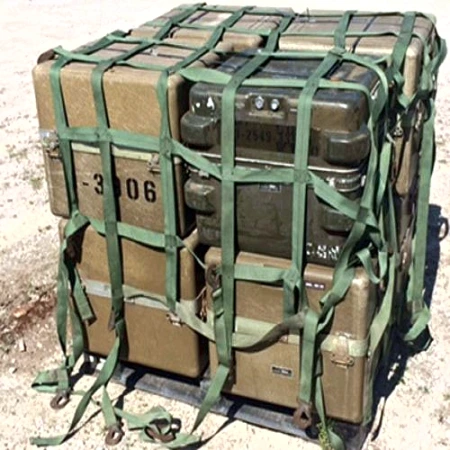
Kompania e manipulimit të hobeve të ngritjes prodhon rrjetë sigurimi të ngarkesave,Rrjeta për sigurimin e ngarkesës,Rrjetë e vogël për sigurimin e ngarkesës me rrjetë,Rrjetë për sigurimin e kontejnerëve,Rrjetë rrjetë e sigurt për ngarkesa.
Rrjet për sigurimin e ngarkesave
A cargo securing net is a flat-belt restraint net laid over a load and tensioned down to the deck, so that the cargo cannot slide, rock or topple on the way. The belts are woven from high-tenacity polyester into an open lattice, the border is folded and double-stitched, and the edge carries rated attachment points that are pulled down with ratchet tensioners until the load is pressed onto the vehicle or container floor.
The distinction that matters on this product is duty, not appearance. A cargo securing net restrains; it does not lift. Its label carries a lashing capacity (LC) and a standard tension force (STF) në daN, the arrangement is calculated to EN 12195-1 and the belts are type-tested to EN 12195-2 – not to a lifting working load limit. We weave the belts in our own mill in Taizhou, so net size, rrjetë, belt width, fittings and markings are set to your load, your vehicle and your anchor points.
- Restraint rating, jo një vlerësim ngritës – LC and STF marked in daN, calculated to EN 12195-1, belts type-tested to EN 12195-2.
- Flat high-tenacity polyester belts – 25 mm në 100 mm, single or duplex, UV stabilised and rot-proof.
- Sized to the load or the aperture – cover nets, container doorway nets, partition nets and bag form, all made to order.
- Rated fittings and tensioners – ratchets, grepa, D-rings and lashing points, with anti-slip mats where the deck friction is low.
- Çertifikuar CE dhe GS – të endura, të qepura, marked and tested in one plant, me ISO 9001, CNAS and DNV behind it.

Restraint is not lifting – and the label says which one you have
The two products look alike, are made from the same belt and are often bought by the same fleet. Ato nuk janë të këmbyeshme, and the difference is not a formality: one is sized so a load cannot move, the other is sized so a load cannot fall. Using a restraint net on a crane hook, or a lifting net as a tensioned tie-down, is a safety failure rather than a paperwork problem.
Tabela 1 – Why a securing rating and a lifting rating are not interchangeable.
| Pika e krahasimit | Rrjetë për sigurimin e ngarkesave (këtë faqe) | Rrjetë ngritëse |
|---|---|---|
| Çfarë bën | Kufizon një ngarkesë që qëndron në automjet | Mban peshën e plotë të një ngarkese në ajër |
| Të qeverisur nga | NË 12195-1 (llogaritja e forcave siguruese) dhe EN 12195-2 (kamxhik me rrip i trashë pëlhure) | Standardet e ngritjes, with webbing rated on the EN 1492-1 bazë |
| Vlerësuar në | Kapaciteti i qerpikëve (LC) dhe forcën standarde të tensionit (STF), në daN | Kufiri i ngarkesës së punës (WLL), në ton |
| How it is sized | Sized to resist the acceleration and friction case for the journey | Përmasat me a 5:1, 6:1 ose 7:1 faktor dhe testuar me prova për hobe |
| How it is tested | Belt and tensioner type-tested to EN 12195-2 | Every sling break-tested on our own 1000 t makine |
| Si dështon | The load moves – a road accident | The sling breaks – a dropped load |
If the requirement is to lift – a pallet onto a roof, a bag into a hold – the right product is a lifting net: të rrjeta e ngarkesave të paletës së vinçit, të rrjetë ngritëse poliester ose të hobe rrjetë ngarkesash najloni të rënda. If the requirement is to keep a load still from the loading bay to the delivery point, this page is the right one.
The forces the net has to answer for
A load on a moving vehicle is pushed in three directions, and each one is a design case rather than an accident. The accelerations below are the ones EN 12195-1 uses for road transport; other modes and national rules differ, which is why we ask where the load is travelling before we size the net.
Tabela 2 – Design accelerations for road transport and what resists each one.
| Direction | Design acceleration | What resists it |
|---|---|---|
| Forward (braking) | 0.8 g | Blocking or a headboard first, then direct lashings to the front; friction contributes |
| Rearward (acceleration) | 0.5 g | Rear lashings and a tailboard; the net’s rear edge lines |
| Anash (cornering) | 0.5 g | Side lashings, containment by the lattice, and friction from the pre-tension |
| Vertikale | Not a road design case | Held down by pre-tension and containment; a net reduces bounce but is not a substitute for blocking |
The practical consequence is that a net alone rarely carries the whole case. Blocking against a headboard does more for the braking case than any strap, and a net laid over the top does the rest. A good securing arrangement is a combination, and we will say so when a net is the wrong answer for your load.
Si një rrjetë me rrip të sheshtë mban një ngarkesë
Një rrjet sigurie funksionon përmes tre mekanizmave njëherësh. Which one dominates depends on how the net is fitted, and that is decided at the vehicle rather than at the factory.
Tabela 3 – The three mechanisms a securing net uses.
| Mekanizmi | Si funksionon | What it depends on |
|---|---|---|
| Fërkimi (lidhëse) | Rrjeta e tensionuar e shtyn ngarkesën në kuvertë, dhe fërkimi ndërmjet ngarkesës dhe kuvertës i reziston rrëshqitjes. This is the main effect of a cover net | Një e pastër, dry deck or anti-slip mats. Pa fërkim e njëjta rrjetë frenohet shumë më pak |
| frenimi | Grilë fizikisht ndalon përhapjen e ngarkesës, rocking, or throwing individual items out | A mesh fine enough for the smallest item, and a net fitted tight rather than draped |
| Direct lashing | Where the edge belts run down to rated points on the vehicle, vetë rripi mbart forcën frenuese | Certified anchor points on the vehicle – never a random protrusion or a load’s own packaging |
Two numbers decide whether the arrangement works, and both are usually ignored. The first is the angle: a tie-down belt is most effective between 75 dhe 90 gradë në kuvertë, and its effective capacity follows LC_eff = LC × sin α. Në 30 degrees you keep roughly half the belt’s rating, so a net pulled down almost flat looks tidy and holds very little. The second is friction: the coefficient between a steel load and a steel deck is about 0.1 te 0.2, steel on timber about 0.2 te 0.3, timber on timber about 0.3 te 0.4, and a good anti-slip mat takes a pallet on a deck to about 0.5 te 0.6. I lagur, oily or icy surfaces take all of these figures down, which is why the same net restrains very different loads on two different days.
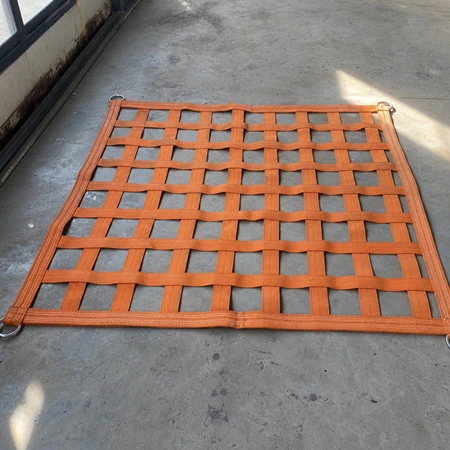
Parametrat teknikë
Shifrat e mëposhtme mbulojnë gamën standarde të sigurimit. Rrip, rrjetë, madhësia neto, Pajisjet e skajeve dhe tensionuesit janë bërë të gjitha sipas porosisë, kështu që trajtojeni këtë tabelë si pikënisje për një kuotim dhe jo si një katalog fiks.
Tabela 4 – Rrjetë për sigurimin e ngarkesave: parametrat teknikë.
| Parametri | Specifikimi |
|---|---|
| Lloji i produktit | Rrjetë për sigurimin e ngarkesave (rrjeta e mbajtjes së ngarkesës) – cover net, partition net, container doorway net or bag form. Jo një pajisje ngritëse |
| Belt material | 100 % poliester me qëndrueshmëri të lartë (PET); najloni me qëndrueshmëri të lartë sipas kërkesës |
| Gjerësia e rripit | 25 / 35 / 50 / 75 / 100 mm |
| Belt construction | Një shtresë ose dupleks, endur e endur, jo një skaj i prerë |
| Belt thickness | 1.8 mm – 4.0 mm në varësi të gjerësisë dhe numrit të shtresave |
| Hapja e rrjetës | 100 × 100 mm standard; 50 mm – 300 mm e bërë me porosi |
| Madhësia neto | Bërë në gjurmën e ngarkesës, shtrati i automjetit, ose hapja e kontejnerit ose e portës |
| Kapaciteti i qerpikëve (LC) | Rreth 750 daN on a 25 mm belt to about 5,000 daN on a 100 mm duplex belt, marked per net |
| Paratensioni (STF) | 250 – 500 daN depending on the tensioner supplied; shënuar në etiketë |
| Baza standarde | NË 12195-1 for the securing calculation; NË 12195-2 for the webbing lashing |
| Kufiri | Folded and double-stitched; të përforcuara në çdo pikë ngjitjeje |
| Pajisjet | Tensionuesit e arpioneve, grepa, Unaza D, cam buckles and lashing points, notë 80 steel where steel is used |
| Ngjyra | Orange for high visibility as standard; blu, jeshile, black or a custom colour |
| Mjekimi | UV i stabilizuar, kundër plakjes, rezistente ndaj gërryerjes dhe grisjes, rezistent ndaj kalbjes |
| Temperatura e punës | -40 °C deri në +100 °C |
| Certifikimi | CE, GS, ISO 9001, JIS sipas kërkesës; Laboratori CNAS; DNV |
| Përshtatje | OEM / Madhësia ODM, ngjyra, printed belt, etiketë, logon dhe paketimin |
| Kodi HS | 6307.90 – nets and netting of textile materials |
Standard sizes, mesh and lashing capacity
A securing net is sized to the load it covers or the aperture it closes, never to a tonnage. The load has to be fully covered, and the border has to land on the deck or on the anchor points instead of hanging in mid-air, because an unsupported edge is an edge that can be pulled sideways.
Tabela 5 – Standard securing net sizes, with the belt and capacity that normally go with them.
| Madhësia neto (L × W) | Rrjetë | Rrip | LC per edge line | Përdorimi tipik |
|---|---|---|---|---|
| 1.2 × 1.2 m (4 × 4 ft) | 100 mm | 35 – 50 mm | 1,000 – 2,000 Dhe | Single pallet in a van or light truck |
| 2.5 × 1.2 m (8 × 4 ft) | 100 mm | 50 mm | 2,000 Dhe | Two pallets abreast in a van or curtain-sider |
| 2.5 × 2.5 m | 100 mm | 50 mm | 2,000 Dhe | Ngarkesa me shtrat të sheshtë, makineri, mixed cargo |
| 5.0 × 2.5 m | 100 – 150 mm | 50 – 75 mm | 2,000 – 3,500 Dhe | Ngarkesa me shtrat të sheshtë dhe rimorkio me gjatësi të plotë |
| 2.4 × 2.6 m (enë) | 100 mm | 75 mm | 3,500 Dhe | Container doorway net, load held back from the doors |
| 1.5 × 1.5 m bag form | 50 – 100 mm | 50 mm | 2,000 Dhe | Loose or bagged goods that would spread on the deck |
| E bërë për vizatim | 50 – 300 mm | 25 – 100 mm | To calculation | Çdo gjurmë, aperture or vehicle bed |
The capacity column is the restraint available per edge line, not a lifting limit. The number of edge lines, their angle and the friction under the load decide what the arrangement actually restrains.
Four forms of securing net
The same lattice is supplied in four arrangements, and choosing the right one is most of the job. Pajisjet ndryshojnë midis tyre; parimi i kufizimit nuk e bën.
Tabela 6 – Cover, partition, container and bag forms.
| Forma | Si është montuar | Përdoret kur |
|---|---|---|
| Rrjetë mbuluese | Spread over the load and tensioned down to the deck or to the vehicle’s rated points | Shtrat i sheshtë, curtain-sider and container loads that must not move in any direction – the most common arrangement |
| Partition net | Fixed upright across the vehicle body and tensioned against its own frame | Separating two loads in one vehicle, or holding cargo away from a bulkhead |
| Container doorway net | Fitted across the door aperture and hooked to the container’s own rings | Stopping cargo migrating to the doors during the journey, so the container is safe to open |
| Forma e çantës | Closed at the bottom, with the cargo sitting inside the lattice | Loose or bagged goods that would otherwise spread across the deck |
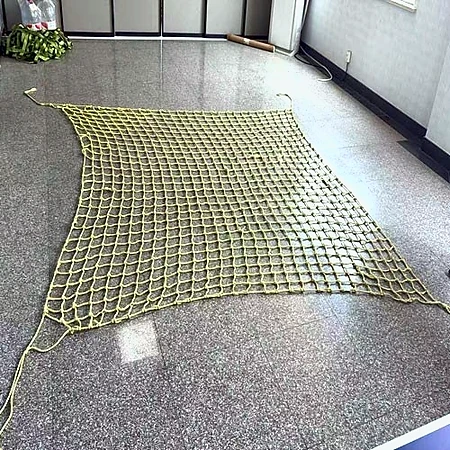
Pajisjet, tensioners and anti-slip
A securing net is only as good as the tensioner that pre-tensions it and the anchor point it pulls against. These are the parts that get specified last and fail first.
Tabela 7 – Pajisje dhe tensionues.
| Përshtatje | Përdoret me | Shënim |
|---|---|---|
| Tensionet me arpion | Rrjetë mbuluese, forma e çantës | Vendos paratensionin (STF). A ratchet that cannot reach the marked STF makes the net ineffective, whatever its LC |
| Lidhja e kamerës | Detyrë e lehtë | Faster than a ratchet but reaches a much lower pre-tension – for light loads only |
| Grepa dhe unaza D | Çdo marrëveshje | The link between net and anchor point; notë 80 çeliku ku përdoret një montim çeliku |
| Pika lidhëse | Rrjetë mbuluese | Rated anchor points in the vehicle structure – the restraint force has to go somewhere rated |
| Tapet kundër rrëshqitjes | Përmbajtje fërkimi | Raises the friction coefficient under the load; usually the single most effective addition on a smooth deck |
| Mëngë mbrojtëse | Ngarkesa me tehe të mprehta | Fits over the belt at the contact point; mënyra më e lirë për të zgjatur jetën e rrjetit |
| Kompleti i riparimit | Fleet maintenance | Matching belt, fije qepjeje dhe një tensionues rezervë |
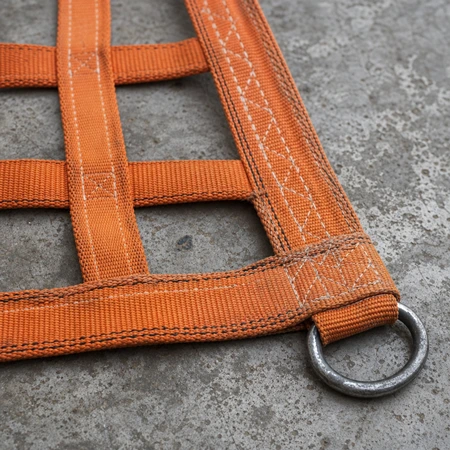
Shënimi, colour and identification
A securing net is checked by the driver before every trip and by an inspector at the roadside, so the marking has to be readable at a distance and has to survive being dragged over a deck.
- Lashing capacity and standard tension force printed along the belt in daN – the units load securing is actually calculated in.
- Net size and date of manufacture printed as well, so the net can be matched to the vehicle and its age judged on the spot.
- Një etiketë me kapacitet të qepur përveç printimit, kështu që rrjeti dhe dokumentet e tij pajtohen gjithmonë.
- Orange as the standard high-visibility colour, with blue, jeshile, black or a house colour for fleet identification.
- Porositë OEM mund të mbajnë markën tuaj, warning text or certificate number printed on the belt.
- Rrjetat dërgohen të palosura në një qese ose një arkë – a fleet order takes a fraction of the space of the same number of loose straps.
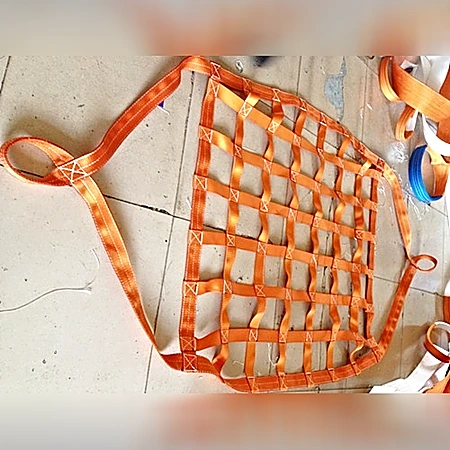
Testimi, certifikimit dhe gjurmueshmërisë
- Dyzet vjet prodhim i pajisjeve ngritëse – themeluar në 1985 në Taizhou, Jiangsu, me më shumë se 200 punonjësit.
- Belts woven in our own mill, pra gjerësia, layer count and colour are under our control rather than bought in.
- Webbing strength-tested on our own 1000 t horizontal machine before it is cut into nets.
- Belts supplied to the EN 12195-2 material requirements for securing duty, with the securing calculation following EN 12195-1.
- Deklarata CE e konformitetit dhe certifikimi GS, with JIS on export orders; ISO 9001, CNAS laboratory accreditation and DNV certification behind the plant.
- Çdo rrjetë shënohet me aftësinë e saj shtrënguese, paratensioni, size and mesh before packing, and supplied with a material test report on request.
Certifikatat dhe raportet e testimit janë të disponueshme si PDF për një skedar tenderi ose një kontroll doganor – shih të plotë certifikimit vendosur.
Aty ku përdoren rrjetat për sigurimin e ngarkesës
The same net covers a road trailer, a container, a rail wagon and a barge. What changes is the number of anchor points, the mesh and how the net is tensioned – not the product itself.
Tabela 8 – Applications by transport mode.
| Modaliteti ose sektori | Çfarë frenon rrjeta | Pse i përshtatet një rrjetë me rrip të sheshtë |
|---|---|---|
| Rruga – shtrat i sheshtë | Makineri, çeliku, lëndë druri, paleta, bateri dhe ngarkesa të përziera | Mbulon të gjithë ngarkesën me një veprim dhe kombinon fërkimin me frenimin |
| Rruga – perde-sider | Palletised and boxed goods that shift against a soft curtain | Përmban ngarkesën ku vetë perdja nuk mbart asnjë kufizim |
| Transporti me kontejnerë | Ngarkesa pas dyerve, and cargo that must not migrate in transit | A doorway net makes the container safe to open and stops the load moving forward |
| Transport mallrash hekurudhor | Palletised and loose cargo in wagons and on flat wagons | Rrjetat e gjata mbulojnë një shtrat vagoni dhe mund të tensionohen në intervale të rregullta |
| Deti dhe rruga ujore e brendshme | Ngarkesa në kuvertë, dhe ngarkesave brenda maunave dhe bareve | rezistent ndaj kalbjes, UV stabilised and unaffected by salt water |
| Transporti i rëndë dhe ngarkesa e projektit | Transformatorët, ngarkesa impiante dhe jashtë matës | Kombinuar me lidhëse direkte dhe bllokim për ngarkesa të pandashme |
| Mbeturinat, riciklimi dhe bujqësia | Bales, refuzoj, kompost dhe ngarkesa me shumicë në automjete të hapura | Mbajtja ndalon materialin e lirshëm që largohet nga automjeti në tranzit |
| Military and relief transport | Palletised and loose cargo in trucks and aircraft | Një rrjetë për ngarkesë, i shpejtë për tu aplikuar dhe i ripërdorshëm gjatë shumë udhëtimeve |
Kujdesi, inspektimit dhe daljes në pension
- Check the net before every trip and record the check: the tensioner first, pastaj qepja në çdo pikë ngjitjeje, pastaj rripat.
- Refuzoni çdo rrip me prerje, dëmtimi i skajit, qepje e thyer, ngjyrosje kimike, lustrim me ngrohje, or the colour and gloss change that signals UV degradation.
- Check the vehicle’s anchor points as carefully as the net. A perfect net on a corroded lashing point restrains nothing.
- Keep the deck clean and dry, and fit anti-slip mats wherever load-to-deck friction is low. That is a securing measure, not a refinement.
- Never use a securing net to lift, and never use a lifting net as a tensioned tie-down unless its label carries both ratings.
- Ruajeni të pastër dhe të thatë, jashtë tokës dhe jashtë diellit të drejtpërdrejtë; never repair a webbing belt by knotting, saldimi ose ngrohja e tij.
- Withdraw the net if a belt, a stitch line or a tensioner is damaged, and have nets inspected by a competent person at the interval your fleet requires.
Pyetjet e bëra shpesh
Can a cargo securing net be used to lift a load?
Nr. It is rated for restraint, duke mos ngritur, dhe të dyja llogariten në baza krejtësisht të ndryshme. If the load has to go onto a hook, use a lifting net with a working load limit and a per-sling proof test – the crane pallet cargo net or the polyester lifting hoisting net, both linked earlier on this page.
Cili është ndryshimi midis LC dhe STF?
LC (kapaciteti i kamxhikut) është forca frenuese që rripi është vlerësuar të mbajë. STF (forca standarde e tensionit) është se sa fort mund ta paratensionojë rripin tensionuesi me arpion. Both are marked in daN. LC është më e rëndësishmja në shtrëngimin e drejtpërdrejtë, ku vetë rripi mban ngarkesën; STF ka më shumë rëndësi në shtrëngimin e lidhëses, where the pre-tension creates the friction that does the holding.
Sa e ngushtë duhet të jetë rrjeta?
Mjaft e ngushtë për të arritur paratensionin e shënuar në etiketë, with the belts running as steeply to the deck as the load allows – 75 te 90 degrees is where a tie-down belt works best. A belt laid almost flat keeps only about half its capacity, kështu që një rrjetë që duket e mbuluar mirë mund të mbajë shumë pak.
A kam nevojë për dyshekë kundër rrëshqitjes?
If the restraint relies on friction – which is what a cover net does – then usually yes. On steel, aluminium or plastic surfaces the friction coefficient is low, and a mat often adds more restraint than an extra strap does. Një e pastër, dry deck is the other half of the same measure.
Sa kamxhik ose pika ankorimi më duhen?
Kjo rrjedh nga ngarkesa, fërkimi i kuvertës, the vehicle and the journey rather than from a rule of thumb. Direct lashing normally needs at least four anchor lines, dy për anë dhe të kryqëzuara, with the vertical and plan-view angles between 30 dhe 60 gradë. Na dërgoni detajet e ngarkesës dhe automjetit dhe ne do ta bëjmë marrëveshjen me ju.
Will a net stop cargo moving inside a container?
Një portë ose rrjetë ndarëse ndalon migrimin e ngarkesës drejt dyerve dhe e bën kontejnerin të sigurt për t'u hapur. For the journey itself the load still has to be restrained as a whole, kështu që një kontejner zakonisht sigurohet me një rrjetë ndarëse plus bllokim ose gropë në vend se me një rrjetë vetëm.
Çfarë hapje rrjetë duhet të zgjedh?
Fine enough that the smallest item in the load cannot pass through. 100 mm është standardi ynë dhe mban paleta, kartona, çanta dhe bateri; sendet e lirshme ose të vogla kanë nevojë për një rrjetë më të ngushtë, dhe ngarkesat e mëdha të pandashme mund të marrin një më të gjerë.
Çfarë tjetër bëni për trajtimin e ngarkesës?
The same belts go into our hobe rrjete dhe hobe të rrumbullakëta pafund, the wire rope range is under hobe me litar teli, the rope itself under litarë najloni, and RoRo and breakbulk work is covered by the rrjetë për ngritjen e automjeteve. The lifting side of the net range starts at rrjeta për ngritjen e ngarkesave.
Kërkoni një kuotim
Send the transport mode, the load weight and dimensions, nëse mund të përhapet apo të rrëzohet, the deck material, madhësia e rrjetës ose e hapjes, the belt width and the anchor points you have – or a drawing of the load and the vehicle. Inxhinierët tanë do të konfirmojnë rrjetin, pajisjet, numrin e linjave lidhëse dhe paketimin, dhe citojini në një përgjigje. Për ta diskutuar fillimisht, kontaktoni inxhinierët tanë.
Lift Sling Rigging Company – Parku Industrial Lifute, Qyteti Taizhou, Provinca Jiangsu, Kinë
tel: +86 523 8693 5818 | WhatsApp: +86 180 6600 2268 | E-mail: lift98@jslift.com