

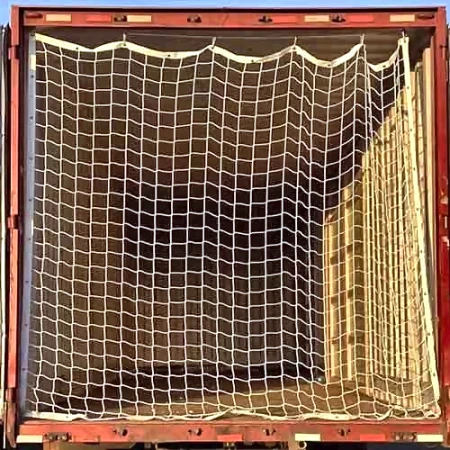
Lift sling rigging company produce Container Cargo Net,Wear Resisting Cargo Container Safety Net,Container Cargo Safety Net,container protection net,Container Safety Net.
Container Cargo Net
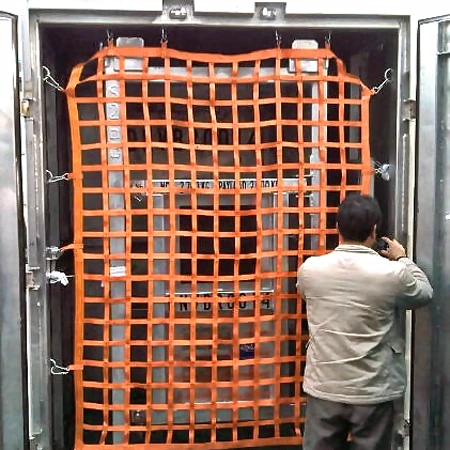
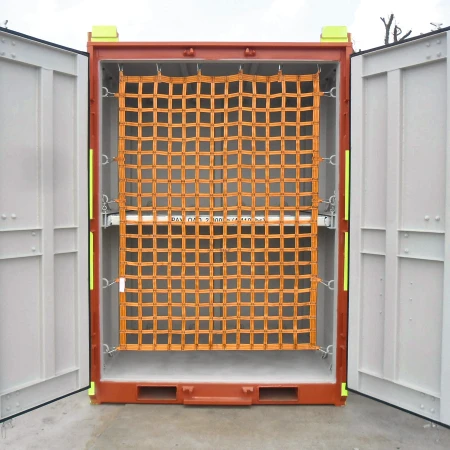
A container cargo net is a high-strength polyester net hung across the inside of a container doorway. Its work starts at the moment the doors are opened: cargo that has shifted in transit is held back by the net, so the doors can be swung open and the load surveyed without anything coming out. Most buyers call the same article a container safety net; the net is light, goes up in minutes, and is not lifting gear.
It is one of the least glamorous items in a container kit and one of the few that is bought for a single moment. Everything else in the box – the lashing, the dunnage, the strapping – is there to stop the load moving. The net is there for what happens if it moved anyway, and it is judged by whether it is still standing when the doors are open and a forklift is waiting.
The moment the doors open
A container is loaded at one end of the world and opened at the other, and between those two events the cargo is subjected to a sea passage, a rail leg, a chassis on a motorway and a yard crane. Cartons settle, bags slump, a pallet that was tight against its neighbour moves a hand’s width. None of it matters until the doors are opened – and then all of it is leaning on the door line.
Two things follow, and they are why the product exists in the form it does. Marka hore, the net must be able to be hung before the doors are opened, from inside, by someone standing on the ground or a step – which is why it is light and why the fixings are hooks and rings rather than bolts. Labaad, it must not rely on the cargo for support: it hangs from the box, not from the load, so a collapsed stack is caught rather than pushed.
It is worth saying plainly what the net is not. It is not a fall-arrest net, it is not a lifting net, and it is not a substitute for lashing the load properly. It is the last line at the door, and a consignment that arrives with everything against it has already failed somewhere earlier in the journey.
Webbing or rope
Both are made in this works, and the choice is about the cargo and the crew rather than about strength.
| Webbing net | Rope net | |
|---|---|---|
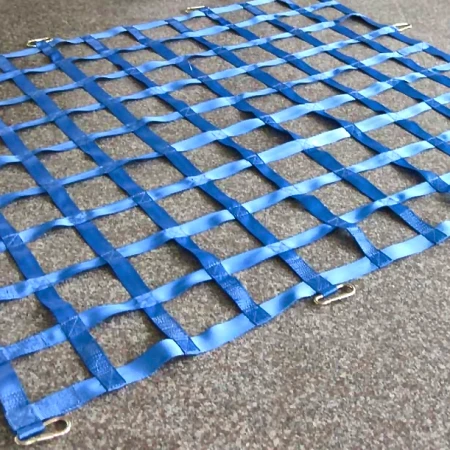
| What it is | Flat polyester webbing stitched into a grid, with a reinforced border and steel rings at the corners | Polyester rope knotted or spliced into a square mesh, with a heavier border rope |
| How it behaves | Wide, flat contact; spreads the push of a carton instead of cutting into it | Rounds over the load; kinder to bags and drums, and easier to repair in the field |
| Halkay ku guulaysato | Cartons, pallets and boxed goods; anything with a flat face | Bulk bags, drums, irregular cargo, and nets that will be handled roughly |
| Weight and bulk | Heavier per square metre, packs flat | Lighter, packs into a smaller bag |
| Repair | Re-stitched at a bench | Re-knotted or re-spliced on site |
Sizing to the box
Container cargo nets are not sold by the square metre. They are made to a box, and the box is measured rather than assumed – two containers of the same nominal size can differ by a few centimetres at the door, and a net that is 50 mm short will not tension.
| Container | Internal L x W x H (about) | Door opening (about) | Net to order |
|---|---|---|---|
| 20 ft | 5.90 x 2.35 x 2.39 m | 2.34 x 2.28 m | door net 2.4 x 2.4 m, or full lining 5.9 x 2.4 m |
| 40 ft | 12.03 x 2.35 x 2.39 m | 2.34 x 2.28 m | door net 2.4 x 2.4 m, or full lining 12.0 x 2.4 m |
| 40 ft high cube | 12.03 x 2.35 x 2.69 m | 2.34 x 2.58 m | door net 2.4 x 2.6 m, or lining 12.0 x 2.7 m |
| 45 ft high cube | 13.56 x 2.35 x 2.69 m | 2.34 x 2.58 m | door net 2.4 x 2.6 m, or lining 13.5 x 2.7 m |
Nominal figures, and builders differ. Measure the box you are fitting: the door opening, the height to the first rail, and the spacing of whatever the net will hook onto.
The border does the work
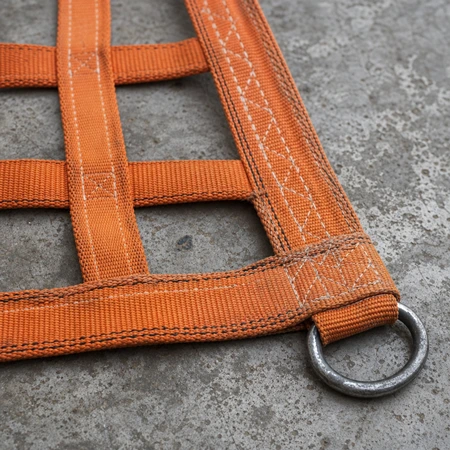
On a container safety net, the mesh carries the cargo and the border carries the mesh. A stitched border – several rows through webbing folded back on itself – takes the tension out of the grid and into the rings, which is why a net fails at the ring or the hook long before it fails in the middle. It is also the part to look at when a net comes back for inspection.
Fixing and tension
A container cargo net is only as good as its fixing, and the fixing is decided by what the box already has.
- Lashing rings inside the box. The best case: the net’s hooks go straight onto the rings down the side walls and across the front, and the net sits a hand’s width inside the door line.
- No rings, or rings only at the front. Common on older boxes. The net is then held by straps taken around the door frame’s vertical rails and back to the corner castings, and the fixing kit is specified with the net.
- Tension. A net that hangs slack will catch a carton and drop it. Tension is taken with a cord through the border eyes, or with a small ratchet on the two bottom corners – enough to take up the slack, not enough to pull the door frame.
- Height. Hang the net so its bottom edge sits on the floor line; a gap at the bottom is where the first carton goes through.
Iftiin, and that is the specification
The net is bought light for a reason that has nothing to do with freight cost. It is hung by one person, at the door, often at night, often in a yard with a forklift waiting. A net that needs two people and a ladder does not get hung, and a net that does not get hung protects nothing.
In practice that means a 2.4 m door net in 25-38 mm webbing, or the same in 8-10 mm rope, folded into a bag that goes in the cab. The full-length lining nets are heavier and are usually fitted once and left in place for the life of the box.
Where it is used
- Unpacking at destination. The most common use: a net hung before the doors are opened, so a shifted load can be seen and worked rather than fallen on.
- LCL and groupage. Part-loads are consolidated by different hands and shift against each other; the net is the barrier between the cargo and the door.
- Bagged and bulk cargo. Bags slump and set; the net holds the face of the stack while the first rows are taken out.
- Drums and coils. A net with a rope construction and a heavier border, hung clear of the door line.
- Depots and repair shops. A box in for inspection is opened and closed repeatedly; a net saves the damage done by a load falling out on the apron.
It is not a lifting net
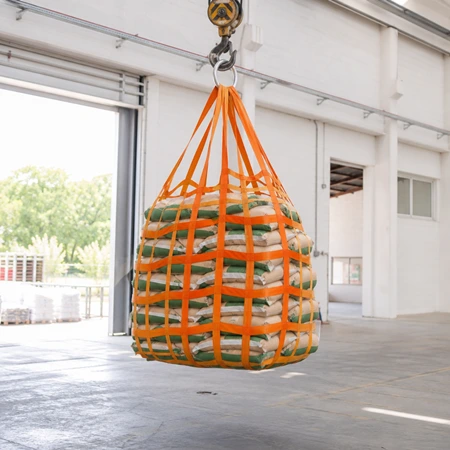
The two products look alike and are bought by different people for different reasons. A cargo lifting net is rated, tested and marked, because it carries a load in the air with people underneath. A container cargo net is a barrier at a door, sized to a box, and it carries nothing on a hook.
| Container cargo net | Cargo lifting net | |
|---|---|---|
| Job | Hold shifted cargo back at the door line | Carry a load under a crane or a hook |
| Rated by | Size and construction, to the box | Working load limit, with a factor and a label |
| Fittings | Rings, hooks, cord or ratchet | Reinforced eyes, master link, certified hardware |
| Inspection | Visual, before fitting | Documented, with a competent person |
| Price driver | Weight, mesh and border | Rated capacity and certification |
Inspection, and what retires a net
A container cargo net has an easy life compared with lifting gear, and it still has a short list of failures worth looking for each time it goes up.
- A cut or a melted strand in the mesh – from a fork tine, a strap hook or a hot cargo. One damaged strand concentrates the load into its neighbours.
- Stitching pulled at the border, especially at the corners: the rows should be intact and the webbing should not have slipped in the stitch line.
- A bent or worn ring, or a hook that has opened. Once a hook has straightened it will straighten again.
- Contamination that will not come out – oil, paint, cement, or anything that stiffens the webbing.
- An unmarked net. If you cannot tell what it is and what it was made for, it is a net, not a piece of equipment.
Six lines on the enquiry
| # | The line | What it fixes | What goes wrong without it |
|---|---|---|---|
| 1 | Container type and measured door opening | The size, and the height to the first rail | A net that will not tension because the door is 30 mm wider than the type sheet |
| 2 | Door-end net, or full-length lining | The net’s depth and where it is fixed | A door net ordered for a job that needed the load lined |
| 3 | Webbing or rope, and the mesh | The construction and the mesh size | A webbing net for drums, which needs the rope version |
| 4 | What the cargo is, and how it is packed | Mesh, border and weight class | A fine mesh that blinds over with bags, or a coarse one that lets cartons through |
| 5 | What the box has to hook onto | Rings, hooks and whether a fixing kit is needed | A net that arrives with nothing to attach it to |
| 6 | Colour, marking and packing | The dye lot, the label and the bag | A net that cannot be identified in a yard at night |
Frequently asked questions
What is a container cargo net for?
A container safety net is hung across the inside of a container doorway so that cargo which has shifted in transit is held back when the doors are opened. It is a barrier at the door, not a lifting net and not a load restraint in its own right.
Webbing or rope – which should I buy?
Webbing for cartons, pallets and boxed goods, where a flat face benefits from a flat contact; rope for bags, drums and irregular cargo, and for nets that will be handled roughly or repaired on site. Both are made here, and both are sized to the box.
Will it fit my container?
Only if the box is measured. Nominal sizes are close but not exact, and builders differ at the door. Send the container type and the measured door opening, and the net is made to that; a 50 mm error is the difference between a tensioned net and a slack one.
What if the container has no lashing rings inside?
Many boxes have rings at the front only. In that case the net is held by straps taken around the door frame’s vertical rails and back to the corner castings, and the fixing kit is quoted with the net rather than after it.
Can a container cargo net be used for lifting?
No. It is sized to a container and has no working load limit, no factor and no lifting hardware. A cargo lifting net is a different, rated article, and the two should never be substituted for one another.
How much can it hold?
It is a barrier for cargo that has moved, not a rated sling, so there is no single figure to quote. What the net has to do is hold the face of the load while the doors are open and the first rows are taken out, and the mesh, border and fixing are specified for that. Where a customer’s safety case needs a documented break strength for the assembly, say so on the enquiry and it is confirmed before the order.
How long does fitting take?
A door net goes up in a few minutes by one person: hook the top corners, hook the bottom, take up the slack. A full-length lining net is a longer job and is usually fitted once and left in the box.
Can it be branded and packed to our own specification?
Haa. Colour, a sewn label with your reference, and a bag or carton marked to your packing list. Send the artwork and the packing requirement with the sizes.
Where the rest of the detail lives
The lifting side of the same material, and the two neighbouring products, are on their own pages.
- Cargo lifting net – the rated article, with the WLL and factor
- Webbing cargo lifting net – the webbing version, in use
- Pallet cargo net – for a single pallet rather than a box
- Truck cargo net – the same idea on a flatbed or a wagon
- Safety rope net – the category, including fall-protection nets
- Cargo lashing – the restraint that stops the load moving in the first place
Xiriir
Hal qayb oo ka mid ah Lift Sling Rigging Co., Ltd., Ltd weaves the webbing, knots the rope and makes the net in one works.
Send the container type, the measured door opening and what the cargo is. We confirm the mesh, the border, the fixing kit and the size in writing before the net is cut.
- Telephone and WeChat: 18066002268
- E-mailka: 702461526@qq.com
- Cinwaanka: Beerta Warshadaha ee Lifute, Magaalada Taizhou, Gobolka Jiangsu, Shiinaha
- HS code: 630790