

Lift sling rigging company produce Durable Safety Netting for Fall Protection,Knotted Double Layer Safety Net,Fall Protection Safety Nets,Knotless nylon fall protection netting,Fall Protection Construction Safety Net For Scaffolding,Flame retardant safety net,Fire Retardant Safety Net.
Durable Safety Netting for Fall Protection
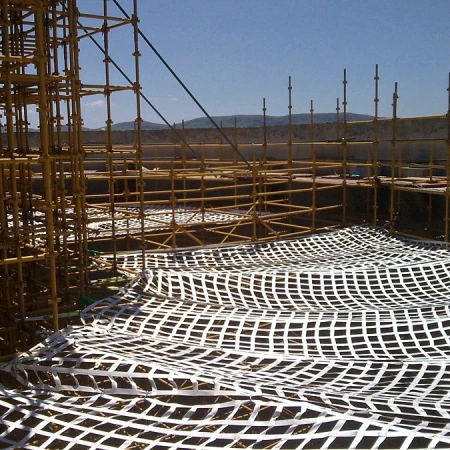
Fall protection netting is the net that stands between a person and the ground. It is hung on a scaffold, across an opening, along a roof edge or under a working platform, in high-tenacity polyester – knotted or knotless, rope or webbing. It is light enough for two people to hang and strong enough to matter, and the word durable is a claim about what it survives: sun, abrasion at the ties, and the handling of a building site.
One warning belongs at the top rather than at the bottom. A net that is expected to arrest a person is a regulated article, and in most markets it has to arrive with test documentation and be installed to a plan. We make the net to that specification when the project says so – and we will not describe a debris net as an arrest net, because the difference is a person’s life rather than a grade. The next section separates the three jobs that this phrase is used for.
Three jobs behind one phrase
The same words – safety netting, fall protection – are sold for three different duties, and the requirements are not interchangeable. Getting this wrong is the most expensive mistake on a net order, because the wrong net can look completely correct on the scaffold.
| The duty | What it does | What decides the specification |
|---|---|---|
| Arrest a falling person | Takes a body at speed, absorbs the energy, holds until rescue | Certified article and test documentation; energy absorption; clearance below; trained installation |
| Contain debris | Catches tools, offcuts, tiles and material so nothing reaches the ground | Mesh smaller than the smallest falling item; border strength; how the load is spread |
| Guard an edge or an opening | Stops a person walking or leaning into a void | Height, tie spacing, mesh that cannot be climbed or pushed through |
A debris net and an arrest net can look identical. Ask for the duty in writing, and for the documents the duty requires.
Kaj “durable” actually means
Fall protection netting does not fail because the rope was too thin. It fails at five places, and each one has a construction answer. A net sold as durable without an answer to these is a net with a longer adjective.
- Sun. UV breaks polyester slowly and nylon faster. The answer is UV-stabilised yarn and a colour that is not pretending to be white for ever; a net left on a facade for two years is a different product from one used for a six-week fit-out.
- Abrasion at the tie. The net moves a few millimetres in wind, always at the same points. The answer is a reinforced border and ties that spread the load over a length of border rather than a single mesh.
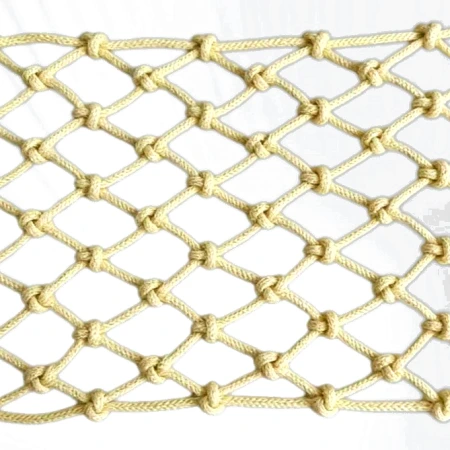
- Knot slip and stitch failure. In a knotted net the knot is the weak point and also the energy absorber; in a knotless net the stitching is. Both are repairable, and both fail visibly if the net is inspected.
- Heat and sparks. Welding, grinding and hot slag burn through any polymer. Where hot work is above the net, the net needs a flame-retardant finish and a physical gap – the finish slows ignition, it does not make the net fireproof.
- Cutting edges. A net pulled over scaffold couplers, rebar or a raw concrete edge wears through where it touches. Sleeves at the contact points cost very little.
Knotted or knotless
This is the construction decision buyers ask about most, and it is a question about how the net behaves rather than how strong it is.
| Knotted net | Knotless net | |
|---|---|---|
| How it is made | Rope knotted at every intersection | Ropes stitched or interlaced, no knots |
| Energy | The knot gives and recovers: good for arrest duty | Firmer; energy is taken by the mesh geometry |
| Strength per kg | Lower – the knot consumes length | Higher – no rope spent in knots |
| Repair | A broken rope can be replaced in the field | Repair usually means a new panel or a specialist splice |
| Feel and handling | Bulkier, heavier, familiar | Flatter, lighter, easier to fold and store |
| Where it wins | Scaffold nets, arrest nets, rough sites | Screens, debris nets, fine mesh, large panels |
Webbing or rope
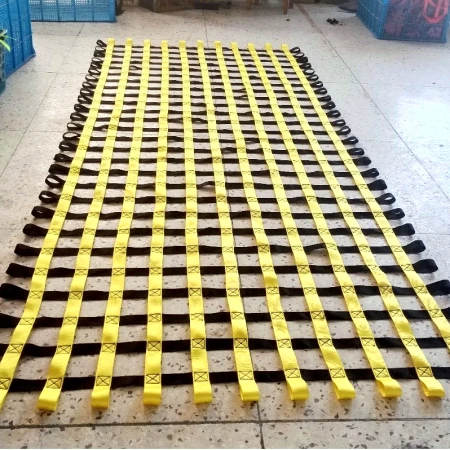
Where the net has to cover a large flat area, webbing does the job with fewer intersections and a flatter surface; where it has to wrap, tie and be handled on a scaffold, rope is more forgiving.
Mesh: the number that decides what it catches
The mesh is chosen from the smallest thing that must not pass through, and from the body part that must not pass through. For debris work the rule is arithmetic; for people it is a matter of the standard that applies.
| Duty | Mesh | Why |
|---|---|---|
| Person arrest, to the European net standard | 100 mm | The test mesh of EN 1263-1: big enough to deform, small enough to hold |
| General debris, tools, offcuts | 45 – 60 mm | Catches what a gang drops; smaller mesh blocks wind and view |
| Fine debris, tiles, fixings, grit | 25 – 45 mm | Needs a fine net or a net plus a sheet |
| Edge guarding, openings | 45 – 60 mm | No foothold, no handhold, nothing to push a knee through |
| Large material, pallets, panels | 75 – 100 mm | Coarser net, more open, lighter to handle |
Where a project is specified to a standard, the mesh is not a design choice – it is a requirement. Send the standard, not the mesh.
The net is only as good as its anchors
A net that holds a person has to put the arrest load into the structure, and the structure has to be able to take it. Three things follow, and they are all installation rather than manufacturing.
- Tie spacing. Short, frequent ties spread the load; a handful of long ties concentrate it. The spacing is set by the plan, not by what is reachable from the lift.
- Clearance below. An arrest net deforms when it takes a fall. The distance from the net to the surface below has to include that deformation, or the net catches the person and then puts them on the ground.
- Nobody re-uses a net that has taken a fall. The energy absorption is a one-time event in the yarn and the knots. A net that has arrested somebody is inspected, documented and retired – not rehung.
Scaffolding nets, which is what most orders are
The commonest enquiry is a scaffold net: fall protection netting cut to a panel that covers the face of a working scaffold for the duration of a contract, tied to the standards, taken down and rehung on the next elevation. Four things decide it: the bay size of the scaffold, the height it has to cover, the tie spacing the site can achieve, and the wind – a net adds sail area, and a scaffold that was stable without netting is not necessarily stable with it.
Where the net is for a long contract, the colour and the UV package matter more than the price per square metre, because a net that chalks and tears in year two costs the same again. That is the sense in which this page uses the word durable: not thicker, but able to finish the job.
Flame retardant, and what FR has to mean
A flame-retardant net is not fireproof: it resists ignition and stops carrying flame, and it does so to a named test. Where FR is required, the requirement is a standard and a class, and the certificate is issued against that standard – so the useful question on an enquiry is not “is it FR” but “to which test”.
Two things are commonly assumed and are wrong. A flame-retardant finish washes out of nothing – it is in the yarn or it is not – but it does age, and it is not a substitute for removing hot work from above a net. And an FR net is still a polymer net: it will melt, and it will be damaged by slag.
What arrives with a net, and what to send
| Duty | What we need from you | What the net arrives with |
|---|---|---|
| Arrest (certificiran) | The standard, the class, the site plan and clearance | The test documentation the standard requires |
| Debris containment | The smallest item, the panel size, the tie points | A net to the drawing, with the mesh stated |
| Edge guarding | The opening, the height, the fixing method | A net with a reinforced border and tie points at the spacing |
| Scaffold face | Bay size, height, tie spacing, contract length | Panels to the elevation, with ties and a repair kit on request |
Inšpekcija, and the four things that end a net
A site net is inspected before it goes up, after any storm, and after anything has fallen into it. Four findings retire a net rather than repair it:
- A burned or melted area, anywhere – the yarn around it has lost strength even where it still looks whole.
- A cut strand in the border, or a tie point pulled out of the border rather than off it.
- UV damage: the net chalks, the colour has gone pale and the rope feels stiff and hairy when rubbed.
- Any net that has arrested a person or a heavy fall of material. It has done its job once; that is the design.
Six lines on the enquiry
The enquiry that gets a correct net is short. These six lines are enough for a quotation and a drawing.
| # | The line | What it fixes | What goes wrong without it |
|---|---|---|---|
| 1 | The duty: arrest, contain or guard | The whole specification | A debris net sold as an arrest net |
| 2 | The elevation, with dimensions and tie points | Panel size and tie spacing | Panels that need re-making on site |
| 3 | The height above the surface below | Clearance and deformation | A net that catches and then grounds the fall |
| 4 | The structure the net is tied to | Anchor type and spacing | Ties into a rail that was never designed for it |
| 5 | The standard, if one applies | Mesh, test, documentation | A net that cannot be signed off |
| 6 | Duration, barva, FR, and who inspects | Yarn package and finish | A net that fails in year two |
Pogosta vprašanja
What is durable safety netting for fall protection?
Fall protection netting is made from high-tenacity polyester rope or webbing, hung to protect people or to contain material at height. Durable refers to the yarn package, the border and the ties: it is built to survive a contract rather than a week.
Can this net arrest a falling person?
Only if it is made and documented as an arrest net. That means the applicable standard, the test documentation and an installation plan. Tell us the standard at enquiry stage and it is quoted as such; a general-purpose safety net is not an arrest net.
Knotted or knotless?
Knotted for scaffold and arrest duty, where the knot absorbs energy and can be repaired on site. Knotless for screens, debris and large flat panels, where a flatter, lighter net with fewer intersections is better.
What mesh do I need?
From the smallest thing that must not pass through – and for people, from the standard that applies. For debris, 45-60 mm covers tools and offcuts; for fine debris, 25-45 mm. Send the duty and the smallest item.
Is it UV resistant?
The yarn is UV-stabilised and the colour is chosen for the exposure. No polymer net is UV-proof: a net left on a facade for years will age, and the inspection interval should assume it.
Do you supply flame retardant netting?
ja, to a named test and class. FR is a finish in the yarn and it ages; it is not fireproof, and it does not replace keeping hot work away from the net.
How is it fixed?
Ties to scaffold standards, anchors into the structure, or clamps on an edge. The tie spacing comes from the installation plan – we supply ties and repair kits, and we will not guess the spacing for a site we cannot see.
What does it weigh?
Light enough for two people to handle a scaffold panel: a rope net of this mesh is fabric, not steel. The exact weight depends on mesh, rope and panel size, and is stated on the quotation.
Related
- safety rope net range
- container cargo net – door-end restraint in a box
- pallet cargo net – load containment on a pallet
- truck cargo net – a net cover for a truck bed
- climbing net – a net to climb on, not to fall into
- cargo lifting net – the rated article, for crane work
- varnostni pas – the other half of a fall-protection system
Kontakt
Lift Sling Rigging Co., Ltd weaves the webbing, knots the rope and makes the net in one works.
Send the frame, the size and who climbs it. We confirm the mesh, the border, the lacing and the colour in writing before the net is cut.
- Telephone and WeChat: 18066002268
- E-pošta: 702461526@qq.com
- Naslov: Industrijski park Lifute, Mesto Taizhou, Provinca Jiangsu, Kitajska
- oznaka HS: 630790