

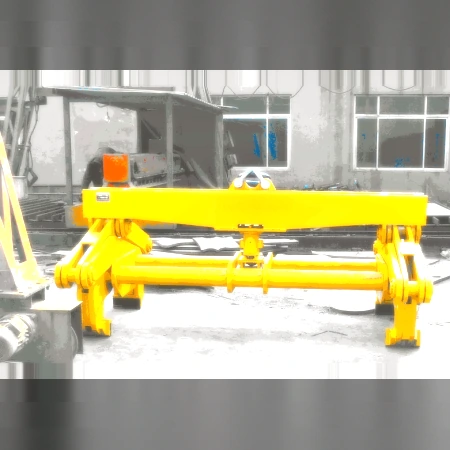
Lift sling rigging company produce Slab Billet Crane Clamp Lifting Tong,Slab Lifting Tong,Crane Clamp Lifting Tong,Billet Tongs,grab of crane lifter,Slab Tong,Steel Billet Hanging Lifter,Billet Lifting Tong,Billet Handling Tong.
Slab Billet Crane Clamp Lifting Tong
A self-closing crane tong for slabs and billets – gravity closes the jaws, gravity releases them, and there is no power pack anywhere on the tool
A slab billet crane clamp lifting tong turns a crane hook into a pair of hands for heavy steel. This one is self-closing: the jaws stand open while the tong hangs, straddle the slab or the billet when you lower it, and close the moment the crane takes the weight. The only power source on the machine is the load itself – no hydraulic cylinder, no power pack, no control cable, no operator standing in the bite. Set the load down and the jaws walk open again, ready for the next pick. We build the tong in Taizhou in standard sizes from 3 t to 32 t, with jaw openings from 60 mm až 450 mm and jaw depths cut to the slab you handle. It is one of a family of mill tools that includes the coil handling beam a C-hooks for coils.
How a Self-Closing Tong Grips
Gravity Does the Gripping
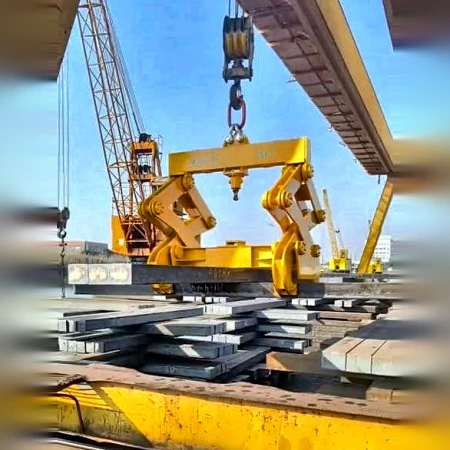
The tong is a linkage, not a machine with a motor. Open, the jaws sit wider than the load. As the hook rises, the lifting eye lifts a cross-head, the cross-head pulls the top links, and the top links rotate the arms about their pins. The jaws close on the slab faces, the load comes off the ground and the tong is carrying it. Put it down and the arms fall back to the open position on their own. Nothing has to be switched, pumped, released or held, which is why the tool keeps working in a yard where nothing else does: no hose to burst, no solenoid to burn out, no battery to charge, and no chance of a power failure leaving a slab in the air.
The Harder the Crane Pulls, the Tighter the Grip
Clamping force is not fixed – it scales with the load. The vertical pull of the hook is resolved through each inclined link into a horizontal component that drives the jaw inward, and the ratio between the two is set by the link angle at the point of contact. Take a heavier slab and the jaw pressure rises with it, so the grip is self-adjusting in the direction that matters. It also means the jaw face can be ground smooth rather than aggressively toothed: the tong does not rely on teeth digging into the steel, so plate and slab surfaces are not marked up on every pick.
An Equalising Head Keeps Both Jaws Level
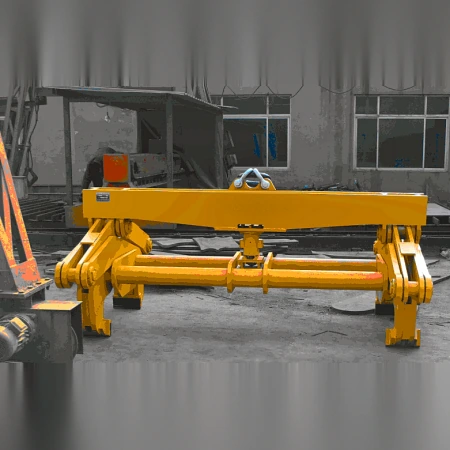
The main beam carries a central equalising pivot, so the two arms can move independently through a few degrees. On a slab that is slightly tapered, or a stack that is not perfectly level, both jaws still land and both jaws still take load. A rigid head would close on one face and hang on the other edge – the classic way a plate slips out of a clamp halfway across a bay.
Stops, Pins and Guards Against the Wrong Pick
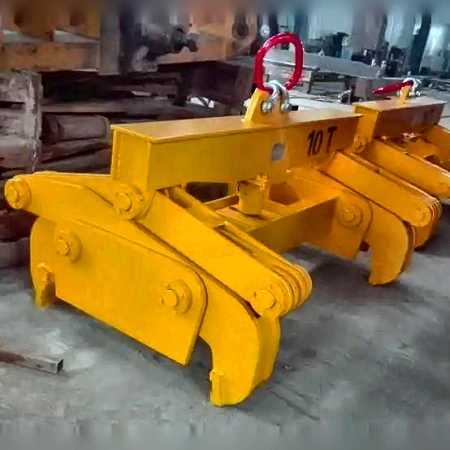
Stop blocks are welded into the arms so the jaws cannot over-close on an empty pick, which is the most common way a tong is damaged in service. Every pin is shouldered and split-pinned so it cannot walk out, and the jaw opening is stamped on the beam next to the capacity, so a slinger can see before the lift whether the tool suits the load in front of him.
Structure and Materials
The main beam is a welded box section in Q355B (S355 equivalent), and the arms are in Q460 where the bending moment is highest. Jaws are forged from 42CrMo, hardened and tempered to about 45 HRC, with a ground gripping face and replaceable wear inserts on the models that see the most cycles. Pins are 40Cr, induction hardened, running in greased bushings and sized so the pin, not the plate, is the part that wears. Finish is shot blast to Sa 2.5, epoxy primer and two coats of polyurethane in RAL 1023 žltá; other colours and a galvanised finish for wet yards are available.
Standard Sizes and Parameters
Jaw opening is measured between the jaw faces with the tong fully open, and grip depth is the vertical face available to the slab. Pick the row that takes your thickest slab with 20-40 mm of clearance to spare, then check the self-weight against the crane’s remaining capacity.
| Model | Menovitá kapacita | Jaw opening | Grip depth | Self-weight (cca.) |
|---|---|---|---|---|
| SBT-3 | 3 t | 60 – 160 mm | 300 mm | 360 kg |
| SBT-5 | 5 t | 80 – 200 mm | 350 mm | 560 kg |
| SBT-10 | 10 t | 100 – 280 mm | 450 mm | 1,150 kg |
| SBT-16 | 16 t | 120 – 320 mm | 500 mm | 1,750 kg |
| SBT-20 | 20 t | 150 – 360 mm | 550 mm | 2,200 kg |
| SBT-25 | 25 t | 180 – 400 mm | 600 mm | 2,700 kg |
| SBT-32 | 32 t | 200 – 450 mm | 650 mm | 3,500 kg |
Štandardný rozsah. Intermediate capacities, extra-wide or narrow jaws and rotating heads are built to order. Rated capacity is the working load limit, not the test load.
Specification Summary
| Položka | Špecifikácia |
|---|---|
| Názov produktu | Slab billet crane clamp lifting tong / slab lifting tong / billet tongs / crane clamp tong / slab grab |
| Typ | Self-closing, gravity actuated, all-mechanical linkage |
| Menovitá kapacita | 3 – 32 t štandard; 40 t a 50 t na požiadanie |
| Jaw opening | 60 – 450 mm between jaw faces, model dependent |
| Grip depth | 300 – 650 mm, cut to the slab or billet height |
| Self-weight | O 11 – 12 % of rated capacity (see the table above) |
| Lifting eye | Forged eye or shackle to suit 5 – 50 t crane hooks; thrust-bearing rotating head optional |
| Closing action | Automatic as the hook takes up the load – no manual latch |
| Opening action | Automatic on set-down, by the weight of the arms |
| Structure | Welded box beam in Q355B; arms in Q460 |
| Jaw material | Forged 42CrMo, hardened and tempered to about 45 HRC, ground face |
| Pins and bushings | 40Cr pins, induction hardened, greased and replaceable bushings |
| Bezpečnostný faktor | 4:1 on the load-bearing structure |
| Dôkazné zaťaženie | 1.25 x rated capacity before dispatch, with test certificate |
| Označovanie | Kapacita, model, serial number and test date on a stainless nameplate |
| Finish | Shot blast Sa 2.5, epoxy primer plus two polyurethane topcoats, RAL 1023 |
| Teplota | Štandardné -20 do +80 °C; hot-duty jaw inserts for slabs up to about 400 °C on request |
| Možnosti | Rotating head, replaceable jaw inserts, extra-wide jaws, non-marking faces, spare jaw and pin set |
| Balenie | Steel frame or wooden case, suitable for sea freight |
| HS kód | 8428.90 – other lifting and handling machinery (confirm with your customs broker) |
| MOQ | One unit; OEM branding and capacity marking to order |
Specification of the standard self-closing tong. Hot-duty, wider-opening and rotating versions are quoted against the slab drawing.
How to Size a Slab or Billet Tong
Four measurements decide the tool, and three of them are on the load rather than on the crane:
- Slab thickness sets the jaw opening. Measure the thickest slab in the programme, not the average, and leave 20 – 40 mm of clearance so the jaw can straddle the stack.
- Grip depth should cover most of the slab’s side face. If the jaw only catches the top third, the slab can roll out of the tong under a swinging load.
- Slab length decides whether one tong is enough. Long slabs, or a two-point pick, are handled with two tongs hung from a rozperný nosník so the lift stays square and the crane hook is not side-loaded.
- The crane hook decides the eye. Check the hook throat and the clearance under the hook block before the tong is drawn, not after it arrives.
- Temperature and duty decide the jaw. Cold slabs take the standard jaw; slabs straight from the caster need the hot-duty insert, and a line that cannot stop needs a spare unit on the floor.
Where These Tongs Are Used
- Slab yards and reheating furnace charging, where the tong has to pick from a stack without a slinger on the load
- Billet and bloom storage, single billet pick or a strapped bundle
- Continuous casting and rolling mill transfer, hot-duty jaws
- Forging shops and steel service centres cutting plate from slab
- Ports and rail transfer points, where the tong travels with the crane and not with the cargo
- Foundries handling ingots and heavy castings
Kontrola a údržba
A tong is a simple tool that fails in a small number of predictable places, and all of them can be seen before the lift:
- Every shift – jaw faces for gouging and cracks, stop blocks for deformation, pins for missing split pins, nameplate legible.
- Monthly – pin and bushing play, grease points, paint cracks around the beam-to-arm welds.
- Annually – strip, inspect the main welds, replace worn pins and bushings, proof load, re-certify and re-mark.
- Jaws are a wear part. Replace them at the wear limit; never rebuild a jaw with weld metal, because the heat treatment that gives the jaw its grip is lost in the repair.
What Ships With Each Tong
- Proof load certificate at 1.25 x rated capacity
- Material certificates for the beam, arms and jaws
- General arrangement drawing with the centre of gravity and the hook clearance
- Operation and maintenance manual, including the inspection schedule
- Spare pin and split-pin set
- Stainless nameplate with capacity, serial number and test date
Často kladené otázky
Does the tong need a power supply or a hydraulic unit?
Nie. The tong is entirely mechanical. Gravity and the crane’s own pull close the jaws, and the weight of the arms opens them again when the load is set down. There is no motor, no cylinder, no hose and no control cable to route to the hook.
Can it lift a bundle of billets rather than one piece?
It can grip a tight, strapped bundle whose faces are parallel, provided the jaw opening covers the full bundle width. A loose pile of billets is not a valid load for any gravity tong – the jaws need two opposing faces to press against, and loose pieces can shift inside the grip.
What happens if the crane takes the load too quickly?
The jaws close faster, which is not a problem: the clamping force rises with the pull. What does damage a tong is shock loading on an empty pick, where the jaws slam shut against the stop blocks, and side loading, where the crane pulls sideways instead of vertically. Both are avoided by lifting vertically and keeping the jaws matched to the load.
Can the same tong handle hot slabs?
The standard tong handles slabs at ambient temperature. For slabs straight from the caster we fit heat-resistant jaw inserts and heat-shielded pins, rated to about 400 °C of continuous contact. Nad tým, the tong geometry and the steel grades change, so send us the temperature and we will quote the right build rather than stretch the standard one.
Is a spreader beam needed?
For a single short slab, č – the tong hangs directly on the hook. For long slabs, or where the crane must pick at two points to stop the slab tilting, two tongs are hung from a four-point lifting beam so the load stays level and the hook is not side-loaded.
How is the capacity verified?
Every unit is proof-loaded to 1.25 times its rated capacity before dispatch and issued with a certificate quoting the serial number on the nameplate. The load-bearing structure is designed on a 4:1 faktor, and the jaws, pins and stop blocks are checked dimensionally after the test.
Request a Quote for a Slab or Billet Tong
Send us the slab or billet size (hrúbka, width and length), the weight per lift, whether it is one piece or a bundle, the crane hook size, the steel temperature and how many shifts the tong will run. We will come back with the model, the jaw opening, a drawing for approval and a delivered price. Lift Sling Rigging Co., Ltd – telephone and WeChat +86 180 6600 2268, e-mailom 702461526@qq.com, Lifute Industrial Park, Mesto Taizhou, Provincia Jiangsu, Čína.
The rest of the mill handling range – roll lifting beams, coil beams and C-hooks – sits under zdvíhacie zariadenia.