

Lift sling rigging company manufacture Aramid braided rope,Aramid Fiber Rope,Braided Aramid Cord,Aramid Fibre Braided Ropes 400 °C.
Aramid braided rope
Para-aramid 12-strand braid for heat, stretch and strength — 4 mm to 24 mm, made to order
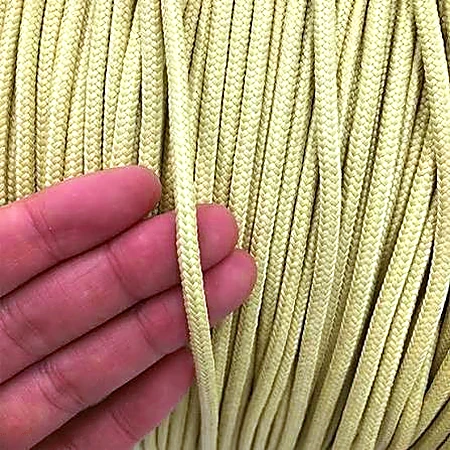
Our aramid braided rope is a 12-strand single braid made from 100 % para-aramid filament. It is the rope to specify when the duty combines heat with strength: it has no melting point, it keeps working above 150 °C, and it holds far more of its strength at high temperature than nylon or polyester. Because it barely stretches under load, the load stays where it was set — which is why braided aramid cord is used for furnace and ladle work, heat-shield rigging, guy lines and high-temperature pulling, as well as for industrial lifting where a nylon rope would be too elastic. Standard braids run from 4 mm to 24 mm, with spliced eyes, thimbles, hooks or buckles fitted at the ends.
- Works hot — no melting point; strength falls to zero only near 455 °C, and long-term service is above 150 °C
- Low stretch — a 70–100 GPa modulus keeps a suspended load steady instead of letting it settle or swing
- Strong for its weight — specific strength 5–6 times that of steel wire at roughly one fifth of the weight
- Cut and abrasion resistant — a dense 12-strand braid with a hard-wearing surface
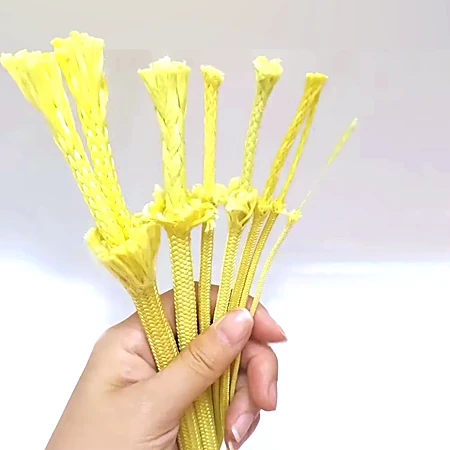
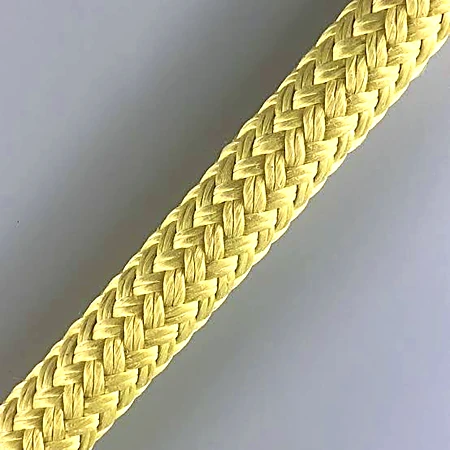
Key Features of Our Aramid Braided Rope
Heat Resistance Where Nylon and Polyester Fail
Para-aramid does not melt and does not drip. It can be used continuously above 150 °C, retains about 75 % of its tenacity after 100 hours at 200 °C, and reaches zero strength only at about 455 °C. That is the reason this rope is specified for areas where ordinary synthetic rope would soften, glaze or fail — see also our high heat resistance mooring rope.
Low Elongation, So the Load Stays Put
A 70–100 GPa tensile modulus means the rope gives very little under load. Where a nylon rope absorbs shock by stretching, an aramid braided rope is chosen for the opposite reason: a suspended load keeps its height, a tensioned line stays tensioned, and there is no stored energy to release when the load is set down.
12-Strand Single Braid
Twelve strands are braided without a core, so the rope is torque-free, round and even, and takes a splice that keeps most of the rope’s strength. The braid angle and density are controlled per batch, which is what fixes the finished diameter and the way the rope behaves in a hand, on a capstan or over a sheave.
Spliced Ends, Not Knotted
A knot gives away a large part of the rope’s strength and becomes the weakest point. We finish aramid rope with hand-spliced eyes, thimble eyes, hooks, swivels or buckles, and whip or heat-seal the free ends so the braid cannot unravel.
Technical Specifications
| Item | Specification range |
|---|---|
| Product name | Aramid braided rope / aramid fibre braided rope / braided aramid cord / Kevlar braided rope |
| Material | 100 % para-aramid (aromatic polyamide) multifilament, natural yellow |
| Construction | 12-strand single braid (round); 8-strand, 16-strand and double braid on request |
| Standard diameters | 4 · 6 · 8 · 10 · 12 · 14 · 16 · 18 · 20 · 24 mm (custom range 3–32 mm) |
| Standard lengths | 100 m · 200 m · 500 m coil, 1000 m spool; any cut length to order |
| Colour | Natural yellow · black · custom colours |
| Coating / finish | Uncoated, or PU-coated for extra abrasion resistance and a locked braid |
| Working temperature | Continuous service above 150 °C; strength falls to zero at about 455 °C; no melting point |
| Elongation | Low — chosen where a suspended load must not settle or swing |
| UV protection | Protective jacket or cover recommended for permanent outdoor exposure |
| End finishing | Hand-spliced eye · thimble eye · hook · swivel · buckle; whipped or heat-sealed ends |
| Packing | Coil with label, spool or carton; custom label and barcode available |
| MOQ & OEM | Low MOQ for trial orders; full OEM — diameter, colour, length, splicing, printed logo, packaging |
Standard specification range — other diameters, braid constructions and lengths are produced to order.
Diameter and Breaking Strength
Diameter follows from the load and from what the hardware will accept. Heavier diameters carry more, stand up to abrasion for longer and are easier to grip; lighter diameters are quicker to handle and cheaper to ship.
| Diameter | Approx. weight (g/m) | Typical breaking strength | Reference working load at 5:1 |
|---|---|---|---|
| 4 mm | ≈ 11 | ≈ 15 kN (1.5 t) | ≈ 3.0 kN |
| 6 mm | ≈ 24 | ≈ 34 kN (3.5 t) | ≈ 6.8 kN |
| 8 mm | ≈ 43 | ≈ 60 kN (6.1 t) | ≈ 12.0 kN |
| 10 mm | ≈ 68 | ≈ 94 kN (9.6 t) | ≈ 18.8 kN |
| 12 mm | ≈ 97 | ≈ 135 kN (13.8 t) | ≈ 27.0 kN |
| 14 mm | ≈ 132 | ≈ 185 kN (18.9 t) | ≈ 37.0 kN |
| 16 mm | ≈ 173 | ≈ 240 kN (24.5 t) | ≈ 48.0 kN |
| 18 mm | ≈ 219 | ≈ 305 kN (31.1 t) | ≈ 61.0 kN |
| 20 mm | ≈ 270 | ≈ 377 kN (38.4 t) | ≈ 75.4 kN |
| 24 mm | ≈ 389 | ≈ 540 kN (55.0 t) | ≈ 108.0 kN |
Typical reference values for standard 12-strand aramid braid. Breaking strength and working load are confirmed by the test certificate issued for your batch — always work from that figure, not from this table.
Material Properties of Para-Aramid
| Property | Typical value |
|---|---|
| Density | 1.43 – 1.47 g/cm³ (para-aramid filament, grade dependent) |
| Specific strength | 5 – 6 × that of steel wire, at roughly one fifth of the weight |
| Tensile modulus | 70 – 100 GPa at room temperature |
| Glass transition temperature | 320 – 380 °C |
| Strength retention | About 75 % after 100 hours at 200 °C |
| Zero-strength temperature | About 455 °C |
| Melting point | None — the fibre decomposes rather than melting (from about 500 °C) |
| Limiting oxygen index | 25 – 29 (flame retardant, self-extinguishing) |
| Moisture regain | 4.0 – 7.0 %, grade dependent (Kevlar 29 ≈ 7.0 %, Kevlar 49 ≈ 4.0 %) |
| Chemical resistance | Good against most organic solvents; degraded by strong acids and alkalis, especially hot and concentrated |
Typical published values for para-aramid filament; confirm against the yarn datasheet used for your order.
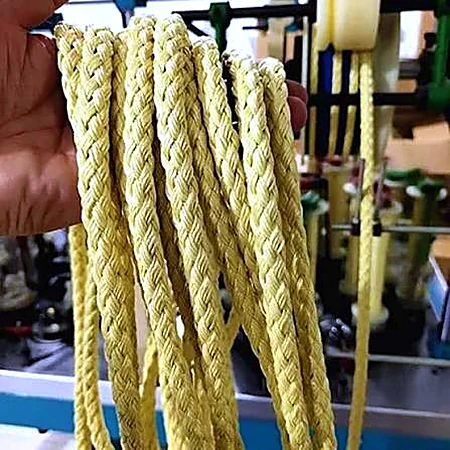
Heat, Chemical and UV Behaviour
- Heat — no melting point; the fibre decomposes from about 500 °C and reaches zero strength near 455 °C. Continuous service is above 150 °C.
- Chemicals — resistant to most organic solvents, but degraded by strong acids and alkalis, especially when hot and concentrated.
- UV — for permanent outdoor exposure, ask about a protective jacket or covered construction rather than leaving the braid bare.
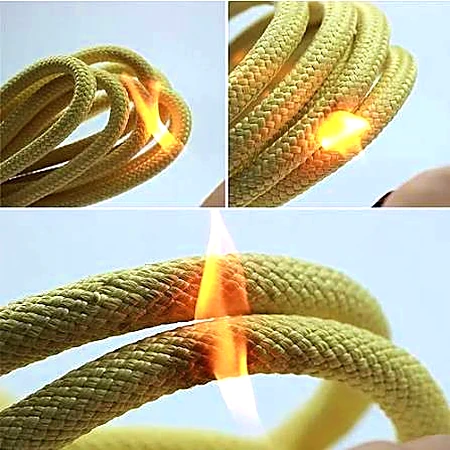
Applications
- Furnace, ladle and foundry rigging where radiant heat is present
- Heat shields, insulation blankets and refractory handling
- Guy lines, static lines and high-temperature pulling
- Industrial lifting and tensioning where the load must not settle
- Utility and winch duty, including the heavier forms of utility winch line
- Cut-resistant cordage for slings and lanyards, alongside pulling rope and climbing rope
Customisation and OEM Service
- Diameter — 4–24 mm standard, 3–32 mm on request
- Construction — 12-strand single braid, or 8-strand, 16-strand and double braid
- Ends — spliced eye, thimble eye, hook, swivel, buckle, or plain cut ends
- Length — any cut length; 100 m, 200 m and 500 m coils, 1000 m spools
- Finishing — PU coating, colour, mid-rope marking, printed label, retail packaging
- Companion items — webbing sling, круглый слинг and safety harness supplied as matched sets
Quality Control
Each batch is checked on diameter, linear density, braid density and end finish, and sampled for breaking strength. We have manufactured rope and webbing for industrial, safety and sports customers for close to three decades. On request we supply the yarn certificate, the batch test report and a sample length for you to handle and test before volume production begins.
Frequently Asked Questions
What temperature can aramid braided rope take?
There is no melting point. Long-term service is above 150 °C, it keeps roughly 75 % of its tenacity after 100 hours at 200 °C, and its strength approaches zero at about 455 °C. Tell us the working temperature and for how long, and we will confirm the construction and whether a heat-resistant cover is needed.
Aramid braided rope or nylon rope — which one do I need?
Choose aramid for heat and low stretch; choose nylon where shock absorption and elasticity matter more than stability. If both heat and shock are present, tell us the duty rather than a fibre, and we will recommend the construction that suits it.
Can the ends be spliced?
Yes. A 12-strand single braid takes a hand-spliced eye that keeps most of the rope’s strength, and thimbles, hooks, swivels and buckles can be fitted to the eye. A finished end shortens the usable length, so allow for it when you order.
Do you supply kevlar braided cord in small quantities?
Yes. We keep the minimum order low for trial orders and will send a sample length to handle and test before volume production. Send the diameter, the length, the working temperature and the end finish you need.
Request a Quote for Aramid Braided Rope
Send us the diameter, the length, the working temperature and how the rope is loaded, plus any marking or certification your market requires. Our team will come back with a specification, a sample length and a factory-direct price.
Contact: Lift Sling Rigging Co., Ltd — telephone and WeChat 18066002268, e-mail 702461526@qq.com, Lifute Industrial Park, Taizhou City, Jiangsu Province, China. HS code 630790.