

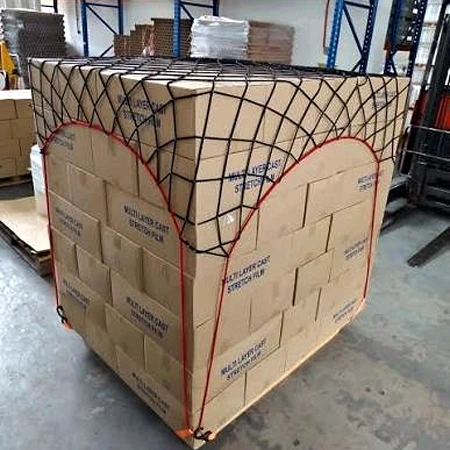
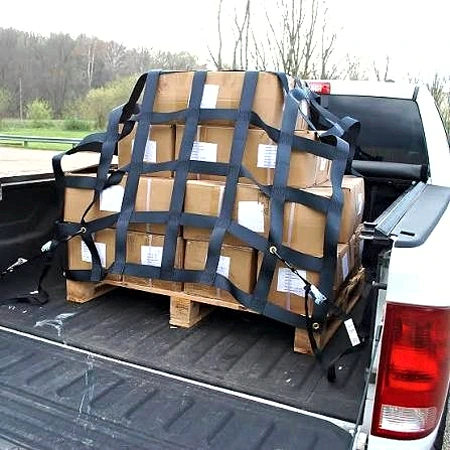
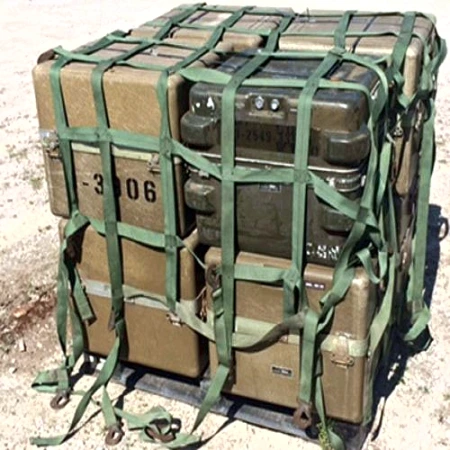
Lift sling rigging company produce Cargo Securing Net,Load Securing Net,Small mesh cargo securing net,Container securing net,Сетка для защиты груза.
Сетка для крепления груза
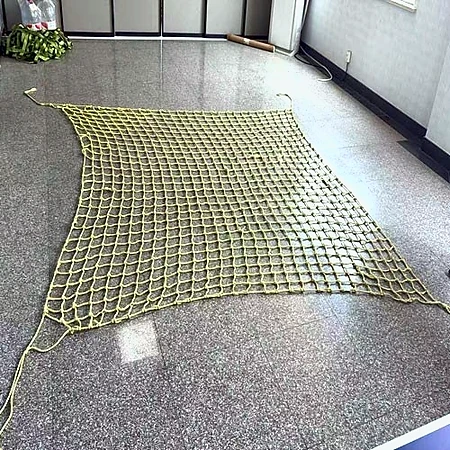
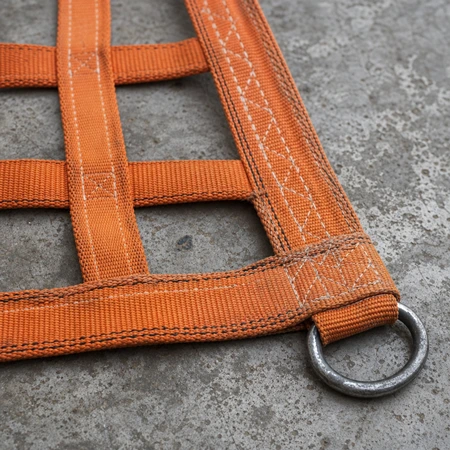
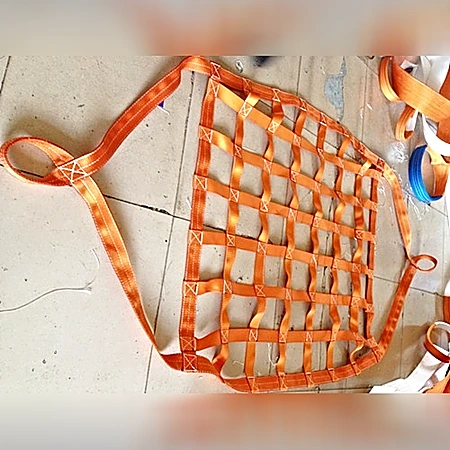
A cargo securing net is a flat-belt restraint net laid over a load and tensioned down to the deck, so that the cargo cannot slide, rock or topple on the way. The belts are woven from high-tenacity polyester into an open lattice, the border is folded and double-stitched, and the edge carries rated attachment points that are pulled down with ratchet tensioners until the load is pressed onto the vehicle or container floor.
The distinction that matters on this product is duty, not appearance. A cargo securing net restrains; it does not lift. Its label carries a lashing capacity (ЛК) and a standard tension force (СТФ) in daN, the arrangement is calculated to EN 12195-1 and the belts are type-tested to EN 12195-2 – not to a lifting working load limit. We weave the belts in our own mill in Taizhou, so net size, сетка, belt width, fittings and markings are set to your load, your vehicle and your anchor points.
- Restraint rating, не подъемный рейтинг – LC and STF marked in daN, calculated to EN 12195-1, belts type-tested to EN 12195-2.
- Flat high-tenacity polyester belts – 25 мм до 100 мм, single or duplex, УФ-стабилизированный и устойчивый к гниению.
- Sized to the load or the aperture – cover nets, container doorway nets, partition nets and bag form, all made to order.
- Rated fittings and tensioners – ratchets, крючки, D-rings and lashing points, with anti-slip mats where the deck friction is low.
- Сертифицированы CE и GS – сотканный, сшитый, marked and tested in one plant, с ИСО 9001, За этим стоят CNAS и DNV.

Restraint is not lifting – and the label says which one you have
The two products look alike, are made from the same belt and are often bought by the same fleet. Они не взаимозаменяемы, and the difference is not a formality: one is sized so a load cannot move, the other is sized so a load cannot fall. Using a restraint net on a crane hook, or a lifting net as a tensioned tie-down, is a safety failure rather than a paperwork problem.
Стол 1 – Why a securing rating and a lifting rating are not interchangeable.
| Point of comparison | Cargo securing net (эта страница) | Lifting net |
|---|---|---|
| Что он делает | Restrains a load that stays on the vehicle | Carries the full weight of a load in the air |
| Governed by | В 12195-1 (calculation of securing forces) и RU 12195-2 (webbing lashings) | Lifting standards, with webbing rated on the EN 1492-1 основа |
| Рейтинг в | Крепежная способность (ЛК) and standard tension force (СТФ), in daN | Предел рабочей нагрузки (ВЛЛ), in tonnes |
| How it is sized | Sized to resist the acceleration and friction case for the journey | Sized with a 5:1, 6:1 или 7:1 factor and proof-tested per sling |
| How it is tested | Belt and tensioner type-tested to EN 12195-2 | Every sling break-tested on our own 1000 т машина |
| Как это терпит неудачу | The load moves – a road accident | The sling breaks – a dropped load |
If the requirement is to lift – a pallet onto a roof, a bag into a hold – the right product is a lifting net: тот грузовая сетка для поддонов крана, тот подъемная сетка из полиэстера или сверхмощный нейлоновый грузовой сетчатый строп. If the requirement is to keep a load still from the loading bay to the delivery point, this page is the right one.
The forces the net has to answer for
A load on a moving vehicle is pushed in three directions, and each one is a design case rather than an accident. The accelerations below are the ones EN 12195-1 uses for road transport; other modes and national rules differ, which is why we ask where the load is travelling before we size the net.
Стол 2 – Design accelerations for road transport and what resists each one.
| Direction | Design acceleration | What resists it |
|---|---|---|
| Forward (braking) | 0.8 г | Blocking or a headboard first, then direct lashings to the front; friction contributes |
| Rearward (acceleration) | 0.5 г | Rear lashings and a tailboard; the net’s rear edge lines |
| Вбок (cornering) | 0.5 г | Side lashings, containment by the lattice, and friction from the pre-tension |
| Вертикальный | Not a road design case | Held down by pre-tension and containment; a net reduces bounce but is not a substitute for blocking |
The practical consequence is that a net alone rarely carries the whole case. Blocking against a headboard does more for the braking case than any strap, and a net laid over the top does the rest. A good securing arrangement is a combination, and we will say so when a net is the wrong answer for your load.
How a flat-belt net holds a load
A securing net works through three mechanisms at once. Which one dominates depends on how the net is fitted, and that is decided at the vehicle rather than at the factory.
Стол 3 – The three mechanisms a securing net uses.
| Механизм | Как это работает | What it depends on |
|---|---|---|
| Трение (tie-down) | The tensioned net presses the load onto the deck, and friction between load and deck resists sliding. This is the main effect of a cover net | A clean, dry deck or anti-slip mats. Without friction the same net restrains far less |
| Сдерживание | The lattice physically stops the load spreading, rocking, or throwing individual items out | A mesh fine enough for the smallest item, and a net fitted tight rather than draped |
| Direct lashing | Where the edge belts run down to rated points on the vehicle, the belt itself carries the restraint force | Certified anchor points on the vehicle – never a random protrusion or a load’s own packaging |
Two numbers decide whether the arrangement works, and both are usually ignored. The first is the angle: a tie-down belt is most effective between 75 и 90 градусов на палубу, and its effective capacity follows LC_eff = LC × sin α. В 30 degrees you keep roughly half the belt’s rating, so a net pulled down almost flat looks tidy and holds very little. The second is friction: the coefficient between a steel load and a steel deck is about 0.1 к 0.2, steel on timber about 0.2 к 0.3, timber on timber about 0.3 к 0.4, and a good anti-slip mat takes a pallet on a deck to about 0.5 к 0.6. Влажный, oily or icy surfaces take all of these figures down, which is why the same net restrains very different loads on two different days.
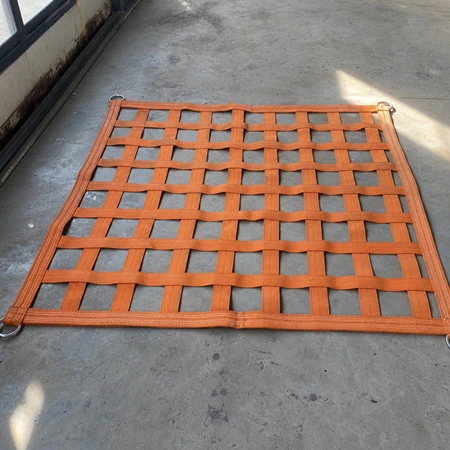
Технические параметры
The figures below cover the standard securing range. Пояс, сетка, чистый размер, edge fittings and tensioners are all made to order, поэтому рассматривайте эту таблицу как отправную точку для составления предложения, а не как фиксированный каталог..
Стол 4 – Cargo securing net: технические параметры.
| Параметр | Спецификация |
|---|---|
| Тип продукта | Cargo securing net (load restraint net) – cover net, partition net, container doorway net or bag form. Not a lifting device |
| Belt material | 100 % высокопрочный полиэстер (ДОМАШНИЙ ПИТОМЕЦ); высокопрочный нейлон по запросу |
| Ширина ремня | 25 / 35 / 50 / 75 / 100 мм |
| Belt construction | Однослойный или дуплексный, тканая кромка, не обрезанный край |
| Belt thickness | 1.8 мм – 4.0 мм в зависимости от ширины и количества слоев |
| Сетчатое отверстие | 100 × 100 мм стандарт; 50 мм – 300 мм на заказ |
| Чистый размер | С учетом нагрузки, the vehicle bed, or the container or doorway aperture |
| Крепежная способность (ЛК) | О 750 daN on a 25 mm belt to about 5,000 daN on a 100 mm duplex belt, marked per net |
| Предварительное напряжение (СТФ) | 250 – 500 daN depending on the tensioner supplied; отмечено на этикетке |
| Стандартная основа | В 12195-1 for the securing calculation; В 12195-2 for the webbing lashing |
| Граница | Сложенный и двойной сшитый; reinforced at every attachment point |
| Фитинги | Ratchet tensioners, крючки, D-образные кольца, cam buckles and lashing points, оценка 80 steel where steel is used |
| Цвет | Orange for high visibility as standard; синий, зеленый, black or a custom colour |
| Уход | УФ-стабилизированный, против старения, устойчив к истиранию и разрыву, устойчивый к гниению |
| Рабочая температура | -40 °С до +100 °С |
| Сертификация | CE, О.С., ИСО 9001, ДИС по запросу; лаборатория КНАС; ДНВ |
| Кастомизация | OEM / Размер ОДМ, цвет, printed belt, этикетка, логотип и упаковка |
| Код ТН ВЭД | 6307.90 – сетки и рабица из текстильных материалов |
Стандартные размеры, mesh and lashing capacity
A securing net is sized to the load it covers or the aperture it closes, never to a tonnage. The load has to be fully covered, and the border has to land on the deck or on the anchor points instead of hanging in mid-air, because an unsupported edge is an edge that can be pulled sideways.
Стол 5 – Standard securing net sizes, with the belt and capacity that normally go with them.
| Чистый размер (Д × Ш) | сетка | Пояс | LC per edge line | Типичное использование |
|---|---|---|---|---|
| 1.2 × 1.2 м (4 × 4 футы) | 100 мм | 35 – 50 мм | 1,000 – 2,000 И | Single pallet in a van or light truck |
| 2.5 × 1.2 м (8 × 4 футы) | 100 мм | 50 мм | 2,000 И | Two pallets abreast in a van or curtain-sider |
| 2.5 × 2.5 м | 100 мм | 50 мм | 2,000 И | Flatbed loads, техника, смешанный груз |
| 5.0 × 2.5 м | 100 – 150 мм | 50 – 75 мм | 2,000 – 3,500 И | Full-length flatbed and trailer loads |
| 2.4 × 2.6 м (контейнер) | 100 мм | 75 мм | 3,500 И | Container doorway net, load held back from the doors |
| 1.5 × 1.5 m bag form | 50 – 100 мм | 50 мм | 2,000 И | Loose or bagged goods that would spread on the deck |
| Сделано по рисунку | 50 – 300 мм | 25 – 100 мм | To calculation | Любой след, aperture or vehicle bed |
The capacity column is the restraint available per edge line, not a lifting limit. The number of edge lines, their angle and the friction under the load decide what the arrangement actually restrains.
Four forms of securing net
The same lattice is supplied in four arrangements, and choosing the right one is most of the job. The fittings differ between them; the restraint principle does not.
Стол 6 – Крышка, partition, container and bag forms.
| Форма | How it is fitted | Используется, когда |
|---|---|---|
| Cover net | Spread over the load and tensioned down to the deck or to the vehicle’s rated points | Платформа, curtain-sider and container loads that must not move in any direction – the most common arrangement |
| Partition net | Fixed upright across the vehicle body and tensioned against its own frame | Separating two loads in one vehicle, or holding cargo away from a bulkhead |
| Container doorway net | Fitted across the door aperture and hooked to the container’s own rings | Stopping cargo migrating to the doors during the journey, so the container is safe to open |
| Форма сумки | Closed at the bottom, with the cargo sitting inside the lattice | Loose or bagged goods that would otherwise spread across the deck |
Фитинги, tensioners and anti-slip
A securing net is only as good as the tensioner that pre-tensions it and the anchor point it pulls against. These are the parts that get specified last and fail first.
Стол 7 – Fittings and tensioners.
| Примерка | Используется с | Примечание |
|---|---|---|
| Напряженность храпового механизма | Cover net, bag form | Sets the pre-tension (СТФ). A ratchet that cannot reach the marked STF makes the net ineffective, whatever its LC |
| Пряжка Cam | Легкая обязанность | Faster than a ratchet but reaches a much lower pre-tension – for light loads only |
| Hooks and D-rings | Any arrangement | The link between net and anchor point; оценка 80 steel where a steel fitting is used |
| Lashing points | Cover net | Rated anchor points in the vehicle structure – the restraint force has to go somewhere rated |
| Противоскользящий коврик | Frictional restraint | Raises the friction coefficient under the load; usually the single most effective addition on a smooth deck |
| Защитный рукав | Sharp-edged loads | Fits over the belt at the contact point; самый дешевый способ продлить срок службы сети |
| Ремкомплект | Fleet maintenance | Matching belt, stitching thread and a spare tensioner |
Маркировка, colour and identification
A securing net is checked by the driver before every trip and by an inspector at the roadside, so the marking has to be readable at a distance and has to survive being dragged over a deck.
- Lashing capacity and standard tension force printed along the belt in daN – the units load securing is actually calculated in.
- Net size and date of manufacture printed as well, so the net can be matched to the vehicle and its age judged on the spot.
- Вшитая этикетка емкости в дополнение к печати, так что сеть и ее документы всегда совпадают.
- Orange as the standard high-visibility colour, with blue, зеленый, black or a house colour for fleet identification.
- Заказы OEM могут нести ваш бренд, warning text or certificate number printed on the belt.
- Сети отправляются сложенными в сумку или ящик. – a fleet order takes a fraction of the space of the same number of loose straps.
Тестирование, сертификация и прослеживаемость
- Сорок лет производства подъемного оборудования – основан в 1985 в Тайчжоу, Цзянсу, с более чем 200 сотрудники.
- Belts woven in our own mill, такая ширина, layer count and colour are under our control rather than bought in.
- Webbing strength-tested on our own 1000 t horizontal machine before it is cut into nets.
- Belts supplied to the EN 12195-2 material requirements for securing duty, with the securing calculation following EN 12195-1.
- Декларация соответствия CE и сертификация GS, with JIS on export orders; ИСО 9001, CNAS laboratory accreditation and DNV certification behind the plant.
- Every net marked with its lashing capacity, pre-tension, Размер и сетка перед упаковкой, and supplied with a material test report on request.
Сертификаты и протоколы испытаний доступны в формате PDF для тендерного файла или таможенной проверки. – увидеть полностью сертификация набор.
Where cargo securing nets are used
The same net covers a road trailer, a container, a rail wagon and a barge. What changes is the number of anchor points, the mesh and how the net is tensioned – not the product itself.
Стол 8 – Applications by transport mode.
| Mode or sector | What the net restrains | Why a flat-belt net suits it |
|---|---|---|
| Road – бортовой | Машины, сталь, древесина, поддоны, drums and mixed cargo | Covers the whole load in one action and combines friction with containment |
| Road – curtain-sider | Palletised and boxed goods that shift against a soft curtain | Contains the load where the curtain itself carries no restraint |
| Container transport | Cargo behind the doors, and cargo that must not migrate in transit | A doorway net makes the container safe to open and stops the load moving forward |
| Rail freight | Palletised and loose cargo in wagons and on flat wagons | Long nets cover a wagon bed and can be tensioned at regular intervals |
| Sea and inland waterway | Палубный груз, and cargo inside barges and holds | устойчивый к гниению, UV stabilised and unaffected by salt water |
| Heavy haulage and project cargo | Трансформеры, plant and out-of-gauge loads | Combined with direct lashings and blocking for indivisible loads |
| Waste, recycling and agriculture | Тюки, refuse, compost and bulk loads on open vehicles | Containment stops loose material leaving the vehicle in transit |
| Military and relief transport | Palletised and loose cargo in trucks and aircraft | One net per load, quick to apply and reusable over many trips |
Уход, техосмотр и выход на пенсию
- Check the net before every trip and record the check: the tensioner first, then the stitching at every attachment point, then the belts.
- Reject any belt with cuts, edge damage, сломанная строчка, химическое окрашивание, теплое остекление, or the colour and gloss change that signals UV degradation.
- Check the vehicle’s anchor points as carefully as the net. A perfect net on a corroded lashing point restrains nothing.
- Keep the deck clean and dry, and fit anti-slip mats wherever load-to-deck friction is low. That is a securing measure, not a refinement.
- Never use a securing net to lift, and never use a lifting net as a tensioned tie-down unless its label carries both ratings.
- Хранить в чистоте и сухости, над землей и вдали от прямых солнечных лучей; never repair a webbing belt by knotting, сварка или нагрев его.
- Withdraw the net if a belt, a stitch line or a tensioner is damaged, and have nets inspected by a competent person at the interval your fleet requires.
Часто задаваемые вопросы
Can a cargo securing net be used to lift a load?
Нет. It is rated for restraint, не поднимаю, and the two are calculated on completely different bases. If the load has to go onto a hook, use a lifting net with a working load limit and a per-sling proof test – the crane pallet cargo net or the polyester lifting hoisting net, both linked earlier on this page.
What is the difference between LC and STF?
ЛК (способность крепления) is the restraint force the belt is rated to carry. СТФ (стандартная сила натяжения) is how hard the ratchet tensioner can pre-tension the belt. Both are marked in daN. LC matters most in direct lashing, where the belt itself holds the load; STF matters most in tie-down lashing, where the pre-tension creates the friction that does the holding.
How tight should the net be?
Tight enough to reach the pre-tension marked on the label, with the belts running as steeply to the deck as the load allows – 75 к 90 degrees is where a tie-down belt works best. A belt laid almost flat keeps only about half its capacity, so a net that looks neatly covered can be holding very little.
Do I need anti-slip mats?
If the restraint relies on friction – which is what a cover net does – then usually yes. On steel, aluminium or plastic surfaces the friction coefficient is low, and a mat often adds more restraint than an extra strap does. A clean, dry deck is the other half of the same measure.
How many lashings or anchor points do I need?
It follows from the load, the deck friction, the vehicle and the journey rather than from a rule of thumb. Direct lashing normally needs at least four anchor lines, two per side and crossed, with the vertical and plan-view angles between 30 и 60 степени. Send us the load and vehicle details and we will work the arrangement through with you.
Will a net stop cargo moving inside a container?
A doorway or partition net stops the load migrating towards the doors and makes the container safe to open. For the journey itself the load still has to be restrained as a whole, so a container is usually secured with a partition net plus blocking or dunnage rather than with a net alone.
Какое отверстие сетки выбрать?
Fine enough that the smallest item in the load cannot pass through. 100 mm is our standard and holds pallets, коробки, bags and drums; loose or small items need a tighter mesh, and large indivisible loads can take a wider one.
What else do you make for load handling?
The same belts go into our лямки стропы и бесконечные круглые стропы, the wire rope range is under стропы из троса, the rope itself under нейлоновые веревки, and RoRo and breakbulk work is covered by the сетка для подъема автомобиля. The lifting side of the net range starts at грузоподъемные сети.
Запросить предложение
Send the transport mode, the load weight and dimensions, whether it can spread or topple, the deck material, the net or aperture size, the belt width and the anchor points you have – or a drawing of the load and the vehicle. Our engineers will confirm the net, the fittings, the number of lashing lines and the packing, и процитируйте это в одном ответе. Чтобы сначала обсудить это, свяжитесь с нашими инженерами.
Компания по производству такелажных подъемников – Индустриальный парк «Лайфайт», Тайчжоу город, Провинция Цзянсу, Китай
Тел.: +86 523 8693 5818 | WhatsApp: +86 180 6600 2268 | Электронная почта: lift98@jslift.com