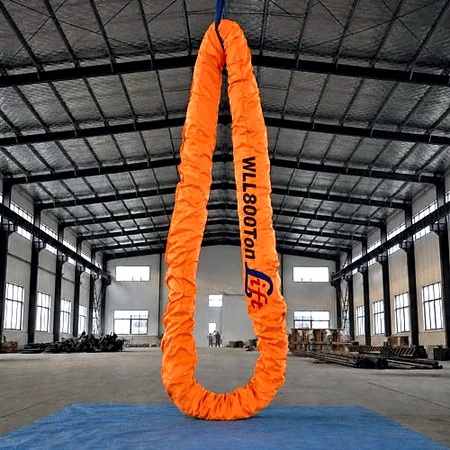
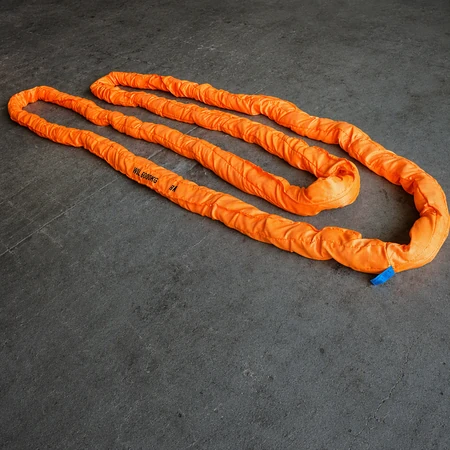
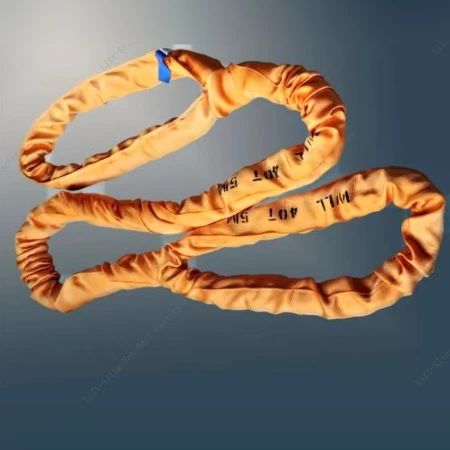
Lift sling rigging company produce 50T Heavy Duty Polyester Lifting Sling Endless Round Sling,50t Polyester Lifting Round Sling,50 Tonne Round Sling.
50T Heavy Duty Polyester Lifting Sling Endless Round Sling
50,000 kg per leg and 350,000 kg before it breaks, in a body with no metal, no ends and no stitching in the load path.
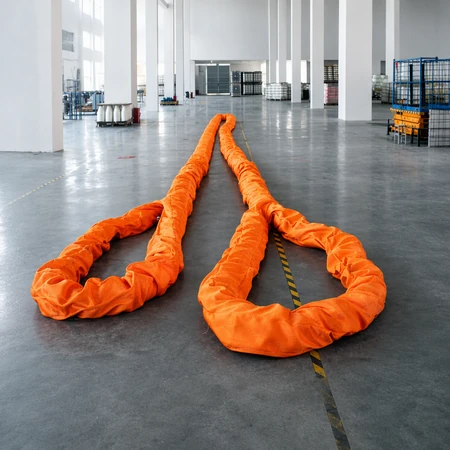
We build it from 1 m to 30 m effective length, single or double sleeve, in polyester as standard, with the working load limit and the length printed on the sleeve and a sewn label carrying the serial. Every sling is proof loaded before dispatch and the test record is matched to that serial, so the certificate in the folder belongs to the sling in the crate. The build follows EN 1492-2 and ASME B30.9 practice.
Part of the round sling range. The tier below is the 40 tonne round sling; the tier above is the 60 tonne round sling. For the whole heavy series see heavy duty round slings.
What the 50 t figure actually buys you
The number on the sleeve is the working load limit of one leg, hanging vertically. It is what the sling is proof loaded and certified against, and it is where a lifting plan starts — but it is not what the sling will pick up in the arrangement you are actually using. Two adjustments turn the single-leg figure into a set figure, and both of them move it.
- The mode. A choke costs 20 %; a basket at a shallow angle nearly doubles the figure; the same sling in a basket at 45–60° is back to its vertical rating.
- The leg angle. The wider the legs spread from the hook, the more tension each one sees for the same load. A multi-leg set is also calculated on fewer legs than it has — four legs are taken as three, because a real load never sits perfectly symmetrically.
| Configuration | Factor | Capacity |
|---|---|---|
| One sling, vertical | × 1.0 | 50 t |
| One sling, choked | × 0.8 | 40 t |
| One sling, basket at 0–7° | × 2.0 | 100 t on the sling |
| One sling, basket at 7–45° | × 1.4 | 70 t on the sling |
| One sling, basket at 45–60° | × 1.0 | 50 t |
| Two slings, 0–45° from vertical | × 1.4 | 70 t set |
| Four slings, 0–45° from vertical | × 2.1 | 105 t set |
Read the table from the load backwards. A 50 t load on two legs needs 50 t slings at 0–45° (70 t set) and 60 t slings once the legs pass 45°. Two 30 t slings do not make 60 t, and two 40 t slings carry 56 t — which is why the tier is chosen from the arrangement rather than from the tonnage on the drawing.
Where 50 t sits against the tiers either side
At this size the sling is rarely the weak link: the hook, the shackle, the beam and the lifting point each carry their own rating, and the lift is limited by the lowest one. What the tier table settles is whether you buy 50 t slings or a pair of smaller ones.
| Sling | Vertical, one leg | Two legs at 0–45° | Chosen when |
|---|---|---|---|
| 30 t | 30 t | 42 t | Up to about 40 t on two legs, with margin |
| 40 t | 40 t | 56 t | 45–55 t on two legs at a moderate angle |
| 50 t | 50 t | 70 t | 55–65 t on two legs, or unknown weights |
| 60 t | 60 t | 84 t | Legs opening past 45° on a 50–60 t load |
A single 50 t sling also makes sense where the hook is unknown or a fleet sling has to cover several jobs: the extra tonne of rating costs less than a second body, a second label and a second inspection.
The core carries the load, the sleeve decides the life
A round sling is two articles in one, and the outer one is what retires it. The core is a parallel bundle of high-tenacity polyester filament, waxed and laid without twist; every filament shares the load, which is how a body this slim rates at 50 t. The sleeve is a woven tubular jacket that protects the core from abrasion, from the load and from daylight, and it is what the person making the lift reads.
The sleeve is the inspection window
Because the core cannot be seen, the sleeve is judged instead: cuts, snags, glazing, chemical staining, and the loop ends where the core turns. A sleeve cut through so that the core is visible retires the sling even if the core itself looks sound — a sling that cannot be judged cannot be used.
Heavy duty is a build, not a rating
The phrase describes the sleeve and the standard of make. A 50 t sling is 50 t whatever the sleeve; a second layer buys wear life rather than capacity. Where the load is abrasive, the yard is rough or the sling is a rental item, specify the double sleeve round sling — on a clean indoor lift it is money spent on nothing.
A stiff body needs room
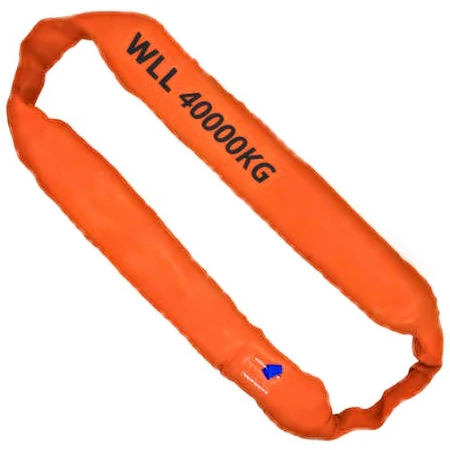
A 50 t body does not bend round a tight radius the way a 10 t one does. As a working rule, a very short body has no slack to seat in the hook and starts to fight the rigging; the minimum length at this rating is confirmed on the drawing issued with the quotation. Tight geometry is usually answered with a longer body, a lifting beam to bring the legs closer to vertical, or a round sling with eyes made to a measured length.
Technical parameters
| Parameter | Specification |
|---|---|
| Product | 50 t heavy duty polyester lifting sling, endless round sling, 50,000 kg round lifting sling |
| Construction | Continuous parallel filament core in a woven tubular sleeve, closed into an endless loop; no metal in the load path |
| Core | High-tenacity polyester (PES) multifilament, parallel lay, waxed |
| Sleeve | Heavy duty woven high-tenacity polyester, single layer as standard; double sleeve to order |
| Working load limit | 50,000 kg (50 t), single leg, vertical |
| Breaking load | 350,000 kg at a 7:1 factor |
| Safety factor | 7:1 as standard; other factors produced to order where the market requires |
| Elongation at WLL | Approximately 2–3 % |
| Service temperature | −40 °C to +100 °C |
| Effective length | 1–30 m made to order; minimum length applies at this capacity |
| Colour | Orange as standard; other sleeve colours to order |
| Marking | WLL and length printed on the sleeve; sewn label with WLL, length, serial, standard and date |
| Standard | EN 1492-2 and ASME B30.9 construction practice |
| Testing | Proof loaded before dispatch; test record matched to the serial number |
| Packing | Coil in a poly bag, labelled carton; pallet or crate on request |
| MOQ & OEM | Low MOQ for a trial order; OEM on length, sleeve colour, core fibre, label layout and packing |
Length: effective length or circumference
An endless sling has no ends, so its length can be quoted two ways and the two are a factor of two apart. This is the most common ordering error on a round sling, and at 50 t it is an expensive one to correct after the event.
| Quoted as | You receive | Used for |
|---|---|---|
| Effective working length | Half the circumference — hook down to the load and back up | Vertical and choked lifts, where the hanging height is known |
| Circumference | The full loop length | Basket lifts, where the girth of the load drives the length |
A 4 m effective length is an 8 m loop. On our slings the figure printed on the sleeve is the effective length, so the print and the quotation always agree. For a basket lift, take the girth of the load, add the headroom to the hook and quote that: a sling that only just reaches forces the legs wide, which is the same as buying a smaller sling.
Marking, serial and proof-load traceability
Above 10 t the colour code stops identifying the sling, so at 50 t the print and the label are the only things a rigger can read. Both are part of the specification, not decoration.
- The working load limit and the effective length are printed on the sleeve in characters sized to be read at arm’s length in a yard.
- A sewn label carries the WLL, length, serial, standard and date of manufacture; the serial is what links the physical sling to its paperwork.
- Every sling is proof loaded before dispatch and the test record is matched to that serial.
- A fibre certificate and batch figures are available on request; if your market needs a specific standard marking, say so before the order rather than after.
Where a 50 t sling earns its place
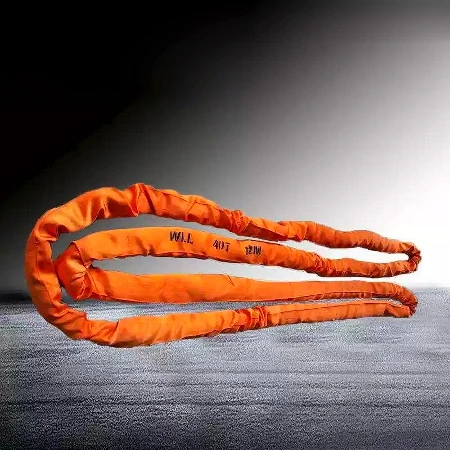
At this capacity the sling is chosen for what it does not do to the load — a wire rope grommet carries the same figure. The difference is contact.
- Precast girders and bridge segments. One sling at each end, girder lifted level; the sleeve protects the formed face and the chamfer.
- Steel coils and plate packs. Basket under the pack, sleeve against the plate edge — the round body follows the coil rather than bearing on a line.
- Transformers, generators and machine beds. Trunnions and lifting holes are small and the surfaces are machined or painted; nothing metal touches the load.
- Moulds, dies and skids. Lifting holes are drilled rather than designed for a fitting, so a soft loop threaded through the hole is the whole method.
- Ship and module blocks. Four-point with a beam above, where the sling angle is the variable that decides the set.
Inspection, care and retirement
Inspect before every use, and formally at the interval your regime requires. The check is nearly all on the outside, because that is all there is to see.
- Sleeve along its full length: cuts, snags, glazing, melts, chemical staining.
- Loop ends, where the core turns inside the sleeve, and the stitching at the join.
- Label and print: if the WLL or the length can no longer be read, the sling cannot be verified.
- Grit inside the sleeve — it abrades the core from within long after the yard has been swept.
- Retire on any cut through to the core, heat glazing, a core that has gone stiff or lumpy, chemical attack or a missing label.
- Store coiled and off the floor, out of daylight and away from heat, solvents and weld spatter; never store a sling wet in a closed bag, and never drag one under load.
Frequently asked
Can one 50 t sling lift 100 t in a basket?
On the sling side, yes — 100 t at 0–7°. In practice the hook, master link or beam above it also has to be rated for 100 t, and at this size the crane usually is not. That is why the basket at 50 t is a grip decision first and a capacity decision second.
Do two 50 t slings lift 100 t?
Not at an angle. Two legs at 0–45° from vertical carry 70 t, and 50 t once the legs open past 45°. A genuine 100 t load on two legs needs 75 t slings, which is why we ask for the arrangement before the price.
Polyester or UHMWPE at this capacity?
Polyester is the general-purpose core: low stretch, good abrasion life, −40 to +100 °C, lowest cost at this rating. A UHMWPE core is worth it where the sling’s own weight is the problem — long bodies, high picks, or a sling that has to be carried up a ladder.
What about hot loads?
A standard polyester core is rated to +100 °C. Above that the fibre degrades, and the answer is an aramid core or a high temperature round sling rather than a thicker standard sleeve.
What length do I order — 4 m or 8 m?
Say which convention you mean. A 4 m effective length is an 8 m loop. For a vertical or choked lift the effective length is the distance from hook to load; for a basket, add the girth of the load to the headroom and quote that.
What documentation comes with the sling?
A sewn label carrying the WLL, length and serial; a proof-load record matched to that serial; a fibre certificate and batch figures on request. Tell us before the order if your market needs a specific standard marking.
Can the sleeve be replaced or repaired?
No. A sling is proof loaded as a complete article, and re-sleeving or re-stitching voids that record. A damaged sleeve retires the sling; the answer is a new body, or a double sleeve next time.
Request a 50 t round sling quotation
Send the lift, get a drawing and a price
Load per leg, the arrangement and the angle from vertical;
Distance between pick-up points and the headroom to the hook;
Effective length or circumference, the environment, and any sleeve or marking requirement.
Lift Sling Rigging Co., Ltd · Lifute Industrial Park, Taizhou, Jiangsu, China · HS code 630790 · Tel +86 523 8693 5818 · WhatsApp +86 180 6600 2268
Related products
- All round slings, 1–1000 t — the full range this sling belongs to;
- WLL 40T polyester round slings — the tier below, same build;
- WLL 30T polyester round slings — for 40 t loads on two legs;
- 60 tonne round sling — the tier above;
- Heavy duty round sling range — 50 t and above, heavier sleeves;
- Round sling with eyes — a measured length and two pick-up points;
- Flat webbing sling — the same rating in a thinner profile;
- Lifting beams — to keep multi-leg sets closer to vertical.