

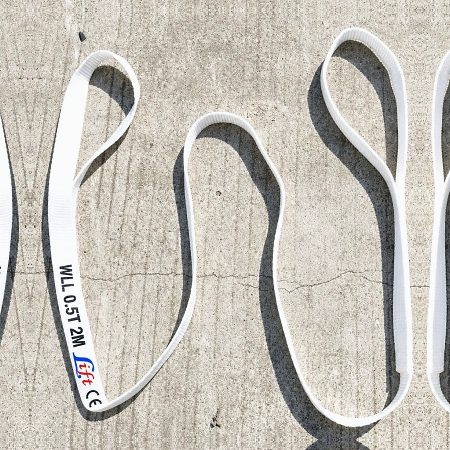
Lift sling rigging company produce Single ply eye-eye webbing sling,Olho & Eye Single Ply Polyester Web Sling,Olho & Olho 1 Ply Polyester Sling,Polyester Flat Double or Single Eye-Eye Webbing Sling for Lifting,Single ply webbing sling,steel pipe webbing sling,Single Ply Flat Eye & Eye Lifting Sling,1 Ply Lifting Strap,Olho & Olho 1 Ply Polyester Sling.
Single Ply Eye-Eye Webbing Sling
A single ply eye-eye webbing sling is one flat woven polyester band with a stitched eye at each end – one ply, not two stitched together. It is made in 25 mm para 300 milímetros web width, reaching 1 para 12 t em um 6:1 fator de segurança, não se estende mais do que 3 % no limite de carga de trabalho, is colour coded to EM 1492-1, and is supplied with effective working lengths from 0.5 m para 100 eu.
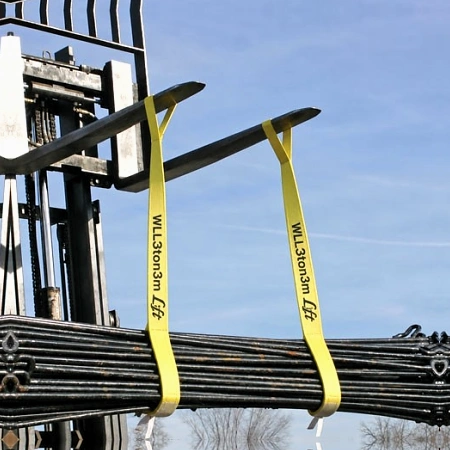
The Two Words in the Name
Olho-olho is the end configuration: the band is looped back at each end and closed with rows of stitching, so it hangs from two fittings and carries between them. Camada única is the build: one layer of webbing in the load path, where a duplex or multi-ply sling stacks two or more layers and stitches through the set.
The eyes decide how the sling meets the hook and the load; the ply decides how thick the band is, how much bulk sits at the eye, and how far up the tonnage ladder one band can go. That second question is what this page is for, porque single ply stops at 300 milímetros, e 300 mm é 12 t at 6:1.
Especificações
| Parâmetro | Opções |
|---|---|
| Produto | Single ply eye-eye webbing sling / olho & olho 1 ply polyester sling |
| Construir | One ply, flat woven; eye stitched at each end |
| Fibra | Poliéster (PES), high tenacity |
| Largura da web | 25 milímetros – 300 milímetros |
| Limite de carga de trabalho | 1 t – 12 t, camada única |
| Fator de segurança | 6:1 dois UM 1492-1; 5:1 para ASME B30.9; 7:1 a pedido |
| Carga mínima de ruptura | 6 x the WLL at 6:1 (um 2 t sling is 12 t minimum break) |
| Alongamento em WLL | 3 % ou menos, e se recupera quando a carga sai |
| Cor | EM 1492-1 capacity colour; undyed white on request |
| Tipo de olho | Formed flat, folded (tapered), reinforced, or sleeved |
| Comprimento de trabalho efetivo | 0.5 eu – 100 eu, olho no olho |
| Temperatura | Working limit around 100 °C |
| Marcação | VAI, length and your reference, printed or on a sewn label |
| Código SH | 630790 |
What One Ply Actually Decides
The capacity of a flat sling is set by the cross-section of load-bearing yarn, which is width x plies. One ply buys its capacity with width alone, a duplex with a second layer of the same width, a multi-ply build with several – so single ply is the simplest way to a figure, and it runs out where the web runs out, no 300 milímetros.
- It is the thinnest build at a given width. One layer, so it folds tighter at the eye and passes through a smaller shackle bow or a tighter choke than the same width in duplex.
- It is the lightest. Half the layers of the equivalent duplex, which matters on a long band and on a sling that a rigger carries up a ladder.
- It is the most supple. A single ply drapes over a curved surface and follows a pipe or a rolled coil instead of bridging it, so contact is better on a round load.
- It reaches 12 t at 300 mm at 6:1. Above that the same fibre is built in multiple plies of 300-400 mm teia, because a wider single band stops being practical to handle.
- It has one layer to cut. A compensação é honesta: a duplex puts a second layer between a sharp edge and the load path. Where the edge is the whole risk, the answer is a sleeve or a duplex, not a wider single ply.
Single Ply Against Duplex
Four of the five differences below are structural consequences of one layer rather than of a different fibre. None of them changes the rule that the label governs.
| Aspect | Camada única | Dúplex / multi-ply |
|---|---|---|
| Bulk at the eye | Thin eye, folds tight, suits a small shackle or a short choke | Thicker eye stack, needs a larger bow or a longer eye |
| Massa e manuseio | Lighter band, easier to throw over a load and to carry | Heavier at the same width; more body, less flop |
| Contato em uma carga curva | Drapes and follows pipe, coil and drum | Stiffer, so it bridges slightly on a tight radius |
| Resistance at a cut edge | One layer in the load path: a sleeve is the answer on a sharp corner | A second layer in front of the load path buys time on grit and burrs |
| Top of the range | 12 t at 300 milímetros, 6:1 | Acima 12 t, in multi-ply builds of 300-400 mm teia |
Ply count is not a multiplier a buyer applies by hand. Order the working load limit and the hitch; the width and the ply that reach it are stated on the drawing, and the figure printed on the band governs the lift.
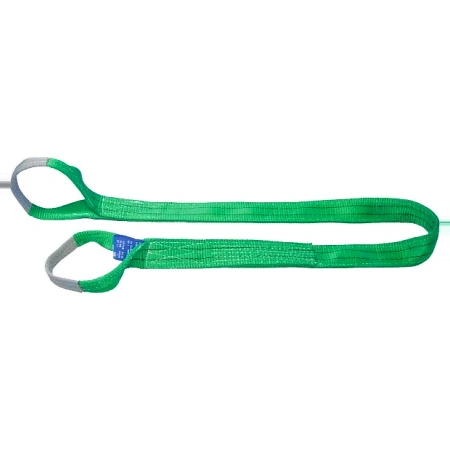
Width for a Given Figure
The ladder below is the published single-ply range for flat woven polyester at 6:1. A largura não é escolhida livremente – it follows from the figure, and the figure is the one you need per leg in the hitch you are actually using.
| Largura da web | VAI | Mínimo. carga de ruptura | Dever típico |
|---|---|---|---|
| 25 milímetros | 1.0 t | 6 t | Ferramentas, pequenos componentes |
| 35 milímetros | 1.5 t | 9 t | Oficina de uso geral |
| 50 milímetros | 2.0 t | 12 t | O tamanho mais pedido |
| 75 milímetros | 3.0 t | 18 t | Fabricações, peças de máquinas |
| 100 milímetros | 4.0 t | 24 t | Aço pintado, painéis |
| 125 milímetros | 5.0 t | 30 t | Cano, seções agrupadas |
| 150 milímetros | 6.0 t | 36 t | Unidades pré-moldadas |
| 200 milímetros | 8.0 t | 48 t | Fabricações pesadas |
| 240 milímetros | 10.0 t | 60 t | Módulos, derrapagens |
| 300 milímetros | 12.0 t | 72 t | Topo da linha de camada única |
Read the ladder with the factor you are building to, not a single factor. At a 7:1 factor the same 300 mm web carries 10 t rather than 12 t, and the narrower widths move up one step each – 1 t needs 30 milímetros, 2 t needs 60 milímetros, 3 t needs 90 milímetros, 5 t needs 150 milímetros, 8 t needs 240 milímetros. O 7:1 column is published on the tipoia de cinta plana branca página; the full mode-factor table is on the página de categoria de tipoia de correia.
Minimum length follows width, not tonnage: 0.5 m from 30 milímetros, 1.0 estou em 60-90 milímetros, 1.5 estou em 100-150 milímetros, 2.0 estou em 200 mm e acima. These wide-band minimums are confirmed with the order.
Capacity Is Per Hitch, Not Per Tonnage
A tag fornece uma figura, para um elevador vertical. Qualquer outro arranjo o desvaloriza, and an eye-eye sling is the build where the choke figure is most often forgotten – because both eyes look equally usable, and the simplest way to hang a bundle is to pass one end round and hook it back.
| Engate | Fator | UM 5 t sling dá |
|---|---|---|
| Vertical, perna única | 1.0 | 5.0 t |
| Sufocado | 0.8 | 4.0 t |
| Cesta, legs 0-45° | 2.0 | 10.0 t |
| Cesta, legs 45-60° | 1.4 | 7.0 t |
| Duas pernas, 0-45° | 1.4 | 7.0 t por montagem |
| Duas pernas, 45-60° | 1.0 | 5.0 t por montagem |
| Quatro pernas, 0-45° | 2.1 | 10.5 t por montagem |
UM 5 t sling estrangulamentos 4 t, então um 4.5 t load choked on a 5 t band is an overload, não é uma margem. And a choke wears at the bearing point faster than any other part of the band, which is why a sleeved eye is worth fitting there rather than replacing the sling early.
The Eye, and What It Has To Fit
The eye is sized to the fitting it will sit in, not to the load. An eye that will not pass a bow shackle is a sling that gets knotted at the quay, and an eye that is far too large is an eye that walks on the pin. Send the hook or the shackle and the eye is made to sit in it.
| Olho | Como é feito | Where it is the right answer |
|---|---|---|
| Formed flat eye | Band folded back on itself and closed with rows of stitching | The general-purpose end: macio, plano, sits on a hook with no thimble |
| Folded / tapered eye | The eye narrows towards the body of the band | A shackle or a pin; keeps the hardware from walking along the eye |
| Olho reforçado | Extra webbing laid in before stitching | A rough, small or heavily loaded fitting |
| Olho com manga | A separate sleeve over the eye where it meets hardware or a sharp load | Choking a shackle, or any bearing point that wears first |
The stitching is the joint, and it is what makes an eye-eye band different from an endless one: the load goes into shear across the full width of the band instead of into the last row of thread. Where a load has square edges, an eye turned through 90 graus – a reverse eye – lets the band lie flat against the corner instead of standing on its edge over it.
Comprimento, and the Convention It Is Measured In
An eye-eye band is quoted either as the effective working length between the bearing points of the two eyes, or as the overall length including both eyes. The gap is two eye lengths – on a short band the difference between a load that hangs level and one that does not.
- Diga qual convenção você está citando. Effective working length is what the lift geometry needs; comprimento total é o que as lojas medem. Ambos são legítimos; misturá-los não é.
- O comprimento dos olhos faz parte da figura. UM 3 m banda com 300 mm olhos não é o mesmo artigo que um 3 m banda com 150 mm olhos, even where both read 3 t.
- Faixa. 0.5 m para 100 estou nesta família, com o mínimo definido pela largura e não pela tonelagem.
The Colour Is the Capacity
EM 1492-1 assigns a colour to each working load limit, qual é a inspeção mais rápida no local: se a faixa for amarela é 3 t, o que quer que a papelada diga. Acima 10 nenhuma cor é atribuída, because the band is too wide for colour alone to be reliable and the label carries the figure.
| Cor | VAI | Cor | VAI |
|---|---|---|---|
| Violeta | 1 t | Vermelho | 5 t |
| Verde | 2 t | Marrom | 6 t |
| Amarelo | 3 t | Azul | 8 t |
| Cinza | 4 t | Laranja | 10 t |
ASME B30.9 não usa codificação de cores: the tag states the working load limit and the hitch, so never infer capacity from colour on a sling built to B30.9. An undyed tipoia de cinta plana branca sits outside the code entirely: it is specified for loads that cannot take a dye transfer.
Where a Single Ply Is the Right Order
A single ply eye-eye webbing sling is not the cheap version of a duplex; it is the right build for a set of jobs. Steel pipe is the one this page is most often bought for: a pipe pack is curved and often coated, and a supple band that follows the bundle beats a stiff one that bridges it.
| Load | What decides the order | Usual build |
|---|---|---|
| Steel pipe and tube packs | Wall edge and coating decide the width; the band has to drape over the bundle, and a sleeve goes at the bearing line | 100-150 milímetros, 4-6 t, formed or sleeved eye |
| Rebar and bar bundles | Bound as one, so the figure is per bundle; the ends of the bars are the cutting risk | 75-125 milímetros, 3-5 t, sleeved eye |
| Painted and coated panels | Bearing pressure marks the face, so the band is often one step wider than the figure needs | 50-100 milímetros, 2-4 t, formed flat eye |
| Precast and concrete units | Mass per unit and the arris at the lift point; grit is the abrasion | 100-200 milímetros, 4-8 t, sleeved eye |
| Machine parts and tooling | Small fittings and tight access; the thin eye is the reason to choose one ply | 25-75 milímetros, 1-3 t, folded eye for a shackle |
Marcação, Storage and Retirement
The band of a single ply eye-eye webbing sling carries the working load limit, o comprimento efetivo de trabalho, the factor it was built to and any reference your system needs. A printed figure and a sewn label that disagree is a contradiction, não é um detalhe – where both exist they come off the same order line. Store it clean and dry, fora da luz solar, off the floor and out of grit. Polyester takes water and most common chemicals well, but strong alkalis and some solvents attack it; the working limit is around 100 °C, and these fibres fail by melting rather than by deforming politely.
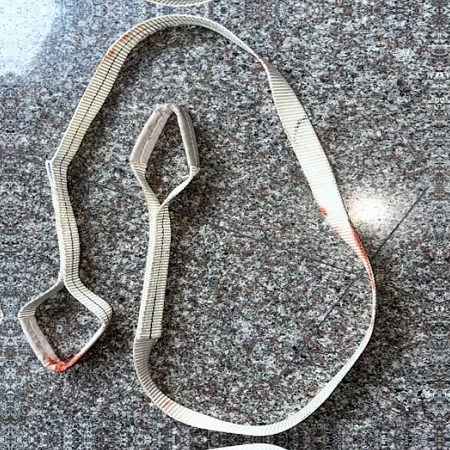
Inspecione antes de cada uso, and formally at the interval the site rules set. Qualquer um desses aposenta a banda, and none of them is repairable.
Perguntas frequentes
What is a single ply eye-eye webbing sling?
One flat woven polyester band, with a stitched eye at each end and a single layer of webbing in the load path. Not a duplex: nothing is stacked or stitched through a set of layers. It is the standard build from 25 mm para 300 mm teia, carrying 1 para 12 t em um 6:1 fator.
Single ply or double ply – which should I order?
Single ply for a load that needs a supple band, a slim eye on a small shackle, or the lightest sling at a given width. Duplex where a cut edge or grit is the real risk, because the second layer stands in front of the load path. Acima 12 t there is no single-ply answer at all: the build goes multi-ply.
How much does a single ply webbing sling hold?
De 1 t at 25 mm para 12 t at 300 mm at a 6:1 fator, with the minimum breaking load six times the working load limit. No 7:1 the same 300 mm web carries 10 t. The figure printed on the band governs, and it is the vertical figure unless the label says otherwise.
Does choking reduce the capacity of an eye-eye sling?
Sim – para 0.8 of the vertical figure, então um 5 t sling estrangulamentos 4 t. An eye-eye sling makes a choke easy to rig by passing one eye through the other, which is exactly why the reduction is so often missed on site.
How is the length measured on an eye-eye webbing sling?
Either eye to eye, which is the effective working length, or overall including both eyes. Say which one you are quoting: the gap is two eye lengths, and on a short band that is enough to make a load hang unevenly.
How big should the eyes be on a webbing sling?
Big enough to pass the shackle bow or the hook it will sit in, and not much bigger. An eye sized to the fitting sits still on the pin; an oversized eye walks along it and wears at the wrong point.
Can a single ply sling be supplied undyed or printed with our own reference?
Yes to both. An undyed band is outside the EN 1492-1 código de cores, so the printed figure carries the capacity; and the working load limit, the length and your own part or asset number can be printed as a production instruction, in the exact string and case you send.
Solicite uma cotação
Send the working load per leg, the hitch and the included angle, the effective working length eye to eye, the shackle or hook the eyes must pass, and the surface the band must not mark. We come back with the width, the ply, the eye type and the labelled working load limit – on a drawing, antes de qualquer coisa ser tecida.
Send your sling specification for a quotation
Telefone / WeChat: +86 180 6600 2268 | E-mail: 702461526@qq.com
Endereço: Parque Industrial Lifute, Cidade de Taizhou, Província de Jiangsu, China | Código SH: 630790