

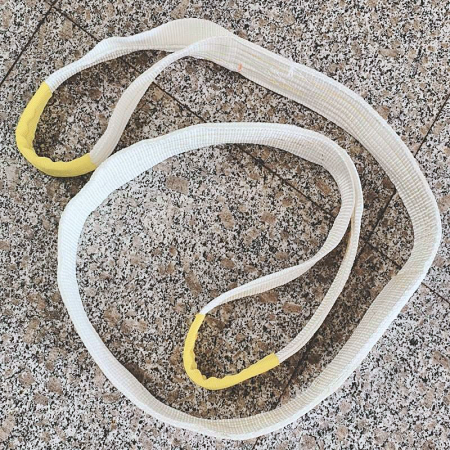
Lift sling rigging company manufacture White Lifting Sling Belt Crane Flat Polyester Webbing Sling,White Flat Belt Lifting Webbing Sling,White Webbing Sling,White Flat Webbing Sling,White Lifting Sling,White Lifting Strap.
White Lifting Sling Belt Crane Flat Polyester Webbing Sling
White is not a colour choice on this belt. A white lifting sling belt in flat polyester webbing is the undyed version of the same product: the yarn goes from loom to cutting and sewing without passing through a dye bath. That one omission is where the cost advantage, the shorter lead time and most of the environmental claim come from.
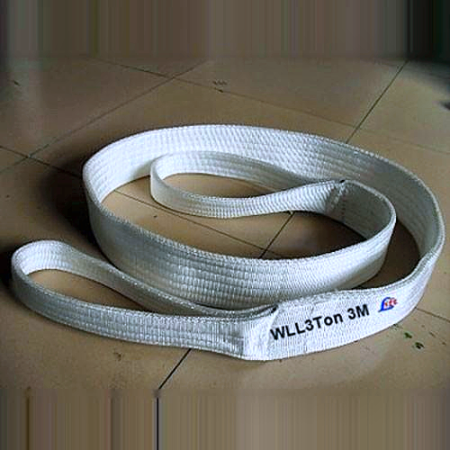
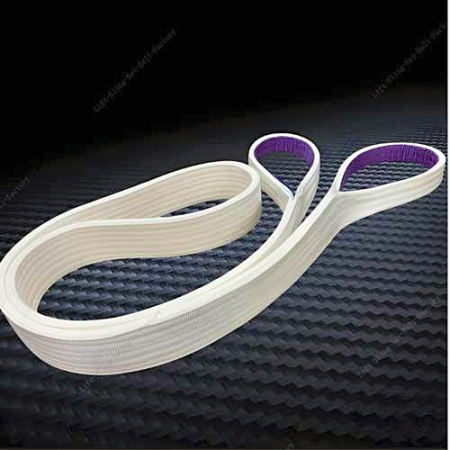
We build them from 0.5 t to 24 t, 25–300 mm wide, single or double ply, with soft eyes or reinforced eyes, and a sewn label that carries the working load limit and length.
What the Dye Bath Costs, and What Skipping It Saves
A coloured webbing sling passes through at least four steps that a white one does not: dyeing at temperature, rinsing, drying, and colour-lot control. Each step consumes water, heat and handling; the dye bath also produces coloured effluent that has to be treated before it leaves the plant.
Remove those steps and three things change. The cost per metre drops, because you are no longer paying for energy, chemicals and wastewater treatment. The lead time shortens, because there is no dye lot to schedule or match. And the minimum order falls, because there is no colour batch to commit to before a single metre is woven.
On a short belt the saving is small. On a 20 m belt, or on a container of them, it is the difference between a competitive quote and a lost one.
| Step | Dyed | Undyed |
|---|---|---|
| Dye bath | Yes | — |
| Rinsing | Multiple | — |
| Drying | Yes | Reduced |
| Colour-lot control | Per batch | — |
| Minimum order | Colour batch | Lower |
| Lead time | Longer | Shorter |
What white gives up
- Colour coding. Some fleets identify capacity by colour at a glance. A white belt relies on the sewn label; colour coding is available, but it puts the dye cost back.
- Cosmetic life. White shows grease, rust and concrete dust early. A belt can look tired while still being perfectly serviceable.
- Nothing structural. The yarn, weave, stitching and rating are identical to the dyed version. Colour is a finish, not a strength grade.
What white gives you
- Lower cost per metre — fewer process steps, less energy, no dye chemicals.
- Shorter lead time — no dye lot to schedule or match across repeat orders.
- No dye transfer — relevant when lifting painted, coated or wrapped loads.
- Better inspection — cuts, grit and contamination show up on white far earlier than on dark webbing.
The Green Claim, Stated Precisely
“Eco-friendly” is easy to print and hard to defend. Here is what this belt actually is, and what it is not.
What it is: a lower-impact process. No dye bath means less water, less heat, fewer chemicals and no coloured effluent for every metre woven. That is a real, measurable reduction at the factory gate.
What it is not: a biodegradable product, or a recycled one by default. The webbing is high-tenacity polyester, which is petroleum-based and does not disappear at end of life. If you need recycled yarn content, specify it — it is a separate material, a separate price and a separate test certificate.
Technical Parameters
| Product | White flat polyester webbing sling, single or double ply |
|---|---|
| Material | High-tenacity polyester (PES) webbing, undyed — natural white |
| Weave | Flat woven, dense warp, reinforced selvedge |
| Eyes | Folded soft eyes as standard; reinforced eyes or wear pads on request |
| Working load limit | 0.5–12 t single ply; up to 24 t double ply |
| Safety factor | 7:1 |
| Width | 25, 35, 50, 75, 100, 150, 200, 300 mm |
| Elongation at WLL | approx. 2–3% |
| Standard | EN 1492-1 / ASME B30.9 construction practice |
| Service temperature | −40 to +100 °C |
| Length | 0.5–20 m standard; longer to order |
| Colour | Natural white, undyed; dyed colours and capacity coding to order |
| Marking | Sewn label: WLL, length, serial number, standard |
| Packing / OEM | Bundle, poly bag, carton; OEM width, length, label and packing |
Width, Ply and Working Load
Capacity in a flat belt comes from width and ply, not from length. The table gives typical single-ply ratings; a double-ply belt of the same width is rated at roughly twice the figure, which is how the heavier sizes are built without going wider.
Two limits sit outside the table. A choked hitch reduces the rating to about 80% of vertical. And a basket hitch does not double the capacity of a flat belt the way it does on a round sling — the belt has to bend through the eye, so the label figure governs.
| Width | WLL | Typical use |
|---|---|---|
| 25 mm | 1.0 t | Light components, tools |
| 35 mm | 1.5 t | Small bundles |
| 50 mm | 2.0 t | General workshop lifting |
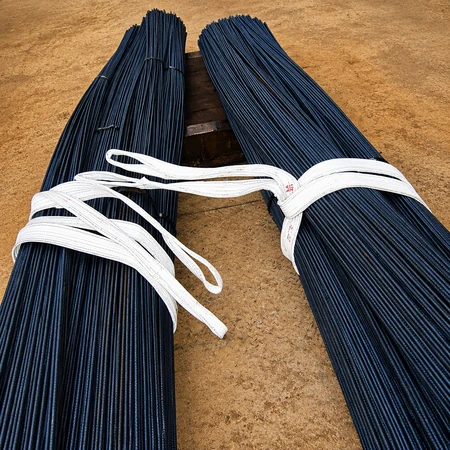
| 75 mm | 3.0 t | Rebar, timber, pipes |
| 100 mm | 4.0 t | Precast, steel sections |
| 150 mm | 6.0 t | Heavy bundles, machinery |
| 200 mm | 8.0 t | Structural loads |
| 300 mm | 12.0 t | Heavy industrial lifts |
Where a White Belt Fits
- General crane lifting. Workshop and yard work where the site does not run a colour-code system.
- Precast and concrete. White shows cement dust and grit before it works into the weave.
- Glass, stone and finished surfaces. No dye transfer, no metal contact, no marking.
- Paper, print and packaging. Clean contact for loads where a dark mark is a reject.
- Export and logistics. Low cost per metre on long belts and container quantities.
Where a site does mandate colour by capacity, this belt is the wrong choice — take the dyed version instead and accept the higher cost. That is a specification decision, not a quality one.
Two substitutions are worth knowing. Where the edge is sharp or abrasive, a double sleeve round sling takes that wear better than any flat belt. Where the load is long and flexible, a viga de elevação keeps the legs off the load entirely.
Inspection: White Works in Your Favour
On a dark belt, a cut or a patch of embedded grit blends into the colour. On white it does not. That is the practical argument for white in a fleet that inspects properly.
- Cuts and edge wear. Look along the selvedge; a frayed edge is where a cut starts.
- Stitch line. Check the eye stitching for broken or pulled thread, not just loose thread.
- Contamination. Concrete dust, metal swarf and oil all show. Brush out dry grit; wash with water and mild detergent, never solvent.
- Heat damage. Glazing or stiff patches mean the belt has been near something hot; withdraw it.
- Label. If the WLL or serial number is unreadable, the belt cannot be verified.
Frequently Asked Questions
Is a white sling weaker than a coloured one?
No. Colour is a dye finish applied after weaving; it does not change the yarn, the weave or the 7:1 safety factor. A white 3 t belt and an orange 3 t belt are rated identically.
Why is the white version cheaper?
Because four process steps disappear: dyeing, rinsing, drying and colour-lot control. That removes energy, chemicals, water and wastewater treatment from the cost of every metre, and it removes the colour batch minimum from the order.
Can I still get colour coding by capacity?
Yes, as a dyed product. It adds cost and lead time, and it brings back the dye effluent. If your site rules require colour coding, specify it — just do it deliberately rather than assuming white can be re-coloured later.
Does white stain easily?
It shows marks sooner, but staining is cosmetic. Wash with water and mild detergent and let it dry naturally; never use solvents on polyester webbing. A stained belt is not automatically a failed belt — a cut, glazing or damaged stitching is.
Is “undyed” the same as eco-friendly?
No. Undyed means the dyeing step — and its water, heat, chemicals and coloured effluent — is absent. The fibre is still virgin polyester and the product is not biodegradable. Call it a lower-impact process, which is a claim that holds up.
Send the width, the length and the load
We quote white flat polyester webbing slings from 0.5 t to 24 t, with eye type, label and packing to your specification. Tell us the lift and we will come back with price, lead time and sample availability.