

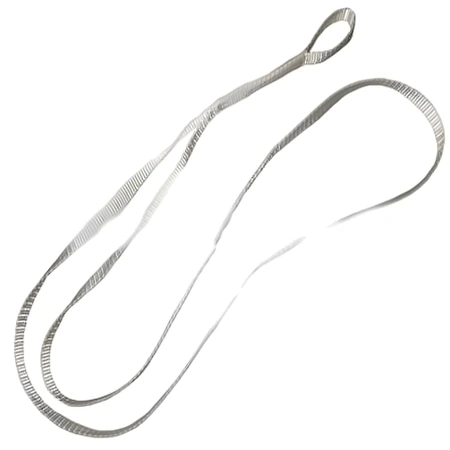
Lift sling rigging company produce Disposable webbing sling one eye,Single eye disposable webbing sling,One Way Sling With One Eye,Single Use Sling With One Eye,Single Use Lifting Sling With One Eye.
Disposable Webbing Sling One Eye
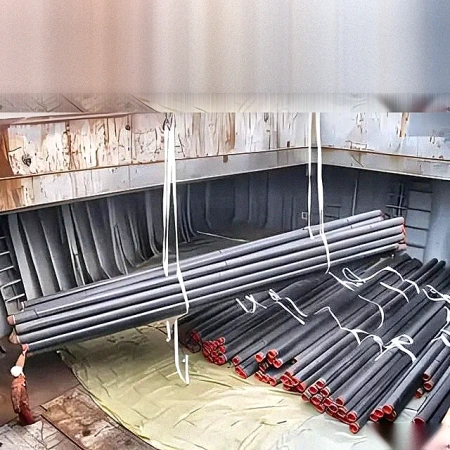
A disposable webbing sling one eye is a single-trip polyester sling: flat woven webbing with one formed eye at one end and a plain finished tail at the other, used as a choker around cano, rubber e sheet, then left on the load and shipped out with it. It is made in 25 mm para 300 milímetros widths and 4 milímetros ou 7.5 milímetros grossura, with a working load limit of 1 para 24 t at a safety factor of 5:1, 6:1 ou 7:1, em comprimentos de 0.5 m para 100 eu.
Especificações
Four lines decide the price of a disposable sling – a largura, o fator de segurança, the length and the marking – because the eye is formed from the same band and adds nothing but a stitch pattern.
| Parâmetro | Opções |
|---|---|
| Produto | Disposable webbing sling one eye / single-trip sling, single eye |
| Correias | Flat woven polyester, 25 – 300 mm de largura, 4 milímetros ou 7.5 mm de espessura |
| Limite de carga de trabalho | 1 t – 24 t por tipoia, at the factor ordered |
| Fator de segurança | 5:1 / 6:1 / 7:1 – the same WLL needs a wider band at 7:1 than at 5:1 |
| Termina | One formed eye (stitched) and a plain, hot-sealed tail |
| Comprimento | 0.5 eu – 100 eu; quoted as the length of the band, not the circumference of the choke |
| Olho | Sized to the hook or shackle it will sit in, not to the load |
| Marcação | VAI, length and your reference printed on the band |
| Cor | Para pedir, and usually matched to the goods it travels with |
| Embalagem | Coiled and banded in bales, caixas, or packed into the consignment itself |
| Obrigação | Uma viagem – load restraint and handling, never a repeated lifting asset |
| Código SH | 630790 |
O que “Descartável” Means in Practice
The word is about the journey, not the quality. A disposable webbing sling one eye is bought in quantity, put round the goods at loading, and left there: it is not returned, not inspected between lifts, and not carried in a lifting store. Five things follow from that, and they are what separate this article from a general-purpose sling.
- It travels with the load. The sling reaches the customer wrapped round the pipe or the rubber, so the receiving site can lift the bundle off the truck with the same sling it arrived in.
- It is marked with your reference, not a certificate number. The band carries the WLL, the length and the buyer’s own reference; the paperwork for a one-way sling sits in the packing list, not in a lifting register.
- It is packed with the consignment. Coils go into the crate or the container alongside the goods, so the sling costs one line on a packing list rather than a separate shipment.
- It is sized for the choke, not for the crane. One eye and a tail is all a choker needs; a second eye and a longer band are money spent on hardware that will be cut off at the far end.
- It is replaced, not repaired. A cut or a worn stitch on a one-way sling ends its life at the destination, which is why the width is chosen with a margin rather than at the limit.
Why One Eye, and How the Choke Works
The tail passes round the load and back through the eye, and the noose closes as the lift takes up – a choker made with one eye instead of two, which is the cheapest way to grip a round or a slippery load. Two eyes make a vertical or basket sling; one eye makes a choke, and a choke is what pipe, rubber and sheet usually want, because the grip tightens with the load instead of relying on friction alone.
The eye is sized to the hook or shackle, not to the load: an eye that will not pass a hook is a sling that gets knotted at the quay. Tell us the fitting and the eye is made to sit in it.
Matching the Sling to the Goods
The same disposable webbing sling one eye is ordered differently for a pipe bundle, a rubber slab and a stack of plate, because the thing that damages the band is different in each case. It is the one way sling form most buyers repeat – a single eye, a single journey, one line on the packing list.
| Goods | O que decide a tipoia | Usual order |
|---|---|---|
| Pipe and tube | The choke bears on one line of the band, so the edge of the pipe wall and the coating decide the width; a coated pipe wants a wider, softer band | 50 – 150 banda mm, one eye, 4 milímetros, fator 6:1 |
| Rubber sheet and slab | Rubber grips the band and does not cut it, so the limit is the weight per coil and the depth of the choke, not abrasion | 50 – 100 banda mm, one eye, 4 milímetros ou 7.5 mm by weight |
| Plate and sheet steel | The edge is the whole risk: a thin band on a sheared edge is cut on the first lift, so width and a sleeve matter more than tonnage | 100 – 300 banda mm, one eye, 7.5 milímetros, fator 7:1 |
| Bundled tube and profiles | The bundle is lifted as one, so the band is sized on the bundle mass and the choke length, and marked with the bundle reference | 75 – 200 banda mm, one eye, 7.5 milímetros, comprimentos 3 – 8 eu |
Size Selection
The WLL fixes the band width once the safety factor is known, and the factor is a market decision as much as an engineering one: o mesmo 5 t sling is 125 mm at 5:1, 250 mm at 6:1 e 150 mm at 7:1 em um 4 banda mm. The six common sizes are below; the full ladder from 1 para 24 t, in both 4 milímetros e 7.5 milímetros, sits on the single use slings página.
| VAI | Largura em 5:1 | Largura em 6:1 | Largura em 7:1 | Mínimo. comprimento |
|---|---|---|---|---|
| 1 t | 25 milímetros | 50 milímetros | 30 milímetros | 0.5 eu |
| 2 t | 50 milímetros | 100 milímetros | 60 milímetros | 1.0 eu |
| 3 t | 75 milímetros | 150 milímetros | 90 milímetros | 1.0 eu |
| 5 t | 125 milímetros | 250 milímetros | 150 milímetros | 1.5 eu |
| 8 t | 200 milímetros | 200 milímetros | 240 milímetros | 2.0 eu |
| 10 t | 250 milímetros | 250 milímetros | 300 milímetros | 2.0 eu |
Widths as published on our single use slings page and confirmed in writing per order. Where a factor band shows the same width at 5:1 e 6:1, the figure is the one on our current ladder – it is quoted as it stands rather than adjusted here.
Marking and Packing With the Consignment
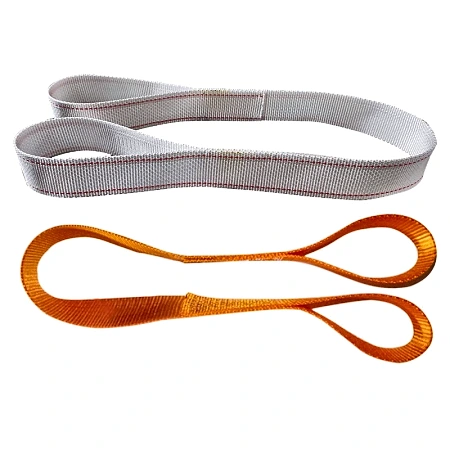
A disposable webbing sling one eye is only useful if the receiving site can read what it is. The band carries the WLL, the length and the reference the buyer supplies; the coil is banded or cartoned, and can be packed into the crate or container with the goods so that it arrives with them rather than ahead of them.
- Printed reference. Order number, bundle number or project code, printed at the same time as the WLL – not on a sticker that comes off in the hold.
- Colour coding. A colour per goods type or per customer, so a sling is not used on the wrong bundle at the far end.
- Packing options. Banded bales for volume, cartons for mixed sizes, or loose coils packed into the consignment.
Before It Leaves
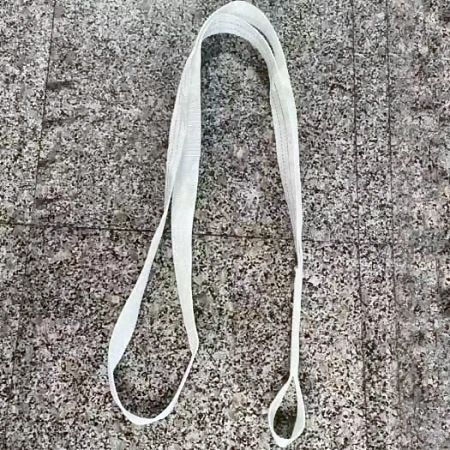
Every disposable sling is checked at the eye and at the tail before it is coiled: the stitch pattern is complete, the eye is the size ordered, the tail is sealed and not frayed, and the print is legible. A one-way sling has no second inspection at the far end, so the check at this end is the only one there is.
Perguntas frequentes
What is a disposable webbing sling one eye used for?
It is used as a single-trip choker for pipe, rubber and sheet: the tail passes round the goods and back through the eye, the lift takes up, and the sling is left on the load and shipped out with it instead of being returned.
Can a disposable sling be used more than once?
It can survive more than one lift, but it is not sold or rated as a reusable asset: it is not inspected between journeys and it carries no lifting register. Treat it as part of the packing and replace it when the consignment is unpacked.
One eye or two eyes on a disposable sling?
One eye makes a choker, which is what a round or slippery load wants and what costs least. Two eyes make a vertical or basket sling for loads that must not be squeezed. If the goods are pipe, tubo, rubber or plate in a bundle, one eye is almost always the right order.
How do I choose the width and the safety factor?
Start from the mass of one lift and the factor your market expects, and the width follows from our ladder – 5 t is 125 mm at 5:1, 250 mm at 6:1 e 150 mm at 7:1 em um 4 banda mm. Then take one size up if the goods have a cut edge or a coating.
How is the length of a disposable sling measured?
The length quoted is the length of the band, not the circumference of the finished choke, because the choke takes up reach: a tail that is too short will not pass back through the eye once the load is on. Tell us the girth of the bundle and the length is worked out from it.
Can a disposable sling be printed with our own reference?
Sim. The WLL, the length and the buyer’s reference are printed on the band, and a colour can be run per goods type or per customer, so a sling is not used on the wrong bundle at the receiving end.
How is a disposable webbing sling packed and shipped?
Coiled and banded in bales, packed in cartons, or packed into the crate or container with the goods so that the slings arrive with the consignment. Código SH 630790; the packing and the banded weight are confirmed on the quotation.
Request a Quotation
Send the goods, the mass of one lift, the safety factor your market expects, the girth of the bundle, the hook or shackle the eye must pass, the colour and the reference to print. We confirm the width, o comprimento, the eye size and the packing before the order is woven – 25 mm para 300 milímetros, 1 para 24 t, 0.5 m para 100 eu.
Send your sling specification for a quotation
Telephone / WeChat: +86 180 6600 2268 | E-mail: 702461526@qq.com
Endereço: Parque Industrial Lifute, Cidade de Taizhou, Província de Jiangsu, China | Código SH: 630790