

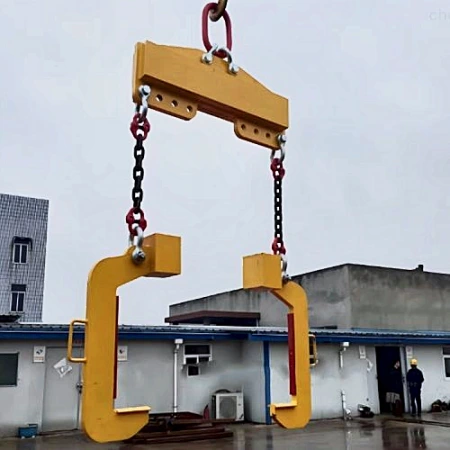
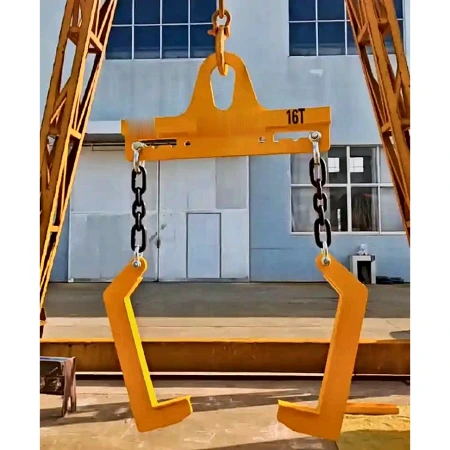
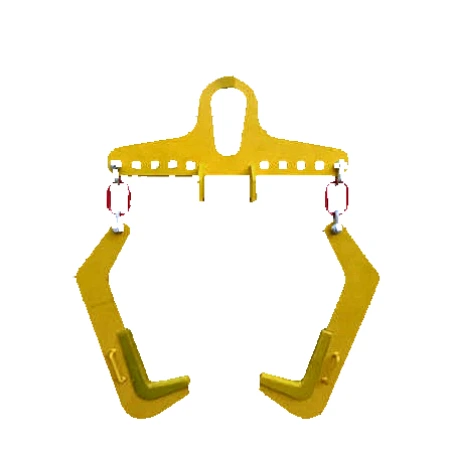
Lift sling rigging company produce Coil Handling Beam,Double-Leg Coil Lifter,Twin Arm C Hooks,Double Leg Two Sided Coil Lifter,Double Leg Steel Coil Lifter,Economical Double Leg Coil Lifter.
Coil Handling Beam
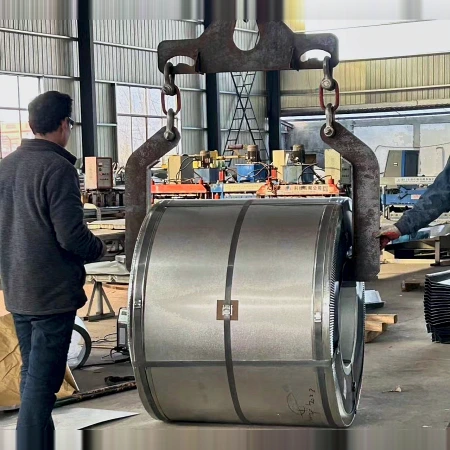
Steel coil is the one load a sling cannot handle well: redondo, smooth, heavy, and it rolls. A coil handling beam takes it by geometry instead of by friction alone – either a double-leg two-sided lifter that closes on the coil from both sides, ou um C-hook that carries it through the bore. Which one you need is decided by one thing before anything else: which way the coil axis is lying when the crane reaches it.
Four Names, Two Machines
Buyers arrive at this page using at least four names, and they do not all mean the same machine. Sorting that out first avoids quoting the wrong tool:
| What the buyer says | What it actually is | How it takes the coil |
|---|---|---|
| Coil handling beam / coil lifting beam | Generic name for either family below | Ask which axis |
| Double leg coil lifter, twin arm C hook, two-sided lifter | Two opposed arms hung from one beam | Closes on the outside diameter from both sides |
| Coil hook, C-hook | One rigid C-shaped arm | Enters the bore, coil hangs on the lower leg |
| Coil tongs, coil grab | Scissor or gravity tongs | Pinches the outside diameter, no beam |
The twin arm C hook in the second row is the shape on this page. It is not a clamp in the workshop sense: it does not need hydraulic pressure, it tightens itself as the load comes on.
The Coil Axis Decides the Tool
A coil stored eye-to-sky has its bore pointing at the roof. A coil stored eye-to-horizontal has its bore pointing sideways. The same crane, the same coil weight, two completely different tools:
| Coil is lying | Bore points | Tool that works | Por que |
|---|---|---|---|
| Eye-to-sky | Up | C-hook, or a leg set lowered into the bore | The hook drops in vertically and lifts on the bore wall |
| Eye-to-horizontal | Sideways | Double-leg two-sided lifter | Nothing can be threaded sideways at height; the arms close on the OD instead |
| Qualquer, on a pallet or still banded | Qualquer | Two-sided lifter with pads | The band and the pallet stay on; pads spread the contact |
| Coil standing on its edge, stacked | Horizontal, low | C-hook from above the stack | Only the bore is reachable without disturbing neighbours |
Getting this wrong is the most expensive mistake in the category: a two-sided lifter cannot pick an eye-to-sky coil that is standing in a rack, and a C-hook cannot reach an eye-to-horizontal coil sitting on a pallet against a wall.
How a Two-Sided Lifter Actually Grips
The arms are hung from a beam on pivots, and each arm ends in a pad that sits under the coil’s outside diameter. Lift the beam and the two arms rotate inwards: the load pulls them together. The harder the coil pulls, the tighter the grip – which is why the tool has no motor, and also why it has to be treated with respect.
- It must be set down on the coil, not dropped onto it. The arms open by their own weight; if they land on the coil’s top edge instead of straddling it, the first lift will tip the coil instead of gripping it.
- The pads carry everything. Worn, oiled or glazed pads reduce the friction the geometry relies on. Polyurethane pads protect the coil surface; steel pads survive hot or rough coils but mark them.
- Coil diameter sets the arm opening; coil width sets the beam length. They are two separate dimensions and one does not imply the other – a narrow, large-diameter coil and a wide, small-diameter coil can weigh the same and need completely different frames.
- Never side-pull. The arms grip vertically; dragging a coil sideways with the crane unloads one arm and can roll the coil out of the tool.
Parameters to Quote a Coil Lifter
A coil lifter is built around the coil, not around a tonnage alone. These are the fields that decide the frame, the arm length and the pad; the first four are the ones that cannot be guessed.
| Parâmetro | What it decides | Typical input |
|---|---|---|
| Peso da bobina (VAI) | Seção de viga, arm thickness, pad area | Per coil, stated with the lift plan |
| Outside diameter, DE | Arm opening and arm length | Measured on the largest coil in the run |
| Inside diameter, EU IA | C-hook leg thickness; or pad seat on a bore lifter | 508 milímetros e 610 mm are the mill standards |
| Largura da bobina | Beam length and arm spacing | Measured, not assumed from the slitting line |
| Coil axis at pick-up | Whole tool family – see the table above | Eye-to-sky or eye-to-horizontal |
| Pad material | Surface protection vs heat and wear | Polyurethane for finished strip, steel for hot or rough |
| Headroom under the hook | Beam depth and sling arrangement | Measured at the lowest pick-up point |
| Duty and environment | Terminar, bearings, pintar | Indoor, outdoor, galvanising line, pickling line |
The Coil Envelope: Declare It, Do Not Average It
A lifter that suits the average coil in the yard will fail on the smallest and the largest. Work through the range and give the extremes; the frame is then sized so it still grips at the small end and still clears at the big end.
| Dimension | Why the extreme matters | What to write on the inquiry |
|---|---|---|
| DE, smallest | Arms must still close far enough to grip | Smallest coil in regular production |
| DE, largest | Arms must open and clear without fouling | Largest coil, plus any oversize rework coil |
| Largura, mais estreito | Beam length must not overhang so far that the arms skew | Narrowest slit coil |
| Largura, mais largo | Arm spacing and beam length | Widest master coil |
| Peso, heaviest | WLL and structure | Heaviest single coil, not the average |
| Bore, if a C-hook | Leg thickness must pass the bore | 508 ou 610 milímetros, and whether the bore is sleeved |
Economical or Heavy Duty
The same geometry is built at two levels, and the difference is not cosmetic. An economical two-sided lifter is welded from standard sections with a fixed arm spacing – right for one coil size, one line, indoor, steady duty. A heavy-duty build adds a fabricated box beam, replaceable pad holders, a wider bearing on the arm pivots and a frame sized for shock, which is what a coil line with crane sway actually applies.
Ask for the economical build when the coils are one size and the crane is smooth. Ask for the heavy build when the same tool will see mixed sizes, outdoor storage, or a coil that gets set down hard.
Safety Points That Belong on the Tool, Not in a Manual
Coil handling has a small number of failure modes that repeat across every yard. They are worth stating plainly, because each one is cheaper to prevent than to explain afterwards.
| Risk | What happens | Control |
|---|---|---|
| Telescoped coil | Wraps slide sideways; the pads grip a step instead of a face | Refuse telescoped coils; re-band or split before lifting |
| Damaged coil edge | Bent wrap cuts into the pad and unloads one arm | Inspect the edge; use steel pads or a cradle for damaged stock |
| Two coils at once | Arms cannot close on both; one coil is only balanced, not held | One coil per lift, always |
| Oiled or painted coil | Friction drops; the self-tightening geometry is defeated | Degrease the contact band, or use a bore-type tool instead |
| Pad wear | Grip reduces gradually and invisibly | Pad thickness in the pre-use check; replaceable holders |
| Side pull or drag | One arm unloads; coil can roll out | Vertical lifts only; use a coil car to move horizontally |
Marcação, Test and Records
Every unit is proof-load tested before dispatch, and the test figure is recorded against the serial number. The tool carries its rated capacity, its tare weight, the coil size range it was built for, and the serial and year – the coil range on the plate matters as much as the tonnage, because the same 10 t frame will not fit every 10 t coil.
Lifting devices are designed to the factor and the standard named in your enquiry – state whether the project calls for a particular one, and whether a periodic examination regime applies on site. The certificate travels with the serial number; keep it with the tool, not in the office.
What to Send With the Inquiry
- Peso da bobina, and whether it is per coil or per lift.
- OD and ID at both ends of the range, plus coil width at both ends.
- Coil axis at pick-up, and a photo of the coil as it actually sits in the yard.
- Headroom under the hook at the lowest pick-up point.
- Pad preference – polyurethane for finished strip, steel for hot, rough or damaged coils.
- Duty: coils per shift, indoor or outdoor, crane type.
- Any standard, colour or marking the plant requires, and the destination country.
Perguntas frequentes
What is a coil handling beam?
A crane-suspended tool for lifting steel coil. In this catalogue it covers two families: the double-leg two-sided lifter, which closes on the coil’s outside diameter from both sides, and the C-hook, which carries the coil through its bore. Both hang from a single crane hook.
Two-sided lifter or C-hook – which do I need?
Follow the coil axis. If the coil lies eye-to-horizontal, nothing can be threaded at height, so a two-sided lifter is the only practical choice. If the coil stands eye-to-sky in a rack or on edge, the bore is the only accessible feature and a C-hook is correct.
Can one lifter cover every coil in the yard?
Sometimes, but only if the OD and width range is narrow enough that the arms still close on the smallest coil and still clear the largest. Wider ranges usually need either an adjustable arm spacing or two tools; declare both extremes and the answer becomes a calculation instead of a guess.
Does it need power or hydraulic pressure?
Não. The arms are pivoted and self-tightening: the load itself closes them. That is why pad condition and a vertical lift matter so much – both are what the geometry depends on.
Will it mark the coil surface?
With polyurethane pads, contact marks are normally avoided on finished or coated strip. Steel pads are used where the coil is hot, rough or already damaged, and they will leave contact marks.
How is the lifter tested?
Each unit is proof-load tested and the result recorded against its serial number, which is stamped on the plate with the rated capacity, tare weight and coil size range. The test certificate is issued with the tool.
What is the most common ordering mistake?
Quoting on tonnage alone. UM 10 t coil at 1,800 mm OD and 300 mm wide is a different tool from a 10 t coil at 1,200 mm OD and 1,500 mm de largura, and only the OD and width figures separate them.
Send the coil range – peso, DE, EU IA, largura, and which way the axis lies – and you will get a frame size back, not a catalogue page. Send coil dimensions