 702461526@qq.com
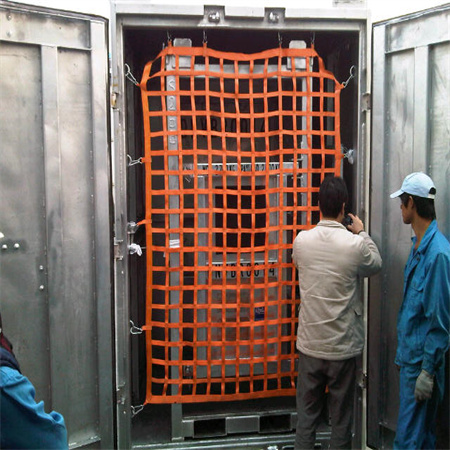
Lift sling rigging company produce Polyester Lifting Hoisting Net,Polyester Cargo Net,Safety Lifting Net Strap,Bungee Cargo Net,Polyester Cargo Lifting Net,Lifting Sling Net,Rope Lifting Net,Pallet Cargo Net,Garden Climbing Net.
Polyester Lifting Hoisting Net
A high-strength polyester webbing net bag for loading and unloading bagged and bulk cargo — woven to order in Taizhou, China
Short description
A polyester lifting hoisting net is a soft net bag woven from high-strength polyester webbing and used for loading, lifting and unloading bagged or bulk cargo. The cargo is loaded into the bag, or the bag is laid under a stack and drawn up around it, and the whole consignment is then lifted from its loops. Nothing is strapped, banded or palletised, and nothing has to be re-handled at the far end.
The cargo it is built for is the awkward kind. Sacks and 25 kg bags are slower to lift individually than in one net. Bulk material — grain, fertilizer, sand, aggregate, coal, scrap, fish — will not sit on a pallet at all. This net carries both, and the reason it works for both is that the mesh is designed around the cargo rather than around a tonnage.
We weave the webbing ourselves, so mesh, bag size, depth, bottom construction and capacity are set to your cargo rather than to a catalogue. Nets run from 0.5 t to 20 t with filled volumes from about 0.6 m³ to over 10 m³, every sling is load tested and supplied with a material test report, and the products carry CE and GS certification. For the palletised version see the crane pallet cargo net, for the material-led range the polyester webbing net for lifting, and for the whole range cargo lifting nets.

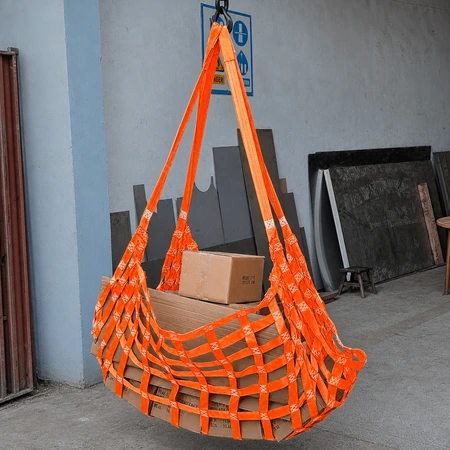
Figure 1 — A polyester webbing net bag under load: bagged goods are contained by the mesh while the four loops carry the weight to the crane hook.
1. What a polyester lifting hoisting net is
Four features separate a net built for bagged and bulk cargo from a general-purpose lifting net.
- A mesh sized to the cargo, not to the tonnage. The opening has to be fine enough that the smallest item — a 25 kg sack, a handful of grain — cannot squeeze through under load, and open enough that the net stays light and drains.
- A bag form with a closed bottom. Bagged and bulk cargo spreads the moment it is lifted. A closed, reinforced bottom is what turns an open lattice into something that can actually hold a loose load.
- Depth as well as footprint. A bulk net is specified in three dimensions, because how much it holds depends on the depth as much as on the length and width.
- A bottom you can open, if you need one. For free-flowing material, a laced or drawcord bottom lets the load be discharged without tipping the bag or unloading it by hand.
The net is supplied as a closed bag, as a bag with a release bottom, or as a flat lifting net for cargo that is already stacked or palletised. Section 5 explains which bottom suits which cargo, and Section 3 explains why the volume of the bag matters as much as its rated weight.
2. Bagged or bulk: two different jobs
Bagged cargo and bulk cargo are both loose, but they behave differently in a net, and the specification that answers one is rarely right for the other.
| Point of comparison | Bagged cargo | Bulk cargo |
|---|---|---|
| What it is | Sacks, 25–50 kg bags, big bags and bales — individual units | Grain, fertilizer, sand, aggregate, coal, scrap, fish — a continuous mass |
| Does it hold its own shape | Yes. Bags stack and keep their form under load | No. It settles, slumps and takes the shape of the bag |
| What sets the mesh | The smallest bag. A 100 mm opening holds most sacks; small bags need tighter | The smallest particle. Fine material needs a tight mesh or a liner; coarse material can take a wide one |
| What limits the load | Usually weight, because bags are dense and stack high | Often volume, because light bulk fills the net before it reaches the rated weight |
| Bottom construction | A closed bottom stops the stack spreading | A closed bottom is essential; a release bottom is often wanted for discharge |
| Handling at the far end | Bags are taken out by hand or by forklift | Usually discharged straight into a hopper, a barge or a pile |
| Typical risk | A bag squeezing through the mesh or a sharp bag corner cutting a belt | Fine material sifting out through the mesh, or wet material clogging and adding weight |
Table 1 — How bagged and bulk cargo differ in a lifting net.
 Bagged cargo: the closed bottom stops the stack spreading while the mesh contains the bags Bagged cargo: the closed bottom stops the stack spreading while the mesh contains the bags |
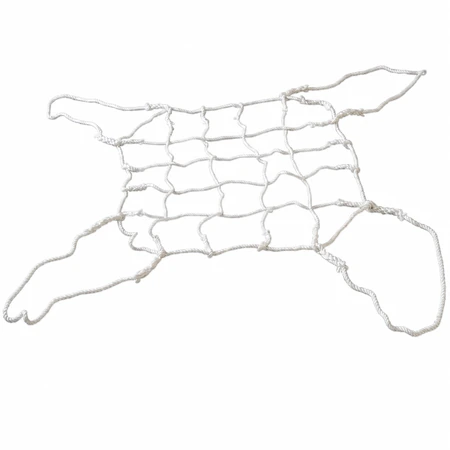
 Laid out ready to load — the bag is spread flat, loaded, then drawn up by its loops Laid out ready to load — the bag is spread flat, loaded, then drawn up by its loops |
3. Weight or volume: how a bulk net is really rated
This is the point that most often goes wrong on a bulk net order, and it is worth two minutes of your time.
A lifting net has two limits, not one. The first is its rated weight — the load it is certified to carry. The second is its filled volume — how much material physically fits inside the bag. For dense cargo the weight limit arrives first. For light bulk the volume limit arrives first, and a net that is only two-thirds loaded by weight can still be completely full.

Figure 2 — The same net, three ways. A light bulk cargo fills the bag before it reaches the rated weight, so the volume of the net governs how much you can carry in one lift.
The practical consequence is simple. If you are lifting grain, wood chips, fertilizer or dried produce, do not specify the net from the tonnage alone — give us the bulk density of the material as well, and we will size the bag so that a full bag is also a legal bag. If you are lifting sand, ore or wet aggregate, the weight is what matters and the volume will look after itself.
| Cargo type | Bulk density, typical | Which limit arrives first | What to give us when ordering |
|---|---|---|---|
| Grain, seed, dried produce | About 0.6 – 0.8 t/m³ | Volume | Bulk density and the weight you want per lift |
| Fertilizer, prills | About 0.8 – 1.0 t/m³ | Volume, then weight | Bulk density, and whether the material is free-flowing |
| Wood chips, bark, light biomass | About 0.2 – 0.4 t/m³ | Volume | Bulk density; expect a large bag for a small tonnage |
| Sand, gravel, crushed stone | About 1.4 – 1.8 t/m³ | Weight | Gross weight per lift; volume will not be the constraint |
| Iron ore, dense aggregate | Above 2.0 t/m³ | Weight | Gross weight, and the abrasiveness of the material |
| Coal, coke | About 0.8 – 1.1 t/m³ | Weight, then volume | Gross weight and the maximum lump size |
| Scrap metal, offcuts | Variable | Weight | Gross weight and the sharpness and bulk of the pieces |
| Fish, shellfish, wet produce | About 0.8 – 1.0 t/m³ | Weight, plus drainage | Gross weight, and how much water has to drain out |
Table 2 — Bulk density against the two limits. Densities are typical figures for the materials named and vary with moisture and grading; tell us the actual figure if you have it.
4. Mesh opening for bagged and bulk cargo
The mesh is the one dimension that has to be right the first time, because it cannot be adjusted later. Size it from the smallest thing in the load, not from the total weight.
| Cargo | Recommended mesh | Why |
|---|---|---|
| 50 kg sacks, big bags, bales | 100 mm | Sacks are far larger than the opening; the mesh only has to stop the stack spreading |
| 25 kg bags, small sacks | 50 – 75 mm | Smaller bags can squeeze through a 100 mm opening once the load settles |
| Grain, seed, dried produce | 25 – 50 mm, or a closed liner | The material must not sift out through the mesh in transit or on the hook |
| Fertilizer, prills, fine powders | 25 – 50 mm, or a closed liner | Fine and often moisture-sensitive; a liner keeps the material in and the weather out |
| Sand, gravel, crushed stone | 50 – 100 mm | Fine enough to hold the bulk, open enough that rainwater drains out |
| Coal, coke | 100 – 150 mm | Larger lumps; a wider mesh keeps the net light and drains well |
| Scrap metal, offcuts | 100 – 150 mm | Open mesh, with a reinforced bottom and protection sleeves at the contact points |
| Fish, shellfish, wet produce | 25 – 50 mm | Fine mesh holds the catch and drains freely, which matters for weight and for freshness |
| Logs, firewood, large offcuts | 150 – 300 mm | Large indivisible pieces; a wide mesh saves net weight without losing the load |
Table 3 — Mesh opening by cargo.
 A tight mesh containing a loose load — the smallest item in the cargo sets the opening A tight mesh containing a loose load — the smallest item in the cargo sets the opening |
 A wide, open lattice: light in weight and quick to drain, which is what bulk work needs A wide, open lattice: light in weight and quick to drain, which is what bulk work needs |
5. Bottom, discharge and emptying
How the load comes out is as much a design decision as how it goes in. For bagged cargo the answer is usually a person; for bulk cargo it is usually gravity.
| Bottom construction | How it works | Used when |
|---|---|---|
| Closed bottom, fully sewn | The bag holds the cargo permanently. It is emptied by tipping the bag or by unloading by hand | Bagged cargo, and bulk work where the bag is emptied into a hopper or onto a pile by tipping |
| Release bottom with lacing | A laced seam across the bottom is untied at the discharge point and the load falls out | Free-flowing bulk — sand, grain, aggregate — where the load has to be discharged without tipping the bag |
| Chute bottom | The bag narrows to a chute that is opened over the receiving hopper | Controlled discharge of free-flowing material into a hopper, a barge or a conveyor |
| Closed bottom with a liner | A fabric liner sits inside the net | Fine, dusty or moisture-sensitive bulk: grain, fertilizer, powders |
| Reinforced bottom panel | An extra layer of webbing is stitched across the bottom of the bag | Abrasive and heavy bulk — aggregate, ore, scrap — where the bottom wears first |
| Lifting loops top and bottom | Loops at both ends so the bag can be lifted either way up | Loading and unloading at height, and emptying by inverting the bag on the hook |
Table 4 — Bottom construction and discharge options.

Figure 3 — Where a bulk net fails first: the reinforced corner and bottom stitching. Stitch quality here decides the working life of the bag.
Where the bag is used together with a beam rather than a single hook, the rating is set by the beam — see lifting spreader beam. If the requirement is to hold bagged or bulk cargo down in transit rather than to lift it, the tensioned version is the cargo securing net.
6. Technical parameters
The figures below cover the standard bagged and bulk range. Mesh, bag size, depth, bottom construction, loops and capacity are all made to order, so treat this table as the starting point for a quotation rather than a fixed catalogue.
| Parameter | Specification |
|---|---|
| Product type | Polyester lifting hoisting net — soft net bag for bagged and bulk cargo |
| Band material | 100 % high-tenacity polyester (PET) webbing; high-tenacity nylon on request |
| Band width | 25 mm / 50 mm / 75 mm / 100 mm; 50 mm standard |
| Band layer | Single layer or duplex (two layers stitched as one belt) |
| Band thickness | 1.8 mm – 4.0 mm depending on width and layer count |
| Mesh opening | 100 × 100 mm standard; 25 mm – 300 mm to order, sized from the cargo |
| Net size | Made to the load footprint, the hold or the receiving hopper; standard sizes in Table 5 |
| Bag depth | 0.8 m – 2.5 m, or to drawing |
| Filled volume | About 0.6 m³ to over 10 m³ depending on footprint and depth |
| Bottom | Closed, release (laced), chute, lined, or reinforced — see Table 4 |
| Border | Folded and double-stitched border, reinforced at every loop |
| Lifting points | Four corner loops standard; eight for a spreader beam; loops top and bottom on request |
| Rated capacity | 0.5 t – 20 t, set by band, layer count and lifting arrangement |
| Safety factor | 5:1 / 6:1 / 7:1 |
| Elongation | 7 % or less at the working load limit |
| Colour | Standard colour code by working load limit, or a custom house colour |
| Treatment | UV-resistant, anti-ageing, wear and tear resistant; rot-proof in wet use |
| Working temperature | -40 °C to +100 °C |
| Standard basis | Webbing rated to EN 1492-1 |
| Certificação | CE / GS / JIS; ISO 9001; CNAS laboratory; DNV |
| Customisation | OEM / ODM size, printed webbing, label, logo, colour and packing |
Table 5 — Polyester lifting hoisting net: technical parameters.
7. Standard sizes, volumes and capacities
The standard sizes below cover the great majority of bagged and bulk work. Filled volume is approximate — it is calculated from the footprint and the depth with an allowance for the rounded shape a filled bag takes, and how much a particular material settles will move it either way.
| Net size (L × W) | Bag depth | Approx. filled volume | Mesh | Band | Rated capacity | Typical cargo |
|---|---|---|---|---|---|---|
| 1.0 × 1.0 m | 1.0 m | 0.6 m³ | 50 – 100 mm | 50 mm single | 0.5 t – 1.5 t | 25 kg bags, small sacks, bales |
| 1.5 × 1.5 m | 1.2 m | 1.6 m³ | 50 – 100 mm | 50 mm duplex | 1 t – 2.5 t | Bagged grain, fertilizer, produce |
| 2.0 × 2.0 m | 1.5 m | 3.6 m³ | 50 – 100 mm | 50 mm duplex | 2 t – 4 t | Bulk grain, sand, crushed stone |
| 2.5 × 2.5 m | 1.8 m | 6.8 m³ | 50 – 150 mm | 75 mm duplex | 3 t – 6 t | Bulk fertilizer, coal, scrap, fish |
| 3.0 × 3.0 m | 2.0 m | 10.8 m³ | 100 – 150 mm | 75 mm duplex | 4 t – 8 t | Large bulk loads, quay and hold work |
| Made to drawing | 0.8 – 2.5 m | To order | 25 – 300 mm | 25 – 100 mm | 0.5 t – 20 t | Any footprint, depth and cargo |
Table 6 — Standard net sizes, approximate filled volumes and rated capacities at four corner loops.
Flat versions for cargo that is already stacked or palletised are covered as the nylon flat webbing net and the webbing cargo lifting net, and the round-rope version for wet and heavy duty as the nylon cargo lifting net.
8. Lifting configurations and fittings
How the bag is hung decides how much of the load it really carries, and bulk is unforgiving because the load keeps moving inside the bag while it is in the air.
- Four-loop lift — the standard for bagged and bulk work. The four loops gather onto the hook or a master ring and the bag closes around the cargo as the crane takes up the slack.
- Eight-loop lift on a spreader beam — the bag stays square, the load stays level, and each loop carries a predictable share. The right arrangement for large bags and high tonnage.
- Two-loop basket — faster to rig, but it de-rates the net. Ask us for the derated capacity rather than using the four-loop figure.
- Loops top and bottom — lets the bag be lifted either way up, which is how a closed bag is emptied by inverting it over a hopper.
| Fitting | Used with | Note |
|---|---|---|
| Sewn webbing loop | Four and eight-loop lifts | The standard; stitched through the doubled border |
| Master ring or master link | Four-loop lift | Gathers all the loops onto one point under the hook |
| Shackle or hook | Spreader beam lift | Grade 80 fittings supplied with the beam on request |
| Release bottom with lacing | Bulk discharge | Untied at the receiving point; the fastest way to empty a free-flowing load |
| Chute and discharge sleeve | Controlled discharge | For feeding a hopper, a conveyor or a barge without spillage |
| Inner liner | Fine and moisture-sensitive bulk | Keeps grain, fertilizer and powders in and the weather out |
| Protection sleeve or wear pad | Scrap, aggregate, sharp loads | Fits over the belt at the contact point; the cheapest way to extend bag life |
| Repair kit | Fleets maintaining their own equipment | Spare belt, stitching thread and a spare loop |
Table 7 — Lifting configurations and fittings.
Whatever the arrangement, the load goes into the loops and the border — never into the middle of a panel. Dragging a full bag sideways with the crane, or lifting on fewer than the full set of loops, are the two ways a bulk net is destroyed in service.
9. Colour, printing and identification
A bulk bag moves between quays, holds, hoppers and yards, so the identification has to travel with it and stay readable.
- The working load limit, the rated volume and the mesh opening are printed along the belt, where the marking cannot be pulled off or washed away.
- The standard colour code ties the belt colour to the capacity — violet 1 t, green 2 t, yellow 3 t, grey 4 t, red 5 t, brown 6 t, blue 7 t, orange 8 t — so the bag can be identified from across a quay.
- A sewn capacity label is fitted as standard in addition to the printed marking, so the bag and its paperwork always agree.
- The cargo the bag is intended for can be printed as well, which stops a fine-mesh grain bag being used for scrap.
- OEM orders can carry your own brand, address, warning text or certificate number woven into the belt.
- Nets ship folded in a bag or a crate — a set of ten net bags takes the space of one pallet.
10. Quality control and certification
We weave the belt ourselves, which is what makes a made-to-cargo net practical: mesh, bag size, depth, bottom construction, colour and printing are all set inside our own plant.

Figure 4 — Our own weaving floor: high-strength polyester webbing coming off the needle looms, the same belt used in every net on this page.
 CE attestation of conformity covering our webbing slings (EN 1492-1) CE attestation of conformity covering our webbing slings (EN 1492-1) |
 ISO 9001 quality management system certificate ISO 9001 quality management system certificate |
- 40 years of lifting equipment manufacturing — founded in 1985 in Taizhou, Jiangsu, with more than 200 employees, one of China’s largest lifting sling and net production bases.
- CE and GS certified lifting products, with JIS certification on export orders.
- Own testing laboratory — our facilities hold CNAS laboratory accreditation, European CE certification and DNV certification, with 15 authorised patents on our lifting products.
- 1000 t horizontal test machine — the breaking load of every sling is tested and documented rather than sampled, and a material test report travels with the order.
- Webbing rated to the EN 1492-1 basis, and every net marked with its working load limit, rated volume and mesh before packing.
11. How to specify a polyester lifting hoisting net
Nine pieces of information are enough for us to quote correctly the first time. The two that are most often missing are the bulk density and the discharge method — and they are the two that decide whether the net works.
| Information we need | Why it matters |
|---|---|
| Cargo, and whether it is bagged or bulk | Decides the whole specification: mesh, bottom and volume |
| Bulk density, if the cargo is bulk | Without it the rated weight can be reached long before the bag is full — or the bag can fill long before the weight is reached |
| Weight you want per lift | Sets the rated capacity and the band |
| Bag size and depth | Sets how much the net holds and whether it clears the load and the hopper |
| Mesh opening | Sized from the smallest item or particle in the cargo, never from the total weight |
| Discharge method | Decides between a closed, laced, chute or lined bottom |
| Environment and duty cycle | UV, salt water, chemicals, temperature, and how many lifts a day the net runs |
| Lifting arrangement | Four loops, or eight on a spreader beam — and the arrangement sets the rating |
| Documentation | Safety factor, CE / GS marking, test report, own-brand printing and export packing |
Table 8 — What we need to quote a polyester lifting hoisting net.
12. Where bagged and bulk nets are used
| Sector | What the net handles | Why a polyester net suits it |
|---|---|---|
| Ports, quays and terminals | Bagged cargo, grain, fertilizer and bulk material between quay and barge or hold | One bag per lift, no pallet, and the load drains as it travels |
| Agriculture and feed mills | Seed, grain, feed, fertilizer and bagged product | A tight mesh or a liner keeps the product in and the weather out |
| Building materials | Sand, gravel, crushed stone and bagged cement | Fine enough to hold the bulk, open enough that rainwater drains out |
| Mining and quarrying | Aggregate, ore and mineral bulk | A reinforced bottom takes the abrasion that wears a net out |
| Fisheries and food processing | Wet fish, shellfish and produce | Open mesh drains freely, which keeps the weight honest and the catch fresh |
| Recycling and waste | Loose plastics, glass, metal and mixed material | Contains loose material that would otherwise blow or fall from a container |
| Power and biomass | Wood chips, bark, pellets and fuel bulk | A large bag for a modest tonnage, matched to the volume limit |
| Construction and civil work | Bagged materials raised to upper floors and roofs | Slower to load than a hopper, but far faster than carrying bags by hand |
| Disaster relief and military | Bagged and bulk relief cargo in the field | One bag, no pallet, no banding, and it can be emptied straight onto the ground |
Table 9 — Where polyester lifting hoisting nets are used.

Figure 5 — A webbing net bag in bulk service on site: the closed bottom contains the load while the mesh spreads the pressure across the whole consignment.

Figure 6 — Wide, soft-contact lifting equipment at work at a port terminal, where bagged and bulk cargo is handled all day.
13. Care, inspection and retirement
- Check the loops and their stitching first, then the border, then the bottom closure — on a bulk net the bottom and the corners wear before the mesh does.
- Empty the bag completely before storage. Material left in a net holds moisture, adds weight and hides damage.
- Look for cuts, abrasion, broken stitching, chemical staining, heat glazing and the colour or gloss change that signals UV degradation.
- Check the weight of a wet bag before lifting it. Rain, sea water and wet bulk can add far more weight than the cargo was rated at, and a net does not know the difference.
- Never exceed the rated capacity, never lift on fewer than the full set of loops, and never drag a loaded bag sideways with the crane.
- Store nets clean and dry, off the ground and out of direct sun, and never repair a webbing belt by knotting, welding or heating it.
- Withdraw the net from service if a belt, a stitch line, the bottom closure or a loop is damaged, and have nets inspected by a competent person at the interval your site requires.
14. Frequently asked questions
How do I know what size net I need for bagged cargo?
From the way the bags are presented. Bags stacked on a pallet need a net sized to the pallet footprint; bags loaded loose need a bag sized to the volume of the stack. Tell us how the bags arrive and we will size it — the standard sizes in Table 6 cover most of it.
Why does the volume of the net matter more than the weight for bulk?
Because light bulk fills the bag before it reaches the rated weight. Grain at about 0.7 t/m³ and wood chips at about 0.3 t/m³ both fill a 3.6 m³ bag completely, but one load is about 2.5 t and the other is about 1 t. If you order from the tonnage alone, you may end up with a bag that fills at half its rating and doubles your number of lifts.
What mesh do I need for fine bulk such as grain or fertilizer?
A tight mesh of 25 to 50 mm, or a closed liner inside the net. Fine material sifts out through a wide mesh, and losing part of the load on the way is both a waste and a hazard on a road or a quay. For dusty cargo the liner also keeps the weather out.
Can the bag be emptied without tipping it?
Yes. A release bottom with lacing, or a chute bottom, lets a free-flowing load be discharged straight into a hopper, a barge or a conveyor without inverting the bag. For bagged cargo the usual method is a person with a knife and a pallet truck at the far end.
Will the net hold wet cargo?
Polyester does not absorb water and does not rot, so the net itself is unaffected by rain, sea water or wash-down. Two cautions: the cargo gets heavier when wet, and a net does not know the difference between dry weight and wet weight, so check the load before lifting. Fine wet material can also clog the mesh, which adds weight and stops it draining.
What working load should I specify?
The gross weight you intend to lift, for the arrangement you will actually use. A four-loop lift and a two-loop basket give different ratings for the same net, and a bag that is filled by volume may reach a different weight every time the material changes. Tell us both the intended weight and the density and we will rate the net for the case that governs.
Is a polyester net strong enough for scrap and aggregate?
Yes, with the right construction: a wide band, a duplex or triplex layer, a reinforced bottom panel and protection sleeves at the contact points. What destroys a net on that duty is abrasion and sharp edges rather than the load itself, and those are addressed by the construction rather than by a higher tonnage.
How is the capacity proved?
The webbing is rated to the EN 1492-1 basis and nets are supplied at 5:1, 6:1 or 7:1 as specified. The breaking load of every sling is tested on our own 1000 t machine and a material test report travels with the order; our products are CE and GS certified and our facilities hold CNAS, CE and DNV certification.
What else do you make for cargo handling?
The same webbing goes into our webbing slings and endless round slings, the bag range continues with the heavy duty nylon cargo net sling, and the cargo lifting net covers the steel wire rope construction.
15. Why buy polyester lifting hoisting nets from Lift
- 40 years of lifting equipment manufacturing — founded in 1985 in Taizhou, Jiangsu, more than 200 employees, and one of China’s largest lifting sling and net production bases.
- Own weaving mill — belt width, layer count, mesh, colour and printing are under our control, so the net is built to your cargo rather than assembled from a catalogue.
- Own testing laboratory and 1000 t test machine — breaking load is tested per net and documented, with CE, GS, JIS, CNAS and DNV certification behind the products.
- Sized to bagged and bulk cargo — mesh from 25 mm to 300 mm, depths from 0.8 m to 2.5 m, and filled volumes from about 0.6 m³ to over 10 m³, all made to order.
- One supplier for the whole cargo range — bagged and bulk nets, pallet nets, flat lifting nets, webbing slings, fundas redondas, wire rope slings and lifting spreader beams.
See the full certification set, or our export coverage below.
More from the same works: wire rope slings · nylon ropes · vehicle lifting net · safety rope nets

Figure 7 — Our lifting and securing products ship worldwide, through distributors and directly to terminals, mills and processors.
16. Request a quotation
Send us the cargo and whether it is bagged or bulk, the bulk density if you know it, the weight you want per lift, the mesh opening, the discharge method and the environment the net will work in — or a sketch of the bag you have in mind. Our engineers will confirm the net size, depth, bottom construction, band and packing, and quote it in one reply. To talk it through first, contact our engineers.
Lift Sling Rigging Company — Lifute Industrial Park, Cidade de TaiZhou, Província de JiangSu, China
Telefone: +86 523 8693 5818 | WhatsApp: +86 180 6600 2268 | E-mail: 702461526@qq.com
HS code 630790 — lifting nets of textile materials.
Appendix A — SEO data for this page
The values below are ready to paste into the page’s SEO fields. The keyword set is drawn from bagged and bulk handling language, which is what separates this page from the other lifting nets in the same category.
| Field | Value |
|---|---|
| Target URL | /cargo-lifting-net/polyester-lifting-hoisting-net/ |
| Primary keyword | Polyester Lifting Hoisting Net |
| Secondary keywords | polyester hoisting net; lifting hoisting net; bulk cargo lifting net; bagged cargo lifting net; polyester net bag for lifting; bulk bag lifting net; hoisting net bag; cargo hoisting net; polyester webbing hoisting net; net for bagged goods |
| Long-tail / scenario | polyester lifting hoisting net for grain; bulk cargo net bag 3 ton; hoisting net for 25 kg bags; lifting net for fertilizer bulk; net bag with release bottom for sand; polyester net for scrap handling |
| Search intent | Commercial / transactional — the searcher is specifying a net for a known cargo |
| SEO title (56 characters) | Polyester Lifting Hoisting Net | Bagged & Bulk Cargo Net |
| Meta description (140 characters) | Polyester lifting hoisting net for bagged and bulk cargo. Webbing net bag with closed or release bottom, custom size and mesh, CE certified. |
| H1 | Polyester Lifting Hoisting Net |
| Heading chain | H1 Polyester Lifting Hoisting Net → H2 per section → H3 for sub-blocks |
| Canonical | https://www.xulft.com/cargo-lifting-net/polyester-lifting-hoisting-net/ |
| Sitemap priority | 0.8 (product detail page, one level below the cargo lifting net hub) |
| Word count | About 5,800 words in total — roughly 3,150 words of body copy plus 2,650 words of specification tables |
| Images on page | 13 images, every one with descriptive alt text |
| Internal links | 18 unique contextual internal links (see Appendix B) |
| Tables | 16 tables — 13 specification and data tables plus 3 image grids |
| Anchor text style | Descriptive and varied; no two anchors on the page repeat the same phrase |
Table 10 — On-page SEO reference.
Appendix B — Internal link and page-weight plan
Internal links are how a new page inherits authority. Outbound links tell Google which pages are related to this one; inbound links are what actually push weight and ranking power into this page.
B1 — Outbound contextual links from this page
| Target URL | Anchor text | Where it sits |
|---|---|---|
| /cargo-lifting-net/crane-pallet-cargo-net/ | crane pallet cargo net | Short description — the palletised version |
| /cargo-lifting-net/polyester-webbing-net-for-lifting/ | polyester webbing net for lifting | Short description — the material-led range |
| /products/cargo-lifting-net/ | cargo lifting nets | Short description — the category hub |
| /products/lifting-spreader-beam/ | lifting spreader beam | Section 5 — eight-point lifts |
| /cargo-lifting-net/cargo-securing-net/ | cargo securing net | Section 5 — the tensioned restraint version |
| /cargo-lifting-net/nylon-flat-webbing-net/ | nylon flat webbing net | Section 7 — flat nets |
| /cargo-lifting-net/webbing-cargo-lifting-net/ | webbing cargo lifting net | Section 7 |
| /cargo-lifting-net/nylon-cargo-lifting-net/ | nylon cargo lifting net | Section 7 — the round-rope, wet-duty version |
| /webbing-sling/ | webbing slings | Section 14 |
| /round-sling/endless-round-sling/ | endless round slings | Section 14 |
| /cargo-lifting-net/heavy-duty-nylon-cargo-net-sling/ | heavy duty nylon cargo net sling | Section 14 — the heavy-duty bag |
| /cargo-lifting-net/cargo-lifting-net/ | cargo lifting net | Section 14 — the steel wire rope construction |
| /certification/ | certification | Section 15 — the certificate page |
| /products/wire-rope-sling/ | wire rope slings | Section 15 |
| /products/nylon-rope/ | nylon ropes | Section 15 — the raw material page |
| /vehicle-lifting-net/ | vehicle lifting net | Section 15 — RoRo and breakbulk |
| /safety-rope-net/aramid-fall-protection-safety-net/ | safety rope nets | Section 15 — the personnel-protection range |
| /contact-us/ | contact our engineers | Section 16 |
Table 11 — Outbound anchors on this page (18 unique internal links).
B2 — Inbound links to add, so this page gains weight
These are the links that build this page’s ranking power. Each one should be added to an existing, already-indexed page and should point at the polyester lifting hoisting net URL with the anchor shown. Vary the anchor as listed rather than repeating one phrase across every source page.
| Source page | Anchor text to use | Why this link builds weight |
|---|---|---|
| /products/cargo-lifting-net/ (hub) | polyester lifting hoisting net | A link from the category hub is the single strongest internal signal for a child product page |
| /cargo-lifting-net/ (section page) | polyester hoisting net | Passes section-level relevance together with the parent hub link |
| /cargo-lifting-net/cargo-lifting-net/ | bulk cargo lifting net | The parent detail page is closely related and already indexed, so the link is worth the most in context |
| /cargo-lifting-net/polyester-webbing-net-for-lifting/ | bulk bag lifting net | Same belt, different duty — the two pages should link both ways |
| /cargo-lifting-net/heavy-duty-nylon-cargo-net-sling/ | bagged cargo lifting net | The heavy-duty bag page covers the same loose-cargo buyer |
| /cargo-lifting-net/crane-pallet-cargo-net/ | hoisting net bag | Pallet and bulk loads are often specified by the same buyer in one order |
| /webbing-sling/ | net for bagged goods | Material page to finished-product page: a natural relevance match |
| Homepage (products list or footer) | cargo lifting net | One homepage link to the section is enough; do not point the homepage at this page directly |
Table 12 — Inbound internal link plan.
Two rules keep the cluster healthy. First, keep these anchors distinct from each other and from the anchors used on the other lifting-net pages — repeating one phrase across many internal links is the fastest way to create keyword cannibalisation inside your own site. Second, this page should sit one click from the hub and no deeper: breadcrumb Home > Produtos > Rede de elevação de carga > Polyester Lifting Hoisting Net, with the breadcrumb links in the HTML rather than only in a script.
Appendix C — Google indexing and ranking checklist
| Item | What to do for this page |
|---|---|
| Indexability | Return HTTP 200, keep the page out of noindex, and make sure it is not blocked in robots.txt |
| Canonical | Self-referencing canonical to https://www.xulft.com/cargo-lifting-net/polyester-lifting-hoisting-net/ |
| XML sitemap | Include the URL in the product sitemap, then resubmit the sitemap in Google Search Console |
| Internal links | Apply both tables in Appendix B. The page needs at least one inbound link from an indexed page before it will be crawled quickly |
| Title and description | Use the two values in Appendix A; keep them unique against the other net pages |
| Heading structure | One H1, then H2 per section, then H3 for sub-blocks — never skip a level |
| Image SEO | Descriptive alt text on all 13 images, file names in lower case with hyphens, WebP format, and lazy loading below the fold |
| Structured data | Add Product JSON-LD with name, image, description, brand and manufacturer, plus BreadcrumbList for the breadcrumb path and Organization at site level |
| Core Web Vitals | Compress images to WebP, set width and height on every image to avoid layout shift, and defer non-critical scripts |
| Keyword separation | This page owns bagged and bulk handling language. Do not optimise it for pallet or restraint terms, and do not reuse this page’s volume-versus-weight section on the other net pages — it is the strongest differentiator this page has |
| Existing content to keep | The page already carries the five product bullets — fully customizable safety ratio / length / colour, premium materials, wear and high-temperature resistance, soft flexible lightweight with no harm to cargo, and CE and GS certification. All five are covered in the sections above; keep the wording live on the page |
| Search Console | Submit the URL for indexing, then check the Page Indexing and Core Web Vitals reports a week later |
| Rank tracking | Track the primary keyword plus the three main secondary keywords weekly against the parent page and the top three competitors |
Table 13 — Google indexing and ranking checklist.