

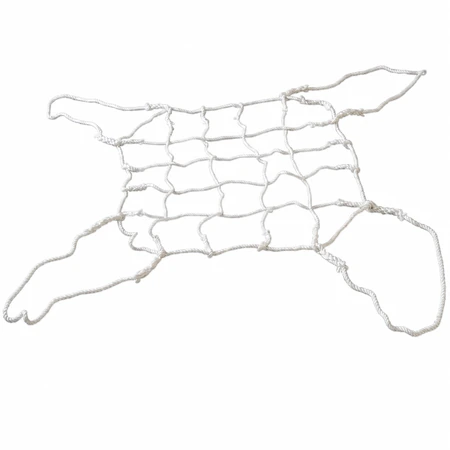
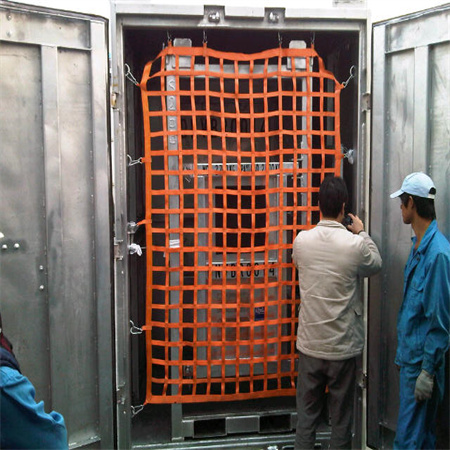
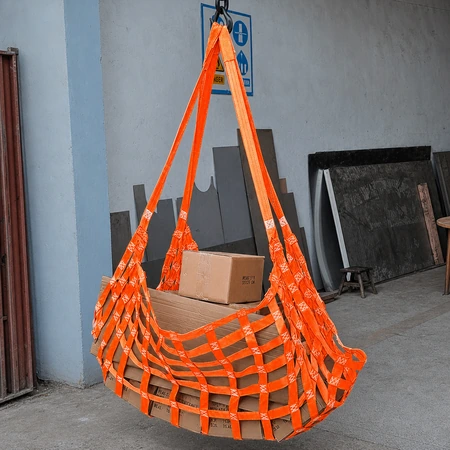
Empresa de aparelhamento de eslinga produz rede de carga com corda de náilon, rede de carga de cabo de aço e rede de carga de alta resistência.
Rede de elevação de carga
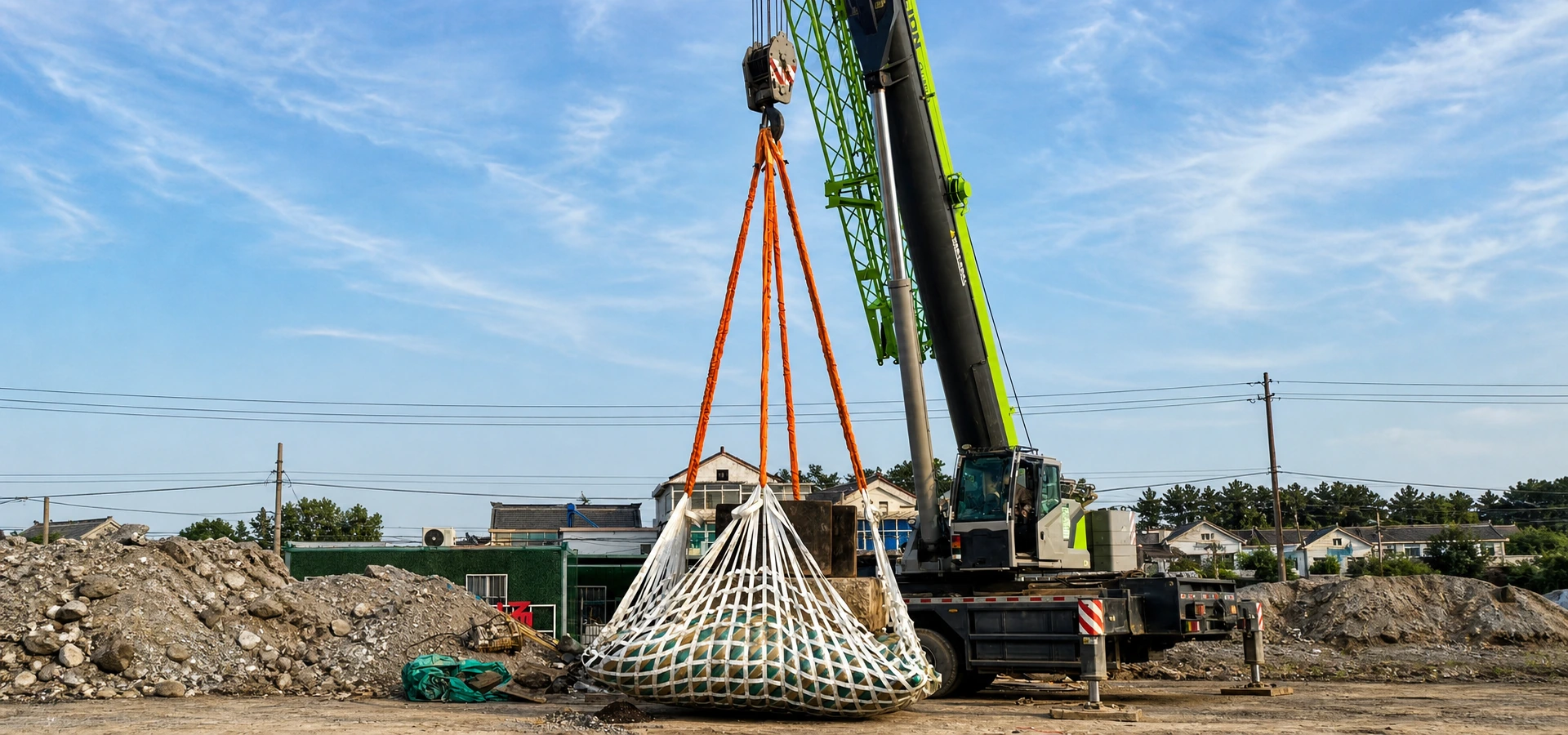
A cargo lifting net turns a loose, stacked or bagged consignment into a single crane lift. The net closes around the whole load instead of choking individual pieces, and it carries that load from its corners rather than from one contact point, so cargo that cannot be repacked, banded or palletised can still be moved in one movement.
We manufacture cargo lifting nets in three woven constructions – high-tenacity nylon rope, galvanised steel wire rope and high-strength polyester webbing – across a rated capacity of 1 para 100 t. Abertura de malha, tamanho líquido, fronteira, lifting points and colour are made to your drawing, and every net is proof-load tested in our own plant before it is packed.
- Capacidade nominal: 1 t – 100 t, stated for the way the net is rigged
- Abertura de malha: 50 milímetros – 400 milímetros, chosen from the smallest dimension of the cargo
- Pontos de elevação: 4 reinforced corners as standard, 8 points for a spreader beam
- Fator de segurança: 5:1 / 6:1 / 7:1 depending on construction
- Documentação: capacity label, material test report and CE marking
- Padrões: built to your nominated standard; ISO 9001 quality system
Which cargo lifting net suits your load?
As três construções se sobrepõem em capacidade, so the choice is normally decided by the cargo and the working environment rather than by tonnage alone. Use the table below as a starting point, then confirm the mesh, the net size and the lifting points with our engineers.
| Carga | Recommended construction | Usual mesh | Capacidade típica |
|---|---|---|---|
| Bagged goods – fertiliser, grão, semente, alimentar | Polyester webbing or nylon rope | 100 milímetros | 2 t – 10 t |
| Caixas paletizadas, boxed goods | High-strength rede de levantamento de carga de correias | 100 x 100 milímetros | 2 t – 10 t |
| Tijolos, blocos, pedra dividida | Nylon rope net in bag form | 100 milímetros – 150 milímetros | 2 t – 25 t |
| Quarry run, agregados, detritos de demolição | Rede de cabo de aço | 150 milímetros – 300 milímetros | 10 t – 100 t |
| Registros, madeira serrada, postes | Nylon rope net, atado | 200 milímetros – 300 milímetros | 2 t – 50 t |
| Steel plate packs, feixes de tubos, seções | Webbing net with edge protection, or wire rope net | 100 milímetros – 200 milímetros | 5 t – 50 t |
| Bateria, pneus, bobinas | Nylon rope net or webbing net | 100 milímetros – 200 milímetros | 1 t – 10 t |
| Machined, painted or plated parts | Webbing net only – plano, non-marking bands | 50 milímetros – 100 milímetros | 1 t – 20 t |
| Sucata, mixed abrasive bulk | Rede de cabo de aço | 200 milímetros – 400 milímetros | 10 t – 100 t |
| FIBC big bags, 1 t e 2 t | Rede de correias, or a purpose-made rede de carga de paletes de guindaste | 50 milímetros – 100 milímetros | 1 t – 5 t |
What a cargo lifting net is – e o que não é
Uma rede de elevação de carga é uma treliça tecida, nem uma bolsa e nem uma tipoia. Faixas ou fios se cruzam em ângulos retos para formar uma malha aberta; the border and the corners carry the load; and the cargo sits inside the lattice rather than on top of it. That geometry is what makes a net useful: the load is distributed over a wide bearing face instead of being concentrated at a hook, a choke point or a fork pocket, so contact pressure drops and the surface of the cargo is left intact.
It differs from a sling in three practical ways. A net holds the cargo in three dimensions, so nothing can slide out sideways during the lift. A net can be loaded on the ground, spread flat, and only then closed around the goods, which means the goods never have to be lifted to be netted. And a net is rated as an assembly of corners, border and mesh, so its capacity is quoted for a stated rigging arrangement rather than as a single line pull.
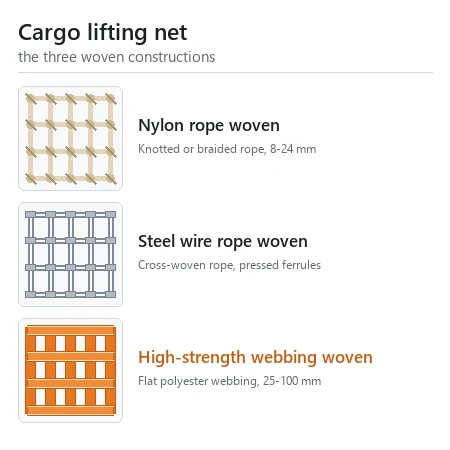
The four elements that set the rating
The strand or the band. Corda de náilon, steel wire rope or flat webbing. This single choice sets the strength, the net weight, the surface contact and the resistance to abrasion, cut and heat.
The mesh opening. The size of the square or diamond aperture. Decide o que fica dentro da rede e quanto pesa a rede. It is chosen from the smallest dimension of the cargo, nunca do tamanho externo da rede – um 6 m net with a 300 mm mesh will lose bricks through the mesh no matter how strong the rope is.
A fronteira. A doubled or reinforced edge running the full perimeter, então as faixas de borda não podem se desenrolar, spread apart or pull out under load. On a webbing net the border is double-layer stitched; on a rope net it is a doubled border rope spliced into the corners.
The lifting points. Four reinforced corner loops as standard, ou oito pontos onde a rede é levantada de uma viga espalhadora. Load must enter the corners and the border, never the middle of a panel. Loading the middle of a net is the most common way a sound net is destroyed in service.
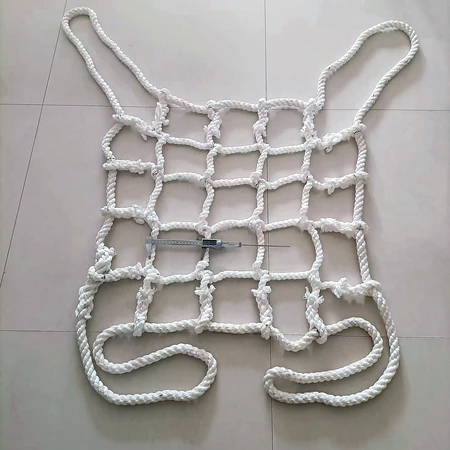
Cargo lifting net technical parameters
The table below puts the three constructions side by side. Values are our standard production range; anything outside it is built to drawing, and the rating that applies is the rating of the net as it is rigged, not the capacity of the crane above it.
| Parâmetro | Nylon rope net | Rede de cabo de aço | Rede de correias |
|---|---|---|---|
| Material | 100% nylon de alta tenacidade (poliamida) multifilamento | Cabo de aço galvanizado; inoxidável 304 / 316 a pedido | 100% correias de poliéster de alta tenacidade; nylon or PP on request |
| Praia / banda | 8 – 24 corda mm, 3-fio colocado ou 8 / 12-fio trançado (até 32 mm a pedido) | 6 x 19 for abrasion, 6 x 37 / 6 x 36WS for flexibility; 6 – 20 milímetros; FC or IWRC | 50 mm webbing standard; 25 / 75 / 100 mm a pedido |
| Abertura de malha | 100 – 300 milímetros, quadrado ou diamante | 150 – 400 milímetros, quadrado | 100 x 100 mm quadrado padrão; 50 – 300 mm a pedido |
| Articulação / lock | Netmaker’s knot, or knotless braided splice | Pressed aluminium ferrule at every intersection | Woven band crossings, stitched at the border |
| Fronteira | Corda de borda dupla, spliced into the corners | Corda de borda contínua, virola travada na malha | Double-layer stitched border round the full perimeter |
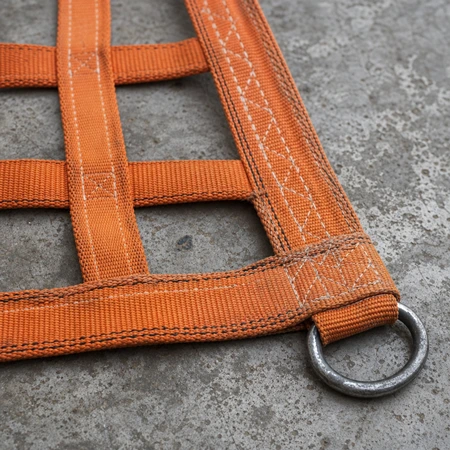
| Pontos de elevação | 4 olhos de canto; 8-ponto a pedido | Olhos de canto prensados com dedais, or rings / links mestres | 4 reinforced corner loops; 8-acessórios de ponta e anel sob consulta |
| Capacidade nominal | 1 t – 50 t | 2 t – 100 t | 2 t – 10 padrão; heavier to order |
| Fator de segurança | 5:1 / 6:1 / 7:1 | 4:1 / 5:1 / 6:1 | 7:1 |
| Alongamento | aprox.. 18 – 22% no intervalo – absorbs shock load | Muito baixo – the mesh keeps its shape under steady load | Baixo, aprox.. 7% no limite de carga de trabalho |
| Abrasão e corte | Bom; a single damaged strand can be replaced locally | O mais alto dos três | Bom, mas deve ser mantido longe de bordas afiadas |
| Corrosão | À prova de podridão; suited to wet and salt-water duty | Galvanised as standard; stainless for marine and chemical service | Poliéster sem ferrugem, Estabilizado contra UV |
| Temperatura de trabalho | -40 C para +80 C | Hot and dirty service – confirme o plantão conosco | -40 C para +100 C |
| Cor | Branco, or dyed to order | Galvanizado / stainless finish | Orange high-visibility, azul, preto, verde ou personalizado |
| Certificação | CE, GS, ISO 9001; test report per net | CE, ISO 9001; CNAS and DNV certified facility | CE, GS, ISO 9001; test report per net |
Net size and rated capacity
Standard sizes are listed below. Cama de caminhão, recipiente, hold and spreader dimensions are made to drawing, and the capacity quoted is the capacity of the finished net, tested before dispatch.
| Tamanho líquido (L x W) | Capacidade típica | Uso típico |
|---|---|---|
| 2.0 x 2.0 eu | 1 t – 3 t | Bateria, peças de máquinas, pequenos componentes |
| 2.5 x 2.5 eu | 2 t – 5 t | Carga paletizada e ensacada, carregamento de contêiner |
| 2.5 x 6.0 eu | 4 t – 10 t | Carga longa, feixes de tubos, carregamento de caminhões e reboques |
| 4 x 4 pés (1.2 x 1.2 eu) | 2 t – 3 t | Cargas pequenas, bateria, peças de máquinas (mercados imperiais) |
| 82 x 82 em | 2 t – 5 t | Pegada de paletes padrão em mercados imperiais |
| 6.0 x 6.0 eu | 10 t – 25 t | Carga ensacada a granel, madeira, sucata |
| 8.0 x 8.0 eu | 25 t – 50 t | Massa pesada, pedra, trabalhos de pedreira e demolição |
| Construído para desenhar | 1 t – 100 t | Cama de caminhão, recipiente, Dimensões do feixe de retenção e espalhador |
Abertura de malha: choose it from the smallest dimension of the cargo
Mesh is the parameter buyers most often get wrong, because it is chosen from the net size instead of from the load. The rule we apply is simple: the aperture must be smaller than the smallest dimension of the smallest piece that must not escape. The table below is the guide we use on quotation.
| Smallest cargo dimension | Cargo example | Mesh to specify |
|---|---|---|
| Sob 50 milímetros | Bottles, small castings, nuts and bolts, components in bulk | 50 milímetros – closed or near-closed bag form |
| 50 – 100 milímetros | Tijolos, bagged fertiliser, boxed goods, FIBC big bags | 100 milímetros |
| 100 – 200 milímetros | Bateria, caixas, pedra dividida, madeira serrada | 150 – 200 milímetros |
| Sobre 200 milímetros | Blocos, registros, sucata, detritos de demolição | 250 – 300 milímetros, ou 400 mm in wire rope |
Lifting configuration and how the rating is stated
A cargo lifting net is rated as an assembly. The same net gives a different rating for a four-point vertical lift, a two-point lift and an eight-point lift from a spreader beam, because the number of load-bearing corners changes. Every net we supply is therefore labelled with its working load limit and, where a net is used in more than one arrangement, each arrangement is listed separately on the label. Quote the configuration you will actually use when you enquire – a rating copied from a catalogue without the configuration is not a rating.
Nylon rope cargo lifting net
UM rede de elevação de carga de náilon is knotted or braided from high-tenacity nylon rope. Each strand can move slightly inside its knot, so the net settles around an irregular stack instead of sitting on top of it, e o alto alongamento do náilon absorve o choque quando o guindaste compensa a folga. It is the usual choice for timber and logs, pedra, bateria, pneus, scrap and any load whose shape shifts as it is lifted.
Rope is also the most repairable construction: a damaged strand can be re-knotted or re-spliced locally and the net re-inspected, which matters on a site where a net is working daily. For polypropylene rope in the same construction, veja o estilingue de rede de carga de corda de polipropileno.
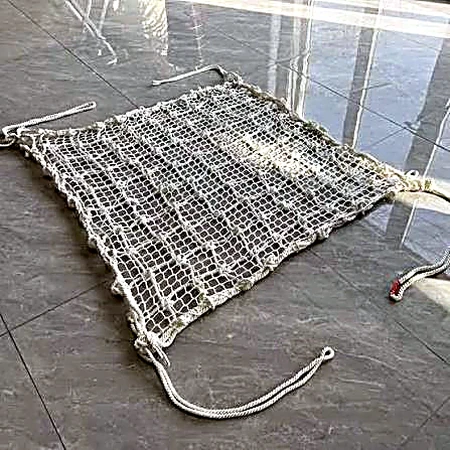
Steel wire rope cargo lifting net
A steel wire rope cargo lifting net is cross-woven from galvanised wire rope and locked at every intersection with a pressed aluminium ferrule, so the mesh cannot open up or distort when the net is dragged across a quay or a truck bed. Wire rope is the construction for abrasion, bordas afiadas, hot surfaces and long service with little maintenance – quarry run, agregados, detritos de demolição, scrap and heavy bulk.
It is the heaviest of the three and the least forgiving to finished surfaces, so it is normally specified where the cargo is rough. Where a wire rope net has to handle dressed material, we supply the same construction with sheathed contact sections, using the rope from our eslingas de cabo de aço faixa.
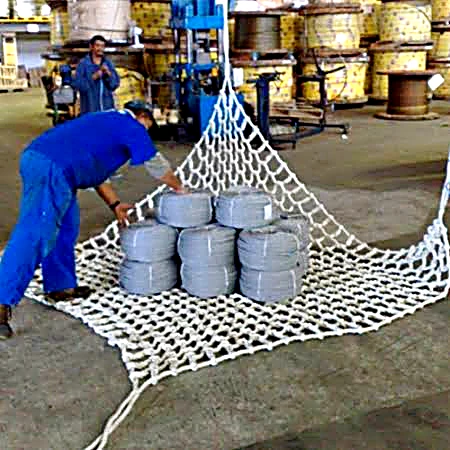
High-strength webbing cargo lifting net
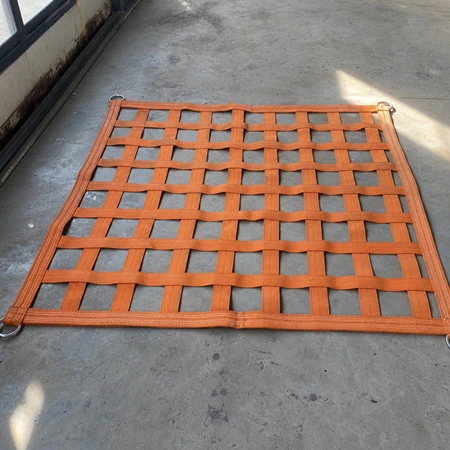
A high-strength webbing cargo lifting net is woven from flat polyester webbing. As faixas se cruzam em ângulos retos para formar uma malha quadrada aberta, the border and corners take the load, e toda a rede é macia o suficiente para assentar contra o saco, encaixotado, carga pintada ou usinada sem marcá-la. Ele carrega a face de apoio mais larga das três construções com o menor peso líquido, which is why it is the default for palletised, bagged and unitised cargo in ports, on trucks and on site cranes.
Poliéster tem baixo alongamento, so the mesh keeps its shape while the crane takes up the slack and the load stays square. A teia é tecida em nossa própria fábrica, which is why band width, cor, mesh and capacity can be tuned to the load instead of bought in from a catalogue. It is the same webbing used in our eslingas de tecido e fundas redondas sem fim, so a net and a sling on the same lift are matched in elongation and colour coding.
Como é montada uma rede de elevação de carga
- Four-point lift from a single hook. Os quatro laços de canto são reunidos no gancho ou em um anel mestre, so the net closes around the cargo as the crane takes up. This is the standard arrangement for bagged, palletised and unitised loads.
- Eight-point lift from a spreader beam. A rede permanece quadrada e a carga permanece nivelada, que é o que uma remessa longa ou larga precisa. Nosso feixe espalhador de elevação takes the eight points and keeps the legs vertical.
- Forma de bolsa. A closed three-dimensional net for loose goods that must not escape – tijolos, pedra dividida, bottles, small castings.
- Flat net, cargo inside the mesh. For palletised, bundled or unitised loads that only have to be held together during the transfer.
Qualquer que seja o arranjo, load must go into the corners and the border. Three habits destroy nets faster than any cargo: loading the middle of a panel, arrastando a rede lateralmente com o guindaste, and lifting on fewer than the full set of lifting points.
O que precisamos para cotar uma rede de elevação de carga
| Informação | Por que isso importa |
|---|---|
| Peso e formato da carga | Define a capacidade nominal e o número de fios ou faixas de suporte de carga sob a carga |
| Net length x width | A rede deve ser maior que a pegada da carga para que a carga fique dentro da malha, não em cima disso |
| Abertura de malha | 100 x 100 mm is our webbing standard; smaller or loose items need a smaller aperture |
| Strand diameter or band width | Sets strength and net weight; band width also sets the bearing face on the cargo |
| Pontos de elevação | Four corners as standard, or eight points and rings for a spreader beam |
| Guindaste, gancho ou espalhador | Determines whether the corners carry eyes, anéis, shackles or thimbles |
| Ambiente | ultravioleta, água salgada, serviço offshore ou de alta temperatura decide o material e o tratamento |
| Documentação | Marcação CE, relatório de teste, declaration of conformity or own-brand labels |
Inspeção: what to check and when to retire a net
Inspect before every lift and record a formal inspection at the interval your site requires. Check the corner loops and the corner stitching first – that is where wear starts – then work round the border and the mesh.
| Check | Retire the net if |
|---|---|
| Corner loops and corner stitching | Stitching is broken, the loop is deformed, or the ring / thimble is cracked or worn |
| Fronteira | The border rope or border band is cut, unravelled or pulled out of the mesh |
| Strands or bands | Any load-bearing strand or band is cut, deeply abraded, heat-glazed or chemically stained |
| Knots and ferrules | A knot has slipped, or a ferrule is cracked, displaced or corroded through |
| Correias | Bands are cut, powdered by UV, or contaminated with oil, paint or chemicals that cannot be removed |
| Labels | The capacity label is missing or illegible – an unlabelled net cannot be rated |
Nunca repare uma rede dando um nó em um fio quebrado, soldar um cabo de aço ou aquecer uma faixa. Repairs belong to the maker or to a competent person using the original materials, followed by a re-test where the standard requires it. Store nets clean, dry and off the ground, fora do sol direto.
Where cargo lifting nets are used
| Setor | O que a rede faz |
|---|---|
| Portos e terminais | Enchimento e desestufamento de contêineres, carga paletizada e ensacada, quay and hold work with a net that is soft, sem ferrugem e fácil de dobrar |
| Aço e fabricação | Pacotes de pratos, pacotes, peças usinadas e cargas de vinhaça onde a superfície não deve ser marcada |
| Pedra, pedreira e agregados | Pedra dividida, blocos, pedras e granel abrasivo; wire rope where cut resistance decides the service life |
| Madeira e produtos florestais | Registros, sawn packs and poles – a rope net settles around an irregular stack as it is lifted |
| Offshore e marítimo | Deck and over-the-side transfer; nylon and polyester drain freely and do not rust |
| Agricultura e sacos a granel | Fertilizante, grão, semear e ração em sacos e big bags, lifted whole without repacking |
| Reciclagem e sucata | Sucata mista e abrasiva, onde uma rede de cabo de aço dura mais que uma rede têxtil |
| Vehicle and plant loading | RoRo and breakbulk loading, where a wide net spreads the load across the body and chassis; veja nosso rede de elevação de veículos faixa |
Two neighbouring ranges are often quoted with a lifting net: heavy duty truck cargo nets e container cargo nets for securing rather than lifting, e redes de corda de segurança where the net protects people instead of holding cargo. Tell us which duty applies and we will confirm the construction – a securing net is not rated for lifting, and a lifting net is not a fall-arrest product.
Perguntas frequentes
What is the difference between a cargo lifting net and a cargo net?
A cargo net is a general term that covers lashing, securing and climbing nets as well as lifting nets. A cargo lifting net is a rated assembly: it is designed for a stated working load limit, testado, labelled and supplied with documentation. If a net has no capacity label, treat it as a securing net and never lift with it.
How do I choose between nylon rope, wire rope and webbing?
Duro, pontos a granel quentes ou abrasivos no cabo de aço. Cargo that must not be marked points to webbing. Irregular loads that have to settle into the net, e trabalho em deck molhado, aponte para corda de náilon. Where two of those apply at once, tell us and we will recommend the construction with the trade-off made explicit.
What safety factor should I specify?
Our standard ranges are 5:1, 6:1 e 7:1 for rope and webbing nets and 4:1 para 6:1 for wire rope nets. The factor must satisfy the standard your site works to, so confirm it at enquiry rather than assuming the lowest option is acceptable.
Can a cargo lifting net be made to my size and mesh?
Sim. Tamanho, malha, strand diameter or band width, número de pontos de elevação, cor e capacidade são feitas sob encomenda, incluindo caçamba de caminhão, recipiente, dimensões de retenção e espalhador. Send a drawing or the internal dimensions of the space the net has to work in.
Will the net hold loose material such as bricks or split stone?
Sim, in bag form with the correct mesh. The aperture must be smaller than the smallest piece, and the net must be closed on all sides. Where material is very fine or very sharp, we will normally propose a smaller mesh in a heavier construction.
Can the net be used in a marine or offshore environment?
Sim. Polyester and nylon nets are UV stabilised and rust-free, redes de cabos de aço podem ser fornecidas galvanizadas ou em aço inoxidável, e todos os três drenam livremente no convés. For offshore duty, tell us the salt-spray exposure and the inspection regime so the material and coating are matched to it.
Is a test certificate supplied with each net?
Sim. Each net leaves the plant with a capacity label and a material test report, e nossas instalações possuem CNAS, CE e ISO 9001 certificação. Etiquetas de marca própria, printed markings and declarations of conformity are available on OEM orders.
Qual é a quantidade mínima de pedido?
There is no fixed minimum for standard constructions – a single net for a trial is possible, and batch quantities can combine mixed sizes and mixed constructions in one order. Mixed pallets are also acceptable where the export packing allows it.
How is a cargo lifting net packed for export?
Folded and strapped with the label and test report attached, então saco ou caixa embalado conforme acordado. Export packing is built to survive sea freight, and nets can be supplied with a repair kit and a spare corner loop where the customer maintains its own fleet.
Can you print our logo or brand on the net?
Sim. We weave and print webbing in house, so brand names, capacity text, fleet numbers and colour coding can be incorporated in the net rather than added as a tag. Send the artwork with the enquiry.
Why buy cargo lifting nets from Lift Sling Rigging Company
- 40 years of lifting equipment manufacturing – fundada em 1985 em Taizhou, Jiangsu, com mais de 200 employees and one of China’s largest sling and net production bases.
- We weave our own webbing and make our own rope nets – largura de banda, cor, malha e capacidade estão sob nosso controle, so a net is tuned to the load instead of being bought in from a catalogue.
- Laboratório de testes próprio e um 1000 máquina de teste horizontal – breaking load is tested per net and documented; the facility holds CNAS, CE and DNV certification and 15 authorised patents.
- One supplier for the whole cargo range – redes de elevação de carga, eslingas de tecido, fundas redondas, eslingas de cabo de aço, spreader beams, cordas de náilon, meias puxando cabos and safety nets.
- OEM e ODM – rótulos de marca própria, correia impressa, cores personalizadas e embalagens de exportação para distribuidores e usuários finais.
Solicite um orçamento de rede para elevação de carga
Send the load weight and shape, o tamanho líquido, a abertura da malha, the lifting points and the environment – or a drawing of the truck bed, recipiente ou segurar a rede tem que caber. Nossos engenheiros confirmarão a construção, a capacidade nominal, the strand or band size and the packing, and quote in one reply. Para conversar sobre isso primeiro, entre em contato com nossos engenheiros; nosso certification and test records estão disponíveis mediante solicitação.
Empresa de aparelhamento de eslinga de elevação
Parque Industrial Lifute, Cidade de Taizhou, Província de Jiangsu, China
Telefone: +86 523 8693 5818 | WhatsApp: +86 180 6600 2268 | E-mail: lift98@jslift.com
Código SH: 630790