

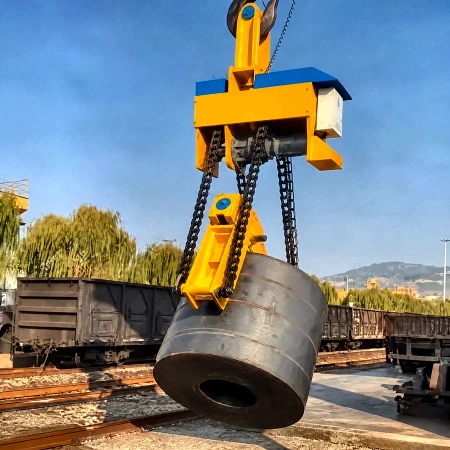
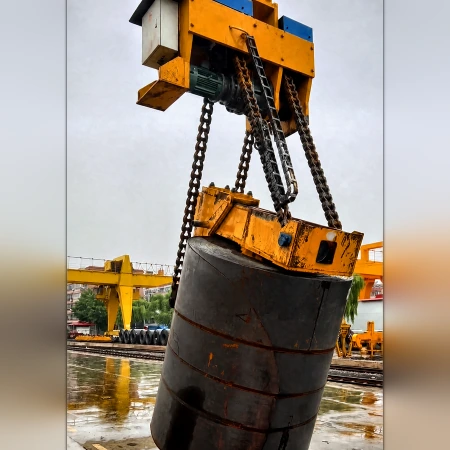
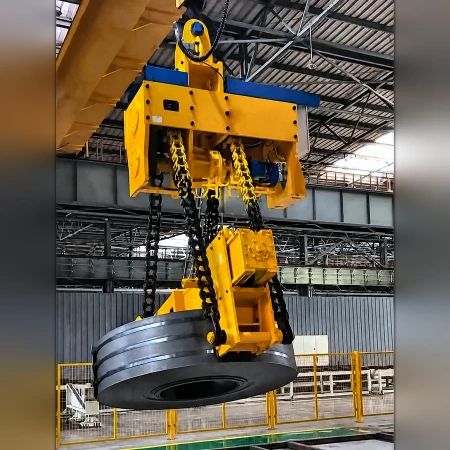
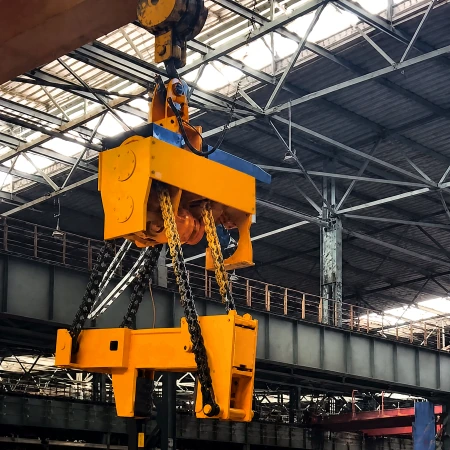
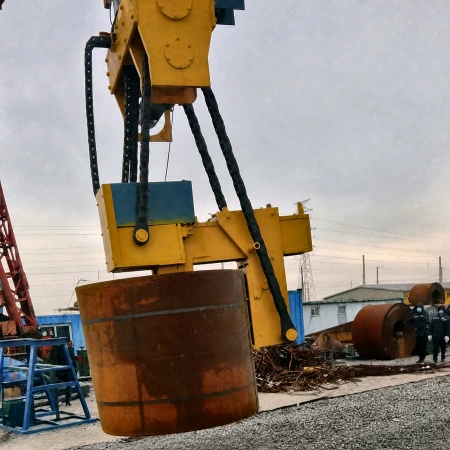
Lift sling rigging company produce Motorized Steel Coil Tilting Lifting Tong,Tilting Coil Tong,Motorized Tilting Coil Tong.
Motorized Tilting Coil Tong
A coil arrives eye-to-sky and the line wants it eye-to-wall. Doing that turn on the floor takes a crane, a soft spot and two men at the edge of the load. A motorized tilting coil tong – sold under the long name motorized steel coil tilting lifting tong – does it in the air: two jaws take the coil on its outside diameter, the motor rolls the tong through 90 stopnie, and the coil lands the way the next process needs it.
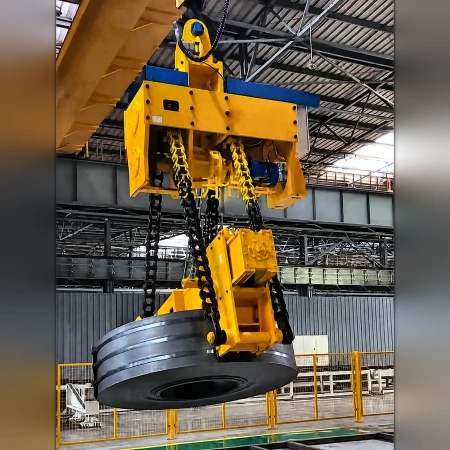
What the Tool Actually Does
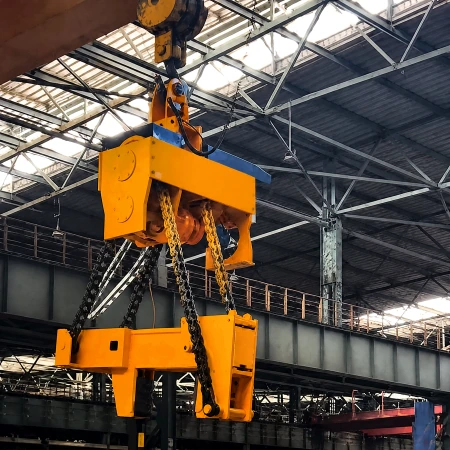
The tong is a three-part machine. A head frame hangs on the crane hook and carries the geared motor and its control box. Two chains run from the head frame down to the jaw body, which grips the coil on its outside diameter with two curved jaws. Shortening the chain on one side rolls the jaw body – and the coil with it – about a horizontal axis.
| Część | Job | What fails if it is wrong |
|---|---|---|
| Head frame and hook eye | Takes the whole load; carries motor and panel | Nothing else can be corrected |
| Geared motor and brake | Drives the tilt and holds the coil at any angle | Coil drifts, or drops past vertical |
| Chains | Suspend the jaw body and transmit the tilt | Uneven tilt, or a chain shock-loaded |
| Jaws and pads | Grip by friction on the coil OD | Slip – the one failure that has no recovery |
| Limit switches | Stop the roll at the set angle | Over-travel and coil slide-out |
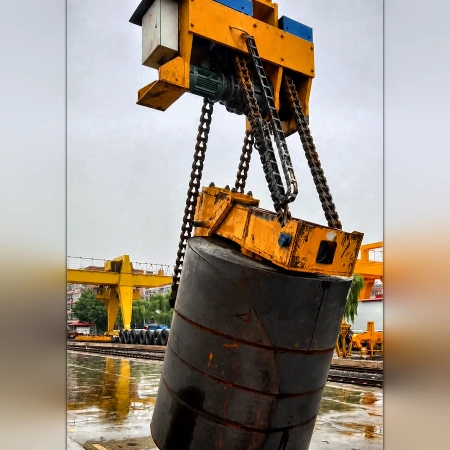
Grip Is Friction, and Friction Is the Rating
A coil tong does not hook the coil; it squeezes it. Holding capacity is clamp force times the friction coefficient at the pad, so the honest capacity of any tong is decided by three things that are easy to overlook:
- Pad condition. Worn, glazed or oil-soaked pads lose friction long before anything looks broken.
- Coil surface. Mill scale, oil and rust all move the friction coefficient – and oiled coils are the normal case in a coil yard, not the exception.
- Wrap integrity. A loosely wound outer wrap can slide under the pad even when the tong holds.
This is why a tong is rated on the coil it carries, not on a bare tonnage figure: a tong that holds a dry, tight coil may slip on the same weight of oiled, loosely wound stock. Tell us the coil condition when you inquire.
Why Motorized, Not Manual
| Manual tilting tong | Motorized tilting tong | |
|---|---|---|
| Turn | Handwheel, chain block or lever by the operator | Geared motor from a pendant |
| Operator position | Has to reach the tong while it hangs loaded | Stands clear, works the pendant |
| Repeatability | Depends on the man | Stops at the set angle every time |
| Cycle time | Slow, and slowest on the heaviest coil | Constant, independent of coil weight |
| Najlepsze dla | Occasional turning, light coils | Production lines, heavy coils, one-man operation |
Choosing the Model: the Inputs That Matter
A coil tong is built around a coil, not ordered from a size list. These figures decide the frame, the jaw opening and the motor:
| Wejście | What it decides | How to state it |
|---|---|---|
| Waga cewki | Frame section, jaw size, chain and motor rating | Heaviest coil in the run, nie średnia |
| Outside diameter | Jaw curvature and opening range | Smallest and largest OD, both |
| Inside diameter | Whether the tong can sit clear of the bore | Measured, or the mill’s standard |
| Szerokość cewki | Jaw face length, tilt moment | Widest and narrowest |
| Axis at pick-up and at set-down | Angle of tilt required | Eye-to-sky to eye-to-wall, or the reverse |
| Stan cewki | Pad compound and clamp force | Dry, naoliwione, scaled, wrapped, gorący |
| Headroom under the hook | Overall height at the worst angle | Measured at the pick-up point |
| Power supply | Motor and control specification | Voltage, phase, frequency at the crane |
| Control | Pendant, radio, or crane-integrated | Who works the tilt, and from where |
| Obowiązek | Motor sizing and brake life | Coils turned per shift |
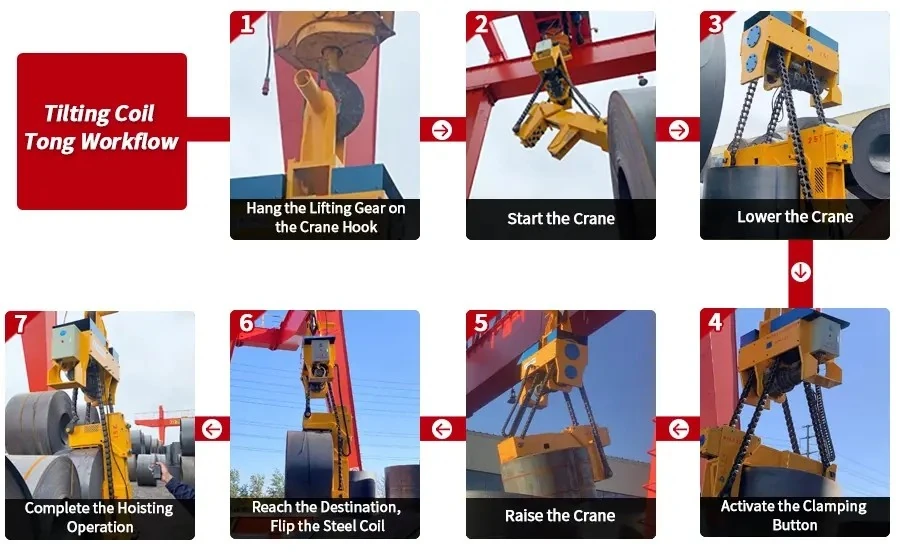
The 90 Degrees Are Not Free: Swing Clearance
Turning a coil through 90 degrees is a rotation about a horizontal axis, and the coil’s corner travels further than its diameter. The swept radius is the diagonal, not the radius:
| Cewka | Swept radius (half diagonal) | What that means on site |
|---|---|---|
| Z 1,250 mm, szerokość 1,500 mm | o 977 mm | Needs about 1.95 m of clear height for the turn |
| Z 1,500 mm, szerokość 1,500 mm | o 1,061 mm | 1.5 t of steel now needs 2.1 m of swing |
Figures above are a worked example of the geometry – half the square root of OD squared plus width squared – not a capacity statement. Measure the real clearance before ordering: a coil that fits the jaw can still hit the crane girder halfway through the turn.
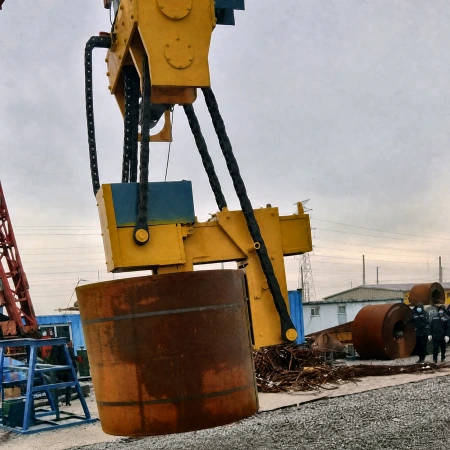
What the Jaws Must Not Do
- Dent the wrap. Clamp force is set for friction, not for crushing; a coil edge that yields under the pad has already lost its wrap tension.
- Sit on the bore. The tong grips the OD; if the jaw reaches into the eye it will bind on the turn.
- Bridge the weld seam. A raised seam under a pad is a line contact, not a face contact.
- Close on a partial coil. A slit or part coil has no closed ring to grip; that is a different tool.
Power, Control and the Brake
The motor’s real job is not lifting – the crane does that. Its job is to roll the coil and to hold it at any angle on the way. That makes the brake a safety device, nie wygoda: if it slips, the coil keeps rolling past vertical and the jaws are no longer under the centre of gravity.
| Element | Requirement to confirm at order |
|---|---|
| Supply | Voltage, phase and frequency as measured at the crane, not as assumed from the plant |
| Motor | Sized on the tilt moment of the heaviest coil, with the duty cycle stated |
| Brake | Holds the rated coil at any angle; check it at every inspection |
| Limits | Mechanical stop plus an electrical limit at each end of the tilt |
| Pendant | Lead length that lets the operator stand clear of the swing |
| Ochrona | Enclosure rating for dust, water and, if applicable, the area classification |
Bezpieczne użytkowanie: What Actually Goes Wrong
| Risk | Przyczyna | Control |
|---|---|---|
| Coil slips out | Worn or oiled pads; clamp force set too low | Pad inspection and replacement on a schedule |
| Over-tilt | Limit switch bypassed or failed | Mechanical stop independent of the switch |
| Shock load on a chain | Lowering onto a stack before the coil is seated | Set down only when the coil is fully supported |
| Person in the swing | Guiding the coil by hand during the turn | Tag lines, and a marked exclusion zone |
| Jaw binds on the bore | Wrong jaw size for the coil ID | Check the ID against the jaw drawing before the lift |
| Brake drift | Worn brake lining, no test routine | Hold test at every shift start |
What to Send With the Inquiry
- Coil weight range, and the heaviest single coil.
- Outside diameter range and inside diameter.
- Coil width range.
- Start and finish axis – which way the coil has to end up.
- Stan cewki: suchy, naoliwione, scaled, wrapped, or hot, and the temperature if hot.
- Headroom under the hook at the pick-up point, and the crane’s rated capacity.
- Power supply at the crane, and who works the pendant.
- A photo of the coil as it sits now, and one of the pick-up area.
Często zadawane pytania
What is a motorized tilting coil tong?
A below-the-hook tool that grips a steel coil on its outside diameter with two jaws and turns it through 90 degrees with a geared motor, so the coil can go from eye-to-sky to eye-to-wall without being rolled on the floor.
What decides how much coil it can hold?
Tarcie, not the hook. Holding capacity is clamp force times the friction coefficient at the pads, so pad condition, oil on the coil and the tightness of the outer wrap all change what the same tong can safely carry.
Can it turn a coil past 90 stopnie?
The usual duty is a quarter turn. Going further needs the jaws to stay under the centre of gravity at every angle, which is a different design question – state the full angle you need rather than assuming 90 degrees covers it.
What clearance does the turn need?
More than the coil diameter. The coil rotates about a horizontal axis, so its corner sweeps the half-diagonal of the coil, which is larger than the radius. Check the clear height before ordering, nie po.
Is it supplied with its own control?
It is supplied with a pendant as the normal arrangement, and can be built for crane-integrated control. The supply voltage, phase and frequency have to be measured at the crane, because a tong built for the wrong supply cannot be corrected on site.
Can it handle hot coils?
Only if it is built for them. Heat changes the pad compound, the cable and the motor’s duty, so a hot-coil tong is a separate specification rather than an option. State the coil temperature with the inquiry.
Send the coil range and the way it has to end up – the frame, jaw opening and motor come back as a specification. Send coil dimensions