

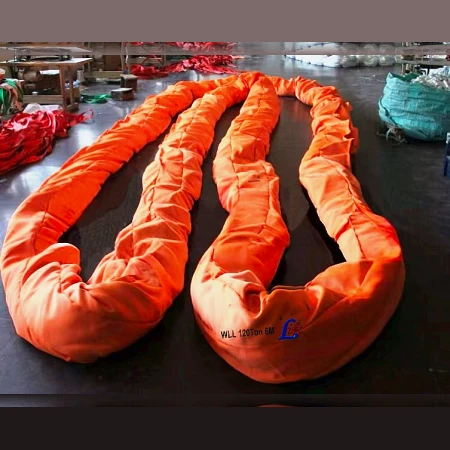
Lift sling rigging company produce WLL 200T Polyester Round Slings,200000kg Heavy Duty Round Lifting Sling,WLL 200 Ton Endless Loop Polyester Round Sling to AS 4497,200 Ton Endless Synthetic Round Sling.
WLL 200T Polyester Round Slings
A WLL 200T polyester round sling is the top of the standard endless range: 200,000 kg on a single vertical leg, 1,400,000 kg minimum breaking load, and a coil that has to be planned for rather than carried. It is the size specified when the lift is a vessel, a mill shell, a transformer or a fabricated frame that cannot be broken down — and the size at which everything around the sling starts to matter as much as the sling itself.
Built to AS 4497:2018 and proof loaded to 400,000 kg on the works’ own test bed, the sling is supplied with its proof record and serial number. Lengths are made to order, including 30 m bodies for large girths.
What Changes at 200 Tonnes
Capacity is limited less by the standard than by the hardware around the sling. Four things change as the figure climbs past 150 t.
- The interface becomes the constraint. A 200 t hook, shackle or beam has a bowl and a pin of a certain size, and the sling has to sit in it properly. A sling that only just fits a small bowl is working on a tight radius, and the load is no longer shared across the body the way the rating assumes.
- The sling stops being hand-portable. A 200 t body at working length is heavy and bulky enough that positioning is a crane or forklift task; plan the lift of the sling itself, not only the lift of the load.
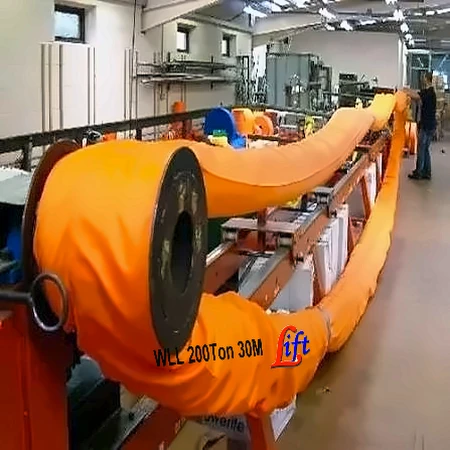
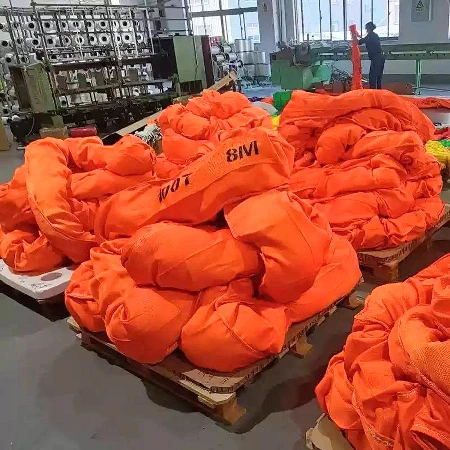
- The coil governs the transport. Long, high-capacity bodies coil large. Confirm the coil diameter, the packed weight and the access at the receiving end before the length is fixed.
- The test becomes an operation. A 400,000 kg proof load needs a bed that can take it — which is why the capacity you can buy is often set by who can test it, not who can sew it.
Capacity in Each Arrangement
| Arrangement | Mode factor | Working load limit |
|---|---|---|
| Vertical | 1.0 | 200 t (200,000 kg) |
| Choked | 0.8 | 160 t (160,000 kg) |
| Basket, 0–7° | 2.0 | 400 t (400,000 kg) |
| Basket, 7–45° | 1.4 | 280 t (280,000 kg) |
| Basket, 45–60° | 1.0 | 200 t (200,000 kg) |
Basket ratings count only if the hook, shackle or beam above is rated for the same figure. Multi-leg assembly factors: 2 legs 1.4 / 1.0 and 3–4 legs 2.1 / 1.5 for 0–45° and 45–60°.
The Interface Above the Sling
At 200 t the lifting set is a chain of rated items, and the weakest link sets the lift — not the sling. Before the sling is chosen, confirm the hook or shackle it will sit in, the beam if one is used, and the lifting points on the load. Three checks repay the time.
- Bowl and pin size. The sling body should bear on a generous radius, not a narrow pin. If the bowl is small, a larger shackle or a beam with proper lugs is the fix, not a thinner sling.
- Matched ratings. A 200 t sling under a 150 t hook is a 150 t lift. Check the marking on every item in the set, and check that the beam’s own SWL covers the total, not the per-leg figure.
- Leg angle. Four legs at 30° share a load very differently from two legs at 60°. The assembly factor belongs to the configuration, not to the sling.
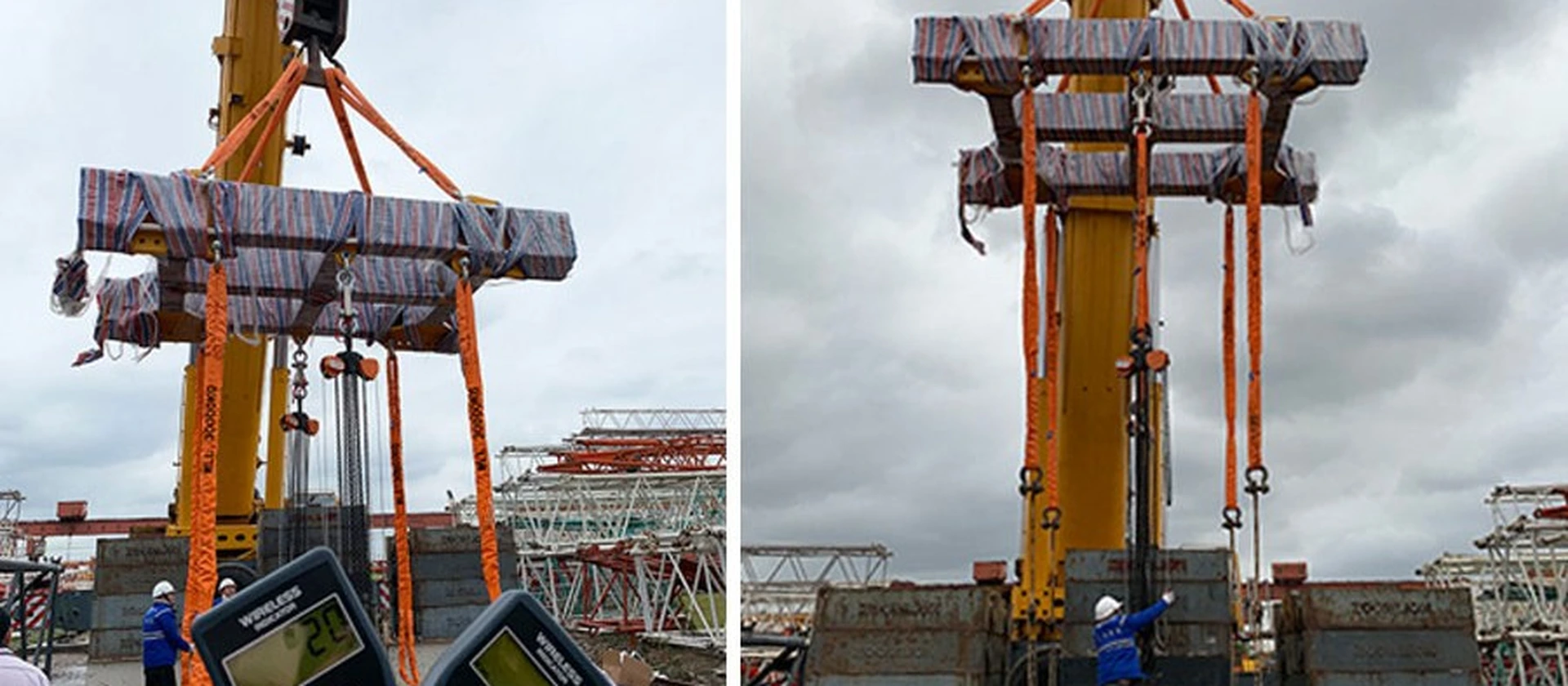
Where the geometry is tight, a spreader beam keeps the legs vertical and takes the horizontal component out of the sling — often the difference between a 200 t sling working comfortably and one working at its limit.
Technical Specifications
| Produkt | WLL 200T polyester round sling / 200 tonne endless round sling / 200,000 kg heavy duty round lifting sling |
|---|---|
| Standard | AS 4497:2018; EN 1492-2 and ISO 4878 on request |
| Working load limit (vertical) | 200,000 kg (200 t) |
| Minimum breaking load | 1,400,000 kg (7 × WLL) |
| Proof load | 400,000 kg (2 × WLL), applied to every sling |
| Safety factor | 7:1 |
| Configuration | Endless loop; eye-and-eye version on request, no metal components |
| Core | High-tenacity polyester parallel yarn, continuous loop |
| Sleeve | Woven high-tenacity polyester; double layer for abrasive or edged loads |
| Elongation at WLL | Approx. 2–3% |
| Working temperature | −40 °C to +100 °C with a polyester core; aramid core above that |
| Effective length | Made to order, including 30 m and longer; state lay-flat length or circumference |
| Marking | Sewn label: WLL, effective length, standard, manufacturer, serial or batch |
| Packing | Coiled, strapped, poly-wrapped; crate or pallet sized to the coil |
| HS code | 630790 |
De 30 m body shown is a made-to-order length. Capacity, length and sleeve are confirmed on the approval drawing before winding.
Above 200 Tonnes
Not every lift stops at the top of the standard ladder. We build beyond it — 250 t, 300 t and larger — on the same principle, with the proof load scaled accordingly on a test bed rated to 1,000 t. Two things change when you go above the standard range: the lead time, because the core is wound and the sleeve made for the order, and the documentation, because an engineered sling is normally specified against a drawing rather than a catalogue line. Tell us the load and the arrangement and we will say plainly what is buildable, what it will be tested to, and how long it takes.
Inspection at This Size: Lumps, Sleeve and Label
A 200 t sling is inspected before each use, and the inspection is mostly by hand and eye on the outside — but there is one check that matters more here than on a small sling. The core cannot be seen, so a lump felt through the sleeve has to be judged. AS 4497:2018 requires a sling to be withdrawn from service if an unexplained lump is found under the cover.
- Explainable lumps. Permitted yarn terminations at the start and finish of the wind can be felt as a small lump and carry no load.
- Unexplained lumps. A hard, pea-sized lump is usually foreign matter; a large, tight thickening over a length usually means the core has bunched. Either way the sling comes out of service pending a decision.
- Sleeve and label. Cut through to the core, glazing from heat, chemical staining or an illegible label all retire the sling, whatever the core feels like.
Frequently Asked Questions
Is 200 t the largest round sling you make?
No. 200 t is the top of the standard range; 250 t, 300 t and larger are built to order and proof loaded on a 1,000 t test bed. Above the standard range the sling is specified against a drawing, with a longer lead time.
What does a 200 t sling lift in a basket?
400 t at 0–7°, 280 t at 7–45° and 200 t at 45–60°. The basket figure is only usable if the hook, shackle or beam above is rated for it, and if the body has a long enough path under the load.
Can the proof load be witnessed or certified?
Yes. Every sling is proof loaded to 400,000 kg as standard and the record travels with the serial number. Third-party witnessing, a declared standard marking or a certificate issued with the consignment can be arranged if specified before production.
How is a 30 m, 200 t sling shipped?
Coiled, strapped and poly-wrapped, usually on a pallet or in a crate sized to the coil. Send us the destination and the handling available at the receiving end and we will confirm the coil diameter and packed weight before the order is released.
Request a Quote for WLL 200T Polyester Round Slings
Send the load, the lifting points, the hook or shackle the sling will sit in, the length convention you use and the handling available on site. We will confirm the capacity, the interface, the coil and the proof-load arrangement before the core is wound.
Contact our lifting engineers for a specification review, or ask for the test record format before you order.
Related Products
- Round slings — the full range from 1 t to 200 t and beyond
- WLL 150T polyester round slings — the step below
- WLL 120T polyester round slings AS 4497
- 100 tonne round sling
- Endless round sling — construction and rigging guide
- Round sling with eyes — fixed length for repeat lifts
- Spreader beams — keeping 200 t legs vertical
- Heavy duty webbing slings — the flat alternative