

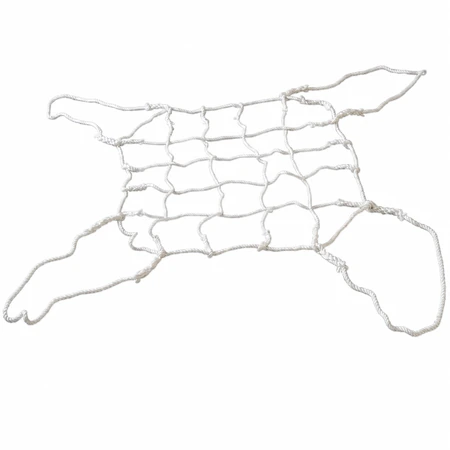
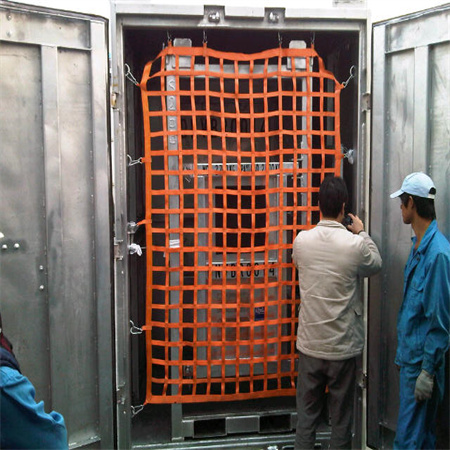
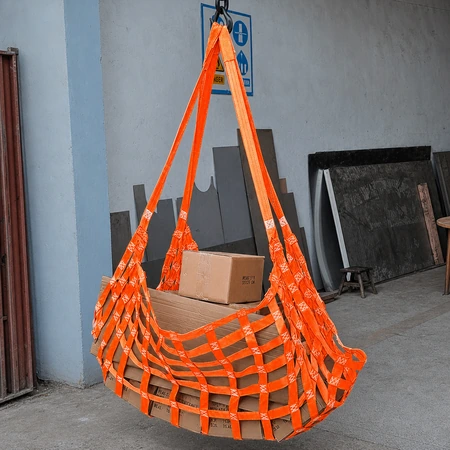
Lift sling rigging company produce nylon rope cargo net, steel wire rope cargo net and high-strength webbing cargo net.
Lasteløftnett
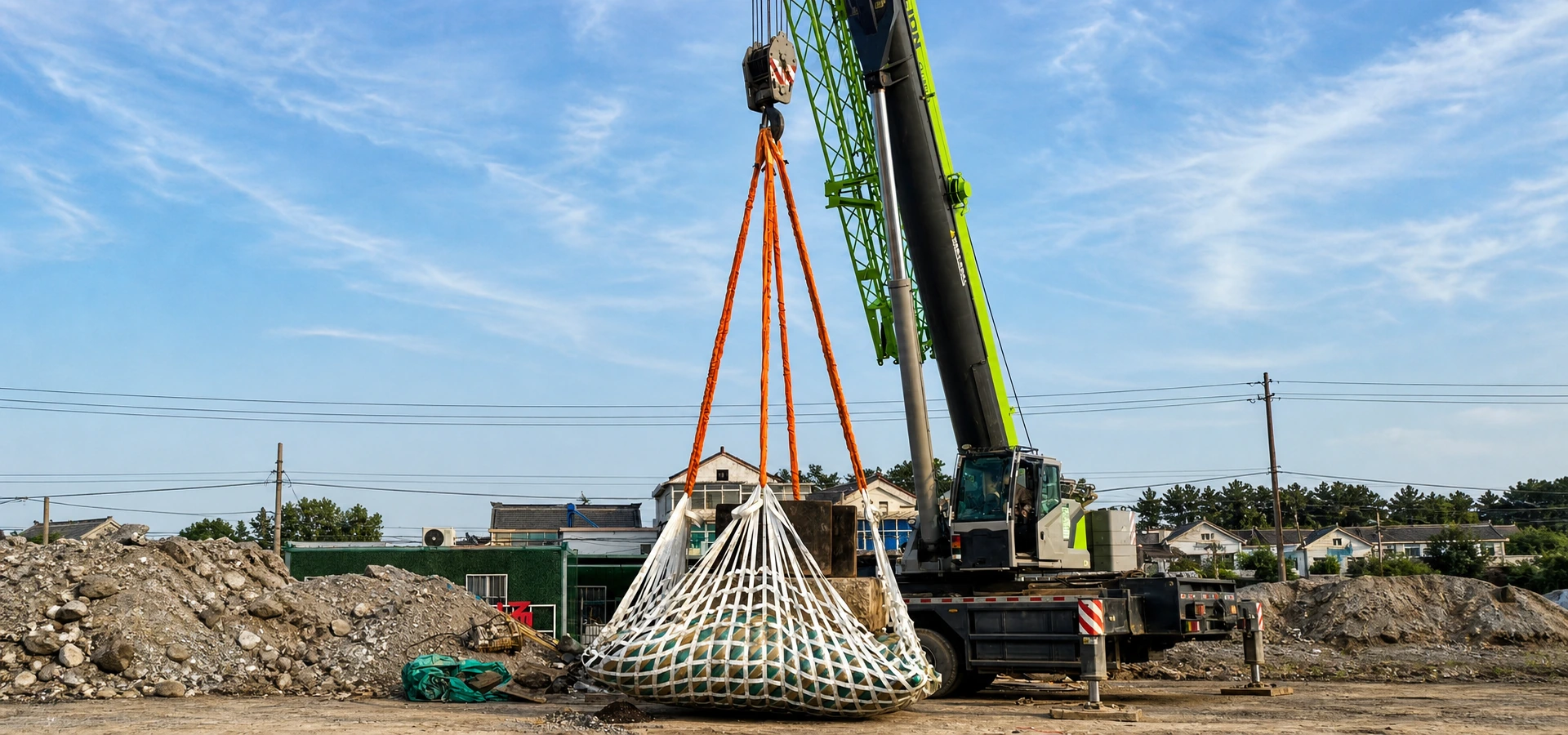
A cargo lifting net turns a loose, stacked or bagged consignment into a single crane lift. The net closes around the whole load instead of choking individual pieces, and it carries that load from its corners rather than from one contact point, so cargo that cannot be repacked, banded or palletised can still be moved in one movement.
We manufacture cargo lifting nets in three woven constructions – high-tenacity nylon rope, galvanised steel wire rope and high-strength polyester webbing – across a rated capacity of 1 t til 100 t. Mesh åpning, netto størrelse, grense, lifting points and colour are made to your drawing, and every net is proof-load tested in our own plant before it is packed.
- Nominell kapasitet: 1 t – 100 t, stated for the way the net is rigged
- Mesh åpning: 50 mm – 400 mm, chosen from the smallest dimension of the cargo
- Løftepunkter: 4 reinforced corners as standard, 8 points for a spreader beam
- Sikkerhetsfaktor: 5:1 / 6:1 / 7:1 depending on construction
- Dokumentasjon: capacity label, material test report and CE marking
- Standarder: built to your nominated standard; ISO 9001 quality system
Which cargo lifting net suits your load?
The three constructions overlap in capacity, so the choice is normally decided by the cargo and the working environment rather than by tonnage alone. Use the table below as a starting point, then confirm the mesh, the net size and the lifting points with our engineers.
| Last | Recommended construction | Usual mesh | Typisk kapasitet |
|---|---|---|---|
| Bagged goods – fertiliser, korn, frø, mate | Polyester webbing or nylon rope | 100 mm | 2 t – 10 t |
| Palleterte kartonger, eske varer | High-strength nett for lasteløfte | 100 x 100 mm | 2 t – 10 t |
| Murstein, blokker, split stone | Nylon rope net in bag form | 100 mm – 150 mm | 2 t – 25 t |
| Quarry run, aggregater, rivningsrester | Nett av ståltau | 150 mm – 300 mm | 10 t – 100 t |
| Logger, saget tømmer, stolper | Nylon rope net, knyttet | 200 mm – 300 mm | 2 t – 50 t |
| Steel plate packs, rørbunter, seksjoner | Webbing net with edge protection, or wire rope net | 100 mm – 200 mm | 5 t – 50 t |
| Trommer, dekk, spoler | Nylon rope net or webbing net | 100 mm – 200 mm | 1 t – 10 t |
| Machined, painted or plated parts | Webbing net only – flat, non-marking bands | 50 mm – 100 mm | 1 t – 20 t |
| Skrapmetall, mixed abrasive bulk | Nett av ståltau | 200 mm – 400 mm | 10 t – 100 t |
| FIBC big bags, 1 t og 2 t | Nettnett, or a purpose-made kran pall lastenett | 50 mm – 100 mm | 1 t – 5 t |
What a cargo lifting net is – og hva det ikke er
A cargo lifting net is a woven lattice, not a bag and not a sling. Bands or strands cross at right angles to form an open mesh; the border and the corners carry the load; and the cargo sits inside the lattice rather than on top of it. That geometry is what makes a net useful: the load is distributed over a wide bearing face instead of being concentrated at a hook, a choke point or a fork pocket, so contact pressure drops and the surface of the cargo is left intact.
It differs from a sling in three practical ways. A net holds the cargo in three dimensions, so nothing can slide out sideways during the lift. A net can be loaded on the ground, spread flat, and only then closed around the goods, which means the goods never have to be lifted to be netted. And a net is rated as an assembly of corners, border and mesh, so its capacity is quoted for a stated rigging arrangement rather than as a single line pull.
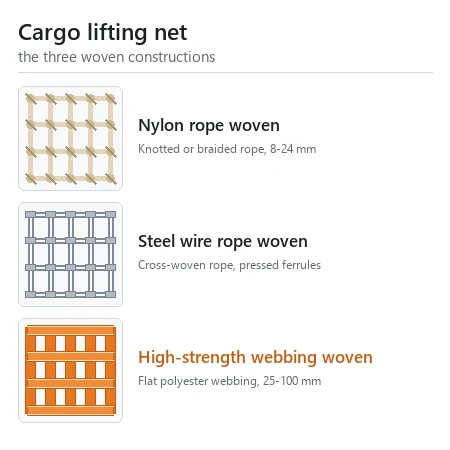
The four elements that set the rating
The strand or the band. Nylon tau, steel wire rope or flat webbing. This single choice sets the strength, the net weight, the surface contact and the resistance to abrasion, cut and heat.
The mesh opening. The size of the square or diamond aperture. It decides what stays inside the net and how much the net weighs. It is chosen from the smallest dimension of the cargo, never from the outside size of the net – en 6 m net with a 300 mm mesh will lose bricks through the mesh no matter how strong the rope is.
Grensen. A doubled or reinforced edge running the full perimeter, so the edge bands cannot unroll, spread apart or pull out under load. On a webbing net the border is double-layer stitched; on a rope net it is a doubled border rope spliced into the corners.
The lifting points. Four reinforced corner loops as standard, or eight points where the net is lifted from a spreader beam. Load must enter the corners and the border, never the middle of a panel. Loading the middle of a net is the most common way a sound net is destroyed in service.
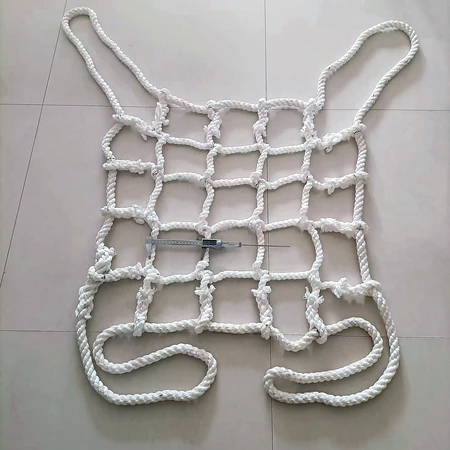
Cargo lifting net technical parameters
The table below puts the three constructions side by side. Values are our standard production range; anything outside it is built to drawing, and the rating that applies is the rating of the net as it is rigged, not the capacity of the crane above it.
| Parameter | Nylon rope net | Nett av ståltau | Nettnett |
|---|---|---|---|
| Materiale | 100% høyfast nylon (polyamid) multifilament | Galvanisert ståltau; rustfritt 304 / 316 på forespørsel | 100% høyfast polyester webbing; nylon or PP on request |
| Strand / bånd | 8 – 24 mm tau, 3-strand laid or 8 / 12-tråd flettet (opp til 32 mm på forespørsel) | 6 x 19 for abrasion, 6 x 37 / 6 x 36WS for flexibility; 6 – 20 mm; FC or IWRC | 50 mm webbing standard; 25 / 75 / 100 mm på forespørsel |
| Mesh åpning | 100 – 300 mm, firkant eller diamant | 150 – 400 mm, kvadrat | 100 x 100 mm kvadratisk standard; 50 – 300 mm på forespørsel |
| Ledd / lock | Netmaker’s knot, or knotless braided splice | Pressed aluminium ferrule at every intersection | Woven band crossings, stitched at the border |
| Grense | Doblet kanttau, spliced into the corners | Continuous border rope, ferrule-locked to the mesh | Double-layer stitched border round the full perimeter |
| Løftepunkter | 4 hjørne øyne; 8-punkt på forespørsel | Pressed corner eyes with thimbles, or rings / hovedlenker | 4 reinforced corner loops; 8-point and ring fittings on request |
| Nominell kapasitet | 1 t – 50 t | 2 t – 100 t | 2 t – 10 t standard; heavier to order |
| Sikkerhetsfaktor | 5:1 / 6:1 / 7:1 | 4:1 / 5:1 / 6:1 | 7:1 |
| Forlengelse | ca. 18 – 22% i pausen – absorbs shock load | Veldig lavt – the mesh keeps its shape under steady load | Lav, ca. 7% ved grensen for arbeidsbelastning |
| Slitasje og kutt | God; a single damaged strand can be replaced locally | Høyest av de tre | God, but must be kept off sharp edges |
| Korrosjon | Rot-proof; suited to wet and salt-water duty | Galvanised as standard; stainless for marine and chemical service | Rustfri polyester, UV stabilisert |
| Arbeidstemperatur | -40 C til +80 C | Hot and dirty service – confirm the duty with us | -40 C til +100 C |
| Farge | Hvit, or dyed to order | Galvanisert / stainless finish | Orange high-visibility, blå, svart, grønn eller tilpasset |
| Sertifisering | CE, GS, ISO 9001; test report per net | CE, ISO 9001; CNAS and DNV certified facility | CE, GS, ISO 9001; test report per net |
Net size and rated capacity
Standard sizes are listed below. Lastebil seng, container, hold and spreader dimensions are made to drawing, and the capacity quoted is the capacity of the finished net, tested before dispatch.
| Netto størrelse (L x W) | Typisk kapasitet | Typisk bruk |
|---|---|---|
| 2.0 x 2.0 m | 1 t – 3 t | Trommer, maskindeler, små komponenter |
| 2.5 x 2.5 m | 2 t – 5 t | Pallert og pakket last, containerlasting |
| 2.5 x 6.0 m | 4 t – 10 t | Lang last, rørbunter, lasting av lastebil og tilhenger |
| 4 x 4 ft (1.2 x 1.2 m) | 2 t – 3 t | Små laster, trommer, maskindeler (imperial markets) |
| 82 x 82 i | 2 t – 5 t | Standard pallefotavtrykk i keiserlige markeder |
| 6.0 x 6.0 m | 10 t – 25 t | Bulkbagasje, tømmer, skrap |
| 8.0 x 8.0 m | 25 t – 50 t | Heavy bulk, stein, quarry and demolition work |
| Bygget for å tegne | 1 t – 100 t | Lastebil seng, container, hold and spreader beam dimensions |
Mesh åpning: choose it from the smallest dimension of the cargo
Mesh is the parameter buyers most often get wrong, because it is chosen from the net size instead of from the load. The rule we apply is simple: the aperture must be smaller than the smallest dimension of the smallest piece that must not escape. The table below is the guide we use on quotation.
| Smallest cargo dimension | Cargo example | Mesh to specify |
|---|---|---|
| Under 50 mm | Bottles, small castings, nuts and bolts, components in bulk | 50 mm – closed or near-closed bag form |
| 50 – 100 mm | Murstein, bagged fertiliser, eske varer, FIBC big bags | 100 mm |
| 100 – 200 mm | Trommer, kartonger, split stone, saget tømmer | 150 – 200 mm |
| Over 200 mm | Blokker, logger, skrap, rivningsrester | 250 – 300 mm, eller 400 mm in wire rope |
Lifting configuration and how the rating is stated
A cargo lifting net is rated as an assembly. The same net gives a different rating for a four-point vertical lift, a two-point lift and an eight-point lift from a spreader beam, because the number of load-bearing corners changes. Every net we supply is therefore labelled with its working load limit and, where a net is used in more than one arrangement, each arrangement is listed separately on the label. Quote the configuration you will actually use when you enquire – a rating copied from a catalogue without the configuration is not a rating.
Nylon rope cargo lifting net
EN nylon lastløftenett is knotted or braided from high-tenacity nylon rope. Each strand can move slightly inside its knot, so the net settles around an irregular stack instead of sitting on top of it, and nylon’s high elongation absorbs the shock when the crane takes up the slack. It is the usual choice for timber and logs, stein, trommer, dekk, scrap and any load whose shape shifts as it is lifted.
Rope is also the most repairable construction: a damaged strand can be re-knotted or re-spliced locally and the net re-inspected, which matters on a site where a net is working daily. For polypropylene rope in the same construction, se polypropylene rope cargo net sling.
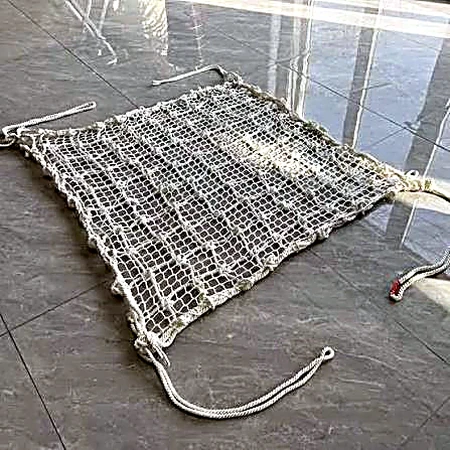
Steel wire rope cargo lifting net
A steel wire rope cargo lifting net is cross-woven from galvanised wire rope and locked at every intersection with a pressed aluminium ferrule, so the mesh cannot open up or distort when the net is dragged across a quay or a truck bed. Wire rope is the construction for abrasion, skarpe kanter, hot surfaces and long service with little maintenance – quarry run, aggregater, rivningsrester, scrap and heavy bulk.
It is the heaviest of the three and the least forgiving to finished surfaces, so it is normally specified where the cargo is rough. Where a wire rope net has to handle dressed material, we supply the same construction with sheathed contact sections, using the rope from our ståltaustropper spekter.
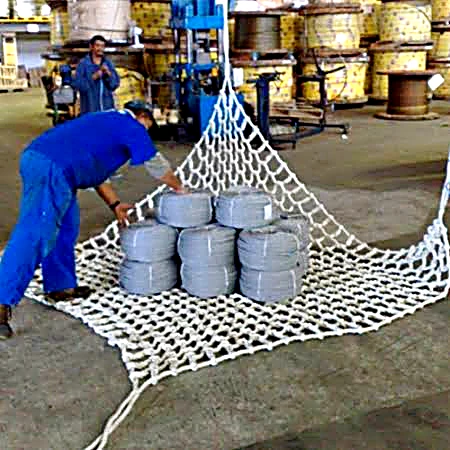
High-strength webbing cargo lifting net
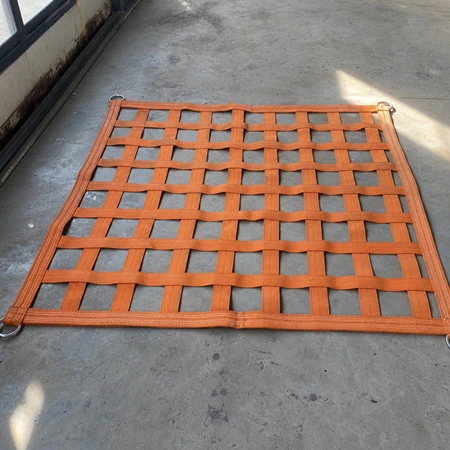
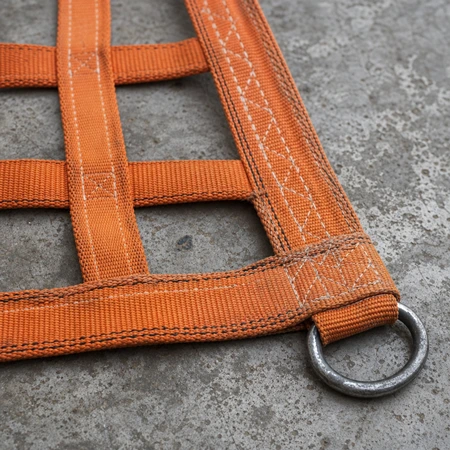
A high-strength webbing cargo lifting net is woven from flat polyester webbing. Båndene krysser i rette vinkler for å danne et åpent firkantet nett, the border and corners take the load, og hele nettet er mykt nok til å sitte mot poser, eske, malt eller bearbeidet last uten merking. It carries the widest bearing face of the three constructions at the lowest net weight, which is why it is the default for palletised, bagged and unitised cargo in ports, on trucks and on site cranes.
Polyester has low elongation, so the mesh keeps its shape while the crane takes up the slack and the load stays square. The webbing is woven in our own mill, which is why band width, farge, mesh and capacity can be tuned to the load instead of bought in from a catalogue. It is the same webbing used in our båndslynger og endeløse runde slynger, so a net and a sling on the same lift are matched in elongation and colour coding.
How a cargo lifting net is rigged
- Four-point lift from a single hook. The four corner loops are gathered onto the hook or a master ring, so the net closes around the cargo as the crane takes up. This is the standard arrangement for bagged, palletised and unitised loads.
- Eight-point lift from a spreader beam. The net stays square and the load stays level, which is what a long or wide consignment needs. Vår løftende spredebjelke takes the eight points and keeps the legs vertical.
- Poseform. A closed three-dimensional net for loose goods that must not escape – murstein, split stone, bottles, small castings.
- Flat net, cargo inside the mesh. For palletised, bundled or unitised loads that only have to be held together during the transfer.
Uansett arrangement, load must go into the corners and the border. Three habits destroy nets faster than any cargo: loading the middle of a panel, dragging the net sideways with the crane, and lifting on fewer than the full set of lifting points.
What we need to quote a cargo lifting net
| Informasjon | Hvorfor det betyr noe |
|---|---|
| Lastvekt og lastform | Sets the rated capacity and the number of load-bearing strands or bands under the cargo |
| Netto lengde x bredde | The net must be larger than the load footprint so the cargo sits inside the mesh, ikke på toppen av det |
| Mesh åpning | 100 x 100 mm is our webbing standard; smaller or loose items need a smaller aperture |
| Strand diameter or band width | Sets strength and net weight; band width also sets the bearing face on the cargo |
| Løftepunkter | Four corners as standard, or eight points and rings for a spreader beam |
| Kran, krok eller spreder | Determines whether the corners carry eyes, ringer, shackles or thimbles |
| Miljø | UV, saltvann, offshore or high-temperature duty decides the material and the treatment |
| Dokumentasjon | CE-merking, testrapport, declaration of conformity or own-brand labels |
Undersøkelse: what to check and when to retire a net
Inspect before every lift and record a formal inspection at the interval your site requires. Check the corner loops and the corner stitching first – that is where wear starts – then work round the border and the mesh.
| Check | Retire the net if |
|---|---|
| Corner loops and corner stitching | Stitching is broken, the loop is deformed, or the ring / thimble is cracked or worn |
| Grense | The border rope or border band is cut, unravelled or pulled out of the mesh |
| Strands or bands | Any load-bearing strand or band is cut, deeply abraded, heat-glazed or chemically stained |
| Knots and ferrules | A knot has slipped, or a ferrule is cracked, displaced or corroded through |
| Webbing | Bands are cut, powdered by UV, or contaminated with oil, paint or chemicals that cannot be removed |
| Labels | The capacity label is missing or illegible – an unlabelled net cannot be rated |
Never repair a net by knotting a broken strand, welding a wire rope or heating a band. Repairs belong to the maker or to a competent person using the original materials, followed by a re-test where the standard requires it. Store nets clean, dry and off the ground, ute av direkte sol.
Where cargo lifting nets are used
| Sektor | Hva nettet gjør |
|---|---|
| Havner og terminaler | Beholderstopping og de-stuffing, palletised and bagged cargo, quay and hold work with a net that is soft, rust-free and easy to fold |
| Steel and fabrication | Tallerkenpakker, bunter, machined parts and stillage loads where the surface must not be marked |
| Stein, quarry and aggregates | Split stone, blokker, cobbles and abrasive bulk; wire rope where cut resistance decides the service life |
| Tømmer og skogprodukter | Logger, sawn packs and poles – a rope net settles around an irregular stack as it is lifted |
| Offshore and marine | Deck and over-the-side transfer; nylon and polyester drain freely and do not rust |
| Agriculture and bulk bags | Fertiliser, korn, seed and feed in bags and big bags, lifted whole without repacking |
| Recycling and scrap | Mixed and abrasive scrap, where a wire rope net outlasts a textile one |
| Vehicle and plant loading | RoRo and breakbulk loading, where a wide net spreads the load across the body and chassis; se vår kjøretøys løftenett spekter |
Two neighbouring ranges are often quoted with a lifting net: heavy duty truck cargo nets og container cargo nets for securing rather than lifting, og sikkerhetstaunett where the net protects people instead of holding cargo. Tell us which duty applies and we will confirm the construction – a securing net is not rated for lifting, and a lifting net is not a fall-arrest product.
Ofte stilte spørsmål
What is the difference between a cargo lifting net and a cargo net?
A cargo net is a general term that covers lashing, securing and climbing nets as well as lifting nets. A cargo lifting net is a rated assembly: it is designed for a stated working load limit, testet, labelled and supplied with documentation. If a net has no capacity label, treat it as a securing net and never lift with it.
How do I choose between nylon rope, wire rope and webbing?
Ujevn, hot or abrasive bulk points to steel wire rope. Cargo that must not be marked points to webbing. Irregular loads that have to settle into the net, and wet deck work, point to nylon rope. Where two of those apply at once, tell us and we will recommend the construction with the trade-off made explicit.
What safety factor should I specify?
Our standard ranges are 5:1, 6:1 og 7:1 for rope and webbing nets and 4:1 til 6:1 for wire rope nets. The factor must satisfy the standard your site works to, so confirm it at enquiry rather than assuming the lowest option is acceptable.
Can a cargo lifting net be made to my size and mesh?
Ja. Størrelse, mesh, strand diameter or band width, number of lifting points, colour and capacity are all made to order, inkludert lastebilseng, container, hold og spreder dimensjoner. Send a drawing or the internal dimensions of the space the net has to work in.
Will the net hold loose material such as bricks or split stone?
Ja, in bag form with the correct mesh. The aperture must be smaller than the smallest piece, and the net must be closed on all sides. Where material is very fine or very sharp, we will normally propose a smaller mesh in a heavier construction.
Can the net be used in a marine or offshore environment?
Ja. Polyester and nylon nets are UV stabilised and rust-free, wire rope nets can be supplied galvanised or in stainless steel, and all three drain freely on deck. For offshore duty, tell us the salt-spray exposure and the inspection regime so the material and coating are matched to it.
Is a test certificate supplied with each net?
Ja. Each net leaves the plant with a capacity label and a material test report, and our facility holds CNAS, CE og ISO 9001 sertifisering. Etiketter av eget merke, printed markings and declarations of conformity are available on OEM orders.
Hva er minimum bestillingsmengde?
There is no fixed minimum for standard constructions – a single net for a trial is possible, and batch quantities can combine mixed sizes and mixed constructions in one order. Mixed pallets are also acceptable where the export packing allows it.
How is a cargo lifting net packed for export?
Folded and strapped with the label and test report attached, then bag or crate packed as agreed. Export packing is built to survive sea freight, and nets can be supplied with a repair kit and a spare corner loop where the customer maintains its own fleet.
Can you print our logo or brand on the net?
Ja. We weave and print webbing in house, so brand names, capacity text, fleet numbers and colour coding can be incorporated in the net rather than added as a tag. Send the artwork with the enquiry.
Why buy cargo lifting nets from Lift Sling Rigging Company
- 40 år med produksjon av løfteutstyr – grunnlagt i 1985 i Taizhou, Jiangsu, med mer enn 200 employees and one of China’s largest sling and net production bases.
- We weave our own webbing and make our own rope nets – båndbredde, farge, mesh og kapasitet er under vår kontroll, so a net is tuned to the load instead of being bought in from a catalogue.
- Own testing laboratory and a 1000 t horisontal testmaskin – breaking load is tested per net and documented; the facility holds CNAS, CE and DNV certification and 15 autoriserte patenter.
- Én leverandør for hele lasteutvalget – lastløftenett, båndslynger, runde slynger, ståltaustropper, spreader beams, nylon tau, kabeltrekkende sokker and safety nets.
- OEM og ODM – own-brand labels, trykt webbing, tilpassede farger og eksportpakning for distributører og sluttbrukere.
Request a cargo lifting net quotation
Send the load weight and shape, nettostørrelsen, nettingåpningen, the lifting points and the environment – or a drawing of the truck bed, beholder eller hold nettet må passe. Our engineers will confirm the construction, den nominelle kapasiteten, the strand or band size and the packing, og siter i ett svar. For å snakke gjennom det først, kontakt våre ingeniører; vår certification and test records er tilgjengelig på forespørsel.
Lift Sling Rigging Company
Lifute Industripark, Taizhou by, Jiangsu-provinsen, Kina
Tlf: +86 523 8693 5818 | WhatsApp: +86 180 6600 2268 | E-mail: lift98@jslift.com
HS-kode: 630790