

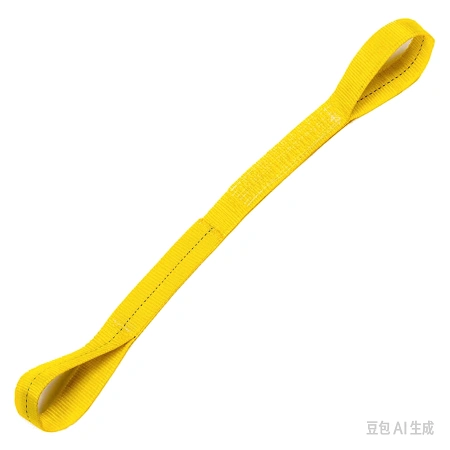
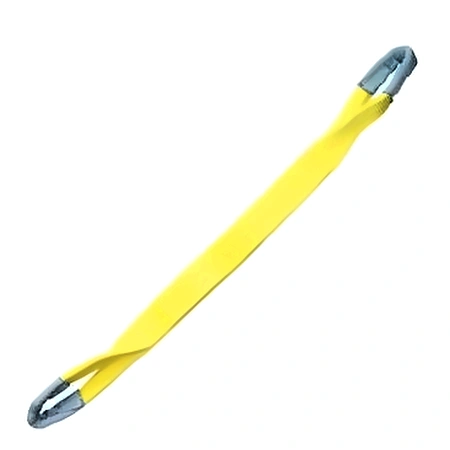
Lift sling rigging company produce Polyester Flat Eye & Oogwebslinger,Platte oog-tot-oog polyester websling,Eye and Eye Web Slings (Plat oog of gedraaid oog).
Webbing Sling · Eye and Eye
Polyester plat oog & Oogwebslinger
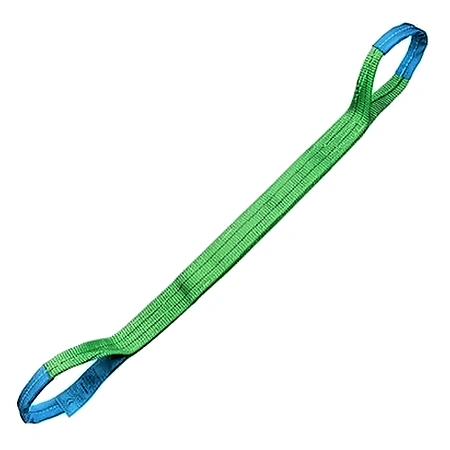
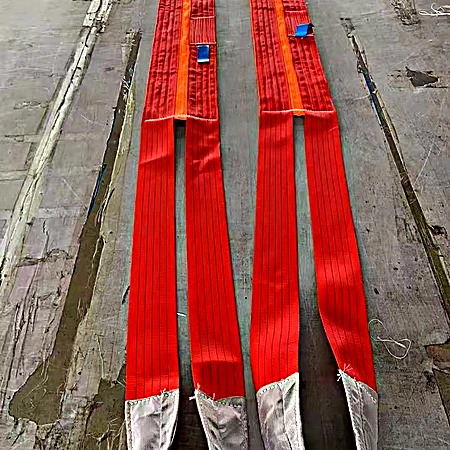
A polyester flat eye & eye web sling is the most direct answer to a simple question: where does the sling attach? Two folded, stitched eyes at each end sit straight on the hook, the shackle or the master link, and the distance between them is fixed at the length you ordered. No wrapping, no threading, no adjustment on site. Made from 100% polyester met hoge sterktegraad webbing in a flat band 25–300 mm breed, beoordeeld 1 t naar 24 T working load limit and built to IN 1492-1 met een 7:1 design factor. Where the lift is planned and repeated — a mould, a precast unit, a bundle that lands in the same cradle every time — this is the sling the method statement is written around.
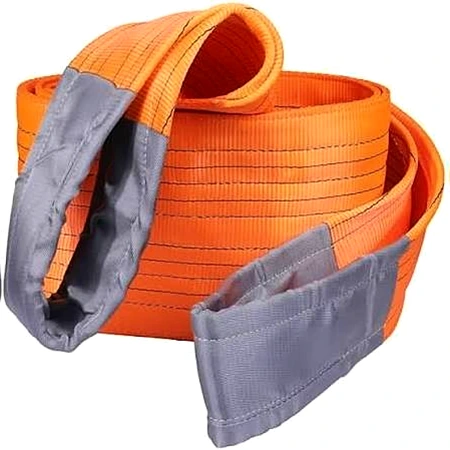
Twee ogen, one fixed length
The eye and eye form does one thing the endless sling cannot: it declares where the sling attaches. Dat is belangrijker dan het klinkt. On a planned lift the rigger does not choose a hitch, he executes one, and a sling with two defined pick-up points makes the geometry of the lift repeatable — the same angle, the same leg length, the same headroom, every cycle.
It also makes the sling’s condition visible. An eye is a discrete component: you can look at the fold, the stitching rows and the hook contact zone in one glance, and condemn it on evidence rather than on the average condition of a two-metre band.
The trade-off is that everything is decided at order time — the working length, the eye length and the ply. Get the length convention wrong and the sling arrives either short and unusable or long and out of headroom. Both are avoidable, and both start with the two numbers below: the length convention, and the eye length that clears your hook.
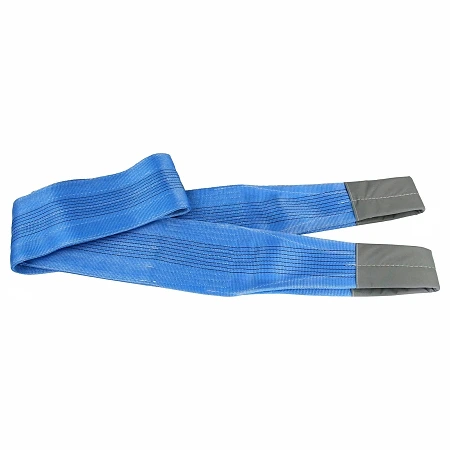
Flat eye or twisted eye?
Both ends of an eye and eye sling carry a sewn eye. The difference is the plane the eye sits in, and it decides how the sling sits on a hook. It is the first specification question on almost every enquiry.
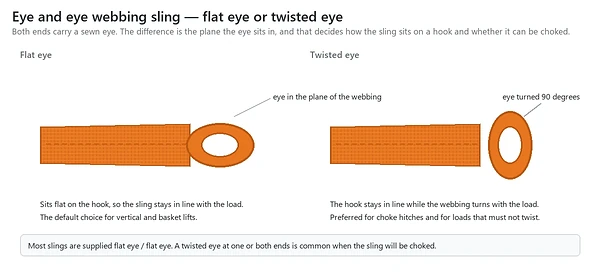
| Eigendom | Plat oog | Twisted eye |
|---|---|---|
| Eye plane | In the plane of the webbing | Turned 90° to the webbing |
| Aan de haak | Lies flat on the hook seat; the band stays in line with the load | Hook stays in line while the band turns with the load |
| Beste voor | Vertical and basket lifts, loads that must not rotate | Choker hitches, and loads that would otherwise twist the band |
| Common supply | Standaard, both ends | One or both ends, op aanvraag |
| Opmerking | Wider seating on the hook, less eye wear | Keep the twist out of the bearing area; check the eye fold more often |
Most slings ship flat eye at both ends. A twisted eye at one or both ends is specified when the sling will be choked, or when the load must stay square to the hook. Mixed configurations — flat one end, twisted the other — are a normal build, not a special.
Technische specificatie
| Parameter | Specificatie |
|---|---|
| Product | Polyester flat eye & eye web sling / flat eye to eye polyester web sling / eye and eye webbing sling |
| Standaard | IN 1492-1, 7:1 serie; ALS 1353 referenced for Australian supply |
| Materiaal | 100% polyester met hoge sterktegraad (PES); polyamide en polypropyleen op aanvraag |
| WLL-bereik | 1 T - 12 t single ply standard; 2 T - 24 t dubbellaags; multi-ply up to 50 t op aanvraag |
| Ontwerpfactor | 7:1 twee EEN 1492-1; 6:1 En 8:1 engineered to specification |
| Singelband | 7.5 mm enkellaags; 2 × 7.5 mm (15 mm) dubbele laag; breedte 25 – 300 mm |
| Oog lengte | 300 – 900 mm standaard, measured with the eye pulled flat; longer eyes to order |
| Working length | Effectieve werklengte (EWL) 0.8 – 3 standaard, custom to 200 M; tolerance ±3% |
| Eye build | Folded eye, multi-row lock stitching across the full band width; reinforced eye with inner sleeve available |
| Verlenging | Max 3% bij WLL; max 10% at breaking load |
| Temperatuur | −40 °C tot +100 °C (polyester) |
| Markering | IN 1492-1 capacity colour, one black stripe per tonne, genaaid label met WLL, lengte, materiaal, standaard, maker and batch |
| Documentatie | Batch MTC, type-test reports and Declaration of Conformity; CE to 2006/42/EC on the 7:1 serie |
| Verpakking | PE bag, karton, pallet; matched sets packed and labelled as a set |
Standaard maten
Pick by the vertical WLL, then read across for the eye length that fits your hook or shackle. Single ply is 7.5 mm polyesterband; double ply is two plies sewn into a 15 mm composiet, giving more capacity at the same width and a band that resists cutting better.
| Model | Laag | Kleur | WLL verticaal | WLL-choker | WLL-mand | Breedte | Oog lengte | Minimale lengte |
|---|---|---|---|---|---|---|---|---|
| EWE-1T | Enkel | Violet | 1,000 kg | 800 kg | 2,000 kg | 30 mm | 300 mm | 0.8 M |
| EWE-2T | Enkel | Groente | 2,000 kg | 1,600 kg | 4,000 kg | 60 mm | 300 mm | 1 M |
| EWE-3T | Enkel | Geel | 3,000 kg | 2,400 kg | 6,000 kg | 90 mm | 350 mm | 1 M |
| EWE-4T | Enkel | Grijs | 4,000 kg | 3,200 kg | 8,000 kg | 120 mm | 500 mm | 1.5 M |
| EWE-5T | Enkel | Rood | 5,000 kg | 4,000 kg | 10,000 kg | 150 mm | 550 mm | 1.5 M |
| EWE-6T | Enkel | Bruin | 6,000 kg | 4,800 kg | 12,000 kg | 180 mm | 600 mm | 1.5 M |
| EWE-8T | Enkel | Blauw | 8,000 kg | 6,400 kg | 16,000 kg | 240 mm | 700 mm | 2 M |
| EWE-10T | Enkel | Oranje | 10,000 kg | 8,000 kg | 20,000 kg | 300 mm | 800 mm | 2 M |
| EWE-12T | Enkel | — | 12,000 kg | 9,600 kg | 24,000 kg | 300 mm | 900 mm | 2 M |
| EWED-2T | Dubbele | Groente | 2,000 kg | 1,600 kg | 4,000 kg | 30 mm | 350 mm | 1.5 M |
| EWED-4T | Dubbele | Grijs | 4,000 kg | 3,200 kg | 8,000 kg | 60 mm | 400 mm | 1.5 M |
| EWED-6T | Dubbele | Bruin | 6,000 kg | 4,800 kg | 12,000 kg | 90 mm | 450 mm | 1.5 M |
| EWED-8T | Dubbele | Blauw | 8,000 kg | 6,400 kg | 16,000 kg | 120 mm | 500 mm | 2 M |
| EWED-10T | Dubbele | Oranje | 10,000 kg | 8,000 kg | 20,000 kg | 150 mm | 550 mm | 2 M |
| EWED-12T | Dubbele | — | 12,000 kg | 9,600 kg | 24,000 kg | 180 mm | 600 mm | 3 M |
| EWED-16T | Dubbele | — | 16,000 kg | 12,800 kg | 32,000 kg | 240 mm | 700 mm | 3 M |
| EWED-20T | Dubbele | — | 20,000 kg | 16,000 kg | 40,000 kg | 300 mm | 800 mm | 3 M |
| EWED-24T | Dubbele | — | 24,000 kg | 19,200 kg | 48,000 kg | 300 mm | 900 mm | 3 M |
Boven 10 t de NL 1492-1 colour code no longer applies — the sewn label and the black stripes (één per ton) govern. Langere lengtes en hogere capaciteiten worden op bestelling gemaakt; multi-ply builds up to 50 t are quoted against the lift, not off a shelf.
Two-leg lifts: the arithmetic that decides the size
The label is a single-sling figure in a straight lift. Almost every eye and eye sling is used in a pair, and the pair changes the number. IN 1492-1 gives a mode factor for a two-leg assembly that already accounts for both legs: 1.4 with the legs up to 45° from vertical, En 1.0 tussen 45° en 60°.
| Beenhoek ten opzichte van verticaal | Factor | Wat het in de praktijk betekent |
|---|---|---|
| 0–45° | 1.4 | The normal working range. A 6 t load needs 2 × 5 t stroppen: 6 ÷ 1.4 = 4.3 t per slinger. |
| 45–60° | 1.0 | No capacity gain from the second leg at all — the same 6 t load now needs 2 × 6 T. |
| Enkel been, verticaal | 1.0 | Eén slinger, één been: the label figure, no reduction. |
| Enkel been, verstikte | 0.8 | The eye passes round the load and back through itself or through the hook. |
Uitgewerkt voorbeeld
A 6 t mould lifted on two eye and eye slings with the legs at 30° from vertical: 6 t ÷ 1.4 = 4.3 t required per sling → EWE-5T (5 T, 150 mm band, 550 mm ogen). Open the legs to 55° and the same lift needs 6 t per sling → EWE-6T. The load has not changed; the rigging has. Ten degrees of leg angle bought a heavier sling, and that is exactly the conversation to have before the order, niet na.
Lengte: the number buyers get wrong
An eye and eye sling carries two length figures and only one of them is the lift. De effectieve werklengte (EWL) is the distance between the bearing points — inside of one eye to inside of the other, laid flat and unloaded. That is what determines headroom. Totale lengte includes both eyes, so it is longer than the EWL by roughly two eye lengths. A 2 m EWL-strop met 550 mm eyes measures about 3.1 m van begin tot eind.
IN 1492-1 holds the EWL to ±3% of nominal, measured with the sling laid flat on a tape graduated in millimetres. Op een 6 m sling that is 180 mm of permitted variation — which is why matched sets for multi-leg lifts are ordered as a set and stamped with their own length, rather than assembled from stock.
If you know the hook height above the load’s pick-up points, send that instead of a length. It is the number that actually constrains the lift, and it removes the ambiguity entirely.
Matched pairs and multi-leg assemblies
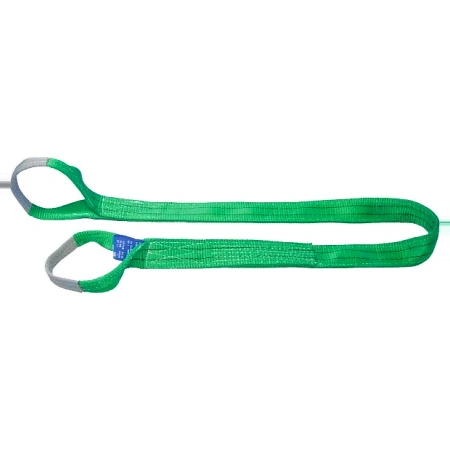
Two slings of nominally the same length can differ by up to 3% elk, in opposite directions. On a symmetric two-leg lift that is enough to put most of the load into one leg, and on a four-leg assembly it is enough to make one leg do nothing at all while another is overloaded — the classic reason a four-leg set is rated as a two-leg set off two legs.
- Order as a set — state the number of legs and the length once, and the slings are cut, sewn and measured together.
- Same ply, same eye length — a mixed set changes both the stretch and the geometry.
- Label the set — batch number and set number on every label, so a sling that comes back from repair can be matched to its partners.
- Check on arrival — lay the set flat together and compare bearing point to bearing point before the first lift.
Where these slings earn their keep
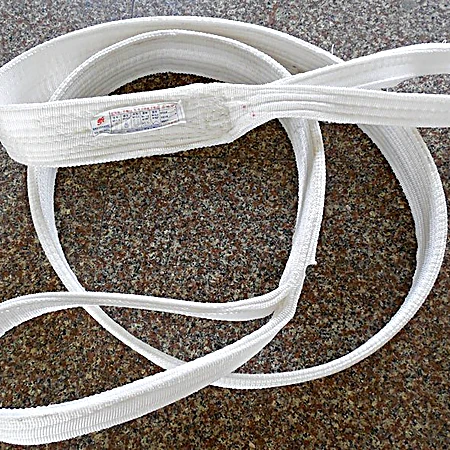
- Precast and concrete units — two eyes onto two lifting anchors or a spreader, wide band on the concrete face, no marking of the finish.
- Moulds, dies and tooling — a repeatable pick-up point that does not change between cycles.
- Machinery and skids — eyes straight onto hooks or shackles, no wrap that could slip on a painted surface.
- Stone and finished plate — flat band in a basket with sleeves, where a wire rope would leave a line.
- Containers and stillages — four-leg assemblies off a master link, ordered as a matched set.
For repetitive basket and choker work on the same load profile, een eindeloze type hijsband is the better article, because the wear rotates around the loop instead of staying at two eyes. On delicate or highly finished surfaces a ronde slinger conforms better still.
Inspectie: het oog is het deel dat als eerste faalt
Webbing rarely fails in the middle. It fails at the eye-to-body junction, where the load path turns through the fold and the stitching carries the whole rated load in shear. That junction gets the first thirty seconds of every inspection.
- Eye fold: bezuinigingen, beglazing, or a fold that has flattened and hardened. Withdraw it.
- Stiksels: broken or pulled threads, a stitch line that has started to unravel at the edge, or a seam that has elongated.
- Hook contact zone: the inside of the eye wearing thin where the hook sits. This is the highest-pressure point on the whole sling.
- Band: bezuinigingen, abrasion and chemical or heat damage along the full length, both faces.
- Label: legible WLL and length, and matching the lift plan. A sling without a readable label is out of service.
Never knot a sling, and never join two slings eye-to-eye through each other: that doubles the load on a single eye and puts the connection outside any rated configuration. Connect through the eye with a shackle sized to it. Houd de band plat en niet gedraaid, pad edges, and stay inside −40 to +100 °C.
Veelgestelde vragen
What is a flat eye and eye web sling?
A flat woven polyester sling with a sewn eye at each end, the eyes lying in the plane of the webbing. The eyes connect directly to hooks, shackles or master links and the working length between them is fixed at manufacture. Beoordeeld 1 t naar 24 t in het standaardbereik, 7:1 twee EEN 1492-1.
Flat eye or twisted eye — which do I need?
Flat eye for vertical and basket lifts and for loads that must not rotate; it sits flat on the hook and keeps the band in line with the load. Twisted eye when the sling will be choked, or when the load must stay square to the hook while the band turns. Mixed ends are a normal build.
Hoe wordt de lengte gemeten?
Effectieve werklengte: inside of one eye to inside of the other, laid flat and unloaded, held to ±3% by EN 1492-1. Overall length includes both eyes and is longer by roughly two eye lengths. If you know the hook height above the pick-up points, send that instead.
Can eye and eye slings be used in a choker?
Ja. Pass one eye through the other, or pass the sling round the load and hook both eyes. Capacity falls to 0.8 of the label figure, and a twisted eye is usually specified because the eye then sits correctly in the choke.
What is the difference from an endless sling?
Een eindeloze slinger heeft geen uiteinden: één lus, geen fittingen, and the wear rotates around it. An eye and eye sling has two defined pick-up points and a fixed length, so the lift geometry repeats exactly. Use eye and eye for planned lifts with hardware, endless for repeated basket and choker work.
Do you supply matched pairs and multi-leg sets?
Ja, and they should be ordered as a set rather than assembled from stock. Same ply, same eye length, measured together and labelled with a set number, so the legs share the load as designed.
Can it lift hot or sharp loads?
Polyester is rated −40 to +100 °C; above that use a heat-resistant or wire rope sling. Sharp edges need sleeves or corner pads — flat webbing cuts far more easily than a round sling.
Wat we moeten citeren
A polyester flat eye & eye web sling is made to the lift rather than picked off a shelf, so the first sample lands closer the more of these numbers you can give us.
- Load weight, shape and the pick-up points; number of legs and the leg angle
- Working length (EWL) or the hook height above the load — say which
- Eye length needed to clear the hook or shackle, and flat or twisted eye
- Single ply or double ply; colour code if a specific WLL band is required
- Mouwen, edge protection or reinforced eyes for abrasive duty
- Standaard, markering, documentation and destination market
Send your lift details for an eye and eye sling quotation
Telefoon / WeChat: +86 180 6600 2268 | E-mail: 702461526@qq.com
Adres: Industrieterrein Lifute, Taizhou-stad, Provincie Jiangsu, China