


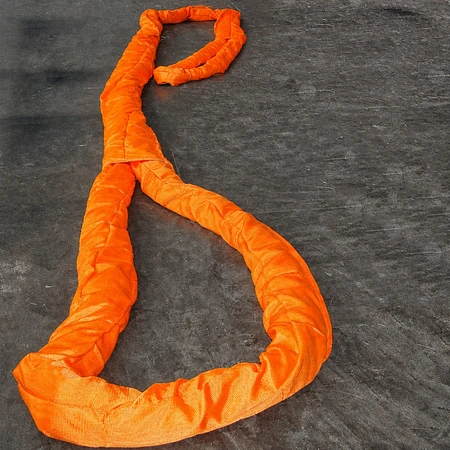
Lift sling rigging company produce WLL 300T Polyester Round Slings,300000kg Heavy Duty Round Lifting Sling,WLL 300T Heavy Duty Round Slings,WLL 300 Ton Endless Round Sling.
WLL 300T Polyester Round Slings
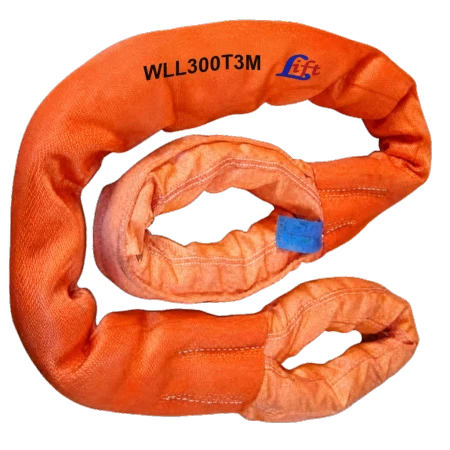
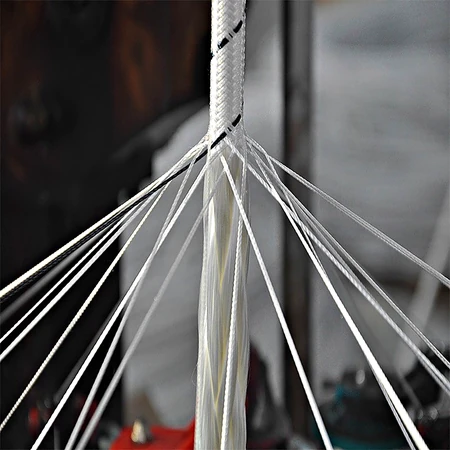
A WLL 300T polyester round sling is rated 300,000 kg on a single vertical leg, with a minimum breaking load of 2,100,000 kg at a 7:1 safety factor. The core is a continuous loop of high-tenacity polyester yarn, the sleeve is a heavy duty woven tube that takes the abrasion and carries the marking, and there is no metal anywhere in the load path.
At this size the sling is almost never bought on its own. It is bought as a set for one lift — and it is the set, not the individual sling, that the lift plan actually rates.
What 300 Tonnes Rates
The rating is one figure — 300,000 kg vertical. Everything else is that figure multiplied by a mode factor for the arrangement the sling is actually used in.
| Arrangement | Mode factor | Working load limit |
|---|---|---|
| Vertical | 1.0 | 300 t (300,000 kg) |
| Choked | 0.8 | 240 t (240,000 kg) |
| Basket, 0–7° | 2.0 | 600 t (600,000 kg) |
| Basket, 7–45° | 1.4 | 420 t (420,000 kg) |
| Basket, 45–60° | 1.0 | 300 t (300,000 kg) |
Basket figures apply per sling. Two 300 t slings in a 0–7° basket rate 1,200 t on paper, but the hook, master link or spreader beam above them decides what the lift can really be — check the rating on every item in the set, not just the slings.
Four Legs Are Not Four Times the Capacity
This is the number that gets misquoted on heavy lifts. Four 300 t slings do not lift 1,200 t. On a symmetric four-leg lift at 30°, the assembly factor is 2.1, so the set rates 630 t. The rest of the nominal capacity is not available, because the legs share load through geometry, not arithmetic.
| Configuration | Assembly factor | Set capacity | Per leg at the limit |
|---|---|---|---|
| 1 leg, vertical | 1.0 | 300 t | 300 t |
| 2 legs, 0–45° | 1.4 | 420 t | 210 t |
| 2 legs, 45–60° | 1.0 | 300 t | 150 t |
| 3–4 legs, 0–45° | 2.1 | 630 t | 158–210 t |
| 3–4 legs, 45–60° | 1.5 | 450 t | 113–150 t |
Two things follow. The angle matters more than the count: opening four legs from 30° to 55° costs 180 t of set capacity before anything else changes. And the factor assumes equal sharing — which only happens when the slings in the set are the same length and the pick-up points are level. That is what the next section is about.
A 300 Tonne Sling Is Bought as a Set
A matched set is not four slings ordered in one email. It means the following, and it is worth checking that the quotation actually says so:
- One production batch. Core yarn, sleeve and stitching from the same run, so the slings stretch comparably under load.
- One length, measured one way. Every sling in the set quoted to the same convention — lay-flat length or full circumference — and measured from it, with the figure on the label.
- Sequential serial numbers. Each sling proof loaded individually to 600,000 kg, with the result recorded against its own serial.
- One certificate. The set is listed as a set, so an inspector can trace any sling in it back to the lift it was bought for.
Order four slings across two orders and you have four slings, not a set. Topping a set up later with a single replacement has exactly the same problem: it will fit the hook, and it may not share the load the way the others do.
Stretch, Headroom and Load Share
Polyester extends roughly 2–3% at the working load limit. On a 20 m body that is 400–600 mm at rated load — enough to decide whether the hook block clears the load, and enough to be worth putting in the lift plan rather than discovering on the day.
In a matched set that stretch is the mechanism that shares the load — the legs extend until they carry equal tension. In a mismatched set the short sling reaches its share first and keeps taking more as the load comes on, so the set can fail below the total it was supposed to carry, while every label on every sling still reads 300 t. Length, not capacity, is the number to control on a repeated lift.
Technical Specifications
| Product | WLL 300T polyester round sling / 300 tonne endless round sling / 300,000 kg heavy duty round lifting sling |
|---|---|
| Standard | AS 4497:2018; EN 1492-2 and ISO 4878 on request |
| Working load limit (vertical) | 300,000 kg (300 t) |
| Minimum breaking load | 2,100,000 kg (7 × WLL) |
| Proof load | 600,000 kg (2 × WLL), applied to every sling |
| Safety factor | 7:1 |
| Configuration | Endless loop as standard; a round sling with eyes on request |
| Core | High-tenacity polyester parallel yarn, continuous loop |
| Sleeve | Heavy duty woven polyester, double layer; wear pads at the choke point on request |
| Elongation at WLL | Approx. 2–3% |
| Working temperature | −40 °C to +100 °C with a polyester core; an aramid round sling for hotter loads |
| Effective length | Made to order; every sling in a set measured to the same convention (3 m body shown above) |
| Marking | Sewn label: WLL in kg, effective length, standard, manufacturer, serial or batch; set identification on request |
| Packing | Coiled and strapped, poly-wrapped, labelled crate or pallet for export |
| HS code | 630790 |
Handling and Storage
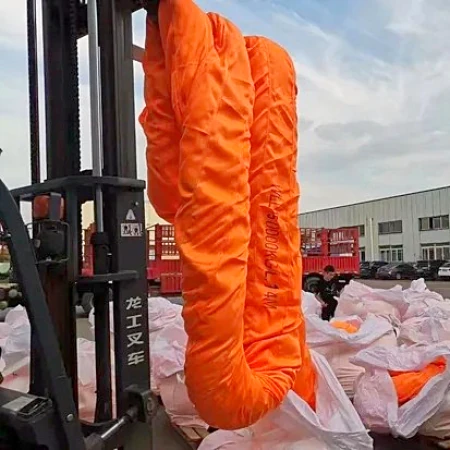
At 300 t the body is a machine-handling item. A working-length sling arrives as a coil that is moved with a forklift or a crane, and it stays on a pallet in the store rather than on the floor. Keep it dry, out of sustained sunlight, clear of acids and solvents, and never drag it across concrete to reposition it — the sleeve is the abrasion layer, and dragging spends it before the lift does.
Log the set, not just the slings: which lift it was bought for, when it was last inspected, and which serial has been withdrawn. It is the record that tells you whether a set is still a set.
Options and OEM
Polyester is the standard core; an aramid core for hot loads and a UHMWPE (Dyneema) core where the weight of the sling itself matters are both made to order at this capacity. Sleeve colour, wear pads, effective length, label layout including set identification, and packing are specified per order, and the same build can be repeated against the approval drawing for follow-on sets.
On size: below 300 t a 250 tonne round sling is often enough for the same lift plan, and above it the 400 tonne round slings only pay off when the set capacity is genuinely short — a larger sling that is never worked at its rating is bulk and freight for nothing. Where the load is flat or bundled rather than a single body, a heavy-duty webbing sling can sit better; the 40-tonne steel pipe lift shows the same trade-off at a smaller scale.
Frequently Asked Questions
How much can four 300 t slings lift together?
630,000 kg at 0–45° to vertical (factor 2.1) and 450,000 kg at 45–60° (factor 1.5) — not 1,200,000 kg.
What is the minimum breaking load?
2,100,000 kg at a 7:1 safety factor, with a 600,000 kg proof load applied to every sling before dispatch.
Can you supply a matched set with one certificate?
Yes — one batch, one length convention, sequential serials, individual proof records and a single set certificate.
How much does it stretch?
About 2–3% at WLL, which is 400–600 mm on a 20 m body. Allow for it in the headroom and in the lift plan.
Can I replace one sling in a set?
Only if it is matched to the others in length and construction. Otherwise replace the pair, or re-match the set against the original drawing.
Request a Quote for a 300 Tonne Set
Send the lift plan — load, centre of gravity, number of legs and angle, hook or shackle size, effective length and delivery port — and we will quote the set, the proof records and the certificate format together. सम्पर्क गर्नुहोस्: lift98@jslift.com · WhatsApp +86 180 6600 2268.