

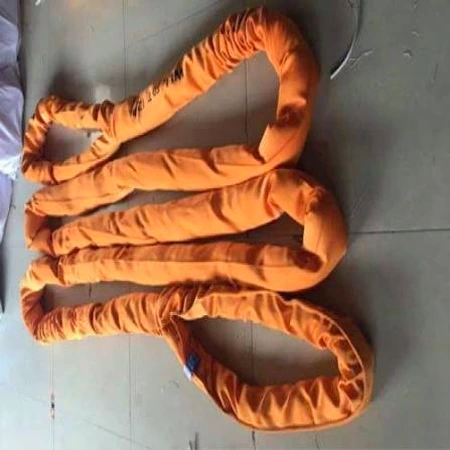
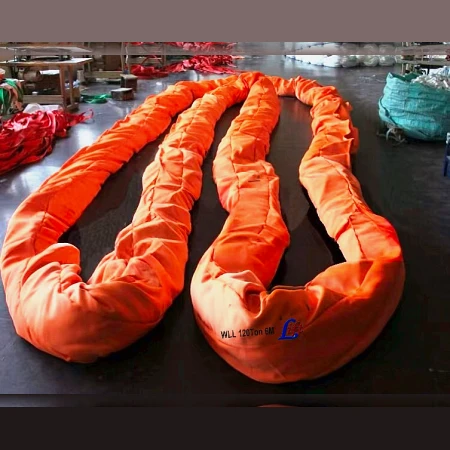

Lift sling rigging company manufacture Heavy Duty Round Sling,Heavy-Duty Lifting Strap,Double Sleeve Heavy Duty Round Soft Lifting Sling,High Performance Round Slings,Heavy Duty Endless Polyester Round Sling.
Polyester · 10–1000 tonne · 7:1
Heavy Duty Round Sling
A heavy duty round sling is not a scaled-up 3 t sling. From about 10 t upward the core becomes a dense parallel bundle, the sleeve moves to two layers, the body gets stiff enough to need two people, and the lift starts to be governed by the hook, the leg angle and the pressure on the load edge rather than by the sling alone.
We build them in high-tenacity polyester from 10 t to 400 t, with a 7:1 safety factor, proof loaded on our own test bed and marked with a serial number that carries its certificate. This page is about the engineering that changes at the heavy end — not the catalogue.
The Figure on the Label Is a Vertical Rating
Every published capacity for a round sling is the vertical, single-leg figure. Choked, basket and multi-leg arrangements are derived from it, and at the heavy end those multipliers move tens of tonnes rather than kilos. Two errors account for most of the misrigging we see on site.
The first is the basket angle. A basket only doubles the rating while the two legs stay close to vertical; by 45–60° the factor has fallen to 1.0, which means a 400 t sling in a steep basket picks 400 t, not 800 t. The second is the multi-leg assumption: two legs at 60° to the horizontal give 1.73 × the single-leg rating, not 2 ×, and four legs rarely share load evenly unless the geometry and the hook are built for it.
Size the sling from the load and the arrangement, then check the hook, the shackle and the lifting point against the same figure. On a 200 t lift the weak link is usually the attachment, not the sling.
Four Things That Change Above 50 Tonnes
1. The core becomes a bundle
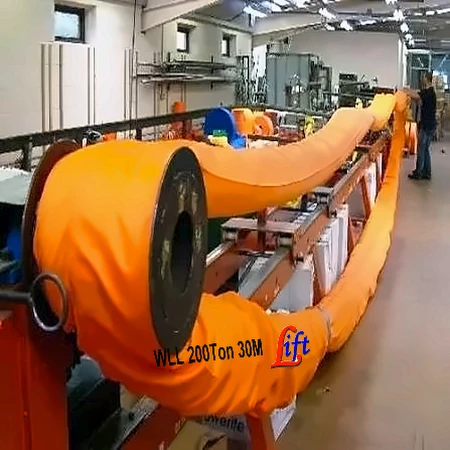
A 10 t core is a single dense lay of polyester filament. By 100 t it is a bundle that behaves like a rope under the sleeve, and by 200 t the body is broad enough that the sling will not fold into a hook without help. That is why heavy slings are ordered with a length that suits the hook height rather than cut on site.
2. The sleeve carries the wear
Double-layer woven polyester from 25 t upward, with wear pads where the body will bear on an edge. The sleeve protects the core from abrasion, UV and cutting, and it is the part that fails first. A worn sleeve on a 200 t sling is not cosmetic.
3. Weight changes the method
A 50 t sling is a two-person item. At 150 t and above, handling, coiling and hanging the sling on the hook become a rigging operation in their own right — plan for a second lift or a stand, and never drag a heavy body across a concrete floor.
4. Stretch becomes a dimension
Polyester elongates roughly 2–3% at working load. On a 10 m body that is 200–300 mm of travel; on a 30 m sling it approaches a metre. If the load has to clear an obstacle by a fixed margin, that travel belongs in the lift plan.
Bearing Pressure: the Number Most Quotes Skip
A capacity table tells you what the sling can hold. It says nothing about what the sling does to the load — or the load to the sling — at the contact patch.
Take a 200 t basket. Each leg carries 100 t. If the sleeve bears on 120 mm of width, that is roughly 0.8 t on every millimetre of sleeve, concentrated on a steel edge that may be sheared, burred or hot. Nothing in the sling’s rating prepares the sleeve for that; only edge protection and a wider bearing surface do.
Three practical measures, in order of effect: round or protect the edge, widen the contact with a softener or a spreader, and keep the bearing line away from welds, cut edges and drilled holes. On long heavy loads a lifting beam removes the pressure problem entirely by taking the horizontal component out of the sling.
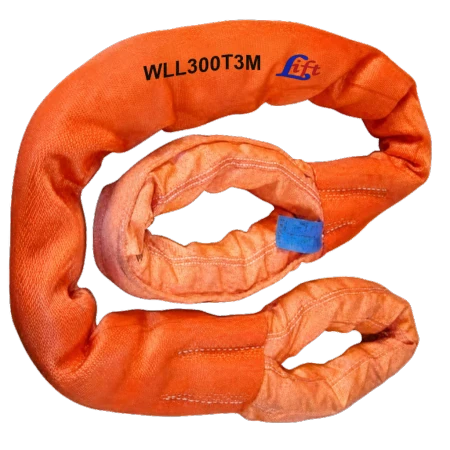
Specification Range
| Product | Heavy duty round sling, endless (continuous loop) |
|---|---|
| Core | High-tenacity polyester (PES) multifilament, parallel lay, waxed |
| Sleeve | Woven polyester; double-layer from 25 t; wear pads and reinforced eyes on request |
| Working load limit | 10–400 t: 10 · 15 · 20 · 25 · 30 · 40 · 50 · 60 · 80 · 100 · 150 · 200 · 250 · 300 · 400 t |
| Safety factor | 7:1 as standard (EN 1492-2 practice); other factors to order |
| Standard | EN 1492-2 and ASME B30.9 construction practice |
| Elongation at WLL | Approx. 2–3% |
| Service temperature | −40 °C to +100 °C |
| Length | 0.5–30 m standard; longer bodies quoted individually |
| Colour | Orange as standard; other colours and colour-coded capacities to order |
| Marking | Sewn label: WLL, length, serial number, standard, date; printed sleeve marking optional |
| Testing | Proof loaded per batch before dispatch; certificate against the serial number |
| Packing | Coil in poly bag; crate or pallet from 150 t |
| MOQ & OEM | Low MOQ for trial; OEM on capacity, length, sleeve, colour, label and packing |
Capacity at the Heavy End
| WLL vertical | Choked ×0.8 | Basket 0–7° ×2.0 | Basket 7–45° ×1.4 | Basket 45–60° ×1.0 |
|---|---|---|---|---|
| 10 t | 8 t | 20 t | 14 t | 10 t |
| 20 t | 16 t | 40 t | 28 t | 20 t |
| 30 t | 24 t | 60 t | 42 t | 30 t |
| 50 t | 40 t | 100 t | 70 t | 50 t |
| 80 t | 64 t | 160 t | 112 t | 80 t |
| 100 t | 80 t | 200 t | 140 t | 100 t |
| 150 t | 120 t | 300 t | 210 t | 150 t |
| 200 t | 160 t | 400 t | 280 t | 200 t |
| 250 t | 200 t | 500 t | 350 t | 250 t |
| 300 t | 240 t | 600 t | 420 t | 300 t |
| 400 t | 320 t | 800 t | 560 t | 400 t |
Choked capacity assumes a single choke with the body free to adjust. Two chokes on the same sling do not double the figure — the second choke reduces it.

How the Heavy End Is Tested
Every batch is proof loaded before it leaves, and the certificate is issued against the serial number on the sewn label — not against the order. That matters when a sling is re-certified, transferred between sites or inspected by a third party: the number on the label has to lead back to a test record.
On receipt, check three things before the sling goes into service: the label matches the certificate, the sleeve is intact along the full bearing length, and the body is the length ordered. Length is measured as the loop circumference — the effective working length — not as the folded body.
For lifts that combine heavy loads with heat, polyester is the wrong fibre. The para-aramid heavy duty round sling covers the same capacity logic with a 300 °C continuous rating, at a higher cost per tonne.
Selecting a Heavy Duty Sling: Three Questions
- What is the load, and how is it rigged? Start from the weight and the arrangement, apply the mode factor, and only then pick the capacity. If the pick-up points are fixed and repeated, a round sling with eyes gives a defined length; if the load is awkward, the endless body is more useful.
- What is the surface? Sheared plate, burred edges and abrasive castings attack the sleeve. Budget for edge protectors and inspect after every lift on that kind of load; on long heavy items, consider a beam instead of a tighter angle.
- How will it be handled and stored? Weight, coil diameter and hook height decide the length you should order. A sling that is awkward to hang will be dragged, and dragging is what retires heavy slings early.
Where weight rather than capacity is the constraint — a long lift at modest tonnage — the Dyneema round sling carries the same load in a lighter body. The full round sling range covers standard capacities from 1 t upward.
Inspection Points That Actually Matter
- Sleeve along the bearing line. Cuts, glazing, compaction and exposed core. On a heavy sling the sleeve is a wear part; judge it over the full contact length, not at the label.
- Stitching and eyes. Reinforced eyes and wear pads are where load concentrates. Loose or broken stitching takes the sling out of service.
- Label and serial. If the WLL, length or serial cannot be read, the certificate cannot be matched and the sling cannot be verified.
- Contamination. Polyester tolerates water and most oils but not strong acids or sustained UV. Store coiled, off the floor, out of sunlight.
- After an incident. Any shock load, dropped load or lift that exceeded the rating retires the sling pending inspection — not a visual check at the hook.
Frequently Asked Questions
What makes a round sling heavy duty rather than standard?
Above roughly 10 t the construction changes rather than just scaling up: the polyester core becomes a dense parallel bundle, the sleeve moves to two layers with reinforced stitching, the body gains weight and stiffness, and the sling is proof loaded and certified as a heavy-capacity item. The label, the test record and the sleeve build are what separate a heavy duty sling from a standard one.
What does a 7:1 safety factor mean in tonnes?
The working load limit is one seventh of the minimum breaking load. A 100 t sling is built to break above 700 t, a 200 t sling above 1,400 t and a 400 t sling above 2,800 t. The factor covers dynamic effects and wear over the service life, and it is the reason the vertical rating — not the fibre strength — governs the lift.
Can you supply 200 t and 400 t slings with test certificates?
Yes. Slings up to 400 t are built to order and proof loaded on our test bed before dispatch, with the test record and certificate issued against the serial number on the label. Lengths to 30 m are standard at that capacity; longer bodies and multi-leg assemblies are quoted individually.
Polyester or aramid for a heavy lift in a hot area?
Polyester is the correct choice for ambient temperature work: it is cheaper, tolerant of abrasion and UV, and available to 400 t. Above roughly 100 °C the polyester core is outside its range, and the lift moves to the para-aramid heavy duty round sling, which carries a 300 °C continuous rating at a higher cost.
How much does a heavy duty round sling stretch under load?
Elongation at working load is roughly 2–3% for a polyester round sling. On a 10 m body that is 200–300 mm, and on a 30 m sling it can approach a metre. That travel has to be allowed for in the hook height and in any lift where the load has to clear an obstacle by a fixed margin.
Send the Load, the Configuration and the Hook Height
That is enough to specify the capacity, the sleeve build and the length, and to confirm what can be certified. Test records and certificates are issued against the serial number on every heavy-duty body.
Related Products