

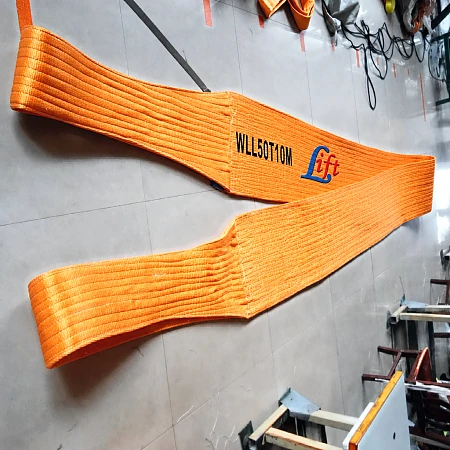
Lift sling rigging company produce 15 Ton Webbing Slings,WLL 15T 15000kg Polyester Webbing Slings, Heavy Duty Flat Lifting Sling,15 ton flat lifting webbing, 15T Flat Web Sling ,15 ton Polyester Webbing Sling,15tonne Endless Webbing Sling,15 Tons Polyester Webbing Lifting Sling,15 Ton Duplex Web Sling.
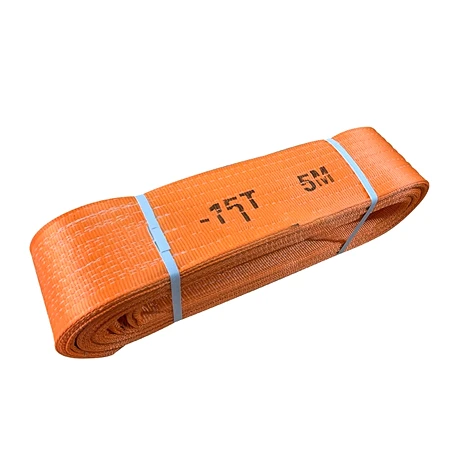
Technical parameters
Standard build shown. Anything in the last row can be changed, but it has to be changed before the band is woven.
| Product | WLL 15T 15000kg polyester webbing sling, flat eye and eye |
|---|---|
| Webbing | 100% high-tenacity polyester (PET), 180 mm, duplex two-ply, approx. 4 mm thick |
| Kev txwv thauj khoom ua haujlwm | 15,000 kg (15 t) per sling, vertical mode |
| Safety factor | 7:1 — 105,000 kg minimum breaking load |
| Proof test | 30,000 kg (2 × WLL), certificate and test report with every sling |
| Elongation | 7% or less at the working load limit |
| Bearing load | Approx. 833 kg per cm of band width at the working load limit |
| Ntev | 1–20 m eye to eye; matched lengths within ±50 mm across a set |
| Ends | Reinforced flat eye, flat or twisted, eye length matched to the hook or shackle bowl |
| Weight | Approx. 0.75 kg per metre; 3.8 kg at 5 m, 7.5 kg at 10 m |
| Working temperature | −40 °C to +100 °C; melting, not softening, above the limit |
| Colour | Orange as standard, white on request; no colour code applies above 10 t |
| Marking | Sewn label plus printed band: WLL, length, mode factors, standard, batch, date |
| Standard | EN 1492-1; AS 1353 and ASME B30.9 builds on request |
| Options | 150 mm three-ply build, sleeved band, wider body, printed logo, own label |
The rating is per hitch — 15 t is only the vertical figure
One sling, one marked figure, eight different answers on site. Multiply the marked 15,000 kg by the factor for the arrangement actually rigged:
| Arrangement | Factor | Capacity of one 15 t sling |
|---|---|---|
| Vertical | 1.0 | 15,000 kg |
| Choked | 0.8 | 12,000 kg |
| Basket, legs 0–45° | 2.0 | 30,000 kg |
| Basket, legs 45–60° | 1.4 | 21,000 kg |
| Two legs, 0–45° | 1.4 | 21,000 kg |
| Two legs, 45–60° | 1.0 | 15,000 kg |
| Three or four legs, 0–45° | 2.1 | 31,500 kg |
| Three or four legs, 45–60° | 1.5 | 22,500 kg |
Two numbers on that table decide most 15 t orders. Choked, the sling holds 12,000 kg — and a band round a pipe, a coil or a bundle of tube is choked, so a 15 t sling is a 12 t sling until it goes under the load in a basket. And two legs at 45–60 degrees give 15,000 kg, not 30,000: a 20 t load hung on two 15 t legs at a wide angle is not a 15 t job at any length or ply count, it is a 20 t sling or a spreader beam. The label on the article always overrides this table.
180 mm: what the width decides
Fifteen tonnes over an 18 cm face is about 833 kg on every centimetre of band. On steel plate, on a casting, on a machine bed that is comfortable. On a painted panel, a coated tube or a finished extrusion it is enough to leave a mark, and the answer is not a stronger sling but a wider one — our wide body lifting sling spreads the same figure over 300 mm and drops the contact pressure by a third.
The opposite problem is access. Where the eye has to pass through a lifting loop or over a hook bowl narrower than 180 mm, the standard answer is a 150 mm three-ply build: same 15 t, same factor, a stiffer band with more yarn behind a cut and less contact width. It has to be decided at enquiry — a band cannot be re-woven, and a sleeve cannot be retro-fitted to a finished sling.
Read the band, not the colour
Under the common colour convention the coded range stops at 10 t, which means there is nothing above it to read: 15 t bands come orange or white as the order specifies, and the figure lives in two places only — the sewn label and the print on the webbing. Three checks take ten seconds and catch almost every mis-shipment: the printed figure matches the label, the printed length matches the rigging drawing, and the batch number and date are legible. A band that fails any of the three is not a band to rig.
Where a 15 t sling does the work
- Steel plate and section bundles — two legs in a basket, 30,000 kg, band wide enough that the plate edge is not a knife.
- Precast beams, stair units and wall panels — the band passes through the lifting loop without marking the face, and the loop diameter is what decides whether 180 mm fits.
- Generator skids, pump sets and transformers — four legs inside a spreader so the plant hangs level and no leg runs past 45 degrees.
- Pipe spools, coated tube and coils — choked, therefore 12,000 kg, and sleeved where the wall end is square.
- Boat hulls and marine refits — a wet band is easier on a hull and on the hands than a chain, and it does not rust in the yard.
Flat band or round sling at the same tonnage
| 15 t flat webbing sling | 15 t polyester round sling | |
|---|---|---|
| Contact with the load | Flat 180 mm face, spreads the load and sits still on plate | Round sleeve, conforms to a curve or a corner |
| Sharp or abrasive edge | Needs a separate sleeve or pad | Cover is part of the sling, but damage hides the core |
| Choked capacity | 12,000 kg | 12,000 kg |
| Handling and storage | Folds flat, coils tight, hangs on a nail | Bulkier, will not fold, needs a hook or a bin |
| Best fit | Plate, precast, machined castings, painted work | Pipe, shafts, round castings, repeated wraps |
The choice is usually made by the shape of the load rather than by the tonnage, and both are proof tested to the same 2 × WLL. Where a lift needs both a flat face and a wrapped grip, the honest answer is two different slings in the same lift rather than one sling asked to do both.
What retires a 15 t sling
- A cut or worn stitch at the eye throat — the eye is the highest-stress point and the first place a burr reaches.
- Ply separation, a blister or a soft patch — heat or chemical attack, with the strength gone where it cannot be seen.
- Grit worked between the plies — the band feels stiff and gritty and has lost strength without a visible mark.
- An unreadable printed figure, length or batch number — an unidentified sling cannot be certified for the next lift.
- Distorted or elongated eyes — the geometry has changed and the rating with it.
Frequently asked
Is WLL 15T the same as 15,000 kg?
h. WLL 15 t means 15,000 kg in vertical mode on one sling, with a minimum breaking load of 105,000 kg at the 7:1 factor. The same sling holds 12,000 kg choked and 30,000 kg in a basket at 0–45 degrees — the marked figure is always the vertical one.
How wide is a 15 t webbing sling?
180 mm duplex as standard, about 4 mm thick and 0.75 kg per metre. A 150 mm three-ply build is available for narrow lifting loops and small hook bowls, and a wide body version for soft or finished surfaces that cannot take 833 kg per cm.
Can two 15 t legs lift 30 tonnes?
Tsis tau. Two legs at 0–45 degrees give 21,000 kg and at 45–60 degrees 15,000 kg, because the load never shares evenly and the angle takes its cut first. A 30 t load on two legs needs 20 t slings, or four legs, or a spreader.
What does a 15 t sling hold when choked?
12,000 kg. A choke loads the band against itself and grips the load, so the capacity drops below the vertical figure. For pipe and tube this is the number that governs the order, not the 15 t on the label.
How do I verify the rating on delivery?
Three sources must agree: the sewn label, the print on the webbing, and the certificate, which states the 30,000 kg proof load, the batch and the test date. If any of the three is missing or unreadable, do not rig the sling.
Related sizes and fittings
The next size up is a 20 t webbing sling with a 240 mm band, and above that a 30 t webbing strop where the coil needs two people. For eye configurations see eye and eye webbing slings, flat or twisted; for a heat-resistant build the high temperature lifting sling; for round loads and repeated wraps a polyester round sling is the better fit. Hooks, shackles and master links for a 15 t assembly are in lifting devices, and a spreader keeps four legs inside 45 degrees. The full range runs from 0.5 t to 50 t in all polyester webbing slings.
Xa qhov hnyav, the number of pick points, the hitch and the length eye to eye. We will confirm the width, the eye, the set configuration and the marking, and quote before the bands are woven.