

Lift sling rigging company manufacture Aramid braided rope,Aramid Fiber Rope,Braided Aramid Cord,Aramid Fibre Braided Ropes 400 °C.
Aramid braided rope
Para-aramid 12-strand braid for heat, stretch and strength — 4 mm to 24 mm, ua raws li kev txiav txim
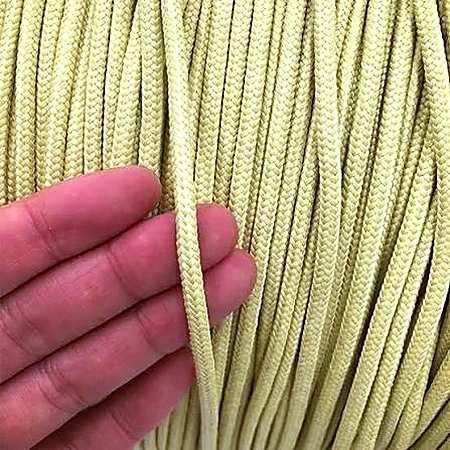
Peb d is a 12-strand single braid made from 100 % para-aramid filament. It is the rope to specify when the duty combines heat with strength: it has no melting point, it keeps working above 150 °C, and it holds far more of its strength at high temperature than nylon or polyester. Because it barely stretches under load, the load stays where it was set — which is why braided aramid cord is used for furnace and ladle work, heat-shield rigging, guy lines and high-temperature pulling, as well as for industrial lifting where a nylon rope would be too elastic. Standard braids run from 4 mm to 24 mm, with spliced eyes, Thimbles, hooks or buckles fitted at the ends.
- Works hot — no melting point; strength falls to zero only near 455 °C, and long-term service is above 150 °C
- Low stretch — a 70–100 GPa modulus keeps a suspended load steady instead of letting it settle or swing
- Strong for its weight — specific strength 5–6 times that of steel wire at roughly one fifth of the weight
- Cut and abrasion resistant — a dense 12-strand braid with a hard-wearing surface
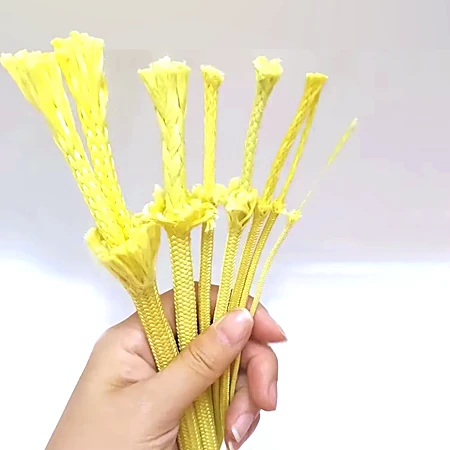
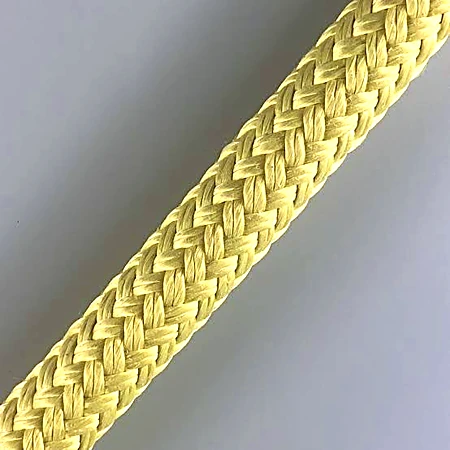
Key Features of Our Aramid Braided Rope
Heat Resistance Where Nylon and Polyester Fail
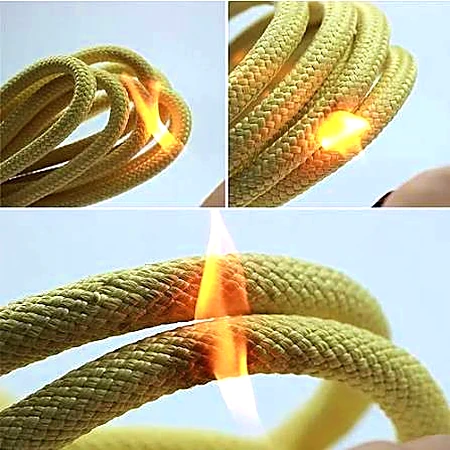
Para-aramid does not melt and does not drip. It can be used continuously above 150 °C, retains about 75 % of its tenacity after 100 hours at 200 °C, and reaches zero strength only at about 455 °C. That is the reason this rope is specified for areas where ordinary synthetic rope would soften, glaze or fail — see also our high heat resistance mooring rope.
Tsawg Elongation., So the Load Stays Put
A 70–100 GPa tensile modulus means the rope gives very little under load. Where a nylon rope absorbs shock by stretching, an aramid braided rope is chosen for the opposite reason: a suspended load keeps its height, a tensioned line stays tensioned, and there is no stored energy to release when the load is set down.
12-Strand Single Braid
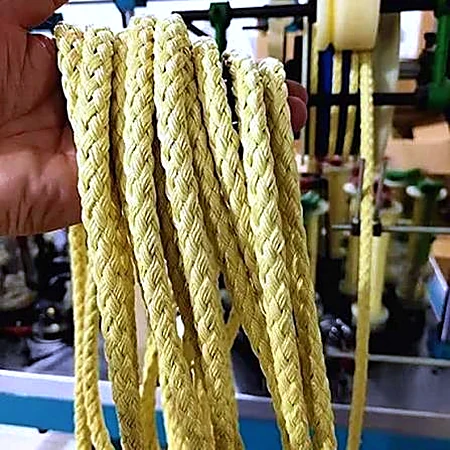
Twelve strands are braided without a core, so the rope is torque-free, round and even, and takes a splice that keeps most of the rope’s strength. The braid angle and density are controlled per batch, which is what fixes the finished diameter and the way the rope behaves in a hand, on a capstan or over a sheave.
Spliced Ends, Not Knotted
A knot gives away a large part of the rope’s strength and becomes the weakest point. We finish aramid rope with hand-spliced eyes, thimble qhov muag, hooks, swivels or buckles, and whip or heat-seal the free ends so the braid cannot unravel.
Technical Specifications
| Item | Specification range |
|---|---|
| Product name | Aramid braided rope / aramid fibre braided rope / braided aramid cord / Kevlar braided rope |
| Material | 100 % para-aramid (aromatic polyamide) multifilament, natural yellow |
| Construction | 12-strand single braid (round); 8-strand, 16-strand and double braid on request |
| Standard diameters | 4 · 6 · 8 · 10 · 12 · 14 · 16 · 18 · 20 · 24 mm (custom range 3–32 mm) |
| Standard lengths | 100 m · 200 m · 500 m coil, 1000 m spool; any cut length to order |
| Colour | Daj ntuj · dub · xim customized |
| Coating / finish | Uncoated, los yog PU-coated rau kev tiv thaiv xeb ntxiv thiab braided kaw |
| Working temperature | Kev pabcuam txuas ntxiv saum toj 150 °C; zog poob mus txog zero 455 °C; tsis muaj melting point |
| Elongation | Tsawg — xaiv qhov chaw uas khoom dai tsis txhob poob lossis yaws |
| Tiv UV protection | Tsho tiv thaiv lossis npog pom zoo rau kev siv sab nraum zoov mus ntev |
| End finishing | Tes splice eye · thimble eye · hook · swivel · buckle; whipped lossis heat-sealed ends |
| Ntim | Coil with label, spool lossis carton; custom label and barcode available |
| MOQ & OEM | Low MOQ for trial orders; full OEM — diameter, xim, ntev, splicing, logo luam tawm, packaging |
Cov qauv qhia tshwj xeeb — lwm yam diameters, braid qauv thiab ntev yog tsim raws li kev txiav txim.
Diameter thiab Breaking Strength
Qhov dav raws li qhov hnyav thiab yam khoom siv txais tau. Qhov dav hnyav nqa tau ntau dua, tiv taus abrasion ntev dua thiab yooj yim tuav; diameter me dua siv sai dua thiab pheej yig dua rau kev thauj.
| Qhov dav | Approx. weight (g/m) | Lub zog tawg feem ntau | Kev siv ua haujlwm piv txwv 5:1 |
|---|---|---|---|
| 4 mm | ≈ 11 | ≈ 15 kN (1.5 t) | ≈ 3.0 kN |
| 6 mm | ≈ 24 | ≈ 34 kN (3.5 t) | ≈ 6.8 kN |
| 8 mm | ≈ 43 | ≈ 60 kN (6.1 t) | ≈ 12.0 kN |
| 10 mm | ≈ 68 | ≈ 94 kN (9.6 t) | ≈ 18.8 kN |
| 12 mm | ≈ 97 | ≈ 135 kN (13.8 t) | ≈ 27.0 kN |
| 14 mm | ≈ 132 | ≈ 185 kN (18.9 t) | ≈ 37.0 kN |
| 16 mm | ≈ 173 | ≈ 240 kN (24.5 t) | ≈ 48.0 kN |
| 18 mm | ≈ 219 | ≈ 305 kN (31.1 t) | ≈ 61.0 kN |
| 20 mm | ≈ 270 | ≈ 377 kN (38.4 t) | ≈ 75.4 kN |
| 24 mm | ≈ 389 | ≈ 540 kN (55.0 t) | ≈ 108.0 kN |
Typical reference values for standard 12-strand aramid braid. Breaking strength and working load are confirmed by the test certificate issued for your batch — always work from that figure, not from this table.
Material Properties of Para-Aramid
| Property | Typical value |
|---|---|
| Density | 1.43 – 1.47 g/cm³ (para-aramid filament, grade dependent) |
| Specific strength | 5 – 6 × that of steel wire, at roughly one fifth of the weight |
| Tensile modulus | 70 – 100 GPa at room temperature |
| Glass transition temperature | 320 – 380 °C |
| Strength retention | Txog 75 % after 100 hours at 200 °C |
| Zero-strength temperature | Txog 455 °C |
| Melting point | None — the fibre decomposes rather than melting (from about 500 °C) |
| Txwv oxygen index | 25 – 29 (flame retardant, tua hluav taws tus kheej) |
| Moisture regain | 4.0 – 7.0 %, grade dependent (Kevlar 29 ≈ 7.0 %, Kevlar 49 ≈ 4.0 %) |
| Chemical resistance | Good against most organic solvents; degraded by strong acids and alkalis, especially hot and concentrated |
Typical published values for para-aramid filament; confirm against the yarn datasheet used for your order.
Kub, Kev coj cwj pwm tshuaj thiab UV
- Kub — no melting point; Cov fiber tawg ntawm kwv yees 500 °C thiab mus txog xoom zog ze 455 °C. Kev pabcuam txuas ntxiv nyob saum toj 150 °C.
- Chemicals —tiv taus feem ntau cov organic solvents, tab sis puas tsuaj los ntawm acid thiab alkalis muaj zog, tsis tshua muaj thaum kub thiab muaj zog.
- UV — rau kev tso tawm sab nraum zoov tas mus li, nug txog lub tsho tiv thaiv lossis kev tsim kho npog es tsis txhob tso lub braid qhib.
Kev siv
- Lub lauj kaub, Ladle thiab foundry rigging thaum muaj cua sov radiant
- Cov thaiv kub, Cov ntaub thaiv cua sov thiab kev tuav refractory
- Cov kab txhawb nqa, static lines and high-temperature pulling
- Industrial lifting and tensioning where the load must not settle
- Utility and winch duty, including the heavier forms of kab winch utility
- Cut-resistant cordage for slings and lanyards, alongside pulling rope and hlua nce toj
Kev kho kom haum thiab OEM Kev Pabcuam
- Qhov dav — 4–24 mm standard, 3–32 mm on request
- Construction — 12-strand single braid, or 8-strand, 16-strand and double braid
- Ends — spliced eye, thimble eye, hook, swivel, buckle, or plain cut ends
- Ntev — txhua qhov ntev txiav; 100 m, 200 m thiab 500 m coils, 1000 m spools
- Finishing — PU coating, xim, mid-rope marking, printed label, retail packaging
- Companion items — webbing sling, round slings and safety harness supplied as matched sets
Kev tswj xyuas zoo
Each batch is checked on diameter, linear density, braid density and end finish, and sampled for breaking strength. We have manufactured rope and webbing for industrial, safety and sports customers for close to three decades. On request we supply the yarn certificate, the batch test report and a sample length for you to handle and test before volume production begins.
Cov Lus Nug Feem Ntau
What temperature can aramid braided rope take?
There is no melting point. Long-term service is above 150 °C, it keeps roughly 75 % of its tenacity after 100 hours at 200 °C, and its strength approaches zero at about 455 °C. Tell us the working temperature and for how long, and we will confirm the construction and whether a heat-resistant cover is needed.
Aramid braided rope or nylon rope — which one do I need?
Choose aramid for heat and low stretch; choose nylon where shock absorption and elasticity matter more than stability. If both heat and shock are present, tell us the duty rather than a fibre, and we will recommend the construction that suits it.
Puas yog qhov kawg tuaj yeem txuas tau?
h. Ib qho 12-strand braid ib leeg yuav tsum tau ib lub qhov muag spliced tes kom khaws tau feem ntau ntawm lub zog ntawm lub hlua, thiab thimbles, hooks, swivels thiab buckles tuaj yeem txuas rau qhov muag. Ib qho kawg tiav yuav txo qhov ntev siv tau, yog li nco ntsoov thaum koj txiav txim.
Koj puas muab Kevlar braided hlua me me?
h. Peb khaws qhov kev txiav txim tsawg kawg rau kev sim txiav txim thiab yuav xa ib qho qauv ntev los kuaj thiab tuav ua ntej tsim ntau. v, ntev npaum li cas, kub ua haujlwm thiab qhov kawg uas koj xav tau.
Thov nqi rau Aramid Braided Rope
Xa peb qhov dav, ntev npaum li cas, kub ua haujlwm thiab yuav thauj li cas, ntxiv rau txhua yam cim lossis ntawv pov thawj uas xav tau hauv koj lub lag luam. Peb pab pawg yuav teb nrog cov lus qhia, ib qho qauv ntev thiab tus nqi ncaj qha ntawm lub hoobkas.
Contact: Lift Sling Rigging Co., Ltd — telephone and WeChat 18066002268, e-mail 702461526@qq.com, Lifute Industrial Park, Taizhou City, Jiangsu Province, China. HS code 630790.