

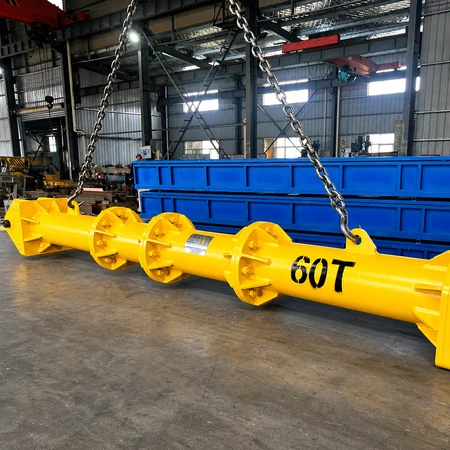
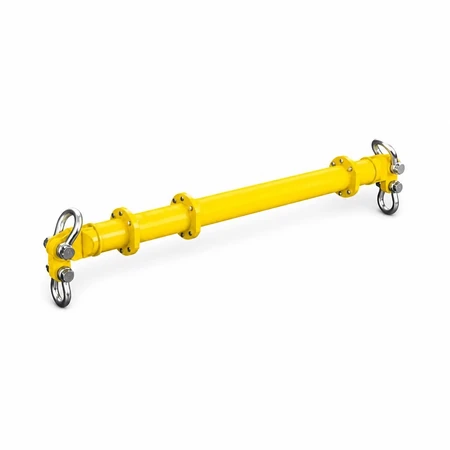
Lift sling rigging company produce Spreader beam,4-point Spreader Frame Beam,adjustable spreader beam,Stainless steel spreader beam.
Spreader Beam
Ruaj khov, Kho tau, Modular & Telescopic Spreader Beams — 100 kg mus rau 180 a, Spans mus 25 m
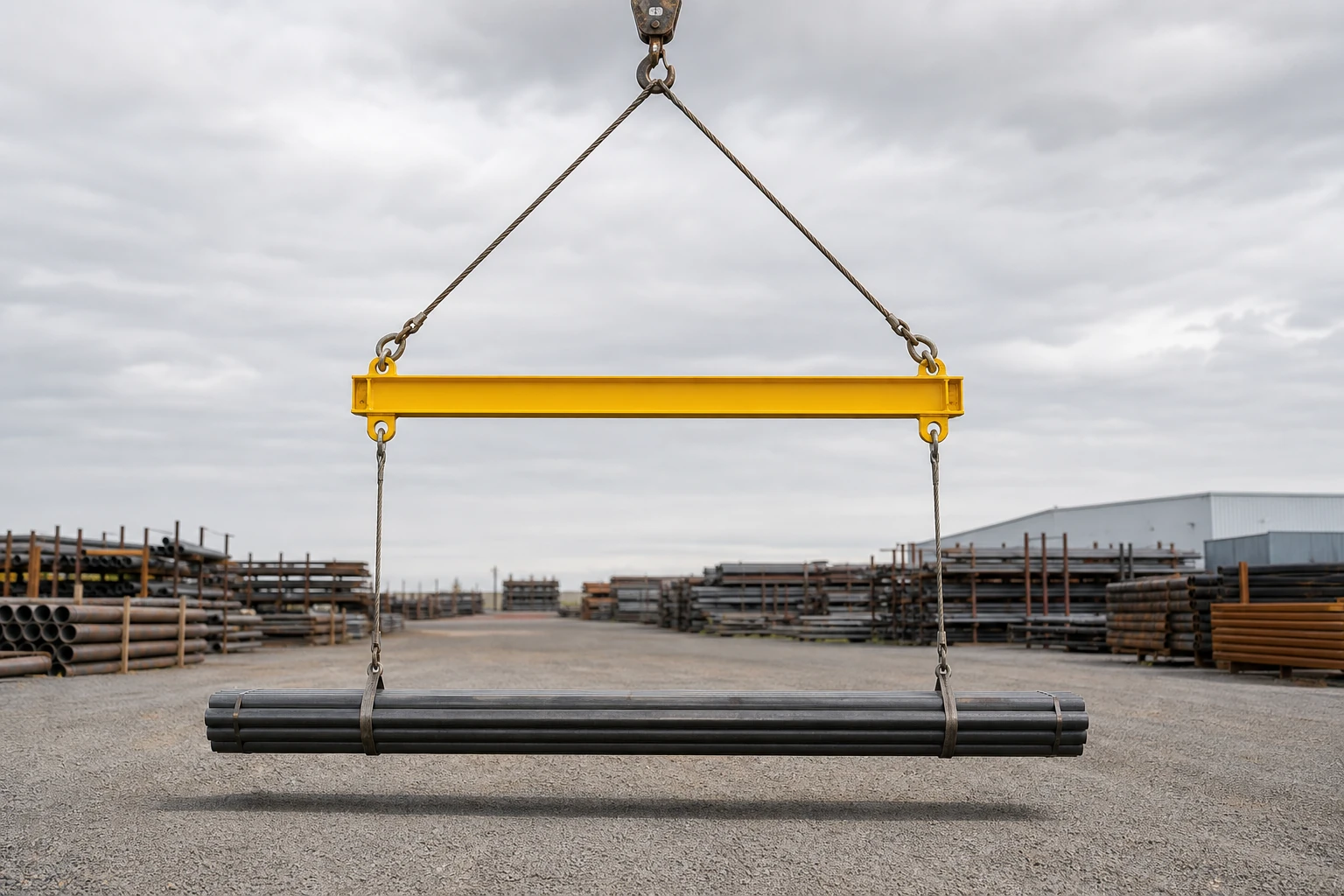
A spreader beam is a horizontal member hung from the crane hook on two suspension slings that form a V, with the load suspended below it on vertical slings. That arrangement changes what the beam has to do. The upper slings are inclined, and their horizontal components put the beam into pure compression — it works as a strut, not as a beam in bending. For the same capacity and span that usually makes it the lighter, shallower and more stable solution. We manufacture fixed, adjustable, modular and telescopic spreader beams and lifting spreader beams from 100 kg mus rau 180 tonnes, in spans to 25 m, proof load tested before dispatch.
- The load is never squeezed — lower slings hang vertically, so the pick points do not pull inward on the load
- Lighter for the same job — a beam in compression needs less steel than one in bending at equal span
- More stable under load — the upper V slings resist sway and rotation
- Kho tau, modular or telescopic — one beam covers a range of load lengths and spans
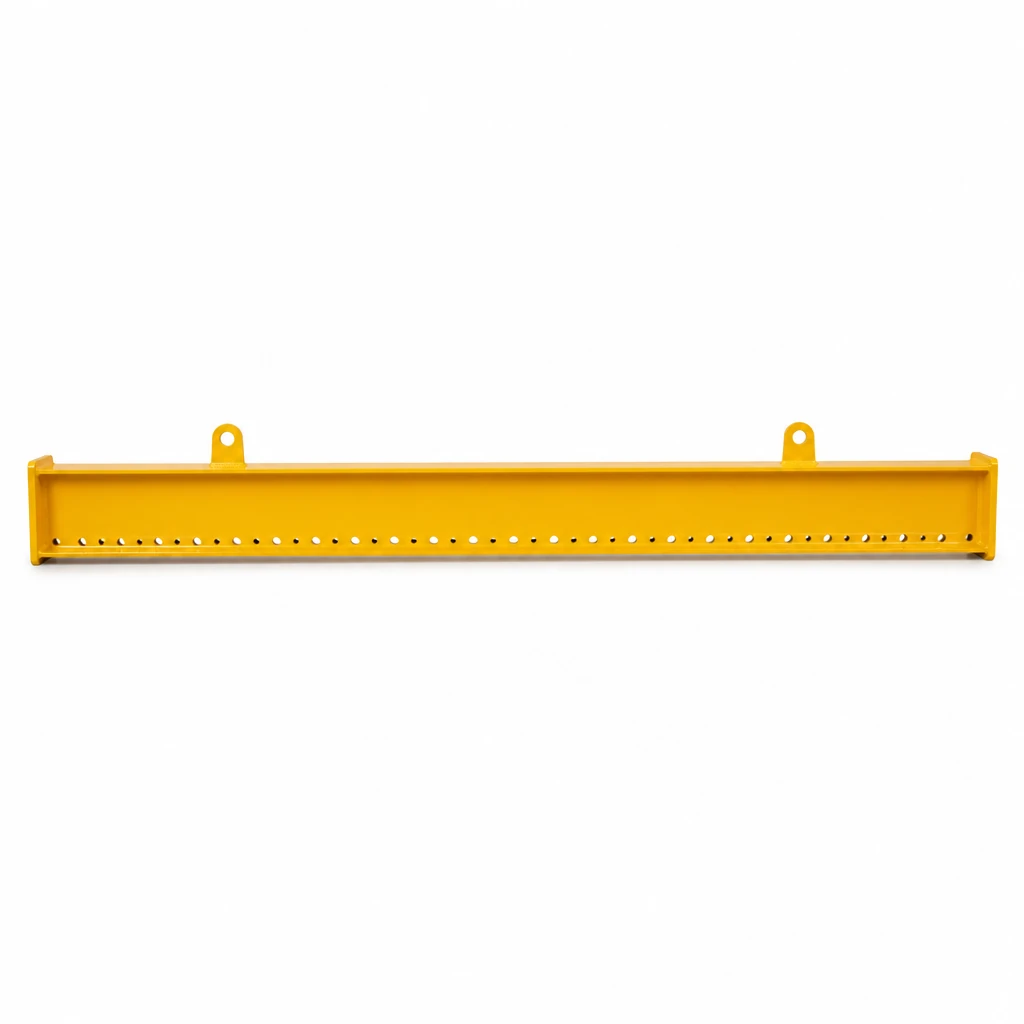
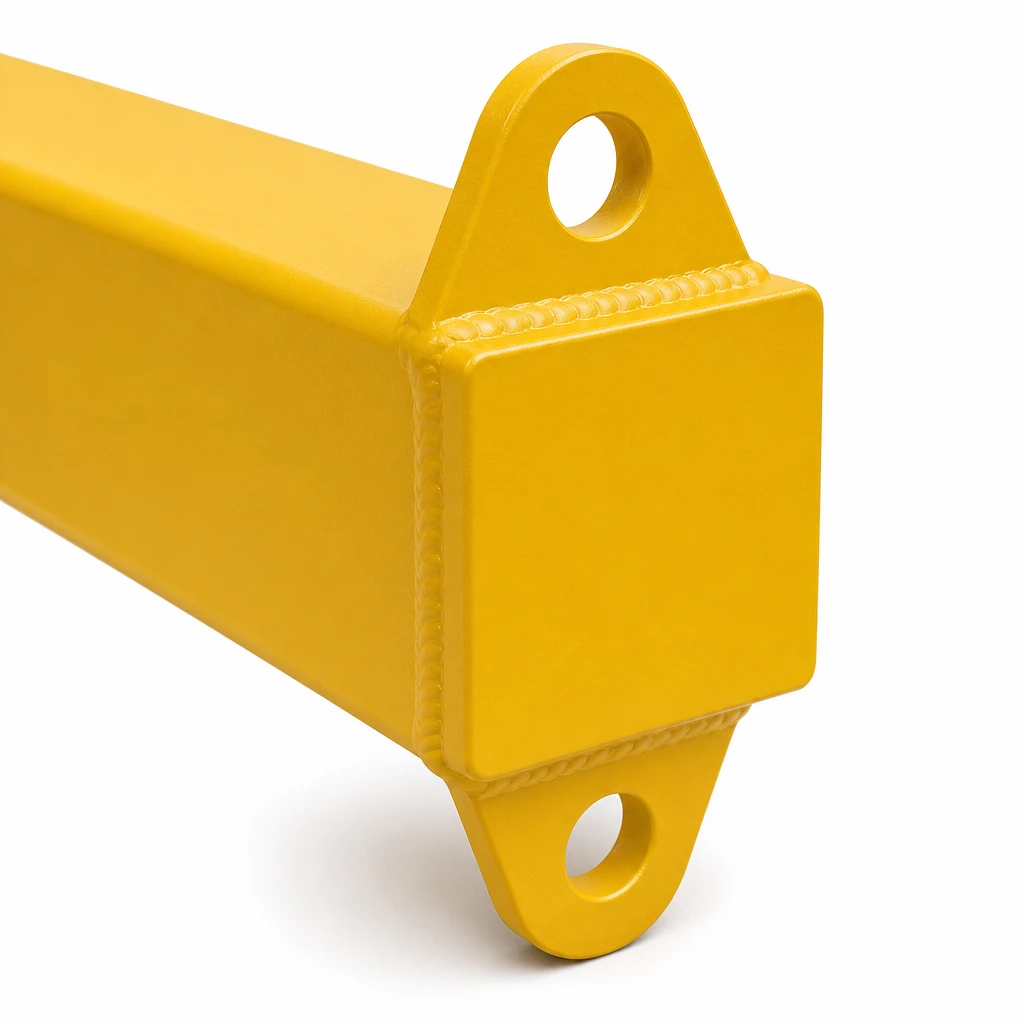
Key Features of Our Spreader Beam
Works in Compression
The upper slings are inclined, so their horizontal components load the beam axially. A member in pure compression needs far less steel than one in bending, which is why a spreader beam is normally the lighter choice at the same capacity and span.
Vertical Lower Slings
Below the beam the slings hang vertically, so the pick points sit directly above the attachment points and put no inward squeeze on the load — important for pipes, finished surfaces and long fabrications.
Better Load Stability
The upper V slings also act as a stabiliser: they resist sway, yaw and rotation far better than a single-point pick, which makes long loads easier to land accurately.
Adjustable and Modular
Muaj ntau qhov txuas hauv qab, ib lub trolley uas txav tau, ib qho telescopic joint, lossis ib lub nplhaib sib txuas uas thauj ua ntu thiab rov tsim dua ntawm qhov ntev uas lub tshuab nqa xav tau.
Cov ncej uas cov ncej hnyav dhau
Truss thiab H-section tsim nqa kev nias tau zoo thaum ntev ntev, yog li ib lub ncej nthuav tawm tseem yog ib qho kev daws teeb meem muaj txiaj ntsig thaum ib qho ncej puab yuav hnyav dhau los tsis muaj txiaj ntsig.
Tau kuaj thiab sau tseg
Kev kuaj pov thawj thauj khoom rau 125 % ntawm peev xwm ntsuas ua ntej xa tawm, nrog peev xwm ntsuas, tare hnyav, tus lej serial thiab xyoo tsim khoom cim rau ntawm lub ncej thiab daim ntawv pov thawj kuaj muab.
Spreader Beam vs Lifting Beam
Ob lub npe feem ntau siv sib hloov, tab sis cov hlua txuas txawv thiab txoj kev thauj hlau kuj txawv. Nws tsim nyog paub tias qhov twg koj lub lift tiag tiag xav tau, vim qhov kev xaiv hloov tau qhov chaw taub hau, qhov hnyav ntawm lub ncej thiab nws ua li cas thaum thauj khoom.
| Spreader beam | Lifting beam | |
|---|---|---|
| Upper rigging | Ob lossis ntau dua suspension slinging tsim ib V los ntawm hook mus rau beam | Tsis muaj — ib qho pick point ib leeg saum beam, feem ntau saum qhov chaw nruab nrab ntawm qhov hnyav |
| Lower slings | Vertical | Vertical |
| Beam raug thauj hauv | Compression — nws ua haujlwm ua ib qho strut | Bending — nws ua haujlwm ua ib qho beam |
| Qhov chaw rau muaj peev xwm thiab dav sib npaug | Lub teeb thiab tob dua | Hnyav dua thiab tob dua |
| Chaw taub hau | Xav tau ntau dua — lub beam nres hauv qab lub hook raws li qhov siab ntawm V | Xav tau tsawg dua — lub beam zaum ze hauv qab lub hook |
| Ruaj khov | Siab dua — V tiv taus kev nres thiab tig | Qis dua — ib qho pick tuaj yeem tig thiab sway |
| Feem ntau xaiv rau | Ntev ntev, thauj khoom ntev, muaj peev xwm siab, ruaj khov | Nqa taub hau qis, chaw me me, cov chaw pick ruaj khov tshwj xeeb |
How a Spreader Beam Works
There are two separate sling systems on a spreader beam, and they do different jobs. The upper rigging runs from the crane hook down to the suspension lugs on top of the beam — usually two slings, so the beam hangs in a V. The lower rigging runs from the load attachment points on the underside of the beam straight down to the load. The upper slings are inclined; the lower slings are vertical.
It is the inclination of the upper slings that defines the spreader beam. Each upper sling carries a share of the load, and because it is not vertical, part of that tension pulls sideways along the beam. Both slings pull inward, so the beam is squeezed — loaded in pure compression — and the amount depends entirely on how steep the upper slings are.
Setting the top slings
Steeper top slings mean less compression in the beam but a taller rig; shallower slings mean a lower rig but a much heavier compressive load. The table shows how quickly that changes.
| Top sling angle α (from horizontal) | Compression in the beam | Tension per upper sling |
|---|---|---|
| 90° (ntsug) | 0 — the beam is no longer a spreader beam | 0.50 × load |
| 60° | 0.58 × load | 0.58 × load |
| 45° (common working angle) | 1.00 × load | 0.71 × load |
| 30° | 1.73 × load | 1.00 × load |
| 20° | 2.75 × load | 1.46 × load |
In practice the top slings are usually set between about 45° and 60° from the horizontal. Going shallower than 45° starts to drive the compression up sharply and also forces very long slings, so it is rarely the economical answer. Tell us the headroom and the load length and we will size the suspension points so the rig works at a sensible angle.
Types of Spreader Beam
| Fixed spreader beam | Suspension and load points welded in fixed positions. The lightest and simplest option when the load size is constant. |
|---|---|
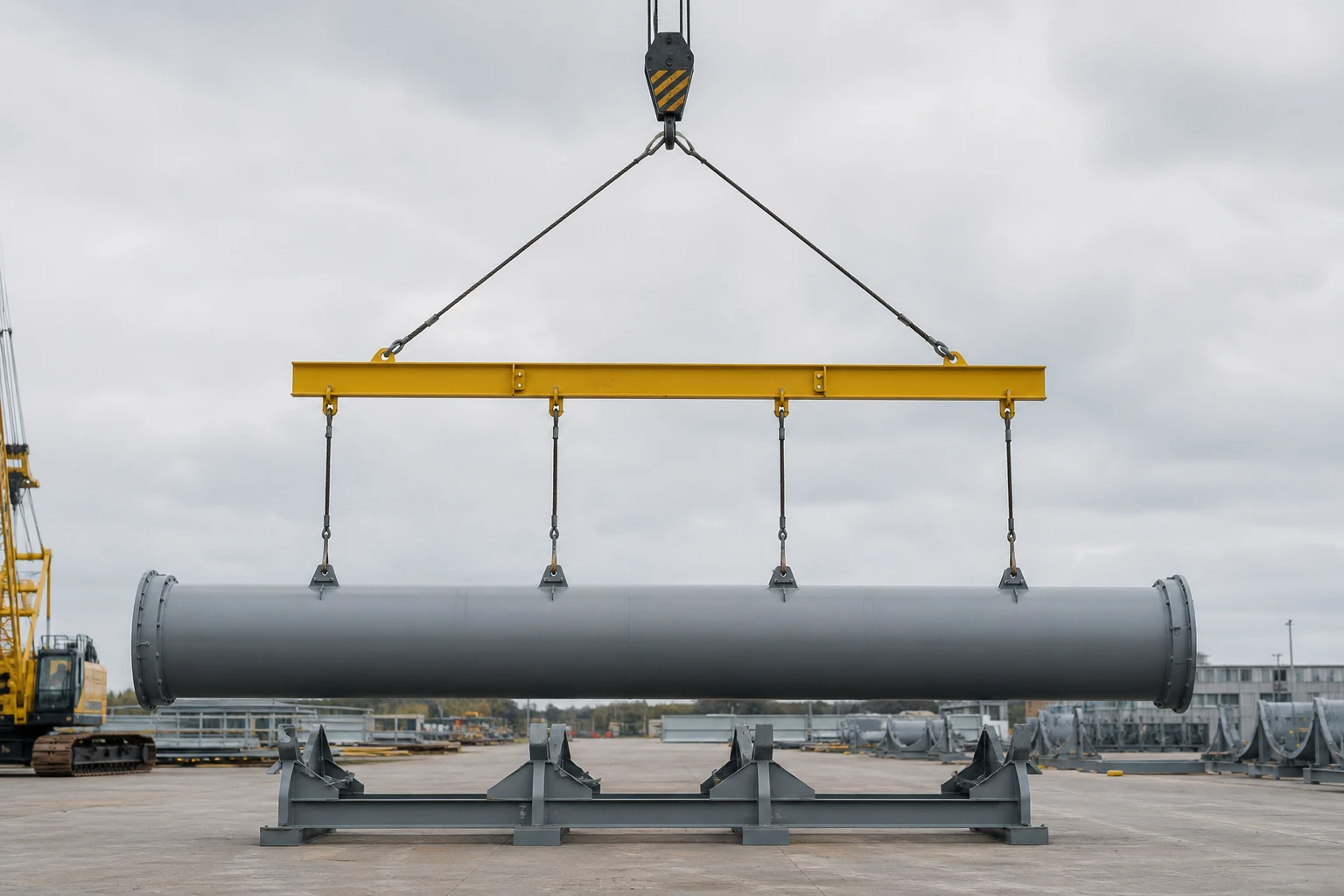
| Kho tau (multi-position) spreader beam | A row of lower attachment holes, or a sliding bracket, so the load pick points can be moved along the beam to suit different load lengths or to trim an off-centre load. |
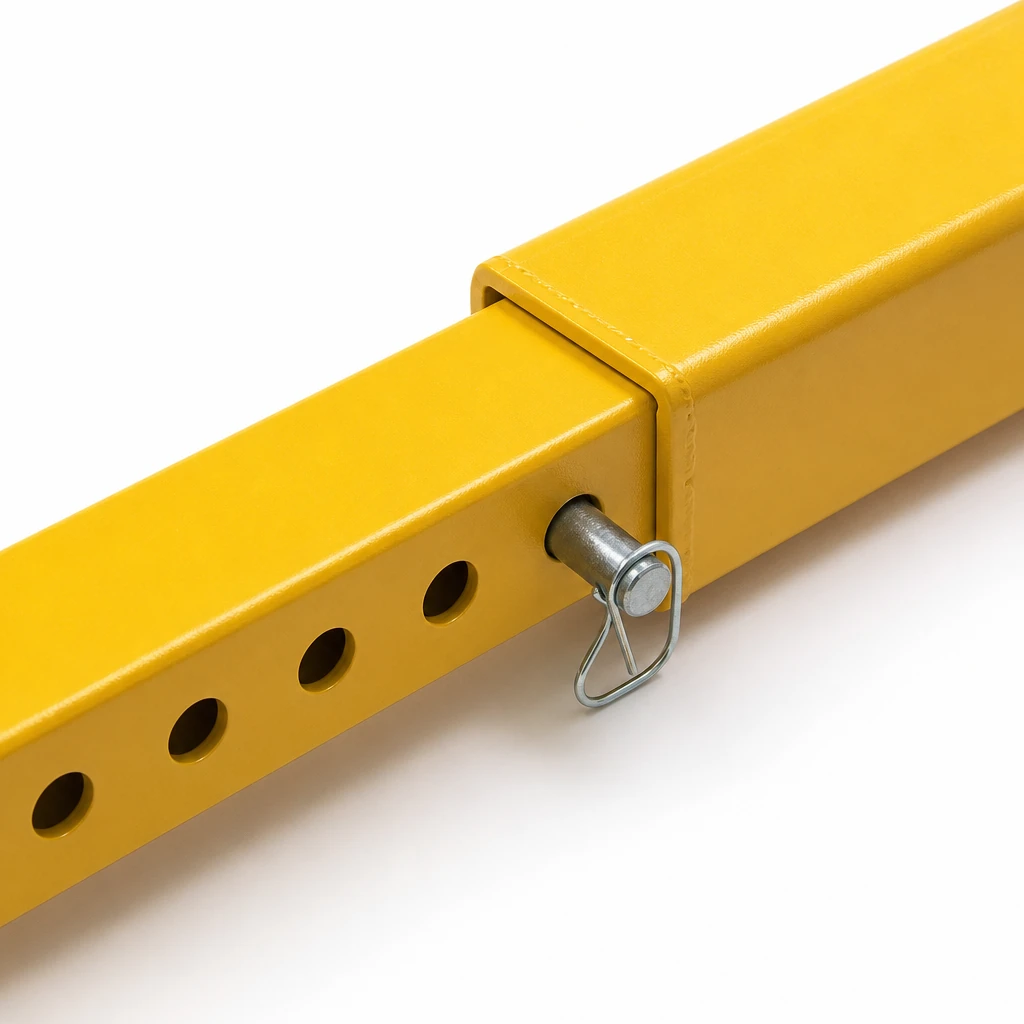
| Telescopic spreader beam | An inner section slides inside the outer beam and locks with pins, yog li qhov dav tuaj yeem kho tau ntawm qhov chaw. Ideal for a lifting yard handling mixed load sizes. |
| Modular spreader beam | Bolt-together sections that ship in manageable pieces and are assembled at the span the lift requires. One set covers many spans, and transport cost stays low. |
| Truss / lattice spreader beam | Lattice construction for long spans and high capacity, where compression is carried most efficiently and a solid section would become too heavy. |
| Container spreader beam | A frame arrangement with dedicated corner fittings for handling containers and containerised cargo in ports and yards. |
Technical Specifications
| Product name | Spreader beam / spreader bar / lifting spreader beam / modular spreader beam / telescopic spreader beam |
|---|---|
| Peev xwm ntsuas (WLL) | 100 kg mus rau 180 standard range; cov qauv loj dua uas tau hais raws li kev thov |
| Ntev / ntev tag nrho | 0.5 m rau 25 m nyob ntawm peev xwm thiab qhov chaw (customized) |
| Beam section | Welded box section · welded H-section · lattice truss for long spans and high capacities |
| Material | Q235B / Q345B (S235JR / S355JR) structural steel; high-strength steel for large-tonnage designs |
| Welding | Full-penetration welds by qualified welders; weld inspection records available on request |
| Upper suspension points | Two welded suspension lugs (qauv) · four for wide or long beams · stainless or plated pins |
| Lower attachment points | Pin holes · shackle lugs · swivel hooks · sliding brackets · 2, 4 or more points, fixed or adjustable |
| Top sling angle | Normally set between 45° and 60° from the horizontal — confirmed against your headroom and load |
| Design factor | Applied against the rated capacity per the applicable standard and service class — typically 3:1 u 5:1; confirmed per project |
| Proof load test | 125 % ntawm peev xwm ntsuas ua ntej xa tawm, with a load test certificate |
| Kev kho nto | Shot blast rau Sa 2.5 + epoxy primer + polyurethane topcoat (kev nyab xeeb daj) · optional hot-dip galvanising |
| Cim npe | Peev xwm ntsuas (WLL), tare hnyav, serial number and year of manufacture marked on the beam |
| Cov ntaub ntawv | General arrangement drawing, material certificate, weld record and proof load test certificate |
| Reference standards | Designed and manufactured with reference to ASME B30.20 / ASME BTH-1 thiab EN 13155 kev xyaum rau cov cuab yeej nqa hauv qab lub hook — lees paub cov qauv thiab qauv uas siv hauv koj lub lag luam |
| Kev xaiv | Kev kho tau lossis telescopic ntev · modular bolt-work ntu · cov hlua saum thiab qis sib phim · shackles · swivel hooks · tag line points · chaw khaws khoom · xim tshwj xeeb |
| Ntim | Steel frame lossis pallet, ntim dej hiav txwv rau kev xa tawm; modular beams nqa hauv knockdown sections |
| MOQ & OEM | Ib qho khoom thiab tsim tshwj xeeb txais tos; OEM nrog koj tus kheej cov cim thiab ntaub ntawv |
Capacity thiab Span Range
Span tsav kev tsim. Vim beam nqa axial compression, ob npaug span nce compression load thiab buckling ntev ua ke — yog li section loj hlob sai, txawm tias qeeb dua li beam thaum bending. The table shows the practical span range for each capacity band. Qhia peb txog peev xwm, the span and the number of lower attachment points and we will confirm the section and the beam’s own weight.
| Peev xwm ntsuas (WLL) | Feem ntau ntev tag nrho / span | Lower attachment points | Hom beam ib txwm |
|---|---|---|---|
| 0.5 t | 1.0 – 2.5 m | 2 | Box section |
| 1 t | 1.0 – 3.0 m | 2 | Box section |
| 2 t | 1.5 – 4.0 m | 2 | Box section |
| 3 t | 2.0 – 5.0 m | 2 | Box section |
| 5 t | 2.5 – 6.0 m | 2 | Box section |
| 10 t | 3.0 – 8.0 m | 2 or 4 | Box / welded H |
| 16 t | 4.0 – 10.0 m | 2 or 4 | Welded H |
| 20 t | 5.0 – 12.0 m | 2 or 4 | Welded H |
| 32 t | 6.0 – 14.0 m | 4 | Welded H / Truss |
| 50 t | 8.0 – 16.0 m | 4 | Welded H / Truss |
| 80 t | 10.0 – 18.0 m | 4 | Truss |
| 100 t | 10.0 – 20.0 m | 4 | Truss |
| 180 t | 12.0 – 25.0 m (customized) | 4 lossis ntau dua | Custom truss |
Design, Kev kuaj thiab ntaub ntawv
- Designed against your load case — rated capacity, span, the top sling angle, the number and position of lower attachment points and the headroom available are all design inputs, not afterthoughts.
- Compression and buckling checked — because the beam works as a strut, the design checks axial capacity, buckling over the unbraced length and the end connection details, not just bending stress.
- Full-penetration welding — lug plates and end fittings are welded by qualified welders, with weld inspection records available on request.
- Proof load tested — every beam is proof load tested to 125 % of its rated capacity before dispatch, and the test certificate is issued with the beam.
- Clearly marked — rated capacity, tare hnyav, serial number and year of manufacture are marked on the beam.
Kev siv
- Pipes, tube bundles and bar bundles where the load must stay level and unmarked
- Fabricated tower sections, cans and pressure vessel shells
- Long steel sections, rails, beams and piling
- Precast concrete panels, beams and pile sections
- Steel plate and sheet packs, and coated or painted surfaces
- Timber packs, board bundles and palletised loads
- Container and containerised cargo handling in ports and yards
- Wind turbine components and other long, heavy fabricated parts
Kho tau, Modular thiab Telescopic Options
Muaj tsawg heev lifts uas zoo ib yam, yog li feem ntau spreader beams peb ua tau hloov tau ib yam. Cov no yog peb txoj kev, thiab lawv daws tau teeb meem sib txawv:
- Qhov chaw txuas qis hloov tau —ib kab ntawm pin holes lossis ib lub bracket uas txav tau raws beam. Siv qhov no los phim qhov ntev thauj khoom sib txawv thiab txiav cov pick points kom txog thaum load tsis nyob nruab nrab daig ncaj. Qhov span nyob ruaj.
- Telescopic beam — qhov ntev hloov tau. Ib feem sab hauv txav mus rau sab nraud thiab xauv nrog pins, yog li ib beam npog tau ntau qhov ntev thauj khoom ntawm qhov chaw.
- Modular beam — lub beam yog ua los ntawm bolt-together sections. Nws xa ua tej daim yooj yim, tau sib dhos ntawm qhov ntev uas lift xav tau, thiab tuaj yeem hloov kho raws li kev xav tau hloov. Kev xaiv ib txwm thaum span ntev lossis thaum chaw thauj thiab khaws khoom tsawg.
Kev kho kom haum thiab OEM Kev Pabcuam
- Muaj peev xwm thiab ntev — 100 kg mus rau 180 t, spans rau 25 m, lossis tsim ib zaug sab nraud qhov ntawd
- Suspension thiab attachment points — 2, 4, 6 lossis ntau dua; ruaj khov, multi-position, sliding lossis telescopic
- Complete rigging sets — slings suspension sab saud sib phim, sling qis, shackles thiab hooks muab nrog beam
- Qhov seem thiab tiav — lub thawv, H-section lossis truss; kev nyab xeeb daj, koj tus kheej xim, or hot-dip galvanised for outdoor and marine use
- Kev cim thiab ntaub ntawv — your own tag format, part numbers, drawings and certificates
Kev tswj xyuas zoo
Each beam is checked on dimensions, plate thickness, weld quality, lug and hole geometry and surface finish before testing, then proof load tested and re-inspected. We have manufactured lifting equipment for industrial, kev tsim kho, port and power customers for close to three decades — including 100-tonne class lifting belts and large-tonnage lifting devices — and we keep the process visible: on request we supply the material certificate, the weld record, the general arrangement drawing and the proof load test certificate for your beam.
Cov Lus Nug Feem Ntau
What is the difference between a spreader beam and a lifting beam?
A spreader beam is hung on two suspension slings that form a V, so the inclined slings put the beam into pure compression and the load hangs from vertical lower slings. A lifting beam has a single pick point on top of the beam, so the beam works in bending instead. A spreader beam is normally lighter for the same capacity and span and is more stable, but it needs more headroom; a lifting beam is the better choice where headroom is limited.
Why does a spreader beam need a sling above it?
Because that is what makes it a spreader beam. The inclined upper slings create the horizontal component that loads the beam in compression, and they also stabilise the lift. With vertical upper slings the beam would carry no compression at all — it would be a lifting beam in bending, which is a different and heavier solution.
What angle should the top slings be set at?
Between about 45° and 60° from the horizontal in most cases. Thaum 45° compression hauv beam yog qhov hnyav; ntawm 30° nws nce mus txog kwv yees 1.73 times the load, thiab cov sling kuj yuav tsum ntev heev. Steeper dua 60° txhais tau tias rig siab dua tab sis compression tsawg dua hauv beam.
Kuv yuav xaiv peev xwm thiab dav li cas?
P, tom qab ntawd xyuas kom meej tias span yog qhov deb tiag tiag ntawm cov chaw txuas qis — tsis yog qhov ntev uas koj muaj. Beam tus kheej dead weight thiab rigging weight ob leeg tawm ntawm crane peev xwm, yog li lawv yog ib feem ntawm kev suav, tsis yog ib qho kev xav tom qab.
Ib lub beam spreader puas tuaj yeem npog ntau qhov hnyav loj?
h. Cov ntsiab lus txuas qis uas kho tau tso cai rau koj hloov chaw pick points raws ib lub beam ruaj khov; ib lub beam telescopic cia koj hloov qhov ntev; Ib lub ncej ntsia hlau modular uas siv bolt-together tso cai rau koj rov tsim dua lub ncej ntawm qhov ntev twg koj xav tau. Qhia rau peb paub txog qhov ntev ntawm qhov hnyav uas koj tswj thiab peb yuav qhia qhov kev xaiv twg yog qhov sib npaug zoo tshaj plaws ntawm kev hloov tau yooj yim thiab qhov hnyav.
Puav leej puas tau kuaj lub ncej faib ua ntej xa khoom?
h. Txhua beam raug kuaj load kom raug 125 % ntawm nws lub peev xwm ntsuas ua ntej xa thiab tau txais daim ntawv pov thawj kuaj hnyav. Lub peev xwm ntsuas tau, tare hnyav, serial number thiab xyoo tsim tau sau rau ntawm beam nws tus kheej, Thiab daim ntawv pov thawj khoom siv, Cov ntaub ntawv weld thiab daim duab kev teeb tsa dav dav muaj rau kev thov.
Thov muab nqi rau Spreader Beam
Xa peb qhov hnyav ntawm qhov hnyav, Qhov ntev, Tus naj npawb ntawm cov ntsiab txuas, Lub crane hook thiab qhov chaw siab muaj. Peb pab neeg yuav rov qab los nrog ib ntu uas tau muab tswv yim, Dead weight, Rigging thiab tus nqi ncaj qha los ntawm lub hoobkas.