

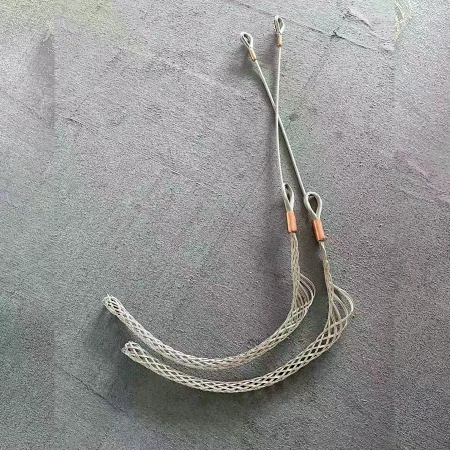
Lift sling rigging company produce Stainless Steel Cable Pulling Grip,Stainless Steel Cable Grips,Stainless Steel Support Grips,Triple Weave Stainless Steel Wire Rope Clip Pulling Grip Cable Wire Mesh Sock,
Standard models cover cable diameters from 9 mm to 160 mm, mesh lengths from 300 mm to 1500 mm, and single, double, flexible, rotating or offset eyes. Heavy-duty versions use 2.5–3.0 mm stainless wire in a long mesh body, so the pulling force is spread over a metre or more of cable instead of a single point. All models are rated at a 5:1 safety factor.
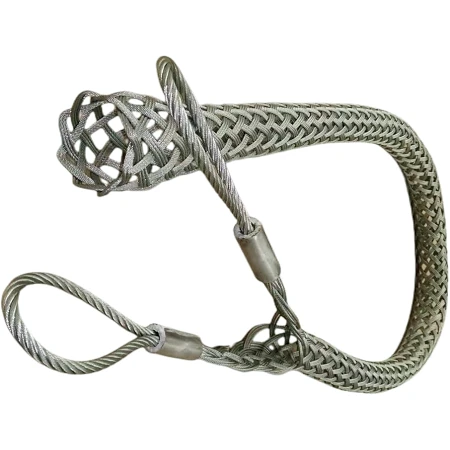
Why choose a stainless steel mesh grip instead of galvanised
- No zinc layer to wear off. A galvanised sock loses its coating where the mesh rubs against duct mouths and sheaves; stainless wire keeps its full section through repeated pulls.
- 304 or 316 — matched to the environment. AISI 304 covers wet tunnels, wash-down areas and general outdoor work. AISI 316 with molybdenum covers chlorides: offshore decks, desalination and chemical plants, coastal yards, de-icing salt.
- No rust staining. Stainless mesh leaves no oxide marks on white duct, fibre pigtails, painted pipe or stainless process lines.
- Stable from −40 °C to +120 °C (coated versions to +70 °C), so the same sock works on a frozen site and next to warm plant equipment.
How a wire mesh pulling grip works
- Slide on. Expand the mesh and push it over the cable end until the cable reaches the eye. The mesh must cover the full gripping length, not just the cable tip.
- Grip. Tension on the eye contracts the weave radially. Pulling force becomes a uniform clamping force along the whole mesh, which is why a thin-wall jacket or a lead sheath survives the pull.
- Release. Slacken the line and push the mesh forward; the weave opens and the sock slides off — no tools, no marks.
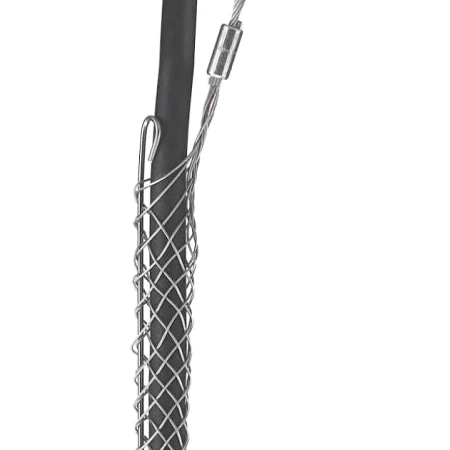
Heavy-Duty Stainless Steel Cable Pulling Grip — specifications
| Product name | Heavy-duty stainless steel cable pulling grip (wire mesh pulling grip / cable pulling sock / cable stocking grip) |
|---|---|
| Material | AISI 304 or AISI 316 stainless steel wire; galvanised steel available as an alternative |
| Structure | Double-layer cross-woven tubular mesh, closed head with braided eye or swaged ferrule |
| Mesh wire diameter | 1.5 mm / 2.0 mm / 2.5 mm / 3.0 mm, selected by cable diameter and pulling load |
| Cable diameter range | 9–16 mm up to 130–160 mm in standard models; larger sizes made to order |
| Mesh (sock) length | 300, 450, 600, 900, 1200, 1500 mm; custom up to 3000 mm |
| Eye / head type | Single eye, double eye, flexible eye, rotating eye, offset eye |
| Eye fitting | Braided stainless rope eye or swaged ferrule eye (thin, low build-up profile) |
| Safety factor | 5:1 on the rated breaking strength |
| Coating options | Plain stainless; PVC or rubber coated mesh; coloured coating for size coding |
| Working temperature | −40 °C to +120 °C (coated versions to +70 °C) |
| Customisation | Custom mesh length and eye, logo marking, private label packing |
| Origin | Lift Sling Rigging Co., Ltd — Taizhou, Jiangsu, China |
Standard sizes and pulling capacity
The chart below is our standard range. Capacity depends on cable surface, mesh length and the number of layers, and stainless models are rated individually — confirm the working load for your cable with our engineers before the first pull.
| Model | Cable Ø range (mm) | Mesh length (mm) | Mesh wire Ø (mm) | Pulling capacity (kg) |
|---|---|---|---|---|
| CPS-16 | 9–16 | 300 | 1.5 | 750 |
| CPS-25 | 16–25 | 450 | 2.0 | 1,300 |
| CPS-38 | 25–38 | 600 | 2.0 | 1,800 |
| CPS-50 | 38–50 | 700 | 2.5 | 2,500 |
| CPS-75 | 50–75 | 900 | 2.5 | 3,500 |
| CPS-100 | 75–100 | 1200 | 3.0 | 5,000 |
| CPS-160 | 130–160 | 1500 | 3.0 | 8,000 |
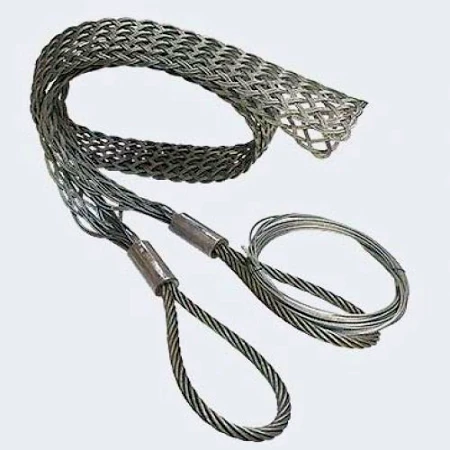
Eye and head options
The head of the grip decides how the pulling line meets the sock. Choose the eye to suit the winch line, the duct run and the space in the manhole:
- Single eye — one braided loop for a straight pull in a clean duct.
- Double eye — two loops, for lashing or for pulling two lines in line.
- Flexible eye — a swaged ferrule eye that articulates, so the sock stays aligned through bends.
- Rotating eye — allows the cable to spin out its own lay on long runs without twisting the mesh.
- Offset eye — keeps the line clear of the duct wall where headroom is tight.
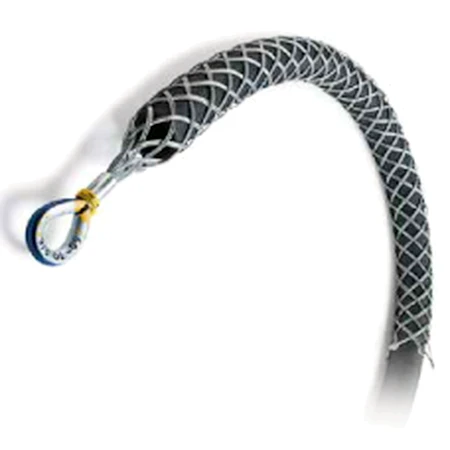
Typical applications
- Pulling LV, MV and HV power cable, control cable and fibre optic cable through ducts, trenches and risers.
- Pulling cable bundles, wire rope and rods with winches, capstans and cable pullers.
- Handling steel pipe, PVC/PE pipe, conduit, hose and ducting without marking the surface.
- Supporting, lowering or holding smooth cylindrical loads where a clamp or hook would crush or scratch.
- Offshore, marine, tunnel, substation and utility installation work — the environments where 316 stainless pays for itself.
How to select the right grip
- Measure the true outside diameter of the cable, pipe or bundle where it will be gripped — not the nominal size. For a bundle, use the overall diameter.
- Cover the range. A sock must be expanded to grip: too large will slip, too small will not slide on.
- Length follows load. Use at least 4–5 × the cable diameter of mesh engagement; heavy pulls and soft jackets need more.
- Match the eye to the line and the duct geometry (see the options above).
- Protect the surface. For painted, polished or plastic pipe, specify PVC or rubber coated mesh.
- Check the environment. 304 for wet and outdoor, 316 for chlorides and offshore; if the pull is also a lift, ask for a model rated and marked for lifting.
Installation, use and inspection
- Inspect mesh, eye and ferrule before every pull: broken wires, deformed eye, slipped ferrule, embedded grit.
- Expand the mesh fully and seat the cable end at the eye — never pull with the cable half inserted.
- Keep the pull in line with the mesh axis; side loading reduces capacity and distorts the weave.
- Never exceed the rated pulling capacity, and never use a pulling sock for overhead lifting unless it is rated and marked for lifting.
- Rinse and dry stainless socks after salt-water or chemical exposure; store coiled and off the floor.
Factory, testing and documentation
Lift Sling Rigging Co., Ltd has braided wire rope and mesh rigging in Taizhou, Jiangsu for nearly thirty years. Wire is selected per batch, the eye is braided or swaged to a controlled length, and samples are proof-loaded before despatch. Pre-shipment inspection reports, material certificates for 304/316 wire and third-party testing can be supplied with the order — see our certification and test reports.
Frequently asked questions
What cable sizes does the heavy-duty stainless steel cable pulling grip cover?
Standard models run from 9–16 mm up to 130–160 mm cable diameter, with mesh lengths from 300 mm to 1500 mm. Larger diameters and mesh lengths up to 3000 mm are made to order.
Should I choose 304 or 316 stainless steel?
304 is the general-purpose choice for wet tunnels, wash-down and outdoor work. Choose 316 where chlorides are present — offshore, coastal, desalination, chemical plant, de-icing salt — because the molybdenum addition resists pitting corrosion.
Does a stainless grip hold as much as a galvanised one?
The mesh geometry and wire diameter set the capacity, so a stainless sock built on the same construction is in the same class. We rate each stainless model individually for your cable and pull load before production.
Will the mesh damage the cable jacket?
No. Load is spread along the whole mesh instead of a point clamp, which is why the grip is used on fibre, lead-sheathed and thin-wall cable. For painted or polished surfaces, specify the PVC or rubber coated version.
Can you supply the galvanised version as well?
Yes — the same construction is available as galvanised steel. See the galvanised cable pulling socks range, or ask us to quote both materials against the same drawing.
Request a quotation
Send the cable diameter, mesh length, eye type and required pulling load, and our engineers confirm the model, the stainless grade and the price within one working day. Custom lengths, logo marking and private label packing are routine, as they are across our wire rope slings and lifting slings and rigging products ranges — including the endless grommet wire rope sling for permanent choke hitches.
Phone / WhatsApp: +86 180 6600 2268 · E-mail: 702461526@qq.com · Lifute Industrial Park, Taizhou City, Jiangsu Province, China — or use the contact form.