

Lift sling rigging company produce 100 Tonne Round Sling,WLL 100T Polyester Round Slings,WLL 100T Heavy Duty Round Slings With Eyes,100ton Heavy Duty Round Lifting Sling.
100 Tonne Round Sling
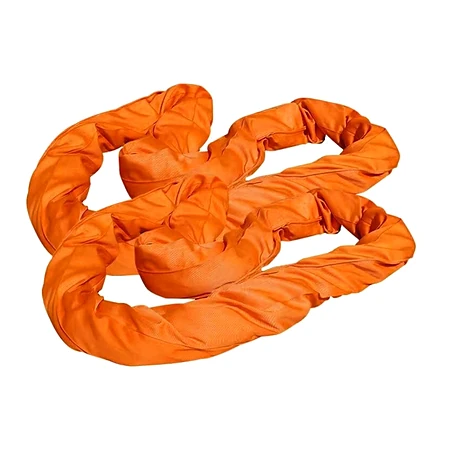
A 100 tonne round sling is a heavy-lift textile sling with a working load limit of 100 t – 100,000 kg – in a vertical lift, and a minimum breaking load of 700 t on the 7:1 safety factor used in EN 1492-2 practice. The load path is a parallel bundle of high-tenacity polyester yarn inside a woven sleeve, and there is no metal anywhere in the sling.
At this capacity the sling stops being something one person carries to the hook. The sleeve is a thick tube, the minimum length is measured in metres rather than centimetres, and the lift has to be planned around the sling – the hardware it sits in, the angle the legs open to, the headroom, and the pallet truck or second person needed to move it. This page covers the 100 t class itself: the numbers behind the rating, the physical size and mass, the assembly arithmetic, and the details that turn an enquiry into a specification.
The 100 Tonne Rating in Numbers
The figure on the label is the vertical rating. Every other arrangement is that figure multiplied by a mode factor, and at 100 t the difference between one arrangement and another is measured in tens of tonnes – so it is worth reading the row you are actually rigging.
| Configuration | Mode factor | Rated capacity | In kilograms | Approx. in kN |
|---|---|---|---|---|
| Vertical | 1.0 | 100 t | 100,000 kg | 981 kN |
| Choked | 0.8 | 80 t | 80,000 kg | 785 kN |
| Basket, 0-7 degrees | 2.0 | 200 t | 200,000 kg | 1,962 kN |
| Basket, 7-45 degrees | 1.4 | 140 t | 140,000 kg | 1,373 kN |
| Basket, 45-60 degrees | 1.0 | 100 t | 100,000 kg | 981 kN |
kN values use g = 9.81 m/s2 and are rounded. Confirm the arrangement before the lift.
The 700 t minimum breaking load – about 6,867 kN – is a property of the sling itself. The mode factors change what you are permitted to lift, not what the sling can take. In a multi-leg assembly the share taken by each leg depends on the included angle and on the load being symmetrical, so the assembly has to be confirmed as well as the sling.
Two further numbers matter at this size. Elongation is around 3% at the working load limit, which on a 6 m sling is roughly 180 mm of extension under full load – that has to come out of the headroom, not out of the lift height. And the safety factor: 7:1 is standard practice here, while a 6:1 or 8:1 factor is produced to order where the market requires it, and the label then carries the factor the sling was built to.
80 t, 100 t or 120 t – Choosing the Class
The neighbouring classes are the same article at different capacities, and the jump between them changes more than the number on the label: the sleeve gets thicker, the minimum length gets longer, the mass per metre rises and the price follows the fibre.
| Class | WLL vertical | MBL at 7:1 | 2-leg assembly at 45 degrees | Where it fits |
|---|---|---|---|---|
| 50 tonne round sling | 50 t | 350 t | 71 t | Coil and plate packs, machine beds, precast panels |
| 80 tonne round sling | 80 t | 560 t | 113 t | Heavy precast, tower sections, shipyard blocks |
| 100 tonne round sling | 100 t | 700 t | 141 t | Transformers, mill rolls, girder and frame assemblies |
| 120 tonne round sling | 120 t | 840 t | 170 t | The largest road-transportable modules, offshore fabrications |
Two-leg figures assume uniform loading with the legs at 45 degrees to the vertical.
Buying up a class “for margin” is the most common mistake at this end of the range. A 120 t sling is not a 100 t sling with extra safety built in – it is a heavier, bulkier article with a longer minimum length, and it may not physically fit the geometry you are rigging. The 100 t figure already carries a 7:1 factor; the margin you actually need comes from sizing the assembly, not from over-buying the sling.
The other mistake is buying one larger sling instead of two smaller ones. Two 100 t slings in a two-leg assembly at a 45 degree leg angle carry 141 t between them, and they let you spread the pick-up points across a load that a single sling would have to choke. Where the geometry allows it, an assembly is usually the cheaper route to more capacity.
Two-, Three- and Four-Leg Assemblies at 100 Tonnes
A multi-leg assembly does not add up the working load limits of its legs. Each leg carries a share set by the included angle, and the assembly is rated by its weakest element rather than by its slings.
| Included angle between legs | Leg angle from vertical | 2-leg assembly | 4-leg assembly (3 legs assumed) |
|---|---|---|---|
| 0 degrees | 0 degrees | 200 t | 300 t |
| 60 degrees | 30 degrees | 173 t | 260 t |
| 90 degrees | 45 degrees | 141 t | 212 t |
| 120 degrees | 60 degrees | 100 t | 150 t |
Uniform, symmetrical loading assumed. An uneven centre of gravity puts the whole share on fewer legs.
A four-leg assembly is rated on three legs because a rigid load rarely shares evenly across four. The practical consequence is that the assembly rating, not the sling rating, governs the lift – and the assembly should be tagged and recorded as its own item of equipment.
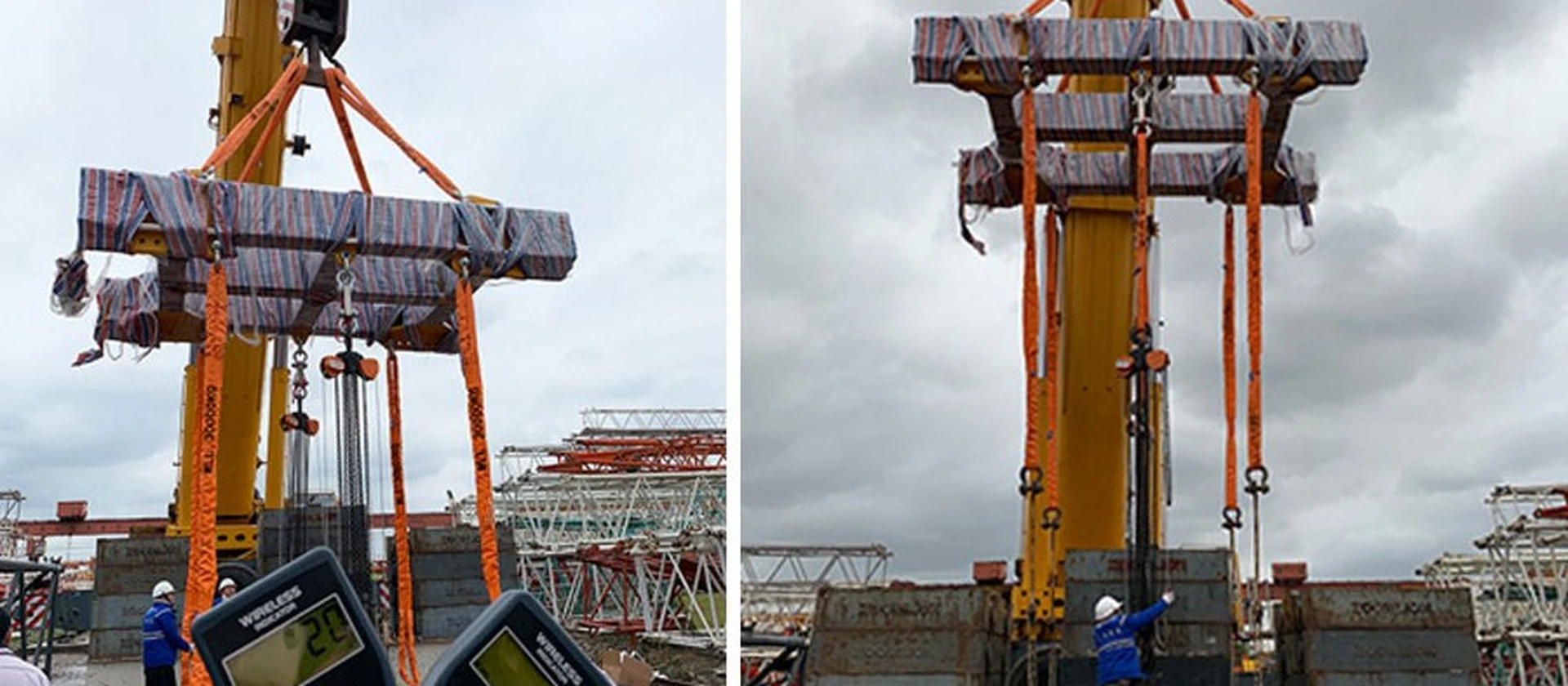
This arithmetic is also why a lifting beam or spreader beam earns its place above 100 t. Held vertical, the legs keep the assembly at its full 200 t or 300 t; allowed to open until the legs sit 60 degrees from the vertical, the same slings rate 100 t. Choosing the beam is often cheaper than buying the next class of sling.
Physical Size, Mass and Length at 100 Tonnes
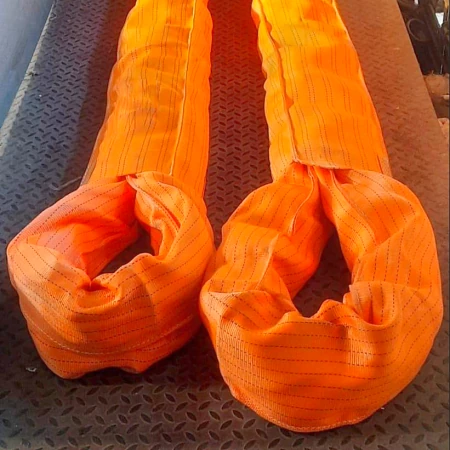
A 100 t core is a dense bundle and the sleeve around it is a thick tube. The figures below are reference values for a standard double-wall polyester build; the approval drawing governs the final dimensions.
| Property | Reference value |
|---|---|
| Sleeve diameter, double wall | approx. 125 mm |
| Mass | approx. 13 kg per metre of body |
| Mass, 6 m eye-to-eye sling | approx. 78 kg |
| Mass, 9 m eye-to-eye sling | approx. 117 kg |
| Standard length range | 3-12 m eye-to-eye, or the equivalent circumference; longer on request |
| Minimum length | Rises with capacity, confirmed on the drawing before production |
Reference values for quotation and handling planning, not manufacturing tolerances.
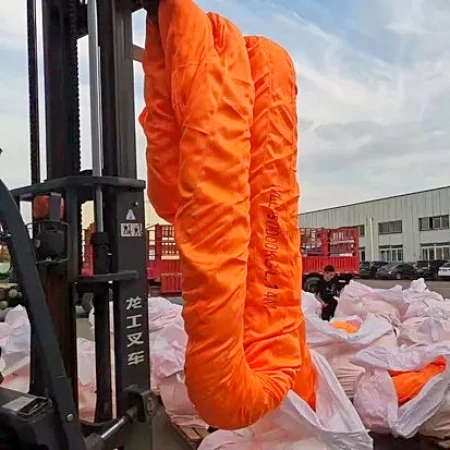
Two consequences follow. First, the sling does not coil small: it arrives bagged, often palletised at long lengths, and it is moved with a pallet truck, a forklift or a second person – never dragged, because dragging a loaded sling is the fastest way to scrap it. Second, there is a floor on the length. A 125 mm sleeve cannot be gathered into a short eye-to-eye distance, so if the length you want falls below the minimum for 100 t we will say so before quoting rather than after.
Eye-and-Eye or Endless at 100 Tonnes
Both are built on the same core and the same sleeve at this capacity. The choice is about how the sling meets the load.
| Property | 100 t eye and eye round sling | 100 t endless round sling |
|---|---|---|
| Termination | Two stitched eyes | Continuous loop, no ends |
| Length | Measured between the eyes | Ordered by circumference; working length about half |
| Rigging | Hooks and shackles like a webbing sling | Vertical, choke, basket, double wrap |
| Wear | Fixed bearing points | Rotate the loop to spread wear |
| Best for | Repeat lifts, fixed geometry, defined pick-up points | Awkward shapes, several arrangements, longest service life |
Construction and inspection for each are covered on the eye and eye round sling and endless round sling pages; this page is about the 100 t class itself. Where the eyes meet steel on every lift, the protected eye-to-eye round sling adds thimbles and replaceable wear sleeves. If the load is hot, the aramid round sling and high temperature round sling carry the same class of rating in a fibre that tolerates heat. Where the weight of the sling itself is the problem, UHMWPE round slings halve it at a higher cost per sling.
Hardware That Matches a 100 Tonne Sling
A 700 t sling is only as good as the shackle under it. Size the hardware to the leg load it will see, not to the sling.
| Arrangement at 100 t | Load in the leg | Minimum shackle WLL |
|---|---|---|
| Single vertical lift | 100 t | 120 t |
| Two-leg assembly, 45 degree leg angle | 70.5 t | 85 t |
| Four-leg assembly, 45 degree leg angle (3 legs assumed) | 70.7 t | 85 t |
Selection guidance only – the hook and shackle must also be rated for the assembly, not for a single sling.
Beyond the shackle, the hook bowl has to be wide and round enough to take a 125 mm sleeve without point-loading the eye, and the hook itself must be rated for the assembly. A hook that is too small turns a 700 t sling into the weak link of the lift. For sheared plate, hot work or coiled steel, compare a 100 tonne webbing sling, a wire rope grommet or a coil C-hook before assuming a round sling is the right tool.
Technical Specifications
| Parameter | Specification |
|---|---|
| Product name | 100 tonne round sling / 100 ton round sling / 100 t round sling / heavy duty round sling |
| Working load limit | 100 t (100,000 kg) vertical; 80 t choked; 100-200 t in a basket by angle |
| Minimum breaking load | 700 t at a 7:1 safety factor (approx. 6,867 kN); 6:1 or 8:1 produced to order |
| Core | High-tenacity polyester parallel yarn as standard; aramid or UHMWPE on request |
| Sleeve | Woven high-tenacity polyester, single or double wall; double wall recommended at 100 t |
| Termination | Endless loop, or two stitched eyes with or without thimbles |
| Length | Eye-to-eye distance or circumference, produced to order; minimum confirmed on the drawing |
| Elongation | Approx. 3% at the working load limit |
| Temperature | Polyester approx. -40 C to +100 C; aramid core version for higher temperatures |
| Reference standard | EN 1492-2 practice as standard; AS 4497, ASME B30.9 and other market standards to order |
| Colour | No EN 1492-2 colour code above 12 t; sleeve colour to order |
| Marking | Sewn label with working load limit, length and batch; sleeve print such as SWL 100T / L6M |
| Packing | Coil in a poly bag, labelled carton, pallet for long lengths, export packing to order |
| HS code | 630790 |
| MOQ and OEM | Low MOQ for trial orders; OEM on length, sleeve, colour, fibre, label layout and packing |
Marking and the Label at 100 Tonnes
EN 1492-2 colour codes the sleeve from 1 t to 12 t. Above 12 t there is no colour code, so on a 100 t sling the sewn label and the sleeve print are the only reliable statements of capacity – read the label, not the colour.
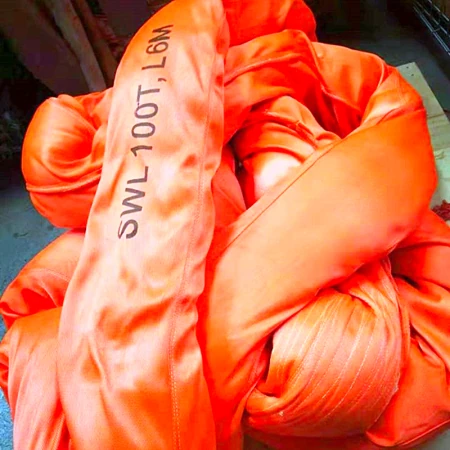
The label carries the working load limit, the length and the batch. The sleeve print repeats the capacity and length in the largest type on the article, which is what a rigger reads from the floor. Both have to stay legible: a sling whose label can no longer be read cannot be identified, and an unidentified sling should not be used.
Inspection at 100 Tonnes
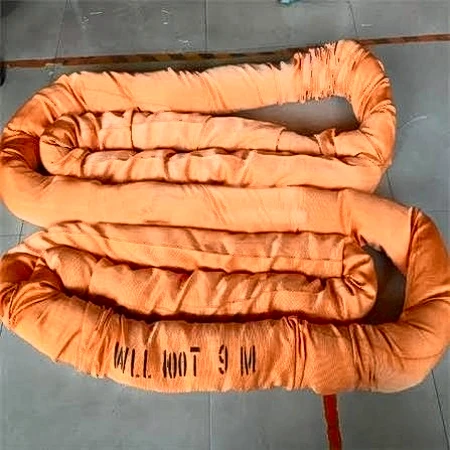
- Read the label first: working load limit, length and batch – legible and still attached.
- Run the whole sleeve through your hands: cuts, abrasion, glazing, hardening, chemical staining.
- Retire the sling immediately if the core shows or bulges through the sleeve anywhere.
- On an eye-and-eye sling, inspect the stitch rows and the gather at each eye before the body.
- Check the hardware as well: a worn hook bowl or a rough shackle pin will chew through a sleeve.
- Record the lifts and the damage, and retire on condition rather than on age alone.
A 100 t sling is an asset rather than a consumable. Store it coiled, off the floor, out of sunlight and away from heat, where it can be seen and inspected between lifts.
Where 100 Tonne Round Slings Are Used
- Steel coils, slabs and plate packs, where a soft bearing protects the surface
- Power transformers, generators and heavy electrical plant
- Rolling mill rolls, press frames, machine beds and machine tools
- Bridge girders, welded frames and fabrication assemblies
- Precast concrete segments, moulds and formwork
- Shipyard blocks, marine modules and offshore fabrications
- Wind turbine components – hubs, nacelle parts, tower sections and blade roots
- Basket lifts under rolls, shafts and pipe spools
Testing, Certification and Export Paperwork
Every sling is checked on its sleeve, its terminations, its length and its label before packing, and slings are load tested to verify the rating. On request a consignment can travel with the fibre certificate, the batch test figures and a test certificate. Where a project calls for a witnessed test or a third-party inspection, tell us before the order so the scope is agreed with the specification rather than after it. Our certification page lists the management systems behind the process.
Export paperwork follows the same rule: state the destination and the standard marking your market reads – EN, AS 4497 or ASME – and the label and the documents are built to match. The HS code for the consignment is 630790.
What to Send With an Enquiry
- The load – mass, shape, and where it can be picked up.
- The pick-up points – the distance between them, or the working height.
- The arrangement – vertical, choked, basket or multi-leg, and the angle.
- The environment – abrasive, sharp, hot, wet, marine or clean.
- The paperwork – the marking, test certificate or inspection your market requires.
If you only know the load and the height, send those two. We will size the rest and confirm it against the lift you intend to rig.
Frequently Asked Questions
How much can a 100 tonne round sling lift?
100 t in a vertical lift, which is the figure printed on the label. Choked, it is rated 80 t. In a basket it is 200 t at 0-7 degrees, 140 t at 7-45 degrees and 100 t at 45-60 degrees. The capacity you actually have depends on the arrangement, so confirm it before the lift.
What is the breaking strength of a 100 tonne round sling?
700 t minimum breaking load, from a 7:1 safety factor on the 100 t working load limit – about 6,867 kN. Where a market requires 6:1 or 8:1, the sling is produced to that factor and the label is marked accordingly.
How heavy is a 100 tonne round sling?
Around 13 kg per metre of body, so a 6 m eye-to-eye sling is approximately 78 kg and a 9 m sling about 117 kg – reference values for handling planning, confirmed on the drawing. Plan a pallet truck, a forklift or two people, and never drag a loaded sling.
Can a 100 tonne round sling be made to a custom length?
Yes. Eye-and-eye slings are made to the distance between the eyes; endless slings are made to a circumference. A minimum length applies and it rises with the capacity, because a 100 t sleeve cannot be gathered into a short span. Send the pick-up distance or the working height and we will confirm what is possible.
Why is a 100 tonne sling not colour coded?
The EN 1492-2 colour code runs from 1 t to 12 t. Above 12 t the colour no longer identifies the capacity, so the working load limit on the sewn label is what governs. Never read the capacity of a heavy sling from its colour.
Do two 100 tonne slings give me 200 tonnes?
Only with the legs vertical. In a two-leg assembly the capacity is reduced by the angle: 173 t at 60 degrees included, 141 t at 90 degrees and 100 t at 120 degrees. A four-leg assembly is rated on three legs, so four 100 t slings do not give 400 t either. The assembly rating governs the lift.
What shackle do I need with a 100 tonne sling?
Size to the leg load, not the sling. A single vertical 100 t lift needs a shackle rated at least 120 t; a two- or four-leg assembly at a 45 degree leg angle puts about 70 t in each leg, so an 85 t shackle is the minimum. The hook and shackle must also be wide enough for a sleeve of roughly 125 mm.
Do you supply test certificates with the order?
Yes. The fibre certificate, the batch test figures and a test certificate can travel with the consignment on request. Tell us the standard marking or third-party inspection your market needs before the order, so the documentation is agreed together with the specification.
Request a 100 Tonne Round Sling Quote
Send the load, the pick-up points, the arrangement and the environment – plus the marking and certification your market requires. We will come back with a length, a sleeve, a test figure and a factory-direct price.
Send your 100 tonne sling specification
Related Products
- All round slings, 1-100 t
- 80 tonne round sling – the class below
- WLL 120T polyester round slings, AS 4497
- WLL 100T heavy duty round slings with eyes
- Endless round sling – no ends, no stitching
- Protected eye-to-eye round sling – thimbles and wear sleeves
- Aramid round sling – heat resistant core
- 100 tonne webbing sling – the flat alternative