

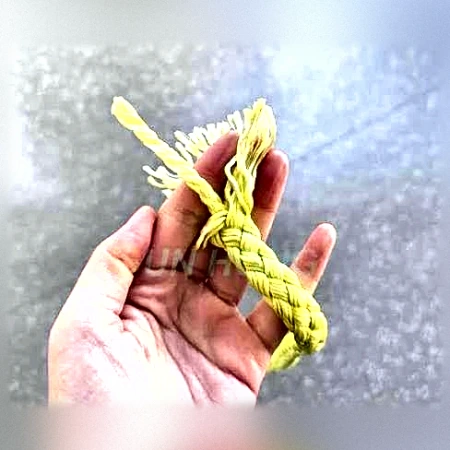
Lift sling rigging company produce Paper Carrier Rope,Paper Guiding Dupont Carrier Rope,Nylon Paper Carrier Rope for Corrugated Paper Mill,Paper Leading Carrier Rope with Core for Paper Making Machine.
Paper Carrier Rope
Nylon 66 eight-strand braid for paper machine tail threading – 8 mm to 16 mm, impregnated, spliced into a closed loop
A paper carrier rope has one job: carry the tail of the paper web from one section of the machine to the next and hold it there while the sheet is threaded. This paper carrier rope is an eight-strand braided rope made from nylon 66 (polyamide 66) multifilament, impregnated with a paraffin-based finish and supplied spliced into an endless loop cut to the length you measure on the machine. It runs in the rope grooves of the dryer cans, guide rolls and rope sheaves – from the press section through the after-dryer to the reel – and on tissue, board and corrugated machines where the tail has to cross a gap that no felt can span. Standard diameters are 8 mm to 16 mm, and 10, 11, 12 and 13 mm cover most installations. For the wider nylon rope range we braid, see nylon rope products.
Key Features of Our Paper Carrier Rope
Nylon 66 That Survives the Dryer Section
A paper machine is a hard place for a rope: wet at the press end, hot and dry in the after-dryer, and coated in starch, size and coating colour in between. Nylon 66 is specified because it holds its strength through that cycle. It melts at about 255 °C, far above any dryer-can surface temperature, and unlike polyester it does not hydrolyse in the humid heat of the drying section. The impregnation is the other half of the answer: a paraffin-based finish fills the space between filaments, so moisture and starch particles cannot work into the braid and the surface stays firm enough to grip the tail instead of glazing over. Where a wet-end or coating duty needs minimum stretch more than toughness, we braid the same rope in filament polyester instead.
Eight-Strand Braid That Stays Round
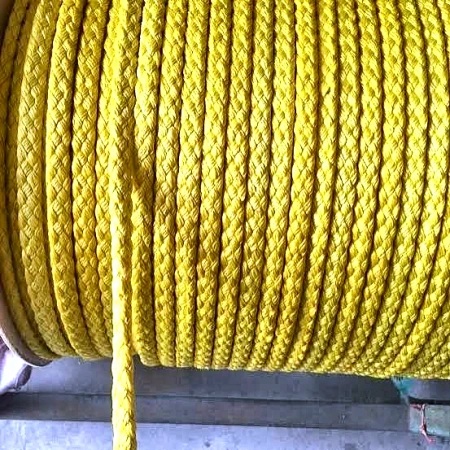
The rope is braided, not twisted. Eight strands interlace around a hollow centre – or around a core, if you specify one – so the rope carries no torque and does not kink as it leaves a sheave. Braiding also lets the rope keep a circular section under running tension, which is the property that matters most in a rope groove. A rope that flattens loses contact area with the groove, slips, and starts to wear on the shoulders of the sheave. Ours is braided at a controlled angle and density, checked batch by batch, so the diameter is consistent along the whole length and the rope sits in the groove the way the machine was designed for.
Low Stretch Under Running Tension
A carrier rope runs pre-tensioned and has to stay that way. If it creeps, the span between two sheaves sags, the tail drops out of the groove and the machine is stopped to re-thread it. Nylon 66 has a high modulus for a polyamide, and because the braid is compact and impregnated, most of the constructional stretch comes out during the first tensioning on the machine. Measure the loop and pre-tension to the figure in your machine manual; on long runs we quote a cored construction that holds tension more firmly.
Spliced Into a Loop, Not Knotted
A paper carrier rope works as a closed loop, and the joint is where most failures begin. A knot gives away a large part of the rope’s strength and leaves a lump that will not pass a sheave. We finish the rope with an eight-strand bury splice: both ends are tapered, married and buried back into the hollow braid, so the joint is smooth, runs over the sheaves and keeps the great majority of the rope’s strength. The splice is made to the loop length you measure – tell us whether you measured around the outside of the pulleys or on the centre line of the run.
Technical Specifications
| Item | Specification range |
|---|---|
| Product name | Paper carrier rope / paper machine carrier rope / paper leading rope / paper guiding rope |
| Material | Nylon 66 (polyamide 66) multifilament, high tenacity; filament polyester on request |
| Construction | 8-strand braided (plaited); hollow braid or braid with core |
| Standard diameters | 8 · 10 · 11 · 12 · 13 · 15 · 16 mm (custom range 6-20 mm) |
| Diameter tolerance | ± 5 % on nominal diameter |
| Linear density | About 30-105 g/m depending on diameter (see table below) |
| Surface finish | Paraffin-based impregnation as standard; unimpregnated on request |
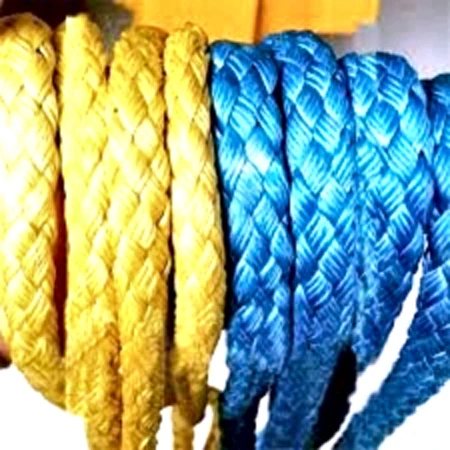
| Colour | Yellow standard; blue, red, black and natural; other colours to order |
| Elongation at break | About 30 % (nylon 66); constructional stretch removed by pre-tensioning |
| Service temperature | Dryer-section ambient; nylon 66 melts at about 255 °C |
| Machine speed | Standard braid for machines running up to about 800 m/min; higher-speed constructions quoted on request |
| End finish | Eight-strand bury splice into an endless loop; fused or whipped tapers; thimble eye on request |
| Loop length | Any length measured on your machine; tolerance ± 0.5 % |
| Spool and packing | 200 · 400 · 600 · 915 · 1525 m spools, or coil in carton; wooden case for export |
| Marking | Length mark, customer logo and batch number; printed label or knurled band |
| MOQ and OEM | Low MOQ for trial orders; full OEM – diameter, colour, length, splice, label and packing |
| HS code | 5607.50 – rope and cordage of synthetic fibres |
Standard specification range – other diameters, braid densities and loop lengths are braided to order.
Diameter and Breaking Strength
The table below is a reference for standard eight-strand braided paper carrier rope. Breaking strength is a batch minimum, not a design allowance: the rope runs pre-tensioned at a small fraction of it, and the running tension is set by the machine rather than by the rope.
| Diameter | Weight (approx.) | Typical breaking strength | Typical running tension | Where it is usually specified |
|---|---|---|---|---|
| 8 mm | 30 g/m | 12 kN (1,220 kg) | 1.2 – 1.8 kN | Tissue and light paper machines, short threading runs |
| 10 mm | 40 g/m | 18 kN (1,830 kg) | 1.8 – 2.7 kN | Tissue and fine paper, narrow tails |
| 11 mm | 57 g/m | 21 kN (2,140 kg) | 2.1 – 3.1 kN | Fine paper and newsprint machines |
| 12 mm | 65 g/m | 25 kN (2,550 kg) | 2.5 – 3.7 kN | Fine paper, newsprint and coated machines – the common size |
| 13 mm | 75 g/m | 27 kN (2,750 kg) | 2.7 – 4.0 kN | Board machines with a wider or heavier tail |
| 15 mm | 91 g/m | 32 kN (3,260 kg) | 3.2 – 4.8 kN | Heavy board, kraft and long loops |
| 16 mm | 105 g/m | 36 kN (3,670 kg) | 3.6 – 5.4 kN | Heavy board machines and worn rope grooves |
Typical reference values for eight-strand nylon 66 paper carrier rope. Diameter, mass and breaking strength are confirmed by the test certificate issued for your batch.
How to Choose the Right Paper Carrier Rope
Four numbers decide the specification, and every one of them comes from your machine rather than from a catalogue:
- Machine speed. It sets the braid density and the surface finish. Above roughly 800 m/min the rope spends less time in contact with each groove, so a denser braid and a firmer impregnation are needed to keep grip.
- Rope groove and sheave diameter. The rope has to fill the groove but not sit proud of it. On a worn groove, the next size up or a cored construction often restores grip without changing the sheave.
- Tail width and sheet weight. A wider, heavier tail needs more contact area and a stiffer rope – 12 mm and 13 mm carry most board-machine tails.
- Loop length and number of loops. Measure the run, count spares, and allow for the splice and for the stretch taken up at first tensioning.
| What we need from you | Why it changes the quotation |
|---|---|
| Machine type and maximum speed | Fixes the braid density, the impregnation and whether a cored rope is needed |
| Rope diameter, or the groove width | Selects the diameter; the groove decides whether it will grip |
| Loop length, and how it was measured | The splice is made to that length; centre-line and outside measurements differ |
| Core or hollow braid | Cored ropes hold tension on long runs; hollow braids splice more easily |
| Colour, marking and packing | Machine-side identification, spare-loop storage and export packing |
Send these five details and we will confirm the specification, the splice length and a factory-direct price.
Where Paper Carrier Ropes Are Used
- Tail threading through the press section and the after-dryer of fine paper and newsprint machines
- Size press and coating stations, where the tail has to cross open draws
- Tissue machines, where the tail is light and the rope runs at high speed
- Board and kraft machines, with a wider and heavier tail
- Corrugated board machines, including single facer and bridge threading
- Rope-less and rope-guided threading systems as the carrier or guide rope
- Paper mills that keep a spare spliced loop per machine for a fast change
On the mill floor the rope is only one part of the handling chain. We also supply the webbing slings and round slings used to move paper reels and broke, and roll lifting beams for handling reels at the winder.
Installation, Splicing and Rope Life
A new loop is only as good as its installation. Feed the rope through the run following the machine drawing, keep it out of contact with sharp edges, and pre-tension it to the figure in the manual before the first threading. Every rope we send is supplied with written splicing instructions, and we will send a video for your maintenance team on request: the tails are tapered over roughly forty diameters, married strand by strand and buried into the hollow braid, then the joint is worked smooth so it passes every sheave.
Life is decided by the sheaves. A carrier rope wears where it touches cast-iron rope pulleys, and a rough or worn groove will cut a rope’s service life short whatever the braid. Inspect the splice and the groove contact line at every shutdown, and replace the loop when the diameter has fallen by about a tenth, when the splice starts to creep, or when the surface has hardened and lost grip. Store spare loops dry, out of sunlight and off a concrete floor.
Customisation and OEM Service
- Diameter – 8-16 mm standard, 6-20 mm on request
- Construction – hollow eight-strand braid, or braid with a core for long runs
- Loop length – any length, spliced to your measurement, ± 0.5 %
- Colour – yellow, blue, red, black, natural; other colours to order
- Marking – length marks, machine number, your logo, batch number
- Packing – spool, coil or wooden case; private label and barcode available
- Companion items – slings, nets and lifting beams supplied on the same order
Quality Control
Every batch is checked on diameter, linear density, braid density, impregnation uptake and splice finish, and sampled for breaking strength before it is packed. We have braided rope and woven webbing for industrial, safety and paper-mill customers for close to three decades. On request we supply the yarn certificate, the batch test report and a sample length for your maintenance team to splice and run before volume production begins.
Frequently Asked Questions
What diameter paper carrier rope does my machine need?
Match the rope to the rope groove first, then to the tail. Most fine-paper and newsprint machines run 11 mm or 12 mm; tissue machines often use 10 mm; board machines with a wider tail use 13 mm to 16 mm. Send us the groove width and the machine speed and we will confirm the size.
Hollow braid or rope with a core?
A hollow eight-strand braid is the easier rope to splice and is what most mills keep on the shelf. A cored rope holds pre-tension better on long runs and resists flattening in a worn groove. If a machine keeps losing tension between shutdowns, the cored construction is usually the fix.
Nylon or polyester for a paper carrier rope?
Nylon 66 is tougher and more abrasion resistant, which suits dryer-section duty and worn sheaves. Filament polyester is the choice where the run is very wet and minimum elongation matters more than impact strength. Both are braided in the same eight-strand construction, so the splice and the handling are the same.
Can you supply the rope already spliced into a loop?
Yes – that is the normal supply. Give us the loop length and how you measured it, and the rope arrives spliced, with the tapers fused or whipped. Loose rope on a spool is also available if your team prefers to splice on site.
How long does a paper carrier rope last?
It depends far more on the sheaves than on the calendar. On a machine with smooth, correctly aligned grooves and the right pre-tension, a loop runs for many months; a rough groove or a running tension that is too low will wear a rope out in weeks. Keep a spare loop per machine and inspect the splice line at every shutdown.
Do you supply small quantities for a trial?
Yes. The minimum order is deliberately low so a mill can splice one loop, run it and judge the braid before committing to a year’s requirement. Send the diameter, the loop length and the machine speed, and we will quote a trial loop and a production price.
Request a Quote for Paper Carrier Rope
Send us the machine type and speed, the rope diameter or groove width, the loop length and how it was measured, plus any colour, marking or certification your mill requires. We will come back with a specification, a splice drawing and a factory-direct price, and can ship a sample length for your maintenance team to handle before the first production loop.
Lift Sling Rigging Co., Ltd – telephone and WeChat +86 180 6600 2268, e-mail 702461526@qq.com, Lifute Industrial Park, Taizhou City, Jiangsu Province, China. HS code 5607.50.