

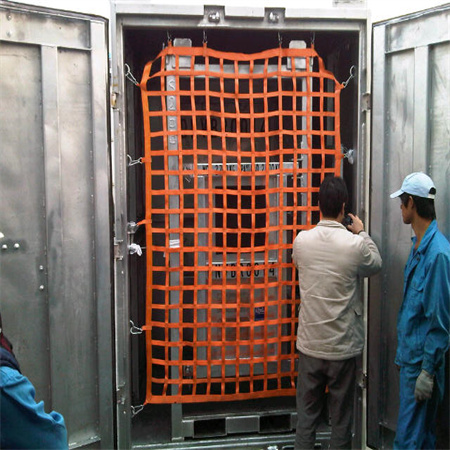
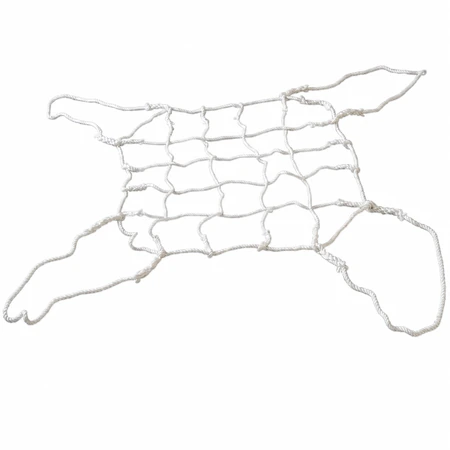
Lift sling rigging company produce Polyester Lifting Hoisting Net,Polyester Cargo Net,Safety Lifting Net Strap,Bungee Cargo Net,Polyester Cargo Lifting Net,Lifting Sling Net,Rope Lifting Net,Pallet Cargo Net,Garden Climbing Net.
Polyester Lifting Hoisting Net
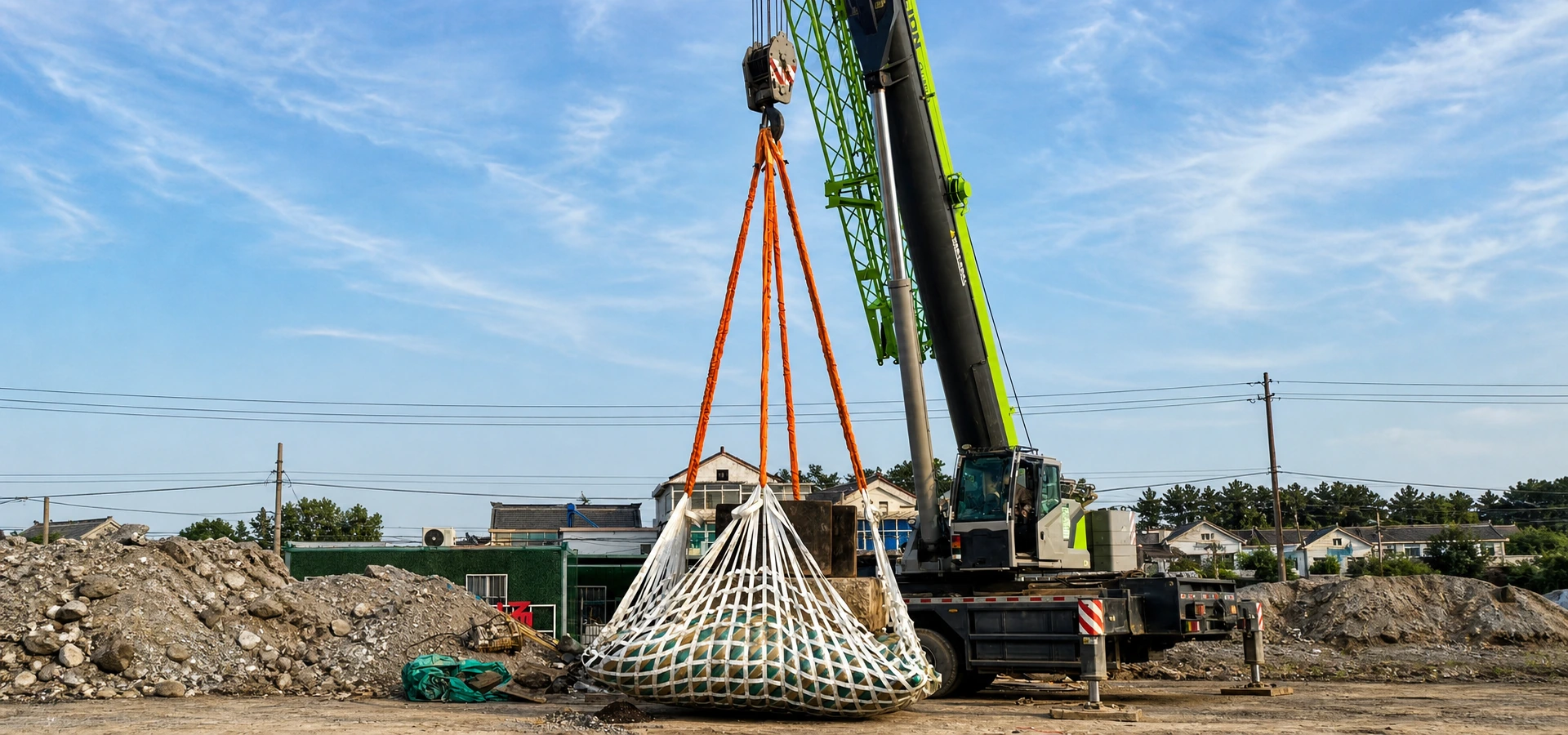
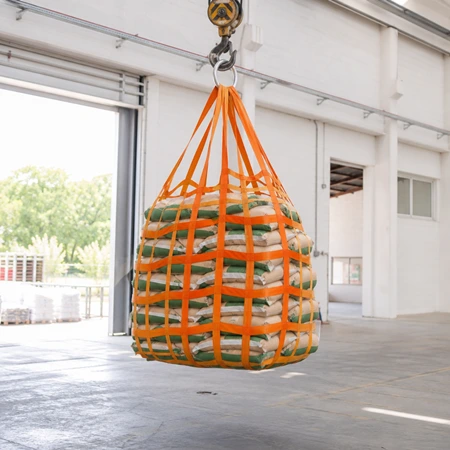
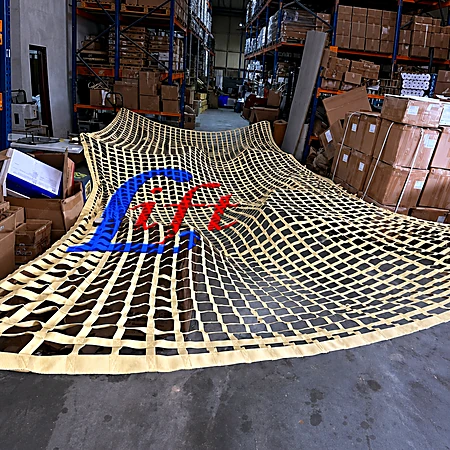
A polyester lifting hoisting net is a soft bag woven from high-tenacity polyester webbing, built to move bagged goods and bulk material in a single crane lift. The load is tipped into the bag, or the bag is laid flat and drawn up around a stack, and four corner loops carry the whole consignment to the hook. There is no pallet to return, no strapping to cut, and nothing to re-handle at the far end.
Because we weave the webbing in our own mill in Taizhou, Jiangsu, the mesh opening, bag footprint, depth, bottom construction and working load limit are all set to the cargo rather than to a fixed catalogue. Standard nets cover 0.5 t to 20 t and 0.6 m³ to over 10 m³, every net is proof-load tested before packing, and each shipment travels with a material test report. Nets are CE and GS certified, with webbing rated to the EN 1492-1 basis.
- Fully custom build – mesh, bag size, depth, colour and safety factor (5:1, 6:1 or 7:1) set to your specification.
- High-tenacity polyester webbing – 25 mm to 100 mm bands, single, duplex or triplex, UV stabilised and rot-proof.
- Wear and heat resistant – working range -40 °C to +100 °C, with a reinforced bottom for abrasive loads.
- Soft, flexible and light – the flat band contacts the load over a wide area, so bags, cartons and finished surfaces are neither crushed nor marked.
- CE and GS certified – tested on our own 1000 t machine, with an ISO 9001 quality system and a CNAS-accredited laboratory behind it.
Why a webbing net bag, and not a rope net or a big bag
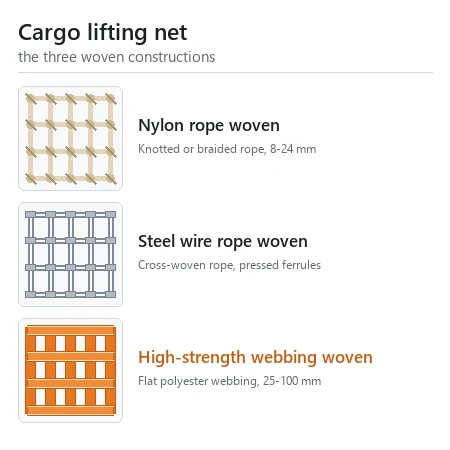
Three products are sold for the same job and they behave very differently once the load is in the air. A rope net concentrates the load on a few contact points. A big bag carries one free-flowing product and is itself the package. A webbing net bag spreads the pressure across flat bands, holds a stacked or mixed load together, and goes back to the store empty.
Table 1 – How the four common ways of lifting loose cargo compare.
| Option | Construction | Contact with the load | Best cargo | Limitation |
|---|---|---|---|---|
| Polyester webbing net bag | Flat woven bands, 25-100 mm, 25-300 mm mesh | Wide flat bands, low pressure per cm² | Bagged, stacked, mixed and bulk cargo | Needs a crane or hook; not a sealed package for powder |
| Nylon rope net | Knotted or braided rope, 8-24 mm | Line contact at every rope | Irregular and heavy single items | Ropes mark soft cargo; a tight mesh adds weight |
| FIBC / big bag | Woven PP fabric with a liner | Full surface, sealed | One free-flowing product per bag | Single product only; the bag is the packaging |
| Pallet and strapping | Timber or plastic pallet plus bands | Rigid base | Unitised cartons | Pallet returned or lost; bands cut and discarded; no drainage |
Five decisions that set the specification
A polyester lifting hoisting net is quoted from five numbers. Get them right and the net arrives right; get the mesh wrong and no amount of extra tonnage will fix it later.
Table 2 – What we need to know, and why each answer changes the net.
| Decision | What it fixes | What to tell us |
|---|---|---|
| 1. Cargo form | Whether the net is a bag or a flat sheet, and how the bottom is built | How the cargo arrives: sacks, big bags, bales, or loose material |
| 2. Weight per lift | Band width and layer count, and therefore the rated capacity | The gross weight you intend to lift, not the weight of the net |
| 3. Filled volume | Footprint and depth of the bag | Bulk density (t/m³) for loose material, or the height of the stack for bagged goods |
| 4. Mesh opening | The largest gap the cargo can pass through | The smallest unit in the load: a 25 kg bag, grain, aggregate or scrap |
| 5. Discharge method | Closed, laced, chute or lined bottom | Whether the bag is tipped, untied over a hopper, or emptied by hand |
Weight and volume are two separate limits, and for light bulk the volume arrives first. Grain at about 0.7 t/m³ and wood chips at about 0.3 t/m³ both fill a 3.6 m³ bag, but one lift weighs about 2.5 t and the other about 1 t. Send the bulk density with the tonnage and we will size the bag so that a full bag is also a legal bag.
Technical parameters
The figures below cover the standard bagged and bulk range. Mesh, footprint, depth, bottom, loops and capacity are made to order, so treat this as the starting point for a quotation rather than a fixed catalogue.
Table 3 – Polyester lifting hoisting net: technical parameters.
| Parameter | Specification |
|---|---|
| Product name | Polyester lifting hoisting net (polyester webbing net bag) |
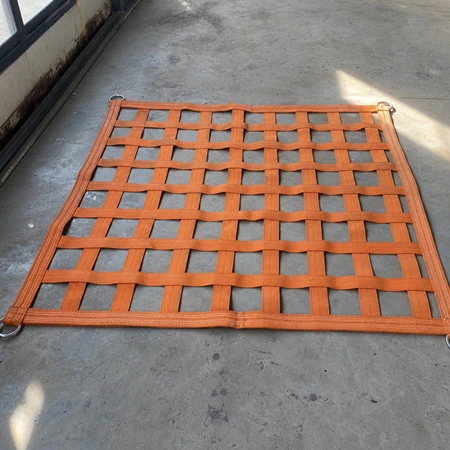
| Configurations | Closed bag, release-bottom bag, or flat lifting net |
| Webbing material | 100 % high-tenacity polyester (PET); high-tenacity nylon on request |
| Band width | 25 / 38 / 50 / 75 / 100 mm (50 mm standard) |
| Band construction | Single layer, duplex or triplex; woven selvedge, not a cut edge |
| Band thickness | 1.8 mm – 4.5 mm depending on width and layer count |
| Mesh opening | 100 × 100 mm standard; 25 – 300 mm made to order |
| Net size | Made to the load footprint, truck bed or receiving hopper; see Table 4 |
| Bag depth | 0.8 m – 2.5 m, or to drawing |
| Filled volume | About 0.6 m³ to over 10 m³, set by footprint and depth |
| Border | Folded and double-stitched, reinforced at every lifting point |
| Lifting points | Four corner loops standard; eight for a spreader beam; loops top and bottom on request |
| Rated capacity (WLL) | 0.5 t – 20 t, set by band, layer count and lifting arrangement |
| Safety factor | 5:1 / 6:1 / 7:1 |
| Elongation at WLL | 7 % or less |
| Colour | Colour code by working load limit, or a custom house colour |
| Working temperature | -40 °C to +100 °C |
| Weather and chemical | UV stabilised, rot-proof, unaffected by rain, sea water and wash-down |
| Marking | WLL, mesh and batch printed on the belt, plus a sewn capacity label |
| Standard basis | Webbing rated to EN 1492-1 |
| Certification | CE, GS, ISO 9001, JIS on request; CNAS laboratory; DNV |
| Customisation | OEM / ODM size, colour, printed logo, label and packing |
| HS code | 6307.90 – nets and netting of textile materials |
Standard sizes, volumes and working load limits
These six lines cover the great majority of bagged and bulk work. Filled volume is calculated from the footprint and the depth with an allowance for the rounded shape a loaded bag takes, so a material that settles well will carry slightly more and one that bridges will carry less.
Table 4 – Standard net sizes at four corner loops gathered on one hook.
| Net size (L × W) | Depth | Filled volume | Mesh | Band | WLL | Typical cargo |
|---|---|---|---|---|---|---|
| 1.0 × 1.0 m | 1.0 m | 0.6 m³ | 50-100 mm | 50 mm single | 0.5-1.5 t | 25 kg bags, small sacks, bales |
| 1.5 × 1.5 m | 1.2 m | 1.6 m³ | 50-100 mm | 50 mm duplex | 1-2.5 t | Bagged grain, fertilizer, produce |
| 2.0 × 2.0 m | 1.5 m | 3.6 m³ | 50-100 mm | 50 mm duplex | 2-4 t | Bulk grain, sand, crushed stone |
| 2.5 × 2.5 m | 1.8 m | 6.8 m³ | 50-150 mm | 75 mm duplex | 3-6 t | Bulk fertilizer, coal, scrap, fish |
| 3.0 × 3.0 m | 2.0 m | 10.8 m³ | 100-150 mm | 75 mm duplex | 4-8 t | Large bulk loads, quay and hold work |
| To drawing | 0.8-2.5 m | To order | 25-300 mm | 25-100 mm | 0.5-20 t | Any footprint, depth and cargo |
The working load limits above assume a four-loop lift. A two-loop basket de-rates the net – ask for the derated figure rather than reading across from this table.
Mesh opening, chosen from the cargo
Mesh is the one dimension that cannot be adjusted after the net is sewn, so it is sized from the smallest unit in the load rather than from the total weight.
Table 5 – Mesh opening by cargo.
| Cargo | Recommended mesh | Reason |
|---|---|---|
| 50 kg sacks, big bags, bales | 100 mm | The sacks are far larger than the opening; the mesh only has to keep the stack together |
| 25 kg bags, small sacks | 50-75 mm | Small bags can squeeze through 100 mm once the load settles in the air |
| Grain, seed, dried produce | 25-50 mm, or a closed liner | Fine material must not sift out on the hook or in transit |
| Fertilizer, prills, powders | 25-50 mm, or a closed liner | Fine and moisture-sensitive: a liner keeps the product in and the weather out |
| Sand, gravel, crushed stone | 50-100 mm | Fine enough to hold the bulk, open enough for rainwater to drain |
| Coal, coke | 100-150 mm | Large lumps; a wider mesh keeps the net light and drains well |
| Scrap metal, offcuts | 100-150 mm | Open mesh with a reinforced bottom and wear pads at the contact points |
| Fish, shellfish, wet produce | 25-50 mm | Holds the catch, drains freely, keeps the weight honest |
| Logs, firewood, large offcuts | 150-300 mm | Indivisible pieces: a wide mesh saves weight without losing the load |
Bottom construction and discharge
How the load comes out is a design decision in its own right. For bagged cargo the answer is usually a person with a knife; for bulk it is usually gravity.
Table 6 – Bottom options and how each one is emptied.
| Bottom | How it works | Chosen when |
|---|---|---|
| Closed, fully sewn | The bag holds the cargo permanently and is emptied by tipping or by hand | Bagged cargo, and bulk tipped over a hopper or onto a pile |
| Release bottom, laced | A laced seam across the bottom is untied at the discharge point and the load falls out | Free-flowing bulk – sand, grain, aggregate – discharged without tipping the bag |
| Chute bottom | The bag narrows to a chute opened over the receiving hopper | Controlled discharge into a hopper, a barge or a conveyor |
| Closed with a liner | A fabric liner sits inside the net | Dusty or moisture-sensitive bulk: grain, fertilizer, powders |
| Reinforced bottom panel | An extra layer of webbing is stitched across the base | Abrasive and heavy bulk: aggregate, ore, scrap |
| Loops top and bottom | Loops at both ends, so the bag can be lifted either way up | Loading at height, and emptying by inverting the bag on the hook |
Lifting arrangements and fittings
How the bag is hung decides how much of the load it really carries, and bulk is unforgiving because the load keeps moving inside the bag while it is in the air.
- Four loops on the hook – the standard for bagged and bulk work; the loops gather on the hook or a master ring and the bag closes around the cargo as the crane takes up the slack.
- Eight loops on a spreader beam – the bag stays square, the load stays level, and each loop carries a predictable share; the right arrangement for large bags and high tonnage, see our lifting spreader beam range.
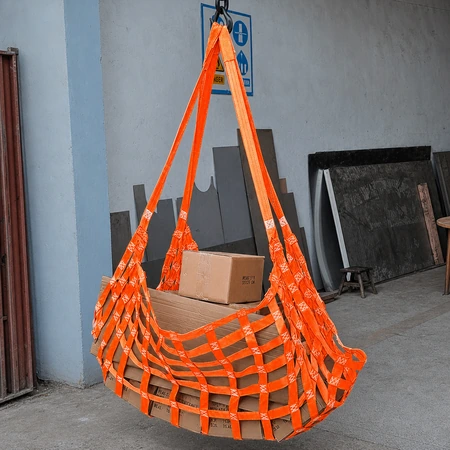
- Two-loop basket – faster to rig, but it de-rates the net; ask for the derated capacity instead of reading across from the four-loop figure.
- Loops top and bottom – lets the bag be lifted either way up, which is how a closed bag is emptied by inverting it over a hopper.
Fittings supplied or fitted on request: sewn webbing loops, master ring or master link, grade 80 shackles, laced release bottoms, chutes and discharge sleeves, inner liners, wear pads and protection sleeves for scrap and aggregate, and repair kits for fleets that maintain their own equipment.
Material, stitching and finish
The belt is the product. We weave it on needle looms from high-tenacity polyester yarn, with a woven selvedge rather than a cut edge, so the band does not fray from the outside in.
- 100 % high-tenacity polyester, low elongation (7 % or less at WLL), UV stabilised, rot-proof and unaffected by moisture.
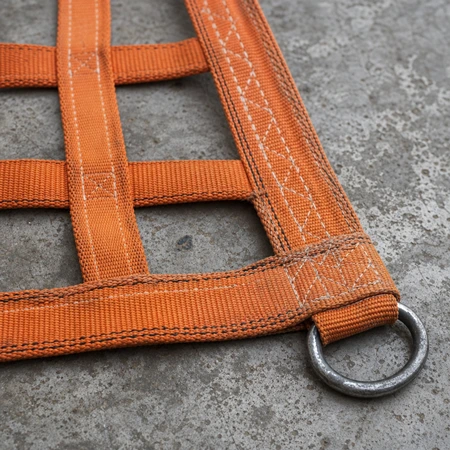
- Locked stitching in high-tenacity polyester thread, run in multiple rows along the border and box-X at every loop – on a cheap net it is the stitch line, not the belt, that fails first.
- Folded and double-stitched border, so the edge of the mesh cannot unravel under load.
- Galvanised or stainless steel rings and master links on request.
- Polyester holds its strength from -40 °C to +100 °C; above that, or in chemical exposure, tell us and we will quote nylon or another construction.
Testing, certification and traceability
- Forty years of lifting equipment manufacturing – founded in 1985 in Taizhou, Jiangsu, with more than 200 employees and one of China’s largest lifting sling and net production bases.
- Every net is proof-load tested on our own 1000 t horizontal test machine – tested, not sampled.
- A material test report travels with each shipment, quoting the belt batch and the test load.
- CE declaration of conformity and GS certification, with JIS certification on export orders.
- ISO 9001 quality management system, a CNAS-accredited laboratory and DNV certification behind the plant.
- Every net is marked with its working load limit, mesh, rated volume and batch number before packing, so the bag and its paperwork always agree.
Certificates and test reports are available as PDFs for your tender or customs file – see the full certification set.
Where these nets work
A polyester lifting hoisting net is used wherever loose cargo has to travel between a stack and a hook – quay, mill, quarry, yard or hold. The sectors below are the ones where the bagged and bulk version earns its place.
Table 7 – Applications by sector.
| Sector | What the net handles | Why a polyester net suits it |
|---|---|---|
| Ports, quays and terminals | Bagged cargo, grain, fertilizer and bulk between quay, barge and hold | One bag per lift, no pallet, and the load drains as it travels |
| Agriculture and feed mills | Seed, grain, feed, fertilizer and bagged product | A tight mesh or a liner keeps the product in and the weather out |
| Building materials | Sand, gravel, crushed stone and bagged cement | Fine enough to hold the bulk, open enough for rainwater to drain |
| Mining and quarrying | Aggregate, ore and mineral bulk | A reinforced bottom takes the abrasion that wears a net out |
| Fisheries and food processing | Wet fish, shellfish and produce | Open mesh drains freely, which keeps the weight honest |
| Recycling and waste | Loose plastics, glass, metal and mixed material | Contains loose material that would otherwise blow or fall |
| Biomass and power | Wood chips, bark, pellets and fuel bulk | A large bag for a modest tonnage, matched to the volume limit |
| Construction sites and relief work | Bagged materials raised to upper floors, field cargo | No pallet, no banding, and it can be emptied straight onto the ground |
Customisation and branding
A net that moves between quays, holds and yards has to be identifiable from a distance and has to keep its marking. Colour, printed logo, working load limit and cargo type are all applied in our own plant, so the marking cannot be washed off or pulled away with a label.
- Colour code by working load limit, or a custom house colour to separate your fleet from a competitor’s.
- Logo, brand name, warning text or certificate number printed on the belt, or woven in on larger orders.
- Cargo type printed on the bag, which stops a fine-mesh grain net being sent out for scrap.
- Sewn capacity label in addition to the print, so the net and its paperwork agree at every inspection.
- Packing folded into a bag or a crate – a set of ten net bags takes the space of one pallet.
Care, inspection and retirement
- Inspect the loops and their stitching first, then the border, then the bottom closure – on a bulk net the bottom and the corners wear before the mesh does.
- Empty the bag completely before storage; material left inside holds moisture, adds weight and hides damage.
- Look for cuts, abrasion, broken stitching, chemical staining, heat glazing and the colour or gloss change that signals UV degradation.
- Weigh a wet bag before lifting it. Rain, sea water and wet bulk can add far more than the cargo was rated at, and a net does not know the difference.
- Never exceed the rated capacity, never lift on fewer than the full set of loops, and never drag a loaded bag sideways with the crane.
- Store clean and dry, off the ground and out of direct sun; never repair webbing by knotting, welding or heating it.
Frequently asked questions
What is the difference between a polyester lifting hoisting net and a cargo net?
A lifting net is rated, marked and tested to carry a load on a crane hook. A cargo net is a restraint: it holds a load down in transit and is not designed to be lifted. If the net is going onto a hook, it must be the rated version – see our cargo securing net for the tie-down case.
How do I choose the mesh opening?
From the smallest unit in the load, not from the tonnage. A 25 kg bag needs 50-75 mm; grain or fertilizer needs 25-50 mm or a closed liner; scrap and coal can take 100-150 mm. Once the net is sewn the mesh cannot be changed, so this is the one number worth checking twice.
Why does the volume matter as much as the weight?
Because light bulk fills the bag before it reaches the rated weight. A bag that is full at half its rating doubles the number of lifts and the crane time. Give us the bulk density with the tonnage and we will size the bag so a full bag is also a legal bag.
Can the bag be emptied without tipping it?
Yes. A laced release bottom or a chute bottom lets a free-flowing load be discharged straight into a hopper, a barge or a conveyor. Bagged cargo is normally emptied by hand or with a forklift at the far end.
Will the net hold wet cargo?
The net itself is unaffected – polyester does not absorb water and does not rot, so rain, sea water and wash-down do no harm. Two cautions: wet cargo is heavier, and fine wet material can clog the mesh, which adds weight and stops it draining.
How is the working load limit proved?
The webbing is rated to the EN 1492-1 basis and nets are supplied at 5:1, 6:1 or 7:1 as specified. Every net is proof-load tested on our own 1000 t machine, a material test report travels with the order, and the products carry CE and GS certification.
Do you make a flat version for palletised cargo?
Yes – the flat lifting net is the crane pallet cargo net, and the material-led range is covered by the polyester webbing net for lifting. The rope constructions sit alongside as the nylon cargo lifting net and the heavy duty nylon cargo net sling.
What else do you make from the same webbing?
The same belt goes into our webbing slings and endless round slings, and the wider cargo range is listed under cargo lifting nets – including the webbing cargo lifting net for flat work.
Request a quotation
Send the cargo and whether it is bagged or bulk, the bulk density if you know it, the weight you want per lift, the mesh opening, the discharge method and the environment the net will work in – or a sketch of the bag you have in mind. Our engineers will confirm the net size, depth, bottom construction, band and packing and quote it in one reply. To talk it through first, contact our engineers.
Lift Sling Rigging Company – Lifute Industrial Park, Taizhou City, Jiangsu Province, China
Tel: +86 523 8693 5818 | WhatsApp: +86 180 6600 2268 | E-mail: lift98@jslift.com