

Lift sling rigging company produce Climbing Net,Climbing Cargo Net,Nylon Climbing Net,Playground Climbing Net,Rope Climbing Net,Indoor Cargo Climbing Net,Outdoor Cargo Climbing Net,Webbing Climbing Cargo Net,
Climbing Net
A climbing net is a high-strength polyester net hung as a surface to climb on, not as a barrier to fall against. It goes on playground frames, in climbing halls, over obstacle courses, on school walls and on the A-frames that parks buy as a single item. It is light for its strength, it is tensioned rather than draped, and the mesh is a safety decision before it is a design one.
That last point is the difference between this page and the other nets in the catalogue. A cargo net is judged by what it holds; a climbing net is judged by what it lets through, how it feels under a hand and a shoe, and whether it is still tight after a season of children hanging off the same square metre.
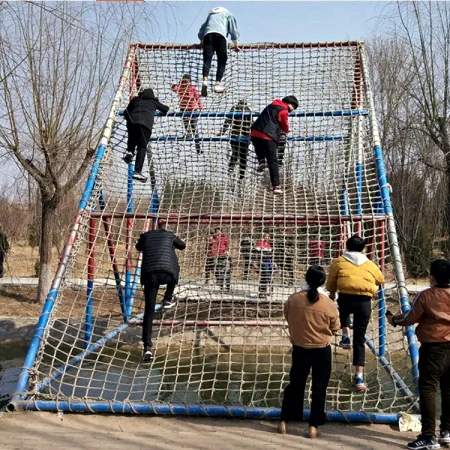
A surface, not a barrier
Three things change when a net is climbed rather than hung in front of cargo, and all three have to be in the specification from the start.
- It is loaded sideways and in shear. A body on a net pushes it out of plane, so the lacing carries the load into the frame along its whole edge rather than at four corners.
- The mesh is gripped. Hands and shoes go into the openings, so the mesh size is set by what a foot and a hand can use – and by what a head cannot pass through.
- It is loaded by people who do not think about loads. A playground net takes repeated dynamic load from children who jump, swing and hang two to a square. A static figure on a drawing is not the design case.
Rope or webbing
| Rope net | Webbing net | |
|---|---|---|
| Feel | Round under hand and foot; the classic climbing surface | Flat and firm; more like a ladder than a net |
| Grip | Better for hands, and for shoes on a steep panel | Better for structure and for edges; less to grip |
| Where it wins | Playground A-frames, climbing halls, training rigs, tree nets | Feature panels, walls and facades, colour-blocked play structures, framed panels |
| Repair | Re-knotted or re-spliced on site | Re-stitched at a bench |
| Look | Traditional net; knots read at a distance | Graphic; a flat grid in one colour |
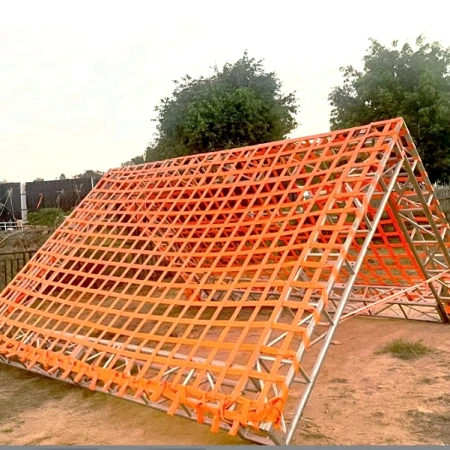
The mesh is the safety decision
Every conversation about a climbing net arrives at the mesh size, and the answer is not a preference. Two constraints pull in opposite directions: the openings have to be big enough for a foot and a hand, and small enough that a head cannot pass through and be held.
Play equipment standards treat an opening of roughly 89 mm ke 230 mm as a head-entrapment risk, which is why playground nets are normally specified with a mesh below that band – 45 to 60 mm is the usual range for a net children climb. Training nets for adults go coarser, 100 to 150 mm, because the grip is bigger and the head is not.
| Use | Typical mesh | Why |
|---|---|---|
| Playground, public | 45 – 60 mm | Below the head-entrapment band, and still big enough for a child’s foot |
| School and club | 50 – 80 mm | Older children, supervised use, larger hands and shoes |
| Adult training and obstacle course | 100 – 150 mm | Grip for a boot; the mesh is a rung, not a surface |
| Feature panel or wall overlay | 60 – 100 mm | Balances the graphic with a usable grip |
A starting point, not a certification. Where a play area is specified to EN 1176 or to a local equivalent, the mesh, the fixings and the fall height are the inspector’s call – say so on the enquiry and the net is made to that specification.
Lacing is the fixing
A climbing net is not bolted to a frame; it is laced to it. A cord or a narrow strap passes through the border and around the tube every 150 to 300 mm, and the tension is set by how hard that lacing is pulled – which is why the border and the lacing, not the mesh, decide whether a net feels like a trampoline or a hammock.
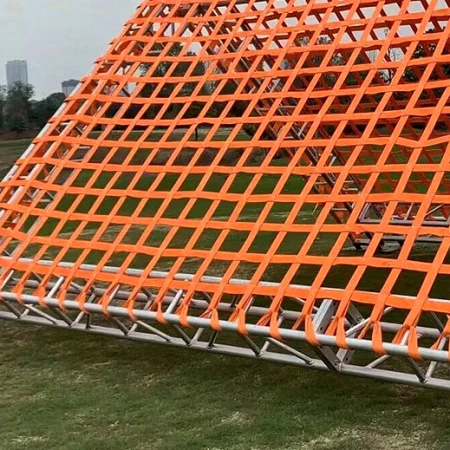
- Spacing. 150 – 200 mm on a play net, 250 – 300 mm on a large training panel. Even spacing matters more than tight spacing.
- Corners. A thimble or a protected eye at each corner; the corner is where a net tears first.
- Tension. Tight enough that the net does not bottom out against the frame when someone stands on it, and not so tight that the frame is pulled out of square.
- Accessories. A tensioning cord with a cleat, or a strap and buckle, lets a net be re-tensioned after a season without re-lacing the whole edge.
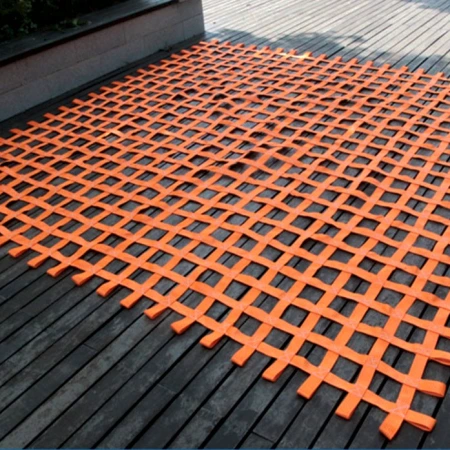
Loads, and what nobody should assume
A climbing net is not a lifting sling and it is not a fall-arrest net, and it carries no working load limit. What it carries is people, dynamically, in numbers nobody controls – two children on one square, an adult pulling themselves up by the border, a group at the top of an A-frame at once.
So the figures come from outside the net: from the play standard the site is built to, or from the engineer who designed the frame. What this works supplies is the net made to that brief – rope or webbing, mesh, border, lacing points and colour – and the frame design stays with whoever signs for the structure. Where a project needs a documented figure for the net itself, say so on the enquiry and it is quoted before the order.
Shapes and frames
- A-frame. The park and school standard: a net over a steel or timber A, climbed from both sides, usually with a horizontal section at the top.
- Wall panel. A flat net on a wall or a facade, framed or laced to anchors, for climbing halls and feature walls.
- Overhead and tunnel. A net slung between two frames as a crawl or a bridge, tensioned along both edges.
- Wall overlay. A net fixed over a climbing wall to add routes, or over a plain wall to create one.
- Tree and garden. A small net between two trees or on a timber frame, for domestic use.
Indoors or outdoors
Polyester is the default outdoors: it takes UV better than nylon, holds colour longer and does not go slack in the rain the way a nylon net does. Nylon is softer in the hand and is often chosen for indoor halls, where the light is kind and the net is not asked to survive a decade of sun.
Colour is a specification, not a decoration: a bright net is visible against a dark frame and reads as play equipment, and a colour that fades in two summers is the most common complaint on an outdoor installation. Say which colour and whether it has to match something that already exists.
Pemeriksaan, and what retires a net
- Wear at the lacing points, which is where a net works hardest and where a strand first goes thin.
- A cut or a UV-stiffened strand – a faded net that has gone stiff has lost strength before it looks worn out.
- Knots that have worked loose, or a splice that has started to draw.
- A border that has slipped in its stitching at a corner.
- Anything that will not tension any more: a net that has stretched beyond its lacing cannot be made safe by pulling harder.
Six lines on the enquiry
| # | The line | What it fixes | What goes wrong without it |
|---|---|---|---|
| 1 | Bingkai itu: size, tube diameter, and a sketch | The net’s shape and the lacing spacing | A net that is 100 mm out and cannot be tensioned |
| 2 | Who climbs it, and how old they are | The mesh, and the border | A play net with a training mesh, or the reverse |
| 3 | The standard the site is built to, if any | Mesh, fixings and the paperwork | A net that an inspector will not sign off |
| 4 | Rope or webbing, and the colour | The construction, the dye lot and the look | A net that fades, or one that is invisible against the frame |
| 5 | Indoor or outdoor, and the sun exposure | Fibre choice and colour fastness | A nylon net on a south-facing frame |
| 6 | How it will be fixed: lacing, tensioner, corner fittings | The border and the hardware | A net that arrives with nothing to lace it on with |
Soalan lazim
What is a climbing net made of?
High-tenacity polyester, as rope or as flat webbing. Polyester is the default for outdoor nets because it takes UV better than nylon; nylon is available for indoor halls where a softer hand matters more than sun resistance.
What mesh size should I choose?
It depends on who climbs it. Playground nets are normally 45-60 mm, which sits below the head-entrapment range that play standards treat as a hazard; school and club nets run 50-80 mm; adult training nets 100-150 mm. Where a site is specified to a play standard, the inspector’s requirement decides.
Rope or webbing for climbing?
Rope is the better climbing surface – round, grippable, traditional – and webbing is the better graphic and the firmer edge. Many installations use rope for the climbing field and webbing for borders, tunnels and feature panels.
Can a climbing net be used as a fall-arrest net?
No. It is a climbing surface with no rated fall-arrest performance, and it is not designed to catch a falling body. Fall-protection nets are a separate product with their own specification.
How is it fixed to the frame?
By lacing: a cord or narrow strap through the border and around the tube every 150-300 mm, with thimbles or protected eyes at the corners. The lacing sets the tension and is the part to check when a net goes slack.
Can you make a net to my frame?
ya – that is the normal way it is bought. Send the frame dimensions, the tube diameter and a sketch, and the net is made to that shape with the lacing points where the frame has something to lace to.
Is it safe for children?
The net can be made to a safe specification, but safety is the whole installation: mesh below the entrapment band, sound frame, correct lacing, adequate surfacing underneath, and supervision. This works makes the net to the brief; the sign-off belongs to the installer and the inspector.
How long does a climbing net last outdoors?
A polyester net on a sound frame, inspected each season and re-tensioned when it slackens, gives years of service. Sun, abrasion at the lacing and the occasional knife or glass are what end it, in that order.
Where the rest of the detail lives
The neighbouring nets, and the two products most often confused with this one, are on their own pages.
- Safety rope net – the category, including fall-protection nets
- Container cargo net – the barrier at a container door
- Staircase safety net – the domestic version of the same idea
- Jaring pengangkat kargo – the rated net that carries a load in the air
- Nylon rope – the rope in the net, and the climbing rope
- Safety harness – for the people who work at height, not for play
Kenalan
Lift Sling Rigging Co., Ltd weaves the webbing, knots the rope and makes the net in one works.
Send the frame, the size and who climbs it. We confirm the mesh, the border, the lacing and the colour in writing before the net is cut.
- Telephone and WeChat: 18066002268
- E-mel: 702461526@qq.com
- Alamat: Taman Perindustrian Lifute, Bandar Taizhou, Wilayah Jiangsu, China
- Kod HS: 630790