

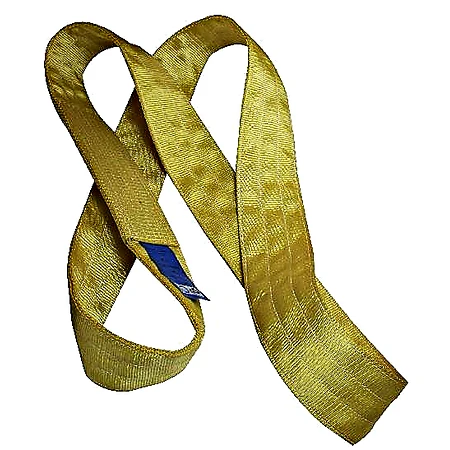
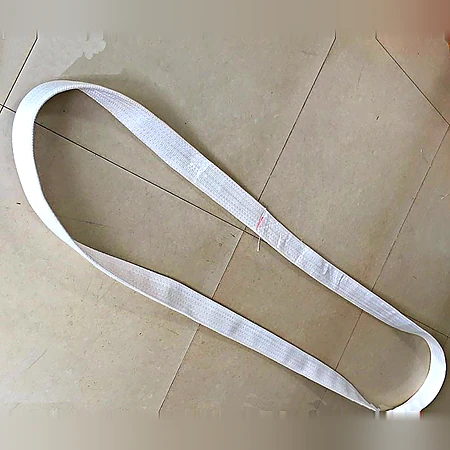
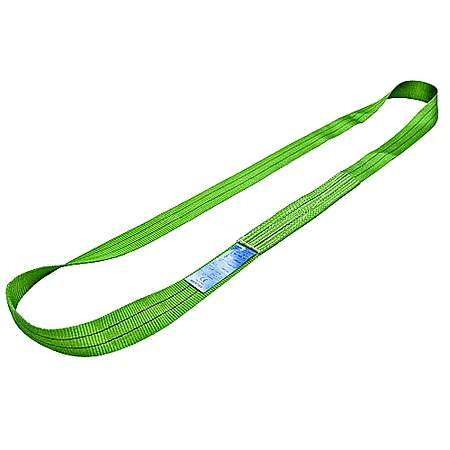
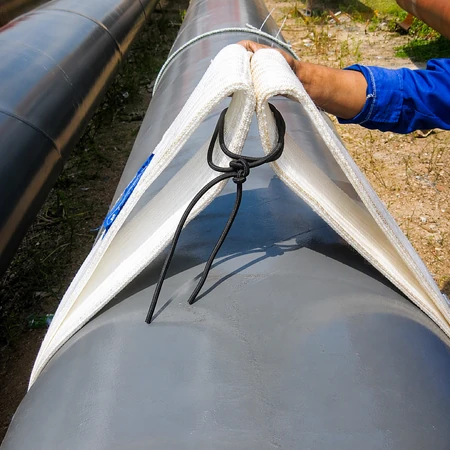
Lift sling rigging company produce Heavy Duty Endless Lifting Web Slings.
Nga Kotaha Tukutuku Whakanuia Nga Mahi Taumaha
5 t ki 30 t, sized by the hitch rather than the tonnage
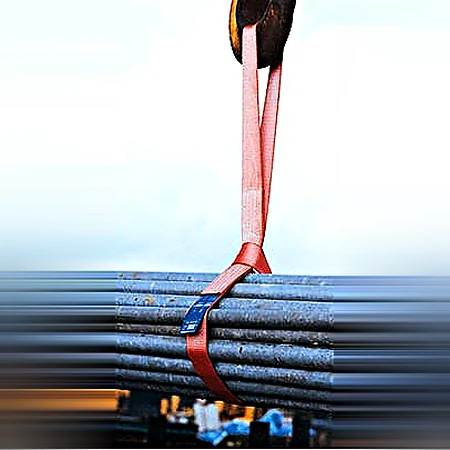
A heavy duty endless lifting web sling is a flat woven polyester band closed into a continuous loop and built in two or more plies, so one article covers 5 t ki 30 t with no ends, no eyes and no metal fitting anywhere on it. Because the loop is the whole sling, the same band can be rigged vertical, in a basket or choked without changing a single component — which is why the class is bought for steel pipe and coil, plate and sheet stacks, peke rakau, precast segments and machined fabrications that have to come off the bed unmarked.
What follows is sizing information rather than a brochure description: the working load limit of each band, what it carries in each hitch, the width that suits a given surface, and the build we hold to. Tukuna te uta, the hitch and the surface, and the loop is confirmed before the band is woven.

What separates a heavy duty endless web sling from a standard endless sling
Four changes are made to the same closed article, and each one can be seen and measured on the band.
- Ply — matarua (e rua nga paparanga) is standard in this class, with three and four layers to order. The layers are stitched through and quilted so that they work as one band.
- Whānui — 100 mm at the bottom of the range to 450 mm at the top. Width does not create capacity; it spreads the bearing.
- Weave density — a thicker, denser weave carries the higher figure at a width the hook can still seat.
- Bearing protection — a stitched-on sleeve or wear pad where the band meets an edge, a coated surface or a rough casting skin.
The consequence that catches buyers out is thickness. A heavy duty band occupies more of the hook bowl than a single-layer sling of the same width, so the hook has to seat the ply as well as the width.
Construction detail — the lapped joint, the stitch pattern and the ply build — is published on our heavy-duty endless loop strap slings wharangi, where the same class is described from the joint outwards. This page takes it from the load inwards.

Technical parameters — heavy duty endless lifting web slings
The figures below are the heavy duty class built to EN 1492-1, quoted in a straight vertical lift. The minimum breaking load is the 7:1 multiple of the working load limit. Reference widths and the 5 t ki 10 t masses are published figures for this range; widths and masses from 12 t upward are confirmed on the order acknowledgement.
| WLL (poutū) | Colour code EN 1492-1 | Te whanui o te roopu tohutoro | Ply | MBL i 7:1 | Kowaowaotia (× 0.8) | Approx. papatipu |
|---|---|---|---|---|---|---|
| 5 t | Whero | 100 mm | Matarua | 35 t | 4.0 t | 0.62 kg/m |
| 6 t | Paraone | 150 mm | Matarua | 42 t | 4.8 t | 0.96 kg/m |
| 8 t | Kahurangi | 200 mm | Matarua | 56 t | 6.4 t | 1.34 kg/m |
| 10 t | Karaka | 250 mm | Matarua | 70 t | 8.0 t | 1.64 kg/m |
| 12 t | Kaore he waehere tae | 300 mm | Matarua | 84 t | 9.6 t | I runga i te tono |
| 15 t | Kaore he waehere tae | 300 mm | Duplex or 3-ply | 105 t | 12.0 t | I runga i te tono |
| 20 t | Kaore he waehere tae | 350 mm | Multi-ply | 140 t | 16.0 t | I runga i te tono |
| 30 t | Kaore he waehere tae | 450 mm | Multi-ply | 210 t | 24.0 t | I runga i te tono |
Kei runga 10 t there is no EN 1492-1 colour left to read, na te tapanga tuia e whakahaere. The label carries the straight-lift figure, nga ahuatanga aratau, te muka, te tohutoro paerewa, te kaihanga, the loop length and a traceability code.

What the sling actually lifts — the hitch decides the figure
A heavy duty endless web sling does not have one capacity. It has a capacity per hitch, and the band is normally bought for the hitch the crew will actually rig. The table below reads one 10 t sling through every arrangement; the label on the article always overrides it.
| Whakaritenga | Tauwehe aratau | Kotahi 10 t sling carries | On the floor |
|---|---|---|---|
| Poutū | 1.0 | 10.0 t | One loop over the hook, load hanging straight. |
| Kowaowaotia | 0.8 | 8.0 t | The loop is passed round the load and through itself; the wrap grips. |
| kete, 0–45° | 2.0 | 20.0 t | Paihere i raro i te kawenga, both sides on the hook. |
| kete, 45–60° | 1.4 | 14.0 t | The same basket with the legs spread. |
| E rua nga waewae, 0–45° | 1.4 | 14.0 t | Two loops to one hook, kawenga tiritahi. |
| E rua nga waewae, 45–60° | 1.0 | 10.0 t | The same pair, spread. Tirohia ano, kaua ki te whakaaro. |
| E toru me te wha nga waewae, 0–45° | 2.1 | 21.0 t | Not three or four times the figure; the load rarely shares evenly. |
| E toru me te wha nga waewae, 45–60° | 1.5 | 15.0 t | The same arrangement, spread. |
Two facts follow, and both change the order. A choked loop keeps 0.8 of its straight-lift figure, na a 10 t load taken in a choke works out at 12.5 t and the band to order is the 15 t. And capacity falls as the legs spread, which is geometry rather than material: it is answered by a spreader beam or a bigger sling, a kahore ke atu.

Whānui, bearing pressure and the surface of the load
Width does not raise capacity; it lowers pressure. That distinction decides the order on any finished surface, because the buyer is not protecting the sling, he is protecting the load.
| Te kawenga | Band width to start from | He aha |
|---|---|---|
| Coated steel pipe and tube | 150–250 mm | A wrap is a line contact along the circumference; width spreads it and keeps the coating intact. |
| Plate and sheet stacks | 200–300 mm + ringaringa | The pack edge is the pressure point, and a sleeve takes the abrasion instead of the weave. |
| Timber and log packs | 150–300 mm | Arrises cut a narrow band; width spreads the bearing across the pack. |
| raima tomua, parepare, poraka | 250–300 mm + pad | A rough casting skin is abrasive; the pad is part of the specification. |
| Machined and painted fabrications | 100–200 mm + ringaringa | A sound surface needs less width, but a machined lip still needs a sleeve. |
These are starting points, not limits. The figure that decides is the contact pressure at the bearing, and it depends on the mass, te maha o nga waewae, the angle and the radius of the edge as much as on the width. Send a photograph of the pick and the width follows from it.

The specification we build to
| Te ahuatanga | Whakatakotoranga |
|---|---|
| Nga ingoa hua | Heavy duty endless lifting web slings · heavy duty endless web sling · endless lifting sling · endless loop sling · type V web sling · endless type A flat woven webbing sling |
| Momo me te paerewa | Momo mutunga kore He kotaha tukutuku raranga papatahi ki EN 1492-1; ASME B30.9 type V built to order; ISO 4878 me JB/T 8521 available |
| Rauemi | 100% polyester tino kaha (PES) hei paerewa; polyamide / nairona (PA) me te polypropylene (PP) ki te ota |
| Hangahanga | Duplex as standard in this class; three and four layer multi-ply to order; nga paparanga kua tuia me te quilted |
| Katinga | One lapped and stitched joint with dense parallel stitch rows — the only made connection in the load path |
| Te rohe kawenga mahi | 5 t ki 30 t in this class; heavier duty moves to the sleeved round form |
| Te take haumaru | 7:1 rua KOTAHI 1492-1 hei paerewa; 5:1 ki ASME B30.9 me 8:1 ki AS 1353 hanga ki te ota |
| Te whakaroa | Mōrahi 3% i te rohe kawenga mahi me te teitei 10% i te kawenga pakaru, hanga polyester |
| Awhe pāmahana | −40 °C ki +100 °C mo te hanga polyester paerewa |
| Bearing protection | Stitched-on sleeve or wear pad to order; reinforced hook seat on the heavy bands |
| Roopu roa | 0.5 m ki 100 m hei koropiko kua oti, whakahuahia ma te porowhita, ma te roa mahi whai hua ranei |
| Te tohu | IN 1492-1 te tae kaha me te karawhiu whakawhiti pango kotahi mo ia tana, plus a sewn label with the straight-lift WLL, āhuatanga aratau, muka, paerewa, te roa me te tohu tohu |
| Whakamatau | Proof tested on our own horizontal test machine; tiwhikete whakamatautau mo ia puranga i runga i te tono |
| Taapapa me te OEM | Ka kohia, ka takaia ki roto i te kaata kua tohua, tarapēke kaweake ritenga ranei; OEM on fibre, paopao, whanui, roa, tae, tahora tapanga me te takai |
| Waehere HS | 630790 |
Me pehea te ota: two figures and one convention
Karekau he pito hei ine i waenganui i te kapiti kati, and this trade quotes the same article under two conventions that differ by about a factor of two. He tika nga mea e rua; ko tetahi anake te ahua i kiia e koe.
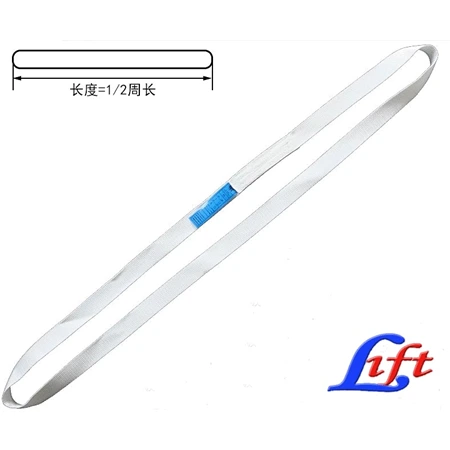
- Porowhita — the perimeter of the loop, measured round the band once.
- Te roa o te mahi whai hua — the usable height, roughly half the circumference.
- The girth of the article — state the pipe diameter or the pack girth and the loop is sized to it.
Whakaingoatia te huihuinga me te ahua, me korero ranei te whakamahi. Along with the length, state the hitch, the standard the site works to, and whether a sleeve or pad is needed.
Where the class is used
- Paipa maitai, tube and casing bundles — choked or in a basket, where a machined end and a coating both have to survive the lift.
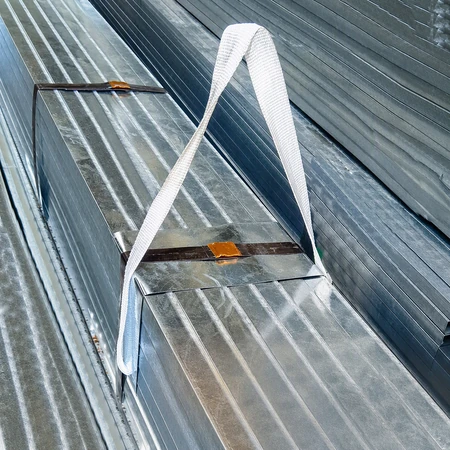
- Roopu maitai, plate and sheet stacks — the loop spreads the bearing across the pack edge and the surface comes off unmarked.
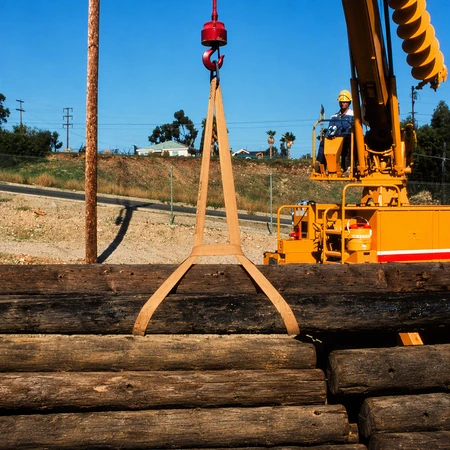
- Timber and log packs — arrises are carried on a wide face rather than a line.
- Nga waahanga raima kua whakarewahia, kerbs and blocks — a rough casting skin is met with a pad rather than with the weave.
- Fabricated sections, box girders and machine beds — one loop serves several rigs.
- Tauranga, depot and yard work — from pipe to timber to a machinery lift in one shift.

Inspection and safe use
A flat web sling shows its whole load path, which is why it can be inspected on the floor rather than in a laboratory. Tirohia i mua i nga whakamahinga katoa, me okawa i te waahi kua whakaritea e to pae.
- The lapped joint first — every stitch row, the webbing at each step of the lap, and that the layers still lie flat and parallel.
- The full band width. Ma te roopu papatahi e kawe te kawenga puta noa i tona whanui katoa, so a cut anywhere in it matters.
- The bearing points and the hook seat — cuts, abrasion, whakarara, or a worn edge where the band has wrapped the load.
- Te poke. Acid or alkali attack leaves little to see outside and destroys the fibre within.
- Hurihia hei kaupapa here, e kore e rite ki te whakatika. Hurihia te koropiko i muri i ia hikina kia rite ki te waahi kawe, the hook seat and the joint keep moving.
- Kaua rawa e whakatika i te kotaha. Karekau he tuitui, kahore he hono, no knotting — a knot can lose half the capacity.
Panui haumaru: He tino kino nga mahi hiki. Follow the equipment manufacturer’s instructions, te mahi a to roopu whakahaere o te motu me nga whakangungu kua whiwhi koe, and never exceed the working load limit for the configuration in use.
Pātai auau
What is a heavy duty endless lifting web sling?
It is a flat woven polyester band closed into a continuous loop and built in two or more plies: wider, denser and with a reinforced bearing area compared with a standard endless sling. There are no ends, karekau he kanohi, karekau he taputapu whakarewa i runga i te tuhinga. This class covers 5 t ki 30 t i a 7:1 take haumaru ki EN 1492-1.
How much does it lift in a choke?
0.8 o te ahua hiki-tika. A 10 t endless web sling carries 8 t kowaowaotia, na a 10 t load taken in a choke needs the 15 t roopu. The label on the sling states the mode factors as well.
Can one sling lift 30 t?
Ae, in the multi-ply build at 450 mm reference width, and the figure is per hitch. Kei runga ake 30 t a flat woven band becomes difficult to handle and awkward to seat in the hook, and the sleeved round form takes over — an kotaha porotaka mutunga kore is a better answer there than a flat band stretched past its practical limit.
How do I state the length?
Whakaingoatia te huihuinga: porowhita, or effective working length, which is about half the circumference. Or state the girth of the article the loop must go round. The two conventions differ by about a factor of two.
Will it mark galvanised, painted or coated steel?
Ko te peera he muka waihanga, kaore he taputapu e pa ki te kawenga, so it will not scratch or burr. Ko te whanui te mehua tiaki; where the edge is sharp or the coating is soft, a stitched sleeve is ordered with the sling.
What standard and safety factor do you build to?
7:1 rua KOTAHI 1492-1 hei paerewa, me 5:1 ki ASME B30.9 me 8:1 ki AS 1353 ki te ota. Ko te take teitei ake e hiahia ana he roopu whanui mo te kaha rite, so tell us the standard the site works to.
Do you supply test certificates and OEM labelling?
Ae. Every batch is proof tested on our own horizontal test machine and a certificate is issued per batch on request. OEM covers fibre, paopao, whanui, roa, tae, tahora tapanga me te takai.
Hua e pa ana
Tonoa he korero
Send the load and its shape, te herenga ka mau te hoia, te rohe kawenga mahi e hiahia ana koe, the width the load surface and the hook will accept, whether a sleeve or pad is required, me te maakete paerewa me te waahi ka mahia te kotaha. Ka hoki mai matou me te putea, he whanui, he roroa roa, he tauira me te utu wheketere-tika.
Lift Sling Rigging Co., Ltd — Lifute Industrial Park, Taizhou City, Porowini o Jiangsu, Haina. Waea: +86 523 8693 5818 | WhatsApp: +86 180 6600 2268 | ī-mēra: lift98@jslift.com | Waehere HS: 630790.